The Usage War


When I first heard the name Noam Chomsky, I learned that some regarded him as the father of modern linguistics, and I learned that he was considered a powerful force in America. How a man whose sole concern was language could have power outside the halls of academe confused me shortly after I dismissed him. The subject of linguistics seemed a narrow conceit with a narrow appeal. As my knowledge of political science grew, and I learned of the power of language, I learned of the power of this seemingly inconsequential subject, and how it has led to the least talked about “war” of our times.

The late author, David Foster Wallace, called it a usage war and he stated that it has been occurring since the late 60’s. Wallace’s primary concern was not the narrow definition of politics. Rather, he was concerned with the use of language, and the interpretation of it. This usage war is a war between two factions that the editor-in-chief of the controversial Webster’s Third New International Dictionary, named Philip Babcock Gove, {1} described as a battle between descriptivists and prescriptivists.

“The descriptivists,” Grove writes, “are concerned with the description of how language is used, and the prescriptivists are concerned with how the language should be used.”

“The late lexicographer Robert Burchfield furthered this description thusly: “A prescriptivist by and large regards (any) changes in the language as dangerous and resistible, and a descriptivist identifies new linguistic habits and records these changes in dictionaries and grammars with no indication that they might be unwelcome or at any rate debatable.” {2}

The descriptivists say that language is elastic, and it should bend to individual interpretations. Language, they say, should largely be without rules.

“Virtually all English language dictionaries today are descriptive. The editors will usually say that they are simply recording the language and how its words are used and spelled. Most Merriam-Webster dictionaries will note if certain words are deemed nonstandard or offensive by most users; however, the words are still included. Of modern dictionaries, only the Funk and Wagnall’s contains a certain amount of prescriptive advice. All the major dictionary publishers – Merriam-Webster, Times-Mirror, World Book, and Funk and Wagnall’s – will tell you that they are primarily descriptive.”{3}

If we were going to succeed in school, we learned that we would have to perfect our spelling and grammar. The successful carried this knowledge onto the real world. Some of us did not. When we entered into the workforce, our skills were such that no high-level employer would consider us for a gig. We had to work our way up. Along the way, we forgot many of the rules of school. We had to re-learn, the rules of grammar. 

We can guess that nearly everyone has learned, at some point in time, the relative machinations of acceptable discourse. We can guess that anyone who has spoken, or written, on a professional level, has learned of the perceptive gains one can accumulate and lose with the use, and misuse, of language. We can also guess that most realize how others manipulate their audience through language. The latter may be the key to the descriptivist movement in linguistics today.

Our introduction to manipulated perceptions often occurs when we enter the workforce. We may see these perceptions parlayed in movies and television, but we don’t experience them firsthand until we enter the workplace and they directly affect us. At that point, it becomes clear how others use language to shift the power of daily life.

If this form of manipulation were limited to the workplace, that would be one thing. It would be powerful, but that power would be limited to that particular environment. As we have all witnessed when one successfully manipulates language, it doesn’t end when we clock out for the day. We accidentally, or incidentally, take these rules of usage, or speech codes, out of the workplace and into our everyday lives. David Foster Wallace catalogued these incremental actions and reactions in the book Consider the Lobster. It details the fact that lexicographers, like Phillip Babcock Gove, have used dictionaries, and other methods, as a foundation for a usage war that has been occurring in America since the late 60’s.

How many of us have used incorrect terminology that violates the current rules of usage? How many of us have used the words “reverse discrimination” as opposed to the more politically correct term “affirmative action”? How many of us have called an illegal immigrant an illegal immigrant, only to be corrected with the term “undocumented worker?” How many of us have had a boss, or members of the Human Resources department tell us, “I understand you have personal beliefs on this topic, but I hope you can see that it has no place in the workplace,” they say in so many words. “You don’t want to offend anyone, I know that. You’re a nice guy.” 

Most of us are nice people, and we don’t seek to offend the people we work with, our neighbors, or anyone else for that matter. To do this, we follow the speech codes handed down from the Human Resources department to help us get along with other people. We then, unconsciously, take those speech codes to the bar, to family functions, and to our home, until we find ourselves assimilated to the point that we’re correcting our friends.

“It’s a peccadillo,” they say, “a very slight sin, or offense, it’s not sexual relations with an intern. It’s a fib,” they say. “It’s not perjury before a grand jury. It’s “environmentalist” not “anti-corporate socialist”. It’s a “feminist” not a “man hating female who can find no other way to succeed”, “multiculturalist” not “racial quota advocate”, “rainforest” not “gathering of trees”, “sexually active” not “promiscuous”, “economic justice” not “socialism”, “fairness” not “socialism”. It’s “giving back” not “class envy”, and it’s “community organizer” not “radical agitator”. This is the war, and these are the little battles within that war that the descriptivists and the liberals have been waging against the “normal” prescriptive America lexicon for generations and they have succeeded beyond their wildest dreams.

This desire to be nice to other people, and understand other cultures, is one of the advantages the descriptivists/liberals have in manipulating the language, and winning the usage wars. When we find a person that may be different from us in some manner, we want to know how best to get along with them. We want to know their sensitivities, in other words, so we do not accidentally violate them. The question that we should bring to the debate more often is how do people learn the sensitivities of others? Are these sensitivities internal, or are they taught to us through repeated messaging? Most people are insecure, and they don’t know how to demand satisfactory treatment, but they can learn. An individual can learn that something is offensive, and they can learn how to communicate that offense.

“What’s wrong with that,” is a common reply to this notion. “What’s wrong with teaching people how they should be treated? We all just want to get along with one another?”        

Prescriptivists would tell you that buried beneath all this “well-intentioned” manipulation of usage is the general loss of language authority. Prescriptivists ache over the inconsistencies brought to our language through slang, dialect, and other purposeful displays of ignorance regarding how the language works. They labor over the loss of standardized language, such as that in the classical works of a Geoffrey Chaucer. Most of them do not necessarily call for a return to Chaucer-era usage, but they are offended when we go to the opposite pole and allow words like “height” and “irregardless” into modern dictionaries. They also grow apoplectic when terms, such as “you is” and “she be” become more acceptable in our descriptivist lexicon. And They hide in a hole when standards of modernity allow sentences to begin with a conjunction, such as “and”, and they weep for the soul of language when casual conversation permits a sentence to end with an infinitive such as to.

Language provides cohesion in a society, and it provides rules that provide like-mindedness to a people that want to get along. It’s fine to celebrate individuality, and some differences inherent in a melting pot as large as America’s, but if you have nothing to bind people together the result can only be a degree of chaos.

A member of the descriptivism movement, on the other hand, celebrates the evolution of language:

“Frank Palmer wrote in Grammar: “What is correct and what is not correct is ultimately only a matter of what is accepted by society, for language is a matter of conventions within society.”

“John Lyons echoed this sentiment in Language and Linguistics: “There are no absolute standards of correctness in language.”

“Henry Sweet said of language that it is “partly rational, partly irrational and arbitrary.”

It may be arbitrary in Sweet’s theoretical world of linguists seeking to either ideologically change the culture, or update it to allow for vernaculars in the current social mores, but in the real world of America today are we doing our students, our language, or our culture any favors by constantly redefining usage? If our primary motivation for teaching arbitrary methods of usage is sensitivity to intellectual capacity, different cultures, and self-esteem is the culture as a whole made better in the long run?

On the ideological front, the descriptivism movement has successfully implemented a requirement that all writers now use the pronouns “they” and “he or she” if that writer is seeking a general description of what a general person may do, or think. Repeated use of the general pronoun “he” without qualifying it with the balanced usage of “she”, “they”, or “he or she” is not only seen as antiquated, but sexist, and incorrect. The reason it is antiquated, those of the descriptivism movement say, is that it harkens back to a patriarchal, White Anglo-Saxon Protestant (WASP) society.

If you work in an office, and you send out any form of communication to a team of people, you know how successful the descriptivism movement has been in infiltrating our language in this regard. Yet, there was a point in our history, a point in the not-so-distant past when no one knew enough to be offended by the repeated use of “he” as a general pronoun. No one that I know of regarded this as improper, much less incorrect. Years of repeated messaging have created ‘gender neutral’ solutions to the point that schools, workplaces, and friends in our daily lives suggest that using “he” as a general pronoun is not just sexist it is incorrect usage. Yet, they deem using the pronoun “she” as an acceptable alternative. If this complaint were limited to the narrow prism of politics, one could dismiss it as a member of the losing team’s hysteria, but we’re talking about the politics of language usage.

A political science professor once told our class that, in his opinion, law breaking became a little more acceptable when the federal government lowered the speed limit to fifty-five in 1974. His theory was that the fifty-five mile per hour speed limit seemed arbitrarily low to most people, and they considered it unreasonable. His theory was that most people were generally more law-abiding in the 50’s, and  –“regardless what you’ve read”– in the 60’s, but in the 70’s more people found the general idea of breaking the law more acceptable, and he deemed this 1974 unreasonable limit on speed to be the antecedent. His theory was that no one person, no matter how powerful their voice is in a society as large as ours, could successfully encourage more people to break the law, and that only the society could do this by creating a law that was seen as not only unreasonable, but a little foolish.

Whether or not his theory is correct, it illustrates the idea that seemingly insignificant issues can change minds en masse. Could one person, no matter how powerful they may be in a society, teach people to be offended more often for more power in that society? Can political linguists dictate a certain form of usage by suggesting that anyone that doesn’t assimilate does so with ulterior motives? Could it be said that Human Resource videos –that anyone that has been employed has spent countless hours watching– are not only being used to teach people how to get along with people different than them, but how those different people should be offended?

“Why does that person continues to use general pronoun “he” instead of “he or she” or “they” continue to do that? Are they trying to offend all the “shes” in the room?” 

Everything stated thus far is common knowledge to those of us who operate in public forums in which we interact with a wide variety of people. What some may not know is that this “usage war” for the hearts and minds of all language users extends to the production of dictionaries.

If this is true, how can a dictionary be ideological? There are prescriptivist dictionaries that call for “proper” interpretations and use of language, and there are descriptivist dictionaries that evolve with common use. “Usage experts”, such as David Foster Wallace, consider the creation of these two decidedly different dictionaries salvos in the Usage Wars “that have been under way ever since an editor named Phillip Babcock Gove first sought to apply the value-neutral principles of structural linguistics to lexicography in the 1971 Webster’s Third New International Dictionary of the English Language.”

“Gove’s response to the outrage expressed by those prescriptivist conservatives who howled at Gove’s inclusion of “OK” and “Ain’t” in his Third Edition of Webster’s Dictionary was: “A dictionary should have no truck with artificial notions of correctness or superiority. It should be descriptive and not prescriptive.” {4}

One of the other reasons that descriptivism eventually took hold is that it allowed for more “free form” writing. Descriptivism allows a writer to get their words down on paper without an overriding concern for proper communication. Descriptivism allows for expression without concern for proper grammar or a more formal, proper lexicon. It allowed a writer to brainstorm, free form, and journal without a “fussbudget” teacher correcting these thoughts into proper usage.

This was a relief to those that enjoyed expression without having to answer to a teacher that informed us we weren’t expressing correctly. How can one “express correctly” those of us that enjoyed expression asked. Without too much fear of refutation, I think we can say that the descriptivism movement won this argument for the reasons those that enjoyed creative expression brought forth. When one of my professors told me to get the expression down, and we’ll correct your spelling and grammar later, I considered myself liberated from what I considered the tyrannical barrier of grammatical dictates. It wasn’t too many professors later that I discovered teachers that went beyond the “correcting the spelling and grammar later” to the belief that the self-esteem of the writer was paramount. If the student doesn’t get discouraged, this theory on usage suggested, they are more apt to express themselves more often. They are more inclined to sign up for a class that doesn’t “badger” a student with constant concerns of systematic grammar, usage, semantics, rhetoric, and etymology. One argument states that colleges based this lowering of standards on economics, as much of what they did encouraged the student. Personal experience with this, along with the other examples listed above, paved the way for the descriptivism movement to move the language, and the culture, away from the prescriptivist rules of usage.

Some have said that the motivation for those in the descriptivism movement is not nearly as nefarious as those in the prescriptivism movement would have one believe. Descriptivists would have one believe that their goal was more an egalitarian attempt at inclusion and assimilation. They would have them believe that the prescriptivists’ grammar requirements, and lexicography, are exclusionary and elitist, but can we take these descriptivist interpretations and nuances into a job interview, a public speech, a formal letter, or even into a conversation among peers that we hope to impress? Can we succeed in the current climate of America today with language usage that is wide-open to a variety of interpretations?

An English as a Second Language (ESL) teacher once informed me that the “impossibly high standards” President George W. Bush, and his librarian wife, placed on her students, made her job more difficult. I conceded the fact that I was an outside looking in, listening to her complaints, and that I didn’t know the standards she had to deal with them on a daily basis. “But I said, “If we’re looking at the intention behind these impossibly high standards, could we say that they were put in place to assist these non-English speakers into learning the language at a level high enough for them to succeed in America?” This ESL teacher then complained that the standards didn’t take into account the varying cultures represented in her classroom. I again conceded to her knowledge of the particulars of these standards, but I added, “You’re theoretical recognition of other cultures is wonderful, and it has its place in our large multi-cultural society, but when one of your students sit for a job interview what chance do they have when competing against someone like the two of us that are well-versed in the “impossibly high prescriptivist, standard white English, and WASP” grammar and usage standards we were forced to learn in our class?”

{1} http://en.wikipedia.org/wiki/Philip_Babcock_Gove

{2}   http://stancarey.wordpress.com/2010/02/16/descriptivism-vs-prescriptivism-war-is-over-if-you-want-it/

{3} http://englishplus.com/news/news1100.htm

{4} Wallace, David Foster. Consider the Lobster. New York, NY. Little Brown and Company, a Hachett Book Group. 2005. eBook.
 

Psychological Swearing and other maladies of the human condition


1) Swearing.  I used to wonder what it would be like to swear like an adult when I was younger.  Their ferocity fascinated me.  Their anger! had such punctuation.  Their sense of regret and sadness were palpable.  Everyone took them so seriously, and I was seen as a little kid.  I couldn’t get my emotions across.  It was a source of great frustration for me.  I saw adults in movies sweep everything off their desk to convey ultimate frustration, and I saw them stare into a mirror for thirty seconds before punching it, but in my inner circle of adults it was swearing that caused one adult to take another adult seriously when they were trying to convey emotion.  Swearing had great punctuation.  I knew I could punch people to get them to understand I was mad at them, but that usually prompted them to punch me back, and I didn’t care for getting punched when I could avoid it.  I knew I could cry to convey my sadness, but I’m a boy, and boys don’t cry.  Boys used different swear words, boy swear words, to convey sadness.  I knew I could raise my voice to convey excitement, and I did when I said something was great! but most people didn’t latch onto that excitement and try what I was telling them to try.  I realized that if anyone was going to take me seriously, I was going to have to start cussing.  It wasn’t that I didn’t want to start cussing, it was that I was bad at it.  I didn’t have the timing aspect of it down, and my inflection was horrible.

I learned timing first.  I learned that there were occasions when group think purveyors considered it mandatory and acceptable to swear, but there were also times when restraint was necessary.   Cussing too much drained the power of the words, and it made one look like they were trying too hard.  Restraint was the key, but even using the words sparingly didn’t help me comprehensively.  I still lacked inflection.  I sounded awkward.  I learned timing, and I learned how to place provocative words before and after sentiments to get people shocked, but due to my inflections few people took me seriously long term.  The inflections came last, but they finally came, and I entered into that adult world of conveyance.  I was shocking and provocative, and people began to take me seriously emotionally, and I found that pleasing.  If I had a rough day, or someone was giving me the business, I could throw out a swear word, and everyone would back up and raise their eyebrows.  They finally knew that I was someone to take seriously.  What a glorious day that was!  Everyone knew I was a person who used swear words adeptly!  I was accepted into the club!  To maintain membership, I swore all the time.  I swore when I was sad, I swore when I was happy, and of course when I was mad and fed up.  I was conveying emotion with a degree of ferocity that could be felt.  A funny thing happened to me at one point in my swearing career, I began overusing the words.  I drained them of their emotional impact through overuse, and I ended up right back at square one.  I was unable to convey emotion in a proper manner, because I was swearing too much, using too many of the designed shortcuts, and no one was taking me seriously anymore.  When I wanted to convey emotion at times when group think purveyors considered it inappropriate and unacceptable to swear I couldn’t think of any appropriate and acceptable words to use.  It was then that I came to the conclusion that most adults have as much trouble conveying emotion as kids do.  They just use swear words to camouflage that struggle.

2) Girl Crazy. “The charms of the passing woman are generally in direct proportion to the swiftness of her passing. –Marcel Proust.

When I was young, and I was very very young, I had this notion that every girl was attracted to me. All I had to do was catch their eye and hold it, and they would be mine on a temporary basis.  It didn’t matter how gorgeous they were, I could captivate them with one powerful stare.  When I got older, I had this notion that no girl was attracted to me.  Now that I’ve met that person that I wanted to meet my whole life, I no longer care who is attracted to me, and I can look back on this cognitive dissonance with some perspective.  Women like men that are attracted to them. They like to be wanted, even if they never cash in on the desire to be wanted, they like to be liked.  So, when I had the notion that a woman was attracted to me, I was actually attracting them with the notion that I was attracted to them.

3) Assigning Characteristics to Animals. Movies, both cartoon and otherwise, depict a dog listening to a conversation and reacting in a manner that suggest they understand more than key words and tones.  Some of us think this is cute and funny.  Some of us think they truly understand.  The cartoonish dogs hide their head when their owner says something stupid, and we laugh.  They scurry from the room when the bad guy suggests that they would make for an excellent dinner.  We laugh.  It sinks in with repetitive messaging.  Why wouldn’t Rover understand what we’re saying? We underestimate animals all the time. Look at what science is uncovering every day about the intelligence of these animals, why would it be so impossible to believe that they can understand us?  It’s not impossible to think that they understand us to a degree, but degrees are the key.  Dogs understand key words, and they understand tone.  Those who believe they understand more than that are trying too hard to understand their pets.  They’re trying to bond with their pets, and they believe their pets understand more than they actually do to bond with them, so they assign a degree of intelligence to these canines to have a better relationship with them.  It is the same mind set we bring to trying to understand infants and small children.  This is more credible, of course, as small children do have a greater capacity to understand language, but they do not understand high-minded, philosophical concepts such as morality.  Some psychologists have stated that young minds don’t have a complete grasp of the ramifications of their actions until they’re about eighteen years old, but we’ve told them and told them, and they still don’t grasp it.  This is due to the fact that their brains are not complex enough to understand these concepts.  As hard as it is for some of us to grasp the complex concept that animals and children don’t understand complex concepts, it actually says more about us that we think that they do than it does whether they do or not.  The question I have is am I onto something here, or do entertainment honchos know that we simply regard this all as entertainment and nothing more?

4) Misunderstood. “Everything great in the world comes from Neurotics. They alone have founded our religion and composed our masterpieces.” –Marcel Proust

I feel that I’m not understood, and I don’t understand that. I speak so clearly that a monkey should be able to understand me, but the humans around me listen to me with their own agenda so often that they do not take the time to understand mine.  Or am I a blowhard that is so ignorant of the various agendas around me that if I took a little time to understand them, they would take the time to understand me?

5) The Dark Days. “Happiness is beneficial for the body but it is grief that develops the powers of the mind.” –Marcel Proust

There are dark days that overwhelm me. Nothing I think, or write, can overshadow these days. These are the ‘all hope is lost’ days when I am so depressed about what is going on in the world philosophically, that I can think of nothing that will supersede it. These are the days when I realize that the world holds views so different than mine that it feels pointless to continue pounding my keyboard.  No one is listening.  No one is watching. No one is reading.  No one knows what’s going on. They all think in terms of their insular world, and they can’t see the greater whole. I look back on all the days I spent screaming from rooftops, and I realize I may have just as well have been shouting into a well. It all seems so pointless on these days that I can think of nothing funny, interesting, or enlightening to say or write. I just want to sit and sulk over the proceedings and realize that I have as little power as anyone else does to affect change. All hope is lost. It’s pointless. I don’t think I’m as important as everyone else thinks they are, so I end up cloistered by my own opinion and therefore invalid in the grand scheme of things.

6) Bring the Magic.  “Every reader finds himself. The writer’s work is merely a kind of optical instrument that makes it possible for the reader to discern what, without this book, he would perhaps never have seen in himself.” –Marcel Proust.

Is it possible for a painting to affect our feelings of relevance?  What about music, have you ever listened to a song and felt alone?  Have you ever been scared by a series of words in a book?  It’s the only form of magic I believe in.  Some of the times, we bring the magic to a piece, some of the times the piece brings magic to us, and some of the times we invent magic that isn’t otherwise there.

I sat in a theater once, one among many, and I horrified myself.  The setting of the movie was one I knew, the characters were familiar to me, and I knew the plot from my own imagination. Goosebumps riddled my skin, my eyes were popped wide, and I wanted this movie to end well.  This is unusual for me, because I normally loathe happy endings.  I see them as unrealistic, cliché, and anti-climactic. When I’m truly horrified, however, I want peace in the valley.

I have a friend who never brings the magic.  The onus is on the artist to bring him enjoyment.  He doesn’t understand magic.

There have also been magicians that stole my magic.  These artists insist on telling me that my artistic interpretation was nowhere near what they had in mind.  How dare they steal my magic?  These magicians have reached a place in their career where they are so accustomed to people enjoying their work that they take it for granted, and they want to define it for us, so that their work properly represents their worldview.  They don’t belong in a world of magic.

It is possible, however, to bring too much magic. Yoko Ono created a work (that’s all I will call it) that was done on a large, white canvas.  It was what she called a ceiling painting.  The canvas was glaringly white and glaringly blank, except for one little word “Yes” painted up in the corner.  The canvas was so large, and the word “Yes” so small that the observer needed a ladder to get to it, and a magnifying glass to see it.  John Lennon later claimed this was one of the reasons he fell in love with Yoko Ono. He claimed that after seeing the piece, he had to know the author of the piece, and he had to meet her to see if she followed his ethic in life.  He wanted to find that one “Yes” person in a glaringly blank world of no.

If you don’t “get” a work of art like this, there’s something wrong with you.  You’re in the world of no, and you’re close-minded to the world of yes.  You’re not smart enough, artistic enough, or hip enough to interpret the insular world of yes.  If you look at this piece as a huge waste of canvas, that’s on you brotha.  You don’t understand the psychological power or the sociological ramification of the grand minimalist approach in such a statement.  Most of us know that art is a term that can be loosely applied to a number of works, but we all have limits.  We all want artists to perform individual interpretations of the world, but we also think that there should be some sweat involved.  Writing a word on a canvas in this manner could be called juvenile, posh and elitist, and something an insecure, high-minded, high-browed college art student would do to complete an assignment by the deadline.  A really devious college student could then add in all the interpretations later, and slip his buddy a high five when the teacher fell for it.  For this to be considered a seminal work by a seminal artist, on the other hand defies credulity, but as they say beauty, like art, is in the eyes of the beholder.

“It was beautiful,” Lennon said of the work.  He got it.   You didn’t, and we all know a number of people who get a lot of mileage out of that mindset.  His interpretation was egotistical and insular.  It could be said that that is what artistic interpretation is, but some of the times we bring too much magic to our interpretation.  Some of the times we bring more than the pieces actually contain.

7) God and Philosophy. I believe in God, and I am sympathetic to those who want to worship Him in a relative manner, but God should have little place in philosophy. Philosophy is the study of the human mind. Philosophers take their observations, and knowledge, of man and spread it out to the masses. They help us understand who we are and why we do the things we do, and in their interpretations of man are many answers to the problems we face if we understand how the human mind works a little better. To say that we should turn to God for all that ails us is, to my mind, a violation of the “God helps those who help themselves” principle. A philosopher should be forced, in his study of general and fundamental problems, to locate an answer that is entirely secular. Everyone has a relative understanding of God, and I understand their need to seek his guidance in matters great and small, but to my mind God placed us on this Earth to fend for ourselves, and our greatest philosophical minds shouldn’t rely on God to provide the answers to human frailty any more than we should.

8) Bullying and inner-strength. “We don’t receive wisdom; we must discover it for ourselves after a journey that no one can take for us or spare us.” –Marcel Proust.

Have you ever met a guy who was never bullied? They’re out there, and they’re usually soft. They have no precedent in their lives. When someone lays into them, they can’t look back at the high school bully and say this particular person laying into them now is not as bad as that bully. They can’t recall a day when they had to fight their way out of a particular corner. They have no mechanism with which to continue the fight of their lives for the rest of their lives. They never had to face the reality that they’re alone in a fight, and they never had to deal with the fact that if they didn’t do something the endless abuse would continue. Your parents can advise you, and in some ill-advised circumstances they can step in and assist you in this fight.  Most friends will abandon you on these occasions.  They may put forth a “Leave the guy alone,” but that usually leads to you having a weaker perception of yourself and increased bullying.  Most friends won’t want to implicated with the names you’re being called, or the degradation that you’re suffering.  They’ll usually take their seat with the rest of the spectators and enjoy the show.  It’s not that they’re evil or negligent in their duties as a friend.  It’s just that they’re insecure individuals who don’t want any part of your pain.  They probably have enough of their own to deal with, and this is especially the case in high school where insecurities are rampant.  When you’re bullied, and I’m not talking about the occasional pot shots that are delivered on a daily basis, but really bullied to the point where you don’t want to go to school the next day, you’re on your own.  You’re on an island with nothing but your own devices.  As Proust says, no one can truly spare you the humiliation of these fights, but you will be wiser, stronger, and mightier for having successfully fought them alone.

9) Argument for pot legalization.  If you bring up the fiscal problems experienced in California and elsewhere, you’re sure to hear a myriad of creative solutions.  One of the most popular out there right now is the legalization of marijuana.  “If we legalized it, and taxed it, the revenue we receive could balance a budget.”  It is possible.  I’m not saying it’s not, but my question is how long would it take to accomplish this goal?  How many balanced budgets would be achieved before the representatives began reallocating that money?  All of these creative measures are band aids to the true problem: spending.  It’s our fault.  We voted these guys in.  They appealed to us by promising record levels of spending, and we continue to require that they spend more.  Bottom line: All of these creative measures may bring more revenue to the government, but if these government representatives received increased revenue, they would simply spend more.  There seems to be no end in sight to this cycle for the moment.  We need a catastrophe.  Legislators don’t usually change their ways without a catastropohe that touches the lives of enough voters to make a difference in how its broadcast to the world.  Even then, they usually find their favorite band aid that allows them to keep doing what they want to do.  We’re in whatever situation we’re in, because it favors those who put us there.

10) Purchasing an identity.  We have too much time on our hands. We have too much disposable income. We have no disasters to worry about. We are so bored. We need a trinket that is backed by a successful marketing campaign to complete us. It’s a nothing nothing, but it’s something we need.  We need something to have, but what do we have to have?  We don’t know.  We’re told in some creative manner that affects what we think of our completion what we have to have, and we fall for it, because  we’re impulsive. We’re bored. We’re insecure.  We’re searching for something to complete us. This one product could make life so much easier. We could be one of the crowd and better than the Johnstons, but at least we’d have something to talking about. We like to talk about the products we purchase and how our products are better than yours.  It shows we know a little something something about the nothing nothing products we purchase. We’re finally complete, until the product runs its course and loses all tangible value to us, and it is a staple in the corner of our storage closet with all the other products that used to do something for us, until they grow so abundant that we need to buy a storage unit to house all of the products that used to complete us.  We can’t throw those products away, because we may fall back a stage if we do.

11) Our interest in the joneses.  We’re disinterested in most people.  We claim to be interested in them.  We detail for others who know them what we know.  Then when we have that narrative validated, we move on.  A friend of mine, we’ll call her Renee, wants to keep up on a girl we’ll call Shelly.  Renee details all that she knows of Shelley’s life.  Then she says: “Is that where she’s at right now at this point in her life?”  Another responds that that is correct.  The thing is if Shelley was at the reunion that just ended, Renee would have virtually no interest in speaking with Shelley.  We all have these little gatherings to help us keep up on each other’s lives, but we’re all usually interested only in those things that have occurred with us and those in our inner circle.  We constantly evaluate those of us around us to determine if there is something interesting in their lives, and we usually determine that there isn’t.  We usually live most of our lives in varying degrees of disinterest to the lives around us.

The Nonconformity Market


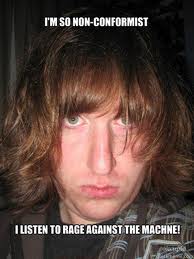
Cool dudes are out there, and nonconformity is their thing. They seek out that which others consider odd. They know that they are trendsetting fashionistas, and that everyone they know, knows it too. They know it better than we do, and they know that they’re not rebelling. They don’t care for labels. This is just who they are. They preach their nonconformist tastes to every fake nonconformist in their inner circle, and they get off on the fact that we don’t understand them. They are the only true nonconformist they know. They don’t fall prey to the whims of the Man, that fat cat, or the Scooby Doo bad guy, CEO that smokes cigars he lit with $100 dollar bills. They are an individual with selective, refined tastes that supersede everyone else’s tastes, and this is your status in their world. They are the true nonconformist.

noncomWhat they don’t understand is that the world is immersed in nonconformist rebels, and that they are so numerous that there are nonconformist rebel markets created for nonconformist rebellious consumers that rebel against conformity. What they don’t understand is that the capitalist pig system abhors conformity for the most part, for if nonconformity didn’t exist there would be very few stores in a mall, there would be little stratification of prices in each store, and there wouldn’t be the large number of products in the large numbers of stores in every mall.

In our youth, it was possible for supermarket chains to have multiple items in the breakfast row. They had the cereal section, in that row, and that was bracketed by other breakfast-related items. The variety of cereals have grown so varied that there is but little room in that side of the aisle for Pop Tarts and other breakfast related items. A shopper is more apt to find maple syrup, and other smaller items on the opposing side of the aisle, or in another aisle altogether.  

Walk into any cell phone store, and we’ll see a number of phones that conform to the function of nonconformity, but we’ll probably see that store for what it is after a while. We’ll start to realize that these stores appeal to our sense of non-conformity, or our elevated knowledge of the technology of one phone versus another that we’ll end up skipping that store to go to the one three stores down that appeals our knowledge and our sense of non-conformity. If we are so well informed that we know that neither of these stores provide the degree of technology necessary to suit our needs, boy, have we got a store for you online.

If you’re willing to pay a little bit more for a socially conscious store, we have a whole line of products for you, and they are friendlier to the environment, they have “We support Green Peace” stickers on all of their products, and anything and everything we abhor about what is being done in the South American rain forests. Let those poor suckers continue to buy their inferior products from store A, but they should do so with the knowledge that they are not down for the cause.

The capitalist pigs of the cell phone industry, the clothing industry, the electronics industry, and the leather wallet industry know more about your selection process than you do. They know that our discerning, refined tastes are such that we would never buy a candle wax that is distilled from “Big” oil. Our preferred candle is composed of a wax carefully removed from honeycombs created by bees, so as to not disturb their honey making process or their larvae storage. They also know that to cater to their clientele, they will be required to provide an example of this process to all concerned consumers in a video on their website. These stores know, probably more than any other outlets, that the success of their niche market depends on making their customers feel more socially conscious, more knowledgeable, and more empathetic, and as such it will be required of them to provide their customer base an outlet through which they can further detail their pleasure, or complaints, with the products they sell in their store. As such, they will have some sort of comments section on their website that they will have to monitor on a daily basis, for even the most simple reply to the comments on the website will substantiate the long-held beliefs of their customer base. All they will have to say is something along the lines of “You’re right Doogie Howser232, we will address your valuable information at our next meeting.”

We are all victims of our own knowledge of markets and political consciousness. We make decisions in life, based on what we read and know. Our discerning tastes based on knowledge are studied and commented on in board meetings, and there is nothing special about us. We are members of a demographic, and if we do manage to somehow become an outlier in anyway, there will be a new market created to suit our new stratified needs and desires.

This new market will want to know how much we now “know” about phones and clothes, and they will soon find a way to appeal to us on a new, knowledge level. They want to understand what shaped our new knowledge, and why we think that way, and they want to have that perfect product ready for us when we’re ready to open up our pocketbook.

But I am a true nonconformist, rebels that doesn’t give a durn about any of that nonsense. The capitalist pig machine can shrivel up and die for all I care, but you’re adding to it poopy bear. We’re all creating, and adding to, a diversified and stratified market that has existed longer than we’ve been alive. We can say we’re rebels, but the month after we claim a new discerning taste, a rebel store will open up with all kinds of new, rebel paraphernalia to appeal to us. You’re a punker you say? Well, where did you get all your punker gear? Did you make it by hand? No, well, what else do you have in that Punkers R’ Us bag?

It’s called consumer rebellion, and it’s become such a primary staple in the capitalist pig, American system that capitalist pigs have opened up a store in just about every mall in America just for us? We wear a constant, nonconformist snarl, how can a capitalist pig sell a snarl? We can’t, but we can give you everything you need to bracket that snarl. We can sell a suitable get up that frames that snarl in such a way that it can make it more powerful during rebellious consumption. We can buy a tongue stud at this store, but for those who want spikes in the shoulder pads of their leather jacket we may have to go to the store three doors down and across the hall, and to buy the latest rebellious, nonconformist punk rock album, we’ll have to go down to the first floor. The current, capitalist pig system in America today needs you! and your rebellious consumerism to survive and thrive.

Tattoos were once the epitome of rebellion. An individual could define himself as an outlier with one simple, strategically placed tattoo that was somewhat visible, but not so visible that it was obvious. An individual with a tattoo attained instantaneous conversation status. Everyone has one now, so the true rebel got two, then three, and finally four, until four wasn’t enough, and the whole body art market rose from the back alley to strip mall status. How embarrassing is it to thee true rebel, tattoo aficionados that this market rose to the level where a consumer in Omaha, Nebraska found that tattoo parlors began to compete with Burger Kings in the total number of locations?

People, from the lowest marketer go to the fat cat CEOs, want to know what we’re buying and what we’re consuming, so they go to our favorite Euro bar to find out what the latest nonconformists are wearing, drinking, eating, and in all ways consuming. There’s a whole lot of consuming going on out there, and it takes a whole team of studious marketers to understand it all. These studious marketers then present their information to that fat cat CEO, with that mighty bank account, to create a fashion line that brackets your snarl and appeals to that nonconformist ethos that we have to tell the world that we just don’t give a durn about nothing.

The 50’s and 60’s were a relatively homogenous era that built a fairly homogenous market. It was the Leave it to Beaver, Dragnet, Davy Crockett era. It was an era where fat cat CEOs dictated to the populous what was hip and fashionable. If they wanted everyone and their brother or sister to buy what they were selling, they had Marilyn Monroe and Marlon Brando wear it. They had The Beatles sponsor it, they had Milton Bearle smoke it, and it all gave birth to the ‘keeping up joneses’ meme. Marketing and commercialization have always dictated style of dress, home décor, and artistic tastes, but the power they had back then was considerably stronger before the late 60’s. The late 60’s were a time of nonconformist sophistication that brought forth some degree of individualism, at least when it came to clothing and music, but the markets didn’t sit around and lick their wounds over the power they lost. They adapted. The nonconformity market was born. It was a submarket that up and coming, risk-takers, otherwise known as entrepreneurs, adapted to, and they left the conformists in the dust, until the nonconformist consumers adapted and bucked the current nonconformist trends, and the market adapted again and again, until they started appealing to the nonconformist goth with a snarl. These sub markets were all created to appeal to those that marketing and commercialization didn’t. Up and coming, risk taking entrepreneurs saw dollar signs in tie dye shirts and bell bottom pants, and Ocean Pacific shirts, and Vans shoes, and on and on, until there was a market for every form of nonconformity a hip, nonconformist dude could think up. Our level of nonconformity is actually conformity in America today, and we are no more special than the nonconformists that we are laughing about here.

As David McRaney states in his book, You are Not so Smart: “Poor people compete with resources. The middle class competes with selection. The wealthy compete with possessions. You sold out long ago in one way or another. The specifics of who you sell to and how much you make – those are only details.”