Using the Force on Uranus


Most of the planets in our universe were discovered by some guy looking up saying, “Hey, lookee there.” And another guy saying, “That right there, that ain’t no star, Jed, that’s a damned planet.” That’s how most planets were first discovered, as far back as 1,000 BC. Neptune was different. Neptune is too faint to be seen by the naked eye. Neptune had to be theorized and mathematically predicted.

This probably reads like a perfunctory narrative at this point in history, because we have the technology and all of the tools and gadgets necessary to uncover numerous mysteries of the universe. They didn’t in 1845. It’s almost a “Who cares now?” story that is so over it’s over, but some of the my favorite stories from history aren’t necessarily about the event in question, but the mind over matter quest to achieve the unachievable. They’re about human ingenuity and/or the power of the human mind. Two men used the science and all of the data available at the time, a pencil and paper, some mathematical theory, and little more than their brains to declare that there should be a planet should be … right there! And they were wrong, initially, and then they were wrong by one degree! This is the story about the discovery of a planet we now call Neptune, a story that illustrates the beautiful idea that every problem we face is one genius away from resolution.

When it comes to the discovery of planets, there’s basically two stories. The unofficial record involved some guy spotting a Saturn, but he was an ancient who didn’t know anything about “the record”. Once the record was established, another guy beat everyone else to get his name on the record for being the “first to spot Saturn.”

“Crock of stuff is what it is,” the naysayers say whenever we talk about the first to discover celestial bodies. “There was always someone who discovered it first, before the record existed, AND, and someone would’ve discovered all of these planets eventually. Most of these names we applaud and memorialize were just right time, right place opportunists. We’re not talking dots of light in the sky when we talk about planets. We’re talking about massive complex bodies that have their own geology, weather, and sometimes even their own atmosphere or moons. They’re huge honking worlds in their own right that would’ve eventually been discovered by someone. The whole idea behind celebrating the humans who first discovered a planet is so ridiculous that it’s hardly even worth talking about.

“It’s like talking about the guy who, according to the record, discovered the moon. You discovered the moon? That right there? You discovered that?”

On July 26, 1609, Thomas Harriot discovered the moon. There is no record of the laughter, derision, or humiliation that followed Harriot’s discovery, but Harriot became the first known person in history to look at the moon through a telescope and draw what he saw. He made multiple maps, including recognizable features. Mr. Harriot either forgot to put his name on the record for his discovery, or his friends started mocking him so ruthlessly for trying to be the first guy to spot the moon that he decided not to submit his name for the discovery. 

The father of modern observational astronomy, Galileo Galilei didn’t give a crud about all that. He knew how to bite that apple. Galileo was an ambitious fella who knew how to get history to celebrate his name, so months later he published findings that mirrored Harriot’s. 

How many of you have heard the name Thomas Harriot? How many of you have heard of the name Galileo? Exactly. Thomas Harriot fell prey to the “publish or perish” dictum that haunts history’s otherwise anonymous names, by failing to publish his detailed maps of the moon, and he died anonymously. In fact, Harriot’s July 26, 1609 findings stayed hidden in notebooks for centuries, until he received proper accreditation in the 19th–20th centuries. The Thomas Harriot story might sound like a miscarriage of justice, unless you’re one of those “I’m pretty sure someone would’ve eventually discovered the moon” naysayers. 

The Perturbing Force 

On March 13, 1781, a man named Sir William Herschel used his trusty telescope to discover a planet we now call Uranus. His observations found that it wasn’t a comet, but a planet, and after his findings became “official” the society of astronomists pretty much thought “Ok, that’s it, Woo Hoo and all that, we’ve discovered the end of the universe.” There was one problem; the astronomists who used Herschel’s findings could not correctly plot point Uranus’ orbital positions based on mathematical projections. Uranus was so all over the place that it made no sense. 

Alexis Bouvard

Using all of the data available to him at the time, Astronomer Alexis Bouvard made seventy-seven projections on where Uranus should be at any given time, but his fellow astronomers called him out. They told him all of his projections proved incorrect. We can guess that Bouvard called them ordures, French for trash, but he went through the projections versus the reality, and he found that they were right. Much to Bouvard’s humiliation, this occurred after he published his seventy-seven projections. He probably could’ve simply corrected the record and published again, but that would’ve meant finding his initial errors and correcting them.

We can only imagine how much time, sweat, and passion Bouvard put into creating those tables, and we can guess that he tried to save face by saying,

“Hey, I didn’t just throw that out there. These were precise projections based on all the data I had at my disposal, coupled with Newtonian laws. I wouldn’t just guess and then publish those guesses to subject myself to this level of humiliation. There’s something more going on.” He initially blamed the data, but when that didn’t satisfy anyone, including himself, he came up with a “Perturbing Force” theory.

Bouvard’s Perturbing Force theory suggested that there was something beyond Uranus pulling and pushing on Uranus in a way that caused irregularities in its orbital path. He suggested that it might even be another planet.He submitted the idea that Uranus might not be the end of the universe to the Paris Observatory, but unfortunate for the legacy of Alexis Bouvard, the member of the astronomical society who received that request for a follow up left his position soon after Bouvard submitted that request for further findings. Furthering the unfortunate nature of Bouvard’s legacy, he died before anyone would substantiate his idea of a perturbing force gravitationally pulling and pushing Uranus off what should have been the precise data points dictating its orbit. Thus, we can only guess that Alexis Bouvard probably died believing himself a failure, or at the very least that everything he accomplished in life ended with a huge stain, in the form of an exclamation point, at the end. 

Skeptics argued that since Bouvard’s projections relied on Isaac Newton’s theories, Newton’s theories must be flawed. Mathematicians, like John Couch Adams, insisted that Newton’s theories were sound and after studying Bouvard’s projections, Adams insisted that he could use Bouvard’s projections, and all of the data the man compiled, coupled with Newton’s laws to deduce the mass, position, and orbit to discover Bouvard’s perturbing force. 

Couch Adams devoted four years of his life to studying, calculating, and projecting where a possible perturbing force could be, and he submitted that work to British Astronomer Royal George Biddell Airy. The esteemed Airy was understandably skeptical, as the mathematician submitting these findings was a twenty-four-year-old, and we can also guess that Airy was unwilling to put his reputation on the line without detailed computations. He did respond to Couch Adams, however, asking for greater precision, as Couch Adams’ findings turned out to be twelve degrees off, and unfortunate to the legacy of John Couch Adams he did not respond.Some suggest that the failure to respond may have been due to Adams’s unprofessional demeanor, his nerves, procrastination, or that Adams did not have the numbers required for greater precision. Whatever the case was, Couch Adams’s failure to respond in a timely manner cost him sole credit for the discovery of the planet Neptune.   

Some suggest that Frenchman, Urbain Jean Joseph Le Verrier, was unaware of John Couch Adams work, his subsequent submission, and his failure to complete the work, but Le Verrier was very aware of Alexis Bouvard’s work. He paid particular attention to Bouvard’s idea of a “perturbing force”, and it fascinated him. He thought he could find the missing link, and he thought he did. He thought he made the discovery of a lifetime, one that could make him famous. 

He first sent those findings to the French Academy of Sciences in Paris, but due to bureaucratic inertia and a lack of proactive observation, the Academy did not follow up. They did not reject Le Verrier’s math, as they found it rigorous, but his findings did not translate into instant acceptance as a confirmed discovery because it remained theoretical until it could be observed. The Academy also had “other concerns”, and they may have lacked the capacity to immediately follow up. Whatever the case was, Le Verrier took some of the complaints The Academy had about the absolute precision of his findings, and he refined his coordinates and submitted them to Johann Gottfried Galle at the Berlin Observatory on September 18, 1846. Berlin had a powerful new refractor telescope, and they provided a more agile response, partly because Galle and his assistant Heinrich d’Arrest were eager to test the hypothesis. 

On September 23, 1846 Galle confirmed, through Verrier’s detailed calculations, that the perturbing force affecting the orbit of Uranus was possibly and probably a planet that we now call Neptune. Galle’s confirmation did note, however, that Le Verrier’s detailed calculations were one degree off. Here we reach another “think about it, before we move on” moment. The Frenchman took Alexis Bouvard’s precise projections, based on pre-discovery data, and he joined Bouvard’s mathematical calculations on his errors, coupled with some theoretical notion of a perturbing force, pushing and pulling Uranus off what should be its orbit, and it should be right there! And those calculating his math,using nothing more than their own math(!), found that he was one degree off! [Note: The international astronomy community eventually decided to settle the international dispute by giving credit to both the British Adams and the French Urbain for Neptune’s discovery, even though Adams unofficially discovered it first.] Astronomy.com also states that “Adams [eventually] completed his calculations first, but Le Verrier published first. Le Verrier’s calculations were also more accurate.” The lesson here for you kids looking to submit astronomical findings to a governing body, when they approach you for detailed calculations to support your astronomical findings make sure you either respond immediately, or maybe you should have your detailed calculations ready before declaring your findings. 

The naysayers have a point when they say someone would’ve eventually discovered something as massive as a planet, but Neptune is different. Someone would’ve eventually discovered it, as the technology advanced, but a couple of guys, we’llsay three in total with Bouvard paving the way with his perturbing force theory, located Neptune by mathematically predicting where it would be based on the irregularities in Uranus’s orbit. Is that phenomenal? No? How about we put ourselves in their era and learn that when they went to the office to complete their theories, they road a horse on a dirt road to get there, if they were lucky enough and rich enough to own a horse. Also, their definition of the heart of the city was often just a bunch of wooden store fronts, like the recreations we see on the old HBO show Deadwood. Most of what these 19th century astronomers and mathematicians saw in the nighttime sky is what we can see by stepping outside and looking up into the sky. They had some technological assistance back then, in the form of relatively weak telescopes, and some theorize that astronomers, like Galileo Galilei in 1613, Jerome Lalande in 1795, and John Herschel in 1830 may have used this technology to spot Neptune first, but they didn’t know they were seeing a planet, because their telescopes were not powerful enough for them to know that. Those of us who write articles about such topics and the geniuses who made ingenious discoveries or theories that proved slightly incorrect or somewhat flawed should asterisk our modern critiques by saying, “I am smart. No, really I am, really, really smart, but as ingenious as I am, I don’t know if I could’ve done what they did with the primitive technology they had, primitive when compared to ours. So, before I go about correcting and critiquing their findings with the technology I have at my disposal, thanks to those who developed it for me, I’d like to say how impressive it is that they came so close that it’s impressive that they did what they did with what they had.” 

Hoomans, Ha!men, and Humans 


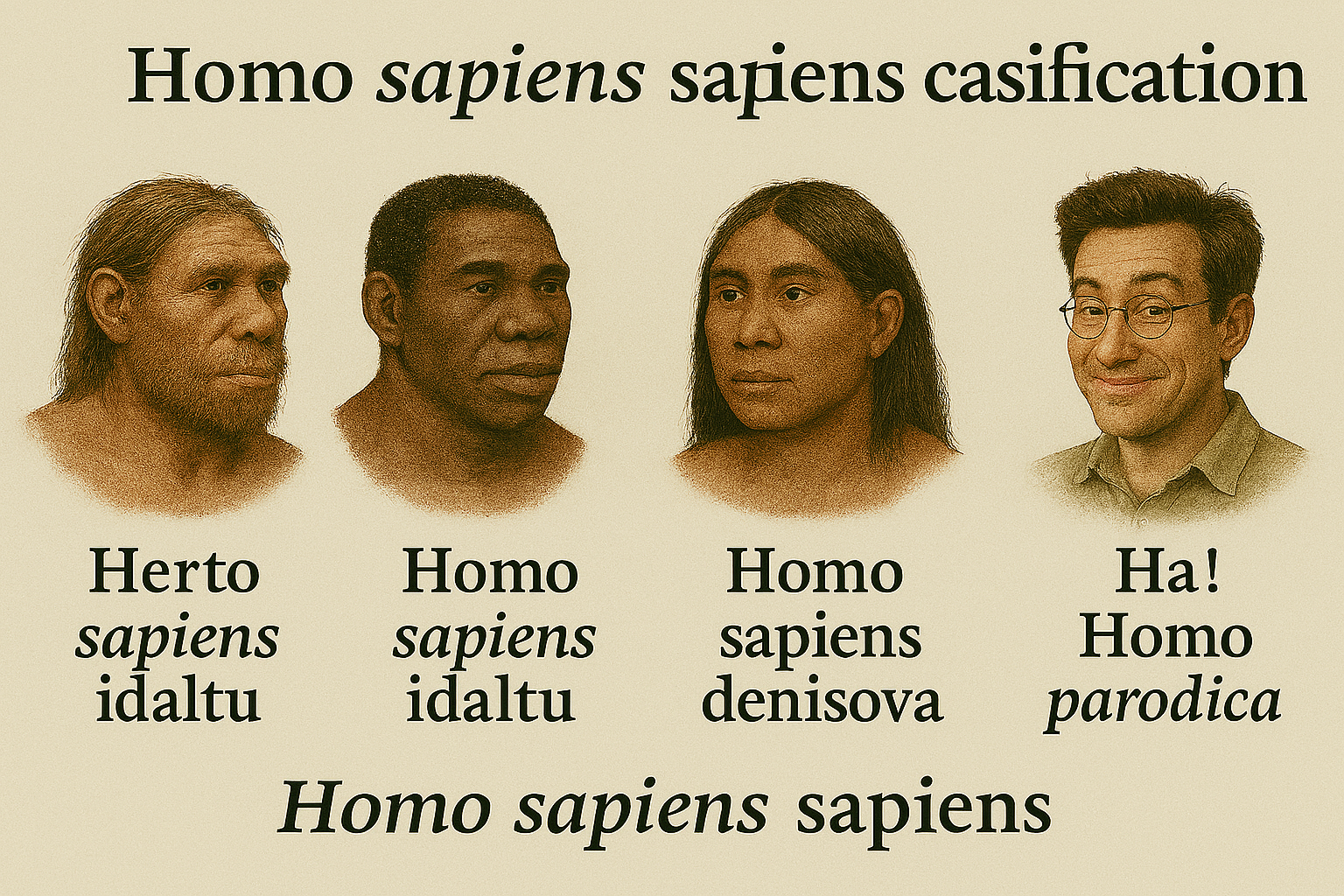
Taxonomists and biological anthropologists classify modern humans as the Homo sapiens sapiens species. No, that is not a typo. The reason for the double-word is that we are a subspecies of the Homo sapiens species. Taxonomists and biological anthropologists created this distinction to separate Homo sapiens sapiens species from the Homo sapiens neanderthalensis, or Neanderthals, the Homo sapiens idaltu, or Herto man, and the debatable inclusion of the Homo sapiens denisova, or Dragon man. We’re all homos, in other words, under the genus Homo, and the biological anthropologists break us down after that.

Our Homo sapiens sapiens subspecies is characterized by advanced cognitive abilities, language, and complex social structures. We’re the most complex subspecies in this regard, but if aliens from another planet were to meet us, greet us, and play in all our reindeer games, they probably wouldn’t agree that we all belong in the same categorization.

When we talk about Alien Life Forms (ALFs) here, we’re talking about Spock, S’Chn T’Gai Spock from the original Star Trek. Spock was half-human, half Vulcan, but we’re going to characterize our ALF as a full-on Vulcan, a full-on reason and rational thinking Vulcan with no empathetic or sympathetic emotions. In this ALF’s After Earth report home, it would write, “Even Earth’s scientists refrain from proper delineations in their Homo sapiens subspecies, because the scientific community thinks that a proper breakdown of various individuals in their subspecies might hurt feelings, but there are clear delineations. Some Homo sapiens sapiens have not fully evolved to the point that they belong to that species. Others have.”

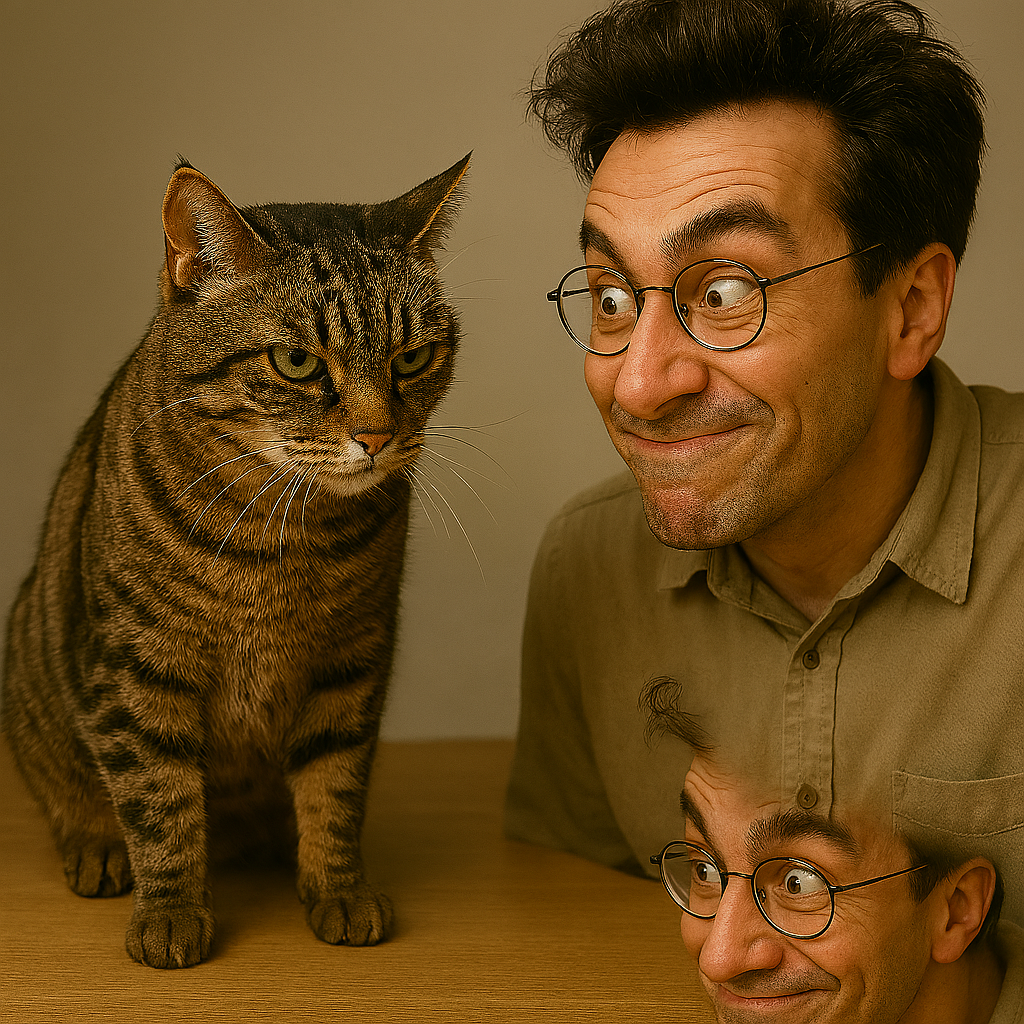
If we never meet Spock-like ALF, or fail to prove they exist, we’ll never be able to verify this characterization. Thus, we will have to turn to the closest thing we have to an Alien Life Form in our universe, one with intimate knowledge of the Homo sapiens sapiens that is dispassionate enough to provide objective analysis. I would nominate the cat. Anyone who has owned a cat knows that we share an off again relationship with them. The cats definition of our relationship might even be punctuated with a “I really don’t care that much what happens to you” exclamation point that is furthered by a “As long as I get some milk and food every once in a while, and someone or something keeps me stimulated every once in a while I’ll continue to exist near you.”

Some might say the dog has as much, if not more, knowledge of our species as the cat, but the dog is biased. Dogs love us. They are so loyal that if they were commissioned to analyze our species, they would tell us what we want to hear. There’s a reason we call them man’s best friend, and it is largely based on the idea that they accept us for who we are. They don’t analyze us in the manner a cat will, and they know nothing about our inadequacies or failures, because their sole goal in life is to make us happy. They know when we’re happy, they’re happy. Cats are almost 180-degrees different.

Instagram posters have characterized this on again, off again, “I really don’t care that much what happens to you” relationship we have with cats with a somewhat humorous, somewhat condescending term that their cats use to describe us, hoomans. Hoomans is a cutesy eye-dialect, similar to that of the “No Girlz Allowed” sign that moviemakers put outside the door of a boy’s clubhouse. The cutesy error is employed to enhance the cutesy idea that cats and young boys can’t spell. The moviemakers might even add a backwards ‘R’ to further emphasize the cuteziness of the boy’s sign.

Another intent behind the cutesy hoomans contrivance is to inform us that we’re not viewing this interaction from the customary human perspective. We’re viewing this particular interactions from a perspective we may not have considered before, the cat’s.

In that vein, the unsympathetic delineations of the cat would suggest there are Homo sapiens sapiens who fail the “advanced cognitive abilities, language, and complex social structures” standards put forth by biological anthropologists. They might suggest we introduce a Homo sapien confusocortex, or Confused Man, subspecies for those who haven’t evolved completely. 

These hoomans were born at full capacity, and their schooling years proved that they were able to achieve full functionality, but as with any muscle, the brain can deteriorate with lack of use. We’re not attempting to make fun of them, but there is a delineation between those who know how to operate at an optimum, and those who fail to make necessary connections.

In the cat-world, I’m not sure if they would characterize me as a human or a hooman. I think they might develop a separate category for those of us who measure up, but we enjoy disrupting the meticulously crafted model they’ve created for human actions and reactions. The cats view such joyful interference with their carefully designed understanding of human nature and its patterns with something beyond skepticism. They’re alarmed. If we watch cats in the wild, they study their prey carefully to gauge whether or not they’ll get hurt. If after examining us completely, they developed a full categorization, it might be ha!men. My brief experience with cats informs me that they don’t have a sense of humor, so it would be impossible for them to properly categorize ha!men without some form of condescending insults. My guess is they would spit out something like, the symbolic, or ironic inversion of their cultural input often critiques the very idea of cultural output, then twist it into recursive satire. Their social systems resemble Escher prints—technically sound, emotionally disorienting. “They are players, jokesters, and fools,” the cats would conclude, “and we say that in the most condescending way possible.”   

Ha!men know that pets and children create profiles of humans based on patterns, and I think cats are quite comfortable with the thought that hoomans were put on this planet to serve them. Hoomans are to provide the cat food, milk, a place to relieve themselves, and various forms of stimuli. It’s a tenuous relationship that suggests if hoomans fail to fulfill the expectations of their relationship the cat will simply go to another hooman who can. Those hoomans who fulfill expectations can, could, and probably should receive the reward of affection. They know adult hoomans need this every once in a while, and they don’t mind occasionally playing that role for them, as long as the bullet point, requirements are met.

They also know we arrive home at around 5:30, feed them and themselves, and sit before the glowing box for a couple hours before it’s time to go to bed. They grow accustomed to these patterns, the way we conduct ourselves, the way we make sounds at one another, and our gait pattern. When we meet their criteria, they might sleep or find some other stimuli to occupy them, as they probably find most hoomans as boring as any other superior would find the actions of their underlings.

I don’t know cats would characterize me, but I highly doubt they would consider me boring. I’ve been their sole focus more times than I can count, and there have been occasions where these rooms housed a half-dozen people. I noticed how cats study us with more intensity than any other pet at a very young age, and I found it creepy in the beginning. “What are you looking at?” I wanted to ask, as if that would help matters. I noticed, early on, that when I acted somewhat out of sorts it only intensified their study of me. After numerous interactions over the years, I found their study of me fascinating, and I began tweaking my actions to destroy their research.

Just to be clear, I never touched one of these cats. I just enjoyed playing the role of their anecdotal information, their aberration. I exaggerated my differences just to be different than any other human they’d ever met, just to see how they’d react. The minute the cat owner I was dating left the room, I would walk across the room in a decidedly different gait pattern. I might slow turn my head to them in the manner an alien would in a movie, and I’d repeatedly stick my tongue out at them. I might even take a drink coaster and throw it across the room in an erratic manner. The list of things I did just to mess with their heads is long, but those are a few examples I remember. I’ve found that all we have to do is act a few deviations away from the normal hooman actions to make their pupils expand with increased scrutiny or fear.

Do the same things to a dog, and they might raise their head for a second, their ears might even perk, or they might even bring us a toy, thinking we want to play. Whatever they do, their reactions suggest they’re either less alarmed by abnormalities among the hoomen population, more forgiving of those who suffer from them, or they’re less intelligent than the cat and thus less prepared for an eventual aberration that cats foresee. Cats immediately switch to alert status. They don’t care for these games. If they don’t run from the room to avoid what they think could happen, they watch ha!men with unblinking, rapt attention. Even when they realize it’s just an act, as evidenced by our return to normalcy when the woman-owner returns to the room, they continue to study us. “I’ve decided that I don’t like you,” is the look they give us ha!men throughout.

***

Suzy Aldermann wasn’t a ha!men, but we thought she was. When we heard what happened at a corporate boardroom, we thought Suzy’s portrayal of a ha!man might’ve been one of the most brilliant portrayals we ever heard. Prior to that meeting, she appeared to abide by so many of the tenets of human patterns that when she deviated, we thought Suzy was employing a recursive inversion technique known to all ha!men as the perfect conceptual strategy for dismantling normative frameworks from within.

Prior to her “full-fledged panic attack!” Suzy successfully presented herself as an individual of advanced cognitive abilities, language, and complex social structures. So, when she experienced this panic attack, this “full-fledged panic attack!” after she opened the door to a meeting room and saw Diana Pelzey conversating with her chum, we thought she brilliantly portrayed a ha!man to the uninformed. As the report goes, Suzy whispered to a friend that she would not be attending the meeting because Diana was present. “BRILLIANT!” we said. “Absolutely brilliant that Suzy would pick the least threatening person in the room to initiate her alleged panic attack!” We all agreed to keep Suzy’s ruse secret to see how it would play out, and we expected a lot of hilarious high-brow hi-jinx as a result. The joke, it turned out, was on us. We either overestimated Suzy or underestimated her, I’m still not sure which, but it became clear that Suzy decided to run away rather than up her game to match, and/or surpass Diana’s presentation. It was, according to Suzy, a full-fledged panic attack.

In the aftermath of our misreading, anytime we met a melodramatic hooman who was having a “full-fledged panic attack!” over a relatively insignificant issue, our instinctive response, based on our understanding of human patters is to think either she’s a ha!man who is joking, or she probably needs to experience some real problems in life to gain proper perspective.

Yet, when we’d talk to Suzy, she’d detail a relatively rough upbringing that included some eyebrow-raising experiences. Those incidents were real issues that Suzy had to manage, and she had to claw through the tumult to reach a resolution. The normal human progression, for those of us who study humans with relative intensity, is that when a human experiences a number of real problems, they become better at resolving them through experience. Suzy worked her way through all of those problems, but she never developed better problem, resolution skills.

We’ve all heard from other souls who purport to travel some tumultuous avenues. Wendi Hansen, for example, detailed for us her “rough life,” but when she was done, we couldn’t help but think that much of her self-imposed trauma was the socio-political equivalent of first-world problems. Suzy was no Wendi Hansen. Suzy’s issues were real and severe, and they were backed up by eye-witness testimony. Our natural assumption is that if she’s experienced problems far worse than a colleague purportedly interested in stealing her job, it would be nothing compared to what she’s experienced in real life.  

If we were to view the humans, the ha!men, and the hoomans from the perspective of the Alien Life Form (ALF), or the cat, without empathy or sympathy, we would conclude that some humans get stronger, better, or gain a level of perspective that allows them to see minor problems for what they are in the moment. Some hoomen, on the other hand, deploy the tactical maneuver of retreat, and they do so, so often that they never fully develop their confrontational muscles.

After experiencing so many different souls who maneuver around their tumultuous terrains differently, I now wonder if hoomans, who’ve experienced real problems in life, blow otherwise insignificant issues up into real problems, because they’re more accustomed to handling their problems at that level. Either that or they know if they retreat during the relatively insignificant phase, it might never progress into more severe phases. Whatever the case is, their experiences have taught them that they can’t handle problems, and as a result of retreating so often, they never do.

***

“It’s a lie,” Angie Foote told me, regarding something Randy Dee told the group.

“It’s not a lie,” I said. “It might be an exaggeration, a mischaracterization, or something he believes is true but is in fact false. It’s not what I would call a lie.”

“Barney, he told everyone that this is what he does, and I’ve seen how he does it. He doesn’t do it that way. He’s a durn liar is what I’m saying.”

Angie is what we in the biz call a simple truther. She sees everything in black and white. A truth is a truth, and a lie is a lie. There is no grey matter involved in her universe. I respect simple truthers in this vein, because I used to be one. I’m still one in many ways, but experiencing precedents in life can wreck the comfortable ideas we develop in our world of simple math and science. Facts are facts and truth is truth is their mantra.

Some of us hear a lie, and we know it’s a lie. When we’re telling lies, we know we’re lying, and we can’t help but view the rest of humanity from our perspective. When they’re lying, they know that one plus one equals two. I know it, you know it, and most importantly, they know it. We witnessed them doing one thing, and we heard them say they do something else, and they said it as if it was something they truly believed happened! How can they do that with a straight face?

My asterisk in the ointment, my new definition of a lie, is that a lie is something someone says that they know to be false. There are good liars who are so good at it that they can convince themselves that it’s true before they try to convince us. The other liars, the fascinating ones, fall into a greyer area. They don’t know they’re lying.

One of the most honest men I ever met, a Randy Dee, taught me the grey. Randy Dee told some whoppers. He told some untruths to me, regarding events that happened the previous night, and I was there for those events. 

He misinterpreted the truth so often that it affected how I viewed him. When I viewed him, and the way he’d lie, I’d watch him with the rapt attention a cat would when encountering a ha!man who proved an aberration to my study of human patterns. While involved in this study, I became convinced that we could put a lie detector on him, and he’d pass with flying colors. “He’s just a durn liar!” I said to myself. Yet, if you knew this guy, and I did, you’d know he’s not lying, not in the strictest sense of the word. By the standard of taking everything we know about lying and inserting that into the equation, Randy Dee never told a lie.

I knew Randy well for a long time. I knew him so well that I learned he was incapable of lying. He was a law-and-order guy who despised deception and all of the other characteristics inherent in criminality. Yet, by our loose standards of truth v. lying, the man was a big, fat liar.

He was incapable of detecting the lies others told him, because he just didn’t think that way. He was somewhat naive in that regard, and after getting to know him well, I considered it almost laughable that anyone would consider him a liar.

Randy Dee was an unprecedented experience for me, and I would have a lot to sort through before I fully understood what I was experiencing with him. If we took this to a social court with a simple truther sitting in the role of a judge, we would experience an exchange of “He’s lying.” ‘I’m telling you he’s not. You have to get to know him.’ “You’re over-thinking this.” ‘If you know the guy as well as I do, you’d know he’s incapable of lying.’ “All right, he’s an idiot then.” ‘If idiot suggests a lack of intelligence,’ I would reply, ‘You have to meet him to know he’s anything but.’

If this argument reached the point of no-return, one of us might suggest using a lie detector. If Randy Dee passed the lie-detector test, the simple truther would then suggest that there was something wrong with that mechanism, and there might be.

When lie detectors first entered the scene, their findings were considered germane to cases. Judges, lawyers, and juries not only thought their findings should be admissible in proceedings, they considered them germane to findings. 

“Did he take a lie detector test?” a judge might ask. “Yes, your honor,” the defense attorney said, “and he passed with flying colors.” Lie detectors eventually became less prominent, because they were deemed wildly inconsistent. How can a machine with no powers of empathy, sympathy, or any emotions differentiate between hoomens, ha!men, and humans to produce inconsistent findings? What progressions occurred? Were so many Ha!men and Hooman able to beat lie detectors so often that the machines lost their relevance in criminal cases?

Randy Dee, a man who was so honest that it seemed almost ridiculous to suggest otherwise taught me that the reason lie detectors are wildly inconsistent has more to do with the idea that we’re wildly inconsistent. We can convince ourselves of a lie, so thoroughly, that it’s not a lie anymore, and we can do it without ever trying to deceive anyone or anything in the case of lie detectors. Ha!men might do it just to see if they can defeat the machine, and its ability to detect different biological reactions, but hoomens might do it because they lose the ability to make those necessary connections that produce truth. The latter provides a wild ride to those of us who once viewed human nature in the ritualistic patterns cats will, and if we continue to view hoomens with the rapt attention a cat gives a Ha!man, until we find the truth, it will wreck every simplistic truth we thought we knew about lying liars and the lies they tell.  

Comfortably Vague 


“If you want to be hilarious, someone has to get hurt,” is something I used to say. “You can be slightly humorous with a knock-knock joke, and quick comebacks might earn you the title clever, but if you want to be truly hilarious, your goal should be offending people and grossing them out.” I used to think that, believe it, and say it all the time, because I thought it was provocative and so true, until I saw someone go after another. They were so savage that I realized causing someone actual pain was not as funny as the theoretical idea of it. I amended my theory by adding, “As long as you’re the victim, because there’s nothing better than a well-timed mean-spirited, self-deprecating joke.”

“And the comedy is in details,” I would add when I heard people keep their stories comfortably vague. “Why would you even tell me this great story about an embarrassing part of your life and leave out the details? That’s like going out to a restaurant and ordering potatoes with a side of broccoli. I like broccoli as much as the next guy, but what’s the difference between broccoli at a restaurant and broccoli at home? No one I know goes out on the town for a head of broccoli. We want the meat.”

When I say stories, I’m talking about those casual, fun stories that two fellas share while sitting in the stands at a baseball game. I’m talking about those tales that are so embarrassing that you may not know the comedic value of them until you say them out loud. They’re the funny ones that get the other fella laughing. Some of us leave out the details of those stories, because they reveal our vulnerabilities. Once we lay those tails out, and the other guy starts laughing his tail off, it can be strangely liberating. The two of us are there, mentally, picturing you in the moment while you remember all of the finer details of your truly embarrassing moment in life, and if you deprive us of those details, it’s the literary equivalent of slamming the door on the best room of your house as you give us a tour.

If you’re anything like me, and you’re in the midst of hearing one of these stories, we don’t want it to end, so we ask them leading questions. Not only do we want to be with them, in the moment, but we want to help them help us find their story entertaining. So, we ask leading questions, such as, “Really? What did you think of that?” or “How did that affect you?”

We ask specific, situational questions that specifically pertain to the other’s story, and some of us have asked these questions for so long that that’s just kind of who we are. We ask active listening questions that some might confuse with those from a psychotherapist, an investigator, or that incredibly annoying person who can’t let someone finish a story without asking five-to-ten questions while they’re trying to tell it. Unlike most quality professionals, however, we only ask such questions to serve the comedy of the story, as opposed to anything that serves a purpose. Were not tracking our subjects through the trials and tribulations of their life to help them find their core, so they might find their way back to greater mental health. We just want the funny.

If you’re anything like me, you crave funny tales about foibles and failures, because there’s something so interesting about a person who is not afraid to let their guard down and tell you who he really is. We do have to be careful, or if careful isn’t the right word, and it usually isn’t when it’s just two fellas telling each other what a foible he is, how about strategic. We need to qualify such questions by saying, “We’ve all done stupid stuff. Trust me, we’ve all done what it takes to go from idiot to a total idiot.” When we drop a line like that, and we mean it, we develop a temporary bond that can lead our storyteller to test the parameters of that line. 

The only thing I love better than a story full of failure and foibles, is an in-depth exploration of those failure and foibles, and if you’ve read any other articles on this site, you know that I’m not the type to just sit there and feed on another’s carcass. I lead the charge and set the template. In doing so, I make the other person feel more comfortable talking about their own failures and foibles.

Once the two of us lay the groundwork of our hilarious misadventures, we spend the rest of the evening trying to top the stories we’ve both told thus far, and neither party cares why we’re trying to do that as long as they’re funny. This builds until somewhere around the second inning, we start to make a thematic connection. Then, somewhere around the fourth inning, after the second beer is partially consumed, the stories become a little more personal as we become a little more vulnerable, and we achieve the next plane of funny together. Shortly after that second round, we’ve also established the idea that we’re not just good listeners, we’re actively engaged in the other’s stories. The two of us become so good at it that we breed a level of trust and confidence in one another, until the competitive desires set in, and we try to make the other guy laugh harder than we did before. We don’t care if the details prove somewhat embarrassing at this point, so we dig deep into our story bank to find the most entertaining nuggets of our life so far. When they laugh, we know we’re really onto something. Neither of us knows what that something is, but we know it’s something worth exploring.

As much fun as these baseball nights can be, age and experience has taught me levels of restraint. I offer some of the details that I require of others, but I refrain from offering details that could prove so embarrassing that the next day at work is a little uncomfortable, and I expect them to do the same. I get as caught up as anyone else in these moments, but experience has taught me that there are details and there are details. Details are funny, as I’ve written, and they’re crucial to the quality story, but some details provide irreversible images that our audience will remember the next time they see us.

I’ve also learned firsthand, the hard way, to avoid too much poking and prodding, because once we convince a fella how entertaining he can be, some of us have trouble stopping. They’re not accustomed to someone finding them so interesting and entertaining, and their competitive desire to top their last story, or ours, can lead them to taking a step off that comfortably vague cloud and accidentally imprint an irreversible image in our brains.

When I’m in one of those conversations with a fella, and he’s dropping details of his failures and foibles on me, I’m so engaged that great plays and key moments in the baseball game we’re attending only serve to interrupt our fascinating discussion.

Roy and I talked about personal details from our lives, but we kept our details comfortably vague, because that’s just what fellas do at a baseball game. No one wants to lay out detail-oriented, personal problems at a baseball game, because we know no one wants to hear about all that at a baseball game. No one wants to go so deep that they end up with tears in their eyes at a baseball game, because as Tom Hanks said, “There’s no crying in baseball.”

Yet, most people can’t stop themselves. They have no governors on content, in the manner automobiles have governors on speed to prevent the vehicle from accelerating faster than programmed thresholds. They dig for more provocative details, because provocative details aren’t just funny, they’re hilarious, and what’s more provocative, embarrassing, and hilarious than misadventures in the bathroom?

Some people just love a great story about what happened to them during the waste removal process. The moment I start to hear them go down this road, my stop sign reflexively pops us, in the manner a stop sign automatically pops us when a train bypasses an indicator in its destination. I instinctively stop poking and prodding, and I try to change the subject, because I’ve learned that some men have no problem discussing their gastrointestinal issues (GI), as long as they’re funny, and they’re always funny to some. “Oh, c’mon, it’s nature!” they say. “Deer poop, dogs poop, even your beloved octopus has to excrete what its body can’t use.”

“That’s true, undeniably true, but for most of us their byproducts are not the reason we hike through nature preserves and swim in oceans,” I return. I say most of us, because I’ve met the exceptions on more than one occasion. I don’t know if it’s a talent, skill, or a preoccupation, but some men are wired in such a way that they can take any topic and turn it into a discussion of misadventures with waste removal.

Tommy Spenceri proved to me how pervasive his talent in this arena was when he told me about the highlight of a relatively expensive whale spotting cruise he attended. These cruises have become so popular that they’ve become an industry in some locales, generating over $100 million a year, and creating thousands of jobs for locals. Some of these tourists are almost spiritually moved at the very sight of the beast, others find the geyser of misty spray bursting skyward from its blowhole an almost religious experience, but Tommy’s wiring led him to find the size of the whale’s excrement the most memorable experience of that vacation. “You should’ve seen it, it was larger than my whole body,” he said with restrained excitement. “I’m serious, I could’ve dove into it Vitruvian Man and still not touched its outer rims.”

As the son of a man with such wiring, Tommy and Roy’s unusually obsessive preoccupation with the products of our biological functions was not new to me, but that didn’t mean I wanted to hear about it. So, the moment these discussions pop up, my stop sign follows suit. I switch my active listening skills into the off position, and I put the picks and shovels of my poking and prodding away. 

I’ve been relatively successful in this endeavor over the years, unless I’m at a baseball game drinking beer, and when I talk about beer I’m not talking about the standard beer that everyone drinks just to tie a buzz on. I’m talking about the delicious craft beer designed by master craftsmen who are so good at what they do that the results of their brainstorming, testing, and hard work go down so smooth that we miss all of the indicators that tell us to stop.  

I wasn’t drunk when the generally unappealing discussion of food poisoning began, but those delicious craft beers dulled my senses just enough that I accidentally ushered him on with my laughter. In a completely sober state, I know that the food poisoning discussion is a war story. It spawns the competitive, “You think you had it bad? Well, get a load of what happened to me,” as the two of us try to top one another with our experiences. Two beers in, and a discussion of food poisoning becomes a part of the funny conversations two fellas have at a baseball game. In that moment, Roy introduced the food poisoning discussion with an innocuous, comfortably vague version of his worst case, but I made the mistake of topping him with my story of an eighteen-year-old, living on his own for the first time.

“I was on my own for the first time, and I knew nothing about the proper ways to preserve meat.” I said. “No one effectively warned me that meat is basically poison when you leave it uncovered in a fridge for a couple days. The meat had little white spots on it, but I thought that the gallon of milk I had a shelf higher sprung a leak again. That happened about a week earlier, with a different gallon, and I just thought it happened again. I basically poisoned myself. The pain I felt from that bout of food poisoning was something I never experienced before or since. Not only did I question whether I was going to live through this, I kind of questioned if I really wanted to.”

That was it from my end, comfortably vague. I could’ve gone into detail, embarrassingly specific detail, but I didn’t want to go down that road. I didn’t want to go down that road, because that’s not what you do when you’re talking to a fella, over beers, at a baseball game, during an otherwise beautiful Friday evening.

Roy saw my move, and he decided to checkmate me with his “You think you had it bad …?” plank. My guess is Roy thought that the best way to top a relatively entertaining story that remained comfortably vague was to go into detail. The humor, Roy must’ve thought, is in the details. Roy must’ve thought that my story was the culinary equivalent of a potato with a side of broccoli, and to top mine, he brought the meat.

“Mine was coming out both ends, you know what I’m saying?” he began. I knew what he was saying, and while the image I had in my head was cringe-worthy, it wasn’t completely irreversible. I don’t know if Roy was feeling ultra-competitive in the war story arena, but he decided that he needed to put an exclamation point on his story by adding one final, irreversibly disturbing nugget, “You know that point where you have to change your underpants three times in a day …”

I’m all for my storytellers telling me about their epic fails, but when this grown man told the tale of his inability to make it to a facility on time, I wasn’t sure how I could help him restore his credibility. To my mind, unless you’re medically declared incapable of doing so, failure to make it to the facility on time might be the most humiliating and embarrassing moment in a grown adult’s life. The one proviso is that if it happens, it happens behind a closed, locked door, and with some diligent effort devoted to the cause, we can destroy any and all evidence until no one will ever find out that our streak of not soiling ourselves since that embarrassing moment in second grade is now over. The only thing that can make that ultimately embarrassing and humiliating moment in life the second most humiliating moment in life is by going public with it.  

My new rule: if we’re having such a discussion, and we’re both grown adult males, at a BASEBALL GAME, keep it vague. I know that goes against everything I wrote earlier, and it goes against my personal constitution to say that, but everything is relative and situational. When we’re sitting at a baseball game, I don’t want to hear excruciating details about an emotional moment from your life that leaves tears rimming your eyes, and I don’t want to picture you, my adult, male friend, with dirty underpants around your ankles, and a look of shame and disgust on your face, as you bear witness to the consequences of your inability to make it to the facility on time. 

As a storyteller who values “The Funny” so much that I don’t care who gets hurt, as long as it’s me, I understand that it’s all about our vulnerabilities, and I understand that comedy is confessional, but we’re smashing some valuable signposts that warn us against going further. We do this, because our standup comedians, podcasters, and our Facebook friends are now saying some of the most awful, embarrassing and incriminating things about themselves. We laugh at/with these boundary smashing and taboo tweaking comedians, because they’re brand of funny feels so new that it feels transcendent, and  we all want to be the guy who tops the other guy and breaks on through to the other side of conventional storytelling and conventional comedy. Before we break through, though, I think we should all ask ourselves what we will look like on the other side? I might be an endangered species now for overthinking such matters, but Roy, Tommy, and my dad taught me that garnering intrigue, eliciting sympathy, and getting the laugh isn’t a gumbo that means so much to me that I’m going reveal an ultimate humiliation that contains irreversible imagery around my ankles. They’ve taught me that there’s nothing wrong with keeping it comfortably vague.