The Happiness of Physical Congruence


“You have some killer calves bra,” Gunther, the gym rat, said at the gym. I can’t remember if I said, ‘thanks’ or ‘SECURITY!’ but Gunther (pronounced Goon~thur as opposed to Gun~thur), sensed my awkwardness. “Seriously bro, you’ve done some good work. I’m thinking of getting mine done. Gonna get me some pumped up calves.” After some back and forth, he confirmed that meant he was thinking about having calf implants surgically inserted into his legs. “I do all of the calf raises, the farmer’s walk, the Box jumps, and jumping jacks, and look at me, I got nothing down there bro. Look at those puny things! Look at them compared to my thighs, they’re incongruent!”

You ever meet this guy, a guy who appears to have it all, and he obsesses over something so trivial that if I told you about it, you might say, “He was joking. He had to be.” I didn’t bother breaking it down with him to see if he was joking, because why would I? I was there, and I knew how serious he was. I did wonder what motivated this obvious obsession with anatomical perfection, and I wondered how deep it went. Did he think everyone was staring at his “puny calves” the minute he walked into a room? Did he refuse to wear shorts, to avoid exposing his humiliation? Did he blame his parents for giving him such awful genes “down there”. I wondered if he thought that by attaining “pumped up” calves, even if by artificial means, that he might be able to improve his perception by eradicating the inadequacies below his leg pits.

“Are you looking to get into a pageant?” I asked.

“First of all, they’re not called pageants,” he said. “They’re called bodybuilding competitions. And no, I’m not looking for any of that. I just think it’s unfair that I work ten to twenty times harder than people like you, no offense, and I get no results.”

Gunther, the gym guy, had so many admirable, and I’ll say it, enviable traits that if he commissioned a poll of a thousand casual observers, my bet is one in a thousand might notice his “puny calves”. If Gunther were asked to predict the outcome of that poll, however, he would probably predict that that figure to be somewhere around 999 out of a thousand who spot them. “How could they miss them?” he might ask.

I told him that if he hadn’t pointed them out to me, I never would’ve noticed them, and I added, “I doubt that anyone else would either.” He acknowledged that and waved it off, basically admitting that he kind of knew it was his issue.

The idea that he moisturized his skin was obvious, as was the idea that he used a wide variety of hair products to color and treat his hair. Gunther, the gym rat, worked hard to perfect every element of his physical presentation, and that included achieving what bodybuilders call the X-frame: broad shoulders, a narrow waist, and well-developed thighs. This shape creates what experts call a striking visual taper, proportion, balance, and a symmetrical emphasis that creates a harmonious and powerful aesthetic that all gym rats strive to achieve.” Yet, Gunther couldn’t do anything about his “puny calves”, so he contemplated letting a surgeon do it for him, because “it wasn’t fair” that he couldn’t.

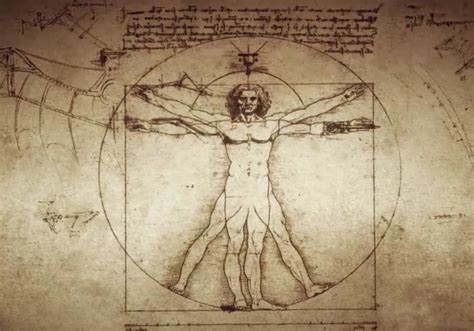
My guess is if another perfectionist, Leonardo da Vinci, decided to give his Vitruvian Man “puny calves”, after studying the ideal proportions of the human form, none of us would notice. Da Vinci would, and Gunther would, because they were far more concerned with achieving anatomical perfection.

We can all understand and appreciate da Vinci’s drive to achieve an artistic representation of perfection, in other words, but there was something almost obnoxious about Gunther’s psychological drive to fix his “incongruity” that when he used that word it stuck with me. I never heard anyone, in the bodybuilding universe, or anywhere else, complain about their incongruity. It was almost as if he thought if he used a different, more creative term, it might exert some special kind of shame for those muscles, and they might finally respond to all of his efforts. And he did speak of these muscles as if they were disembodied entities. Then, he concluded his scorn by saying if they didn’t respond to his wishes, he would find someone (a surgeon) who would.

I don’t know if Gunther eventually purchased that unnecessary, cosmetic surgery, as that would be the last conversation I had with him. If he bought it, I wonder if it helped him feel more congruent. Our immediate guess would be no, as cosmetics only resolve superficial issues. That’s so true it’s almost a fact, but fixing what ails us, or what we think ails us, can have a placebo effect that helps us feel better about ourselves and solves so many other issues. As my science teacher once told me, our initial guesses are often correct, and my initial guess was that Gunther’s feelings of incongruence were so pervasive that the day, the week, or the month after that surgery, he’d find some other incongruity he considered a roadblock to happiness. 

***

Are we happy? Are we happier than we’ve ever been, right here, right now? We’re not as happy as we’ve been, but we’re pretty sure that once forces beyond our control align, we’re going to be happier in the future.

It’s difficult to avoid taking things for granted, but how many of us consider physical congruence an essential element of happiness? Before laughing that off as silly, we need to consider that physical beauty can lead to more confidence, and confidence can lead to greater happiness, and if the congruity of our face equates to beauty, how happy can we be with a big nose? We can get a nose job, but the minute that’s done, it makes our earlobes look flappy. If we lop those off, how congruent are our lips now, and what about our “too narrow” eyes? And, if we have too much forehead, how do we fix that? We often hear that we must accept what our Creator has given or withheld, but to what extent can absolute congruence align with our identity and eventually foster happiness?

We accuse one another of being superficial when we obsess over the physical beauty of others, but what would they think of us if they knew how superficial we are with our own? Good friends and a great family can provide an excellent support system, and making a boatload of money can help even the scales if we love what we’re doing for a living, but none of these elements of life last forever in intangible and tangible ways. Beauty doesn’t last forever either, of course, and we all know that, but instead of appreciating everything we have while we have it, we obsess over the qualities that prevent us from achieving our definition of perfection. 

I know this makes no sense to the healthy, but we should all take a moment to focus our mind’s eye internally, and appreciate how this incredibly efficient machine that we call our body, operates. We’re not talking about the big guys (heart, liver, lungs) that we all know, but the tiny mechanisms in our systems, the cogs, cranks, chains, and linkages that work in conjunction to keep us healthy and happy, because their quiet efficiencies don’t operate at optimum levels forever. And what’s the difference between internal congruence and superficial? Gunther probably wouldn’t even notice his calves if he had trouble breathing, he had heart problems, or some other internal incongruence that cried out for medical attention. His concerns with his calves were as a result of the luxury afforded to those who have achieved so many levels of optimum efficiency that they have to work their way down the list to find one that isn’t.

We’re talking about physical congruence here. We’re talking about how we should factor physical congruence into our huge, multifaceted happiness puzzle. We all know about how reducing stress and achieving emotional stability can lead to happiness, and we’ve all read how diet and exercise can affect mood stability and a general sense of satisfaction, but how many of us look down at our toes and thank our Creator for giving us foot appendages that grew in a congruent manner to provide the typical comfort we enjoy while standing, walking, or just fitting comfortably into a pair of socks?

***

Don Christie had a middle toe that grew too long for the comfort inherent in congruence. An elongated toe might not generate much sympathy from us because, “It’s a long toe! Who cares?” Compared to a person born with a physical abnormality on the face, or any of the truly sad stories we hear about what babies in prenatal units are forced to endure, it’s tough to do anything more than raise an eyebrow at an otherwise healthy man complaining about an abnormally long toe.

Don’s point was that that toe has affected his life in ways most of us take for granted. In order to find comfort standing and walking, Don has had to purchase shoes one size too large to accommodate the space that elongated toe requires. The toe and the shoes he requires, affect his gait pattern, and he has learned to give that toe some slack when he pulls his socks on. It was an annoying attribute when he was a child that grew to a frustration in adulthood, and it’s become a real painful problem, at times, in his senior years. Did it affect his overall sense of happiness? “A little bit, in the ways a toe can affect a day. I’ve adapted, of course, but every once in a while, it becomes a real, painful problem.”  

“If it’s that painful, or that big of a problem, why doesn’t he just have a surgeon lop the elongated portion of it off?” That falls under the “easy answer” umbrella, and the “easier said than done” one. That answer isn’t wrong, of course, but it’s still a toe. It’s an annoying toe at times, and it can prove painful, but it’s still his toe, and he’d obviously much rather deal with it than lop off part of his toe. 

***

Do your ears produce enough wax or too much? The incredibly complex and largely efficient machine we call the human body effectively clears out most excess wax most of the time, but some unlucky few experience a buildup that can lead to an annoying itch, tinnitus, and in some cases, vertigo that can significantly alter an otherwise pleasant Tuesday in June. 

Jack Radamacher was never what we would call a happy person, but he wasn’t miserable, until he started experiencing some hearing loss, a “muffled” sound, and occasional spells of dizziness. The latter was especially concerning to him, and it led him to experience what he considered one of the worst words in the English dictionary, dependent.

“I’d rather die than be dependent on others,” he often said as a younger man, and now, here he was. He didn’t need an arm to hold onto most of the time, but he never knew when a dizzy spell would hit. Prior to his visit to the ear, nose and throat doctor, Jack attributed his hearing loss, and those muffled sounds, to working in a loud machine shop for thirty-eight-years and his age, because he never heard that sometimes the ears neglect to clear out excess wax. Not only did he learn that some ears forget to clear excess wax, he learned that the muffled sounds and dizzy spells he experienced weren’t all age-related.

After the doctor went about cleaning his ears of excessive buildup, Jack experienced what was for him, a revelation.

“I feel cured!” he said when his sense of balance returned, and he no longer experienced muffled sounds. He experienced an odd sense of liberation that led to a greater sense of happiness, until the buildup began again weeks later. When it happened again, he learned about ear wax candles. No one, not even Jack himself, trusted him to do this himself. “The flames generated by the candle can get a little out of control,” his daughter-in-law warned him. So, he was somewhat still dependent on others, but he accepted that if it meant that he could “cure” himself at home on such a regular basis that he achieved a better quality of life as a result.

***

Do you have enough cushion to provide cushion? Some don’t, and we love going after them. “Gil, you got no butt!” we said with laughter. Gil knew that, and he’s known it his whole adult life. It’s why he carries a cushion to the employee cafeteria every day for lunch. “Those chairs are just so uncomfortable,” he said when we ask him about it.

“Huh, I never noticed how uncomfortable these chairs were,” we said. 

“Of course you didn’t,” Gil said in a dismissive manner, “because you have cushion back there.”

We called him “No butt Gil” and one person added, “He’s got back. A long ass back,” but it wasn’t a source of daily conversation.

So, when Gil said that about our biological cushions, seemingly out of nowhere, we didn’t know what he was talking about, until we thought about why he thought the cheap, plastic chairs were so uncomfortable, why he brought that cushion to lunch every day, why he had to wear suspenders, and how he always complained about lower back pain.

Gil thought the jokes were as funny as we did, but the fact remained that Gil had a physical incongruence that diminished his quality of life to some degree. Those of us who have never met a Gil, never placed the sensory delight of comfortable sitting in our happiness equation, because we never considered how the quantity or quality of bun could affect us after a hard day at work where sitting in a relatively comfortable chair provides a reward at the end of the day. Even sitting in cheap, plastic chairs in an employee cafeteria can provide some rewards to the hard worker, if they have sufficient gluteus maximus. We know this now because we know Gil, and we’ve seen him bring that cushion to the lunchroom area.  

Gil’s doctor prescribed that Gil get a gym membership and do certain workouts, with a particular focus on squats, so he could increase the muscle back there, but Gil didn’t have much to work with, and he knew his physical incongruence would prevent him from ever knowing the absolute joy of sitting in a chair, in a manner the rest of us take for granted.

***

“Have you ever had a bad back?” Imelda asked me at the gym. “It goes away, right? What if it didn’t? What if you experienced the worst back pain you’ve ever had, every day, for years? What would you do if you saw every expert, in every field you could think up, and they couldn’t help you? I am not a suicidal person, but I was in such horrible pain, for so long that I thought this was my life now. I just didn’t see how I could go on living like that.”

Imelda and I used to be great friends at our previous place of employment. When we switched jobs, our plan was to always keep in touch and keep connected in some way, but do we ever do that? No, we often leave those people behind. Sometimes, we don’t even remember who we left behind, until we randomly run into them, a decade later, at a gym.

The Imelda I knew back then was such a little thing, and she was someone I considered extremely attractive, because she hit all the bullet points of a small, attractive woman. The woman standing before me now had biceps, triceps, and her shoulders appeared so round and full. She almost looked like a different person, a big sister of the person I once knew. She was ripped, and I thought about all that in all of the complimentary and somewhat insulting ways. She lost all of her beautiful, feminine form, and replaced it with a form that suggested she was rugged and tough looking. She now looked like a person we probably shouldn’t mess with, and I meant that in complimentary and somewhat insulting ways.  

“I was in a car accident, and it really wasn’t even a bad one,” she said. “The woman hit me just right, in a manner that happened to knock me out of alignment.” Imelda went onto to talk about all of the doctors, chiropractors, and massage therapists she visited over the years. “Every time you enter one of these offices, you have hope, and you pray that they are going to be the ones who are going to end it all for you. Then you leave their office, almost in tears, thinking that if you follow their orders it will end it once and for all. They tried, all of them tried, but nothing helped. I was so desperate, at one point, that I accidentally became an addict, addicted to pain meds, the worst of the worst ones,” she said. “They all provided some, limited relief, but the pain, the excruciating pain of not even being able to pick yourself up off the floor, was never far behind the temporary relief those drugs provided.

“When I finally met my Helen Keller, my miracle worker, I thought she was the worst of all. She was a physical therapist who said, ‘There is only so much I can do to help you, and you have to do the rest.’ She was so honest that I considered asking for my money back. What do you mean you can’t help me? What am I doing here, then? Her prescription was working out.  

“Working out?” I said, “I can’t even get off the floor, and you’re telling me to workout?” It made no sense. I thought the massage therapist was an idiot who didn’t understand my level of pain, but I tried it. I did a couple of her low-stress workouts, and I had to admit I felt some relief, some relief as in a little. Then, I worked my way, through her slow, methodical, and prescribed progressions, until I felt even more relief. I told her about it on my next visit, and we cried together, because I thought she saved me, and she did, but it kept coming back. She suggested, after a time, and when she thought I was finally ready, a full-on powerlifting regimen, and I did it,” and here Imelda cried a little, right in front of me, “and she’s my savior now, and I tell her that, and thank her every time I see her.

“I might not be as attractive as I used to be,” she said, and I tried to dispel her of that notion, but she knew. “No, I know that I no longer look cute with all these muscles, but if you knew what I went through for those two long, excruciating years, you’d understand.”

After hearing Imelda’s testimonial, I thought of Gunther’s complaints about his incongruent calves. I thought about how biologists call the human body a marvel of engineering that is also structurally flawed in places, and in various cases. Some people might experience a flaw in their calves ability to respond to specific workouts, but those biologists also direct specific criticism at the structural flaws inherent in the back that make it prone to pain, injury, and dysfunction. Our rush to end our quadrupedal movement and achieve bipedalism is to blame, they say, and some suggest if we never want to have back pain again, we should revert back to the ways of our ancestors and crawl from space to space. Walking is what screwed us all up, because our rush to walk left little time for optimizing the spine’s ability to handle all of the new mechanical stresses bipedal movement caused. Our S-shaped spine enabled balance and flexibility, but it sacrificed some levels of stability when compared to the straighter spines of apes.

So, if Imelda’s testimony taught me nothing else, I learned to appreciate whatever temporary comfort I have, because this marvel of engineering we call our body has structural flaws that are vulnerable to tweaks, and there are no manufacturer’s warranties on these parts either. They’re as is. How was your back today? Good? So good that you didn’t even notice it? Notice it, mentally mark it down as a great day, and be grateful, because it is structurally flawed, and you might learn that one day, the hard way.  

***

“You experienced a vasovagal syncope episode,” the doctor informed AJ Pinter. 

“A vaso what?” AJ asked.

“A vasovagal syncope episode,” the doctor added. “When you were listening to popular podcast, your vagus nerve became overstimulated, causing blood vessels to dilate and pool in the lower body, reducing flow to the brain. Such an episode can also trigger a sudden drop in heart rate and blood pressure, often due to a reflexive response to stress, pain, or fear.”  

There are a number of results that can occur as a result of a vasovagal syncope episode, but in AJ’s experiences, it led him to faint. Most fainting spells are a reflexive response to a high level of stress, pain and fear. These episodes are usually brief, and recovery is quick, but those who study the effect suggest that the best way to experience such an episode, or recover from one, is to do so while lying down. This is impossible to do in most cases, as it’s almost impossible to predict when such episodes will occur.

AJ’s vasovagal syncope episode arrived when he was driving a delivery truck down the road. AJ had a documented history of fainting at the sight of blood, but that’s so common that documented research shows that 15% of the population faint at the sight of blood. What isn’t as common, and something an overwhelming majority of us have never heard of before, is that some hemophobia (the fear of blood) sufferers cannot maintain consciousness after hearing a discussion about blood. AJ’s case is so uncommon that some suggest that sufferers of those who lose consciousness as a result of hearing such a discussion could number under 1% of the population.

AJ experienced just such an episode while listening to a popular podcast containing an in-depth discussion of blood. When AJ felt the symptoms coming on, he tried to pull off to the side of road, while simultaneously trying to turn the podcast off, but he couldn’t manage to do either in time. He lost consciousness while driving and hit an oncoming truck head-on. AJ broke bones in both hips in his pelvic region. If AJ is now able to endure the arduous, lengthy, and painful rehab his doctors prescribed for him, he’ll relearn how to walk but he may never be able to walk without a noticeable limp, and he’ll likely experience moderate to extreme pain for the rest of his life.

“And this happened because he heard a discussion about blood?” we asked the informant detailing for us the catastrophic consequences of AJ’s obscure condition. We asked that a couple times with an ‘Are you sure you have that right?’ tone, because we never heard of a person passing out as a result of hearing another talk about blood. 

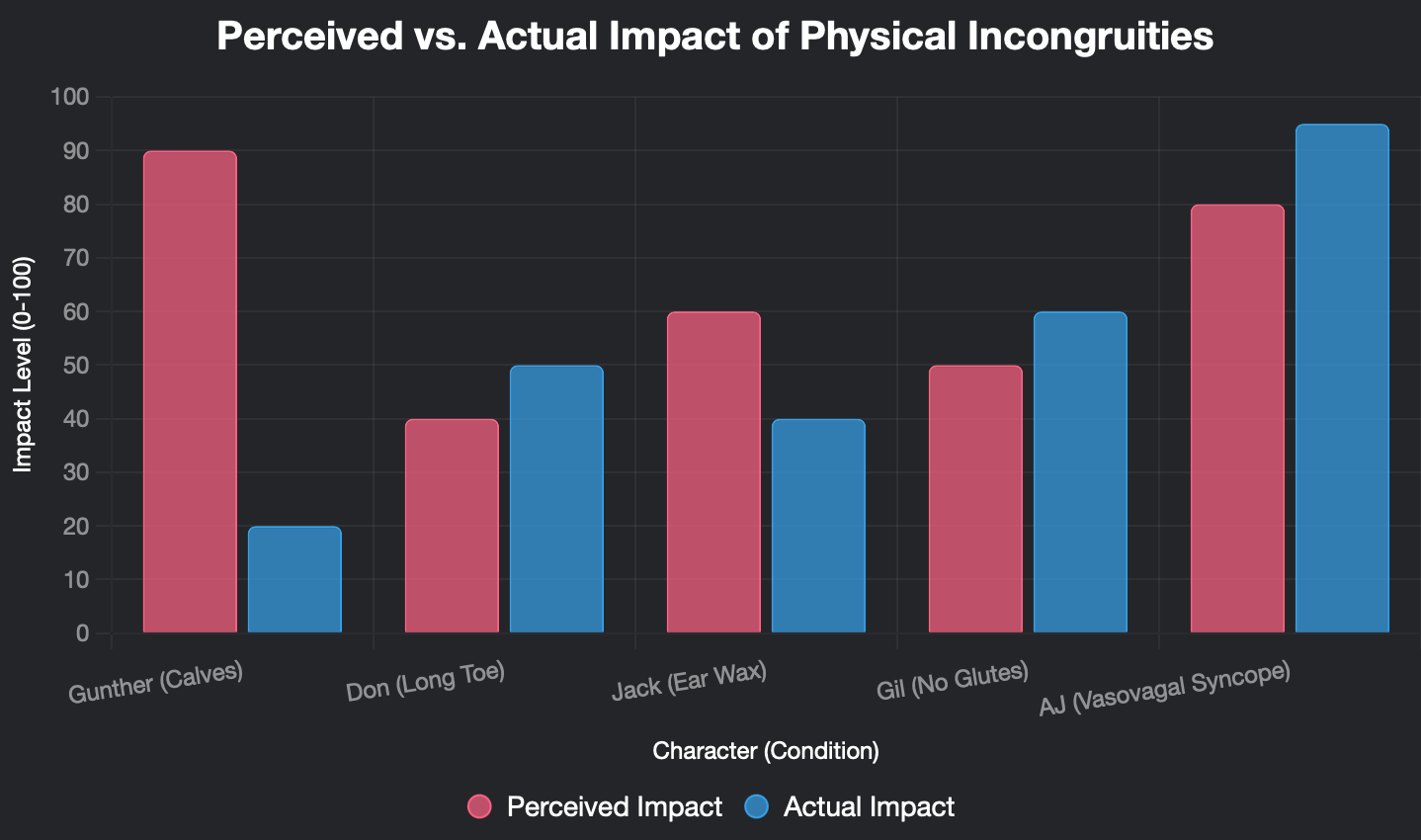
“AJ said it was an in-depth, detail-oriented discussion,” the man informed us, but that didn’t help us understand the matter any better. After working through the particulars of this discussion, we immediately thought about Gunther “the gym rat”, and how Gunther and AJ represented two ends of the spectrum of physical incongruities and their impact on personal happiness. Gunther chose to see an inadequacy that few would notice while failing to recognize the privilege of his otherwise healthy and fully-functional body. He chose to believe that it was “unfair” that he had such “puny calves”. AJ’s story, on the other hand, illustrates true unfairness: a random, obscure condition that upended his life in an instant. Gunther’s fixation is a choice to dwell on an issue most of us consider a non-issue, whereas AJ had no choice in the face of his medical condition. This contrast critiques Gunther’s lack of gratitude and perspective, suggesting that his pursuit of superficial congruence blinds him to the broader, more meaningful aspects of happiness—like the ability to walk, drive, or live without chronic pain. In that light, AJ’s tragedy illustrates the absurdity of Gunther’s self-imposed suffering, framing it as a cautionary tale about the dangers of obsessing over minor flaws at the expense of appreciating one’s overall well-being.

***

Some of us have knee-jerk, impulsive reactions to tales of the incongruent. “They’re weak!” some say. “How can a man survive, or thrive, if he cannot maintain consciousness during a discussion of blood?” Others react with sympathy and/or a sense of appreciation. Some might say that they’re put here, in our lives, to help us gain a renewed sense of appreciation for the idea of physical and mental congruence that we should cherish. 

We rarely think about how our relative levels of congruence produces happiness, until we meet the incongruent. An enlarged heart, prostate, shrunken kidneys, or brain atrophy are more common incongruences that elicit sympathy, but how much sympathy do we have for a man with an elongated toe? If a man was dumb enough to complain about a lack of gluteal muscles, and he did so in manner that suggested he was upset about it, would we be able to restrain our laughter long enough to express sympathy?

“The man can’t sit in most chairs comfortably,” we say to scorn those who cannot control their impulses. “And he experiences chronic back pain as a result.” It’s funny, and it’s not, because most of us don’t consider sitting in a chair or walking on a sidewalk without discomfort one of the luxuries of life, until we have our perspective altered. 

If we hear the terms congruent and incongruent, we often hear them in relation to social, psychological, physiological, philosophical, and spiritual concerns. We rarely talk about the physical, because it just feels so superficial. With all the problems in the world, both in general, and those we learn others experience, it almost feels narcissistic and trivial to complain about an apparent lack of buttocks, an elongated toe, or excessive wax build up. Yet, if we can’t walk or sit without some discomfort, it can affect our quality of life.

When we give thanks for all that we have, we often include good health, but we don’t really mean it. We say it, because that’s just something good people say. A part of us knows that good health can be fleeting, but it’s difficult to appreciate good health, or the incredible machine we have running life for us, until we hear others’ stories. We normally only appreciate such functions when we recover from deficiencies, pain, or some form of tragedy, but when we hear stories of poor health as a result of some odd physical incongruity, it renews our appreciation for even minor functions we currently have operating in peak form, because we know they’re not going to last forever.

The Chosen Ones? Jordan, Einstein, and “The Babe” Defy the Myths


Genius Chronicle: April 30, 1992, game three of the first round of the Eastern Conference’s playoffs, and Michael Jordan is nearly trapped in the corner of the three-point arc by Kiki Vandeweghe and John Starks. Jordan moves left and Kiki Vandeweghe drops off. Starks then baits Jordan into a trap, leading him into one of the most feared defenders in the NBA, Charles Oakley. Seeing those two Knicks narrow in for a trap into the corner would’ve led 99% of the NBA brightest stars to pass the ball. Jordan gambled. He faked left, and Starks fell for it, almost literally falling to the Madison Square Garden floor. Jordan then tucked under Oakley to take advantage of a sliver of real estate that existed between Oakley and the baseline. He straddled that baseline and dunked on arguably the most feared defender in the game at the time, future Hall of Fame inductee Patrick Ewing. If this wasn’t one of the greatest plays in NBA history, it might’ve been one of the most memorable. Jordan himself claimed it was his personal favorite dunk. Some said it was “Michael being Michael.”

Michael wouldn’t have been able to accomplish that play, against those guys, without incredible natural abilities. Yet, how many NBA stars, past and present, have been blessed with similar abilities? Jordan fans would say no one, but what separated Jordan from his peers was his ability to achieve the spectacular and the comparatively routine. He did both so well, so often, that he helped the Bulls achieve a 65.9% winning percentage in the regular season and a 66.5% in the playoffs, and six NBA Championships. Those of us who marvel at highlight reels often forget about that other half. Yet, a Michael Jordan, an Albert Einstein, or any of the geniuses of physical and cerebral accomplishment couldn’t have accomplished half of what they did without outworking their peers.

Genius Chronicle: June 30, 1905, Albert Einstein drops the first of four major contributions to the foundation of modern physics special relativity (later expanded into general relativity). The other major contributions included the photoelectric effect, and Brownian motion. In doing so, he helped fundamentally transform physics by redefining space, time, gravity, quantum theory, and atomic behavior, shaping modern theoretical and applied physics. Those who knew Einstein probably marveled at Einstein’s findings, but others probably said, “That’s just Albert being Albert.”

A line like that sounds like a compliment. It sounds like we’re saying that they’re so talented that they make the miraculous appear mundane, and we just came to expect that from them in their prime. Yet, I consider such lines reductive, because they fail to recognize their struggle to get to the point that their continued greatness was just “them being them”.

Dealing with Failure

Those who drop the “Michael being Michael” line should know that Michael Jordan wasn’t always Air Jordan, or Black Jesus, as some called him. He was cut from the Laney High varsity team as a fifteen-year-old sophomore, due to his height (5’10” at the time), his physical immaturity, and his lack of experience. Yet, how many fifteen-year-old sophomores make the varsity team? Prodigies do, and Michael Jordan thought he was just that. The coach, Clifton “Pop” Herring, later said he spotted Jordan’s potential, but that he didn’t believe the fifteen-year-old was ready to face varsity level competition. Herring basically told Jordan, he wasn’t a prodigy, not yet, and that crushed Jordan. He was so crushed that according to Roland Lazenby’s Michael Jordan: The Life by Roland Lazenby, Jordan kept that publicly posted tryout list as motivation. The young Jordan obviously sulked about it, but then he went to work. Over the decades that followed, Jordan developed a relentless work ethic that he double downed on anytime he experienced defeat.

“I’ve missed more than 9,000 shots in my career [12,345 regular season and 2,309 post-season for a total of 14,954],” Michael Jordan is famously quoted as saying, “I’ve lost almost 300 games [380 regular season and 60 in the post season]. 26 times I’ve been trusted to take the game-winning shot and missed.” This number, twenty-six, is the best-known estimate, attributed to Jordan himself, but it’s not independently verified by modern statistical databases. It likely includes shots to tie or win games in the final seconds of the fourth quarter or overtime, across both regular season and postseason. Bleacher Report estimated Jordan’s clutch postseason shooting percentage at 50% (8 of 16 attempts through his first 16 clutch shots), but this doesn’t specify total misses.

Einstein was asked to leave his school at fifteen. The school’s administrators informed Einstein, “Your presence in the class destroys the respect of the others.” He failed an entrance exam at Swiss Federal Polytechnic, and then he struggled to find work postgraduation, leading him to experience some level of poverty firsthand. His initial attempts at academic recognition fell flat when all of his early papers were either ignored or rejected, as his peers deemed his work unremarkable. Yet, how many young scientists, with no connections, are accepted into the scientific community in their initial attempts? Prodigies, or the “chosen ones” who can remove the proverbial Sword in the Stone are. Like Jordan, the idealistic, young Einstein knew he was destined for greatness, but no one else did. They were both faces in a crowd of idealistic young people who knew they were destined for greatness. 

When we read such stories about geniuses, we can’t help but think of ourselves as faces in that crowd. We thought we were destined for greatness when we were young, and it would’ve meant so much to us to be recognized as the geniuses we were, back then. Is that irrational, considering that we probably didn’t have the remarkable talent we thought we did, and if we did have any talent, we didn’t put in the work necessary to hone it? It is, but we were young, idealistic, and a little delusional back then. When we attempted to remove the proverbial sword from the stone, we realized that we weren’t “the chosen one”. Learning this hurts, but the notion that we are a lot more common than we ever thought stings. Even when it was obvious to everyone around us that we weren’t ready, we resented the guardians at the gate for not recognizing our genius. We became bitter, and we sulked. I don’t care what any eventual recognized geniuses say, they sulked too, and then they achieved greatness by using that rejection as fuel to prove their detractors wrong. Most of them had no shortcuts through nepotism, or anything else to ease their rise, and their only recourse was to just work harder than the similarly gifted.

Dealing with Rewards

The question those of us who will never be invited into the historical halls of greatness would love to know is, was your eventual, hard-won invitation just as meaningful as it would’ve been when you were an idealistic, and perhaps a little delusional, young teen? We’ve all been taught to think that success is the reward for hard work, but how much hard work is too much? When we devote so much of our time and energy to achieving greatness, sometimes we sacrifice the ability to develop normal, human relationships, we might accidentally ignore family members, and we could employ a level of tunnel vision that effectively ruins what could’ve otherwise been a happy life. Is that moment of acceptance as euphoric as we think it would be, or is it almost, in way that’s “tough to describe” anti-climactic?

Our knee-jerk response is that instant recognition would’ve stunted their growth, and the great ones probably wouldn’t be as great if bitterness, resentment, and all that inner turmoil didn’t fuel their drive. Yet, we can also imagine that there had to be some measure of “Where were you when this really would’ve meant so much more to me?” involved in their acceptance.

Michael Jordan hugged and cried on the Larry O’Brien Award the first time he won it, but those in his inner circle say that his almost ingrained sense of bitterness and resentment drove him to win five more. This bitterness and resentment could also be heard after his retirement, in his Hall of Fame induction speech.

Einstein harbored a similar sense of “smoldering resentment” toward the gatekeepers who dismissed him. In a 1901 letter to his sister, he wrote of “fools” in academia who favored conformity over originality, implying that if they weren’t so rigid he wouldn’t have had to work so hard to gain acceptance. The two of them both had chips almost biologically attached to their shoulders throughout their lives, and we can speculate that they may not have achieved half of what they did if they weren’t rejected early. They both used those early rejections to fuel their inner fire to prove their respective communities were wrong about them, but even when they did, my guess is it didn’t remove the pain of those early rejections.

The Supernatural, Natural Abilities

We’ve since limited the idea that Einstein was a genius as Einstein being a genius, as if he didn’t achieve that status. He was just different, so different he may have been a slightly different creature. We’ve studied his brain to see why he was so much smarter than everyone else, to see why he was so different that he was special or supernatural. We discovered that his brain had what they called “a unique morphology, and abnormal Sylvius Fissure, increased glial cells.” We also found that his brain “was actually smaller than average (1,230 grams vs. typical 1,400 grams), contradicting the assumption that larger brains equate to higher intelligence.” Even though speculative estimates suggest less than 1% of the population might have neurological enhancements comparable to Einstein’s, based on neurodiversity research, I still find it reductive to limit his incredible accomplishments with the idea that he had an unusually efficient brain. Why can’t we just say that all of his findings could’ve been the result of a lifetime of intense research into general and specific areas of physics? Why can’t we say that he spent so much time studying physics, persevering through the failures inherent in trial and error that he ended up developing some incredibly creative theories? Why can’t we say while he may have been biologically predisposed to intellectually brilliant findings, many others had the same cranial gifts, and they didn’t do anything anywhere close to what Albert Einstein did with these advantages. Why can’t we just say he worked harder, and more often than his peers?

We know there was nothing supernatural about what Einstein or Jordan did, but it’s just not very interesting to talk about all the hard work they put into it. We’re interested in the origins of genius, and we’re interested in the results, but everything in between is the yada, yada, yada portion of that discussion. We’d rather ask “How did they do that?” than learn about how they actually did it. It’s far more entertaining to think in terms of a “natural talent fallacy” or a “the genius myth” than breakdown the hundreds of hours they spent in a gym, or in a lab, honing their ability, or dedicating so much of their mind and energy to their profession, or craft, that when they happened to be “around”, they probably weren’t much fun to be around.

The Babe

George Herman Ruth (AKA “The Bambino,” “The Sultan of Swat”, or “The Babe”) may have been the opposite of Einstein and Jordan in that he appeared to enjoy every step of his gradual ascension to greatness. The Babe didn’t face the same substantial levels of rejection Einstein and Jordan did, but that may have been due to the fact that The Babe never felt entitled to it. I don’t think anyone would accuse Jordan or Einstein of being entitled, but whatever vagaries we apply to the term entitled in these cases, The Babe was the opposite when he was but a babe.

Babe Ruth was born into poverty, in a rough working-class neighborhood well known for crime and violence. His parents were hard-drinking saloon owners, who provided their son a chaotic, unstable, and troubled environment that led him to commit petty crimes and truancy. His overwhelmed parents sent to a St. Mary’s Industrial School for Boys, a reformatory school. While attending this school, a Brother Matthias taught him baseball, but Ruth’s talent was confined to the school’s teams, unseen by wider audiences. Students of St. Mary’s were not expressly forbidden from playing in youth baseball leagues, but his confinement to the school’s isolated campus and strict schedule prevented participation in other organized, external leagues. Thus, while Ruth excelled, he toiled in obscurity, playing on St. Mary’s team.

Ruth’s luck changed when an owner/manager of the then minor league team the Baltimore Orioles, Jack Dunn, just happened to spot The Babe’s talent in 1914, and by 1916 he was a twenty-game winning pitcher for the Boston Red Sox who pitched a one-run, fourteen inning complete game (still a World Series record) to help the Red Sox win the World Series. Every talent has his or her story on the rise to fame, and they’re littered with personal motivations, including others seeing their raw talent that needed development and those who underestimated how talented they were, but compared to Einstein and Jordan, Ruth’s rise to fame was relatively quick and smooth.  

Based on Ruth’s upbringing, we can only speculate that he didn’t view rejection in the same way an Einstein or a Jordan would. Prior to being “discovered” Ruth likely viewed himself as nothing more than a poor, dumb, reform school kid. As such, we can guess that Ruth didn’t have the social awareness or the levels of expectation they did. As a poor, dumb, reform school kid, The Babe probably viewed anyone giving him a chance, someone paying him to play baseball, and all of his numerous accomplishments thereafter as gravy. In his autobiography, The Babe Ruth Story (1948), he describes his St. Mary’s days fondly, focusing on baseball and Brother Matthias’ mentorship, not on being overlooked. His 1914 minor league struggles (doubts about his discipline) were met with defiance, not despair, per teammates’ accounts. Therefore, we can say that bitterness and resentment never drove The Babe to accomplish rare feats in the beginning, or throughout his illustrious career, but something unusual drove him on the tail end, the very tail end, of his baseball career.

Genius Chronicle: May 25, 1935, George Herman Ruth is five days away from retirement. Did The Babe know 1935 would be his last season? He may not have at the beginning of the year, but his performance was so bad (he hit .181 that year, with thirteen runs batted in, and most importantly, only three home runs prior to 5/25/1935), and his 1935 Boston Braves were so awful, and that he knew. By the time he stepped to the plate in 5/25/1935, the accumulation of twenty-two years, and 2,503 games, of Major League Baseball play were also catching up to him, as his knees were so bad that he ended up only playing 28 games for a team that didn’t even know the definition of the words in-contention. He probably spent the 1935 season depressed with the knowledge that the natural talents, the grit, perseverance, and everything that made the man who changed the game into what he know today, were all gone. He was a shell of his former self, and he was only forty-years-old, relatively young for the average human but ancient for an athlete, particularly in his era.

Even with all that George Herman Ruth stepped to the plate on May 25, 1935, against the Pittsburgh Pirates. The Pirate pitchers he faced were “respectable but not dominant”. The days when Ruth dominated headlines were long-since passed, and I’d be willing to bet that most casual baseball fans probably didn’t know Ruth was still playing by this date. This was probably best reflected by the attendance of Forbes Field that day, was a mere 10,000 attended a game in which Babe Ruth played in a 25,000-seat capacity. Few wanted to see a man many considered one of the greatest to ever play the game of baseball, because it’s always sad to watch a broken-down, old horse gallop around the track in his final days. How many of them regretted that decision afterwards when they learned that Babe Ruth managed to put everything that made George Herman Ruth “The Babe” one final time, and in one final blaze of glory by hitting three home runs, which just happened to be the 712th, 713th, and 714th of his storied career.

Hitting three home runs in a game is still a remarkable feat for any Major League Baseball player, but at the point when Ruth did it, professional baseball was roughly sixty-five years old, and this feat had only been accomplished seventeen times by thirteen different players, including Ruth, who only accomplished it twice before in his lengthy and storied list of home runs. Ruth would go onto only have five more at-bats in the five games left in the season, before he retired. This entry is included in this article because Babe Ruth was often called the “Most naturally talented athlete of his generation.” Fans and players alike appreciated his talent and domination of the game of baseball, but there had to be some temptation to reduce his natural talents as supernatural, as if he  just picked up a bat on a Thursday and by Friday he basically invented the home run that we all celebrate today. Some fans probably marveled at the fact that this celebrated athlete put it all together in one final blaze of glory, but others probably laughed and reduced it to “The Babe being The Babe”.  It’s just kind of what we just do. It’s human nature.

Even with all the information we have about the rise of Jordan, Einstein, and The Babe, we still attach this The Sword in the Stone characterization to them, because we love the idea of superheroes. The three of them may have been blessed with superior natural abilities, but they weren’t supernatural abilities. Yet, belief in the latter permits us to worship them, and it gives us comfort to think “they’re just different”. We prefer to avoid thinking about all the “yada, yada, yada” of true grit, unusual levels of perseverance, and all of the work they put into honing their abilities. We prefer to focus on “natural talent fallacies” and the “genius myth” that suggests their Creator was so generous with them and comparatively stingy with us when it came to dispersing talent. I have news for you brothers and sisters, the idea of a chosen one being the only one able to remove the sword from the stone is a fictional tale, and there’s no such thing as a chosen one. Gifts require honing, dedication to craft, and a level of tunnel vision that would lead many of us to grow so bored with the mind-numbing hours of practice and work these men put in. We also wouldn’t be able to deal momentary, temporary embarrassment that arrives with the level of failure they dealt with under the scrutiny of white, hot lights. Those of us who admire these geniuses from afar often characterize them as the chosen ones, and ourselves as the character Sir Kay of that book, who attempted to pull the sword and failed, because it gives us comfort to think if we were as blessed as they were, we would do the same. It’s a compliment that we deem them different, of course, but it’s also uninformed and reductive.

To my mind, the greater details of the stories of Jordan, Einstein, and Ruth remind us that greatness and genius aren’t a gift bestowed at birth, but a fire forged through rejection, toil, and unrelenting drive. From Jordan’s high school cut to Einstein’s academic snubs and Ruth’s reform school obscurity, their triumphs—whether a baseline dunk, a revolutionary theory, or a final three-homer blaze—were built on the ashes of doubt. We marvel at their highlights, but their true legacy lies in the unseen hours of grit, proving that greatness belongs to those who dig deep enough to find that elusive “other layer” so often that we develop creative theories about how it’s all so unfair.

“It’s Hell Getting Old”


“It’s hell getting old,” was my dad’s answer to questions about how he was doing. “How you doing Hank?” they would ask. “It’s hell getting old.” He wasn’t trying to be funny, and he wasn’t changing the subject. He believed this was the answer to questions about his well-being. If age is a state of mind, my dad was old his whole life, or at least as long as I knew him. He was old in his eighties, but I remember him saying, “It’s hell getting old,” in his forties. We believed him too, because we were kids, and anyone who is older is old when you’re a kid. This response was the end of the discussion for him. It was his ‘learn it, live it, love it’ meaning of life. If he wrote an autobiography, he would’ve titled it It’s Hell Getting Old. 

I met a person his age, later, and she was quick, fiery, and alive. She was the type you just knew wouldnt be put down for eons. When we broke down the borders of our co-worker relationship and became friends, I violated the rules of social decorum and asked her how old she was. When she told me that she was the same age as my dad, I was stunned. How could she act so young? When I gained a different perspective, as I neared my fifties, I realized the forties aren’t hell or even old, and I asked him about it. “Well it’s hell now,” he said, in his eighties.

Friends and family were sympathetic to my dad’s “It’s hell getting old!” rants … in his eighties. They would nod, sympathize, and back up and give him the room necessary to develop his rant. I write the word develop, because he talked about his advanced age so often that it almost seemed like he was working out material for an act. He’d repeat lines and phrases so often that I could say them with him, as he delivered them to friends and relatives. I heard him provide different emphasis and strategic subtlety to his pleas, over the years, and I heard him employ different ways and means of convincing them of his plight. I don’t think there was anything artificial about my dad’s pitch, as I know he believed every word of it, but he did get better at it after practicing this presentation over the course of forty years.

When I told he might be able to defy the aging process, by some measure, with physical exercise, he dismissed me before I could finish the sentence. “I own a weight set,” he would say.

“I know you own it, Dad, but you have to use it.”

“Ok, Mr. Smarty Pants.” He often switched between Mr. Smarty Pants and wise guy to anyone stating the obvious, but no matter what he called us, he always concluded his argument with something about his age. “Old people aren’t supposed to work out with weights.”

“How about a walk then?” we said, and he silently gave us some points here, but what does a person do on a walk? My dad walked when he had a specific destination in mind. The idea of walking just to walk seemed dumb to him. What if someone saw him doing it? “Where you heading Hank?” 

“Nowhere. Just walking for the exercise.” My dad would never subject himself to such a revealing and vulnerable Q&A. 

Some cherish their youth, and the telltale signs that it’s slipping away freak them out. Some of us look forward to getting old, because while we know that while the physical side will falter, greater levels of clarity, sanity, and stability await us on the other side. I suspect my dad couldn’t wait to get old for all of those reasons, but he also knew that getting old grants one the freedom to talk about their “gross” and “funny” bodily functions without being called out for violating societal norms. When my dad would attempt to enjoy his newfound freedom, over the course of forty years, with our friends and family, we would try to rein him in. “No one wants to hear about your bodily functions.”

“Oh, grow up!” he’d say.

***

“What comes out of the rectum can be used an indicator of health, but it’s not the indicator,” I said when he provided me a particularly detailed update on the state of his health. “It shouldn’t be used in place of a handheld pulse oximeter, an ECG monitor, or a glucose monitoring device.” Unless his daughter-in-law, a nurse, administered these in-home tests, the devices his doctor sent home with him were never used. My dad thought that what came out of the rectum was a better indicator of health than all of those medical devices combined. Either that or he just enjoyed talking about them.

Knowing that his diet consisted of baked beans, Oscar Mayer Bologna, butter brickle ice cream, and Swanson’s Mexican TV dinners, it was no surprise to us that he began to face gastrointestinal issues, but knowing inevitability doesn’t make hearing about it any easier. 

“How you doing today Dad?”

“It was like pounding concrete today.” That was his favorite analogy. He’d replace the word “concrete” with “bricks” at times, just to keep it fresh. I don’t know where he picked it up, or what it meant, but I didn’t waste any calories trying to uncover the true meaning of his analogy. I understood what I needed, and more than I wanted.

My dad was a former military man who spent most of his life in a factory. I write that to note that he didn’t waste his time or effort in life on creative pursuits. Creative descriptions of his daily doody, to my knowledge, were his only forays into artistic expression, and he displayed such a rich, provocative vocabulary in this arena that the imagery was almost impossible to block. I write almost impossible, because my mind has chosen to forget the trauma of many of his vivid descriptions, but the “pounding of concrete” stubbornly clings to a place to my soft tissue. I thought of jackhammers destroying concrete.

When we hear people talk about jackhammers destroying concrete, or bricks, in an analogy to what happened that day in their alimentary canal, we might say, “I didn’t know whether to laugh or cry.” We say such things, some of the times, because we hear others use it to describe their uncomfortable moments of confusion. There are moments when we mean it. I saw this on the faces of those who heard Dad’s prognosis of the day. Few cried, of course, though I suspect that some of the third parties he and I sat with in diners may have considered it to try to get him to stop. I stepped in to solve their dilemma by saying, “Dad, that’s gross.” I’m quite sure he wanted to tell me to grow up, but whatever he saw on our third party’s face told him they agreed. Our third party companions didn’t know him like I did, of course, so they’d laugh uncomfortably. I suspect that they laughed, because they enjoyed our father-son interplay, and they might have falsely believed that he was tweaking me in some way for their entertainment. 

He tried his hand at more conventional ways of entertaining people, and it didnt go well, but those of us who struggle in this arena learned a lot about what not to do from him. That isn’t to say that he wasn’t entertaining, because he was one of the funniest people I’ve ever met, unintentionally and in his natural state. Friends and family found him just as entertaining as we did, and we flirted with taking our show on the road, but we knew it would be impossible for him to maintain a natural state. Anytime he thought he was funny or entertaining, he put forth effort, and he subsequently lost his audience. Smiles turned to confusion and confusion turned to polite laughter when they saw how hard he was trying.

The difference between an occasionally humorous person and an entertaining person is complicated and multi-faceted. One way to achieve short-term laughs is to repeat a joke. Achieving the vaunted title “entertaining”, requires the subject to know what everyone else knows so well that it challenges our understanding, our foundation, and everything we believe in. It requires us to examine ourselves, others, and others’ views of us so well that we briefly imagine an alternative universe if just for the moment it takes us to find laughter. We could even say that attempting to be entertaining asks us to be a little phony for as long as it takes to get a laugh. We might have certain beliefs, certain hard-core, concretized beliefs, but its considered entertaining to let our hair down and analyze from a partially fictitious, self-deprecating angle to challenge those beliefs.  

My dad was many things, but he was not phony. I’m not sure if he had that code in his DNA necessary to be a little phony even on those rare occasions when he probably should’ve been. If he did have the code the rest of the human population does, he didn’t use it often enough to hone its capabilities. I called him many awful, mean, and regrettable things in my tumultuous teens, but phony was not one of them. If one of my friends suggested that I might want to try the name out on him, I wouldve rejected them. He was a man of simple truths that he developed in life, and he could not waver on them, even to poke holes in them for comedic effect. 

He spent his whole life believing he was inferior, and he might have done some things in life to prove that he was not, but my definition of phony involves someone who acts in an artificial manner to convince others that he is superior. To those who stubbornly insist that the term phony refers to someone who tries to be something they’re not, then perhaps he acted in artificial ways in some instances, but my dad did everything he could to fit in so he didn’t stand out. 

When he got older and sicker, I suggested I interview him to provide his legacy a transcript. I suggested that his young nephews might never know who he was otherwise. He rejected me saying, “When I die, I want to be forgotten.” It’s illustrative, a little funny, and very frustrating to those of us who wanted others to remember him, but it’s not phony. Try to dissect that sentence for a trace of phoniness. To me, that sounds like a genuinely strange character who felt he was not fit for our world. 

He was a fundamentally flawed human being, stubborn, and one of the weirdest human beings I’ve ever met, but he did not put on airs to impress anyone. Anyone who suggests otherwise need only look to the shoes and socks he wore in life. They were not what a man, built to impress, wears.

*** 

“I don’t understand how you and your brother view the world so clearly,” he once said. “It’s always been so cloudy to me.” He was skeptical to the point of denigrating, regarding his abilities in life. Driving, for example, was such an “awful responsibility” to him. In many instances, Dad talked about the difficulties of life, the “horrible responsibilities” the “accountabilities” and the “misery of life” that he said we’d fully understand once we became responsible adults who were responsible for others. Some of it involved lessons he used to lift our eyebrows and prepare us for the “awful responsibilities” that awaited us, but the anxiety he experienced while driving was very real to him. 

We couldn’t play turn on his car stereo, for example, because that would’ve distracted him from his concentration on the road before him. We could talk and stuff, on most trips, but we didn’t have to “get so carried away” with it. If we laughed too hard, he put the kybosh on that, because it diverted his attention from the road too much. He didn’t care for uproarious laughter, in general, because he thought it made the laugher look foolish. 

Whenever we tried to divert him from 90-degree angled driving, my dad rejected that outright, as he feared he wouldn’t make it to our proposed destination. “You could take A street to 130th and take a right, but if you take Stonybrook, it cuts straight through.” Dad did not care for bisecting an angle. He was a tried and true 90-degree man. 

“We could get lost,” he said with tones that asked us to appreciate his predilection. We didn’t. “We could get so lost that we don’t know where we are,” he added in a fearful tone that suggested there is a point of getting lost that could lead a traveler to never being able to return to the existence they once knew. We didn’t understand the severity of our dad’s anxiety, until someone relayed a story to us of Dad being so lost one time that one of his commanders informed him that his actions could’ve started World War III.  

He was in charge of the map for a tank battalion. We all suspect that one of the great attributes of a military’s boot camp is to determine a soldier’s strengths and weaknesses. Why else would the military put a person through six weeks of intense physical and mental challenges. They want to see what we’re made of, and they want to how they can use our natural talents and gifts. How the military could put a man who lived his whole life in one city and didn’t know his way around it, in charge of leading a tank battalion with a map challenges my perception of the men in charge of the military at the time. Whatever the case, they obviously didn’t know my dad’s preference for neat and tidy 90-degree turns, because they put him in a position to fail, and fail he did. He led the tank battalion into enemy space, Russian enemy space, and he could’ve, in the words of his sergeant, started WWIII. 

I didn’t know any of that as a kid, of course, but I knew that the only time I saw my parents’ fights devolve to screaming matches occurred soon after the map was unfolded. Thanks to GPS apps, I no longer experience the deep seated anxiety I used to when someone pulled a map out. 

The first time I saw Shrek I enjoyed it with a strange sense of familiarity that I couldn’t put my finger on. Shrek was a lovable loser with huge ears, a large belly, and he could be unintentionally and habitually gross in ways he didn’t understand, because he spent too much time in solitude. Shrek also had a strange yet simple philosophy of life that could prove humorously wise at times. I couldn’t shake the sense of familiarity during the movie, and I couldn’t pinpoint it for many years, until someone said, “Shrek’s your dad.” I didn’t laugh, and I found it a little insulting at the time, but when I watched the movie again, in that frame, I realized that the writers of Shrek might owe my dad a  royalty for at least some tangential influence.