The Other Side of Talent


“He has a talent,” one person said of another. “I don’t know what it is,” she furthered, “but he has a real knack for taking photos.” The subject of that compliment beamed in the aftermath. The compliment was vague, but she used the ‘T’ word, and very few can avoid the gush that follows having a ‘T’ word thrown at them.

It was a nice photo (not the one pictured here), but the ‘T’ word? The compliment suggested that this photo was but one of a long line of photos that you had to see to believe, but it was still just a photo.

Most of us reserve our use of the ‘T’ word for athletic and artistic accomplishments, but we know that many use it in broad terms. We know, for example, that an engineer can display a wide array of talents for his craft that others may not have, but we often say that that person is good at what he does, a master craftsman, or expertly skilled, but the use of the word talent is not often used in conjunction with most skills.

Some could say that a grown man’s ability to outdo his young peers in a game of hopscotch is a display of talent, but most fellow adults watching this man hop from square to square would suggest that he should consider finding a more constructive use of his abilities, if he wants others to consider him a talent.

Merriam-Webster defines talent as “a special ability that allows someone to do something well.”

Philosopher Ayn Rand steadfastly refused to recognize photography as art, but she did concede that it requires a skill, a technical skill, as opposed to a creative one.

We all know that definitions, such as these, can be broad, but most of us have personal definitions that fall on stricter lines. If the definition of talent is as broad as Merriam-Webster described, and photography requires some technical skill, then we should concede that taking a quality photograph does require some talent. One could also say that a talented photographer uses discretion and selectivity when he selects his shot, but could this ability to capture a moment be nothing more than a right place, right time decision? Some of them don’t even display that. They take ten to twenty photos and display the perfect one.

If one takes a hundred different photographs, and only one of them is of an exceptional quality, is that a display of the photographer’s skill? Yes it is, in a broad sense of the term. If that’s the case, we could say that if a man takes a hundred free throws and only makes one, he has a talent for shooting free throws, if that one free throw is so perfect that it barely touches the net.

If a photographer purchases a top of the line camera, and he uses the best photo-enhancing software available to produce evidence of his prowess, and he lays that photo down on a table next to the photo of another taken with a disposable Walmart camera, and no enhancements are permitted, does his superior photo reveal God-given talent on his part, or does it contribute to the lie that a skilled, talented photographer is artistically talented?

The Truly Talented

We’ve all witnessed the effect truly talented people can have on a room, and this effect often makes us a little sick. “He’s just a human being for God’s sakes!” is one of the snarky, coping mechanisms we’ve developed for dealing with “the gush” to adore the talented.

The adoration of talent varies with the skill required to accomplish the feat, of course, but if you’ve ever met a truly gifted people, you know that most of them are not interested in being better today than they were yesterday. Most of them enjoy the potential they have to be better more than they do the work involved in becoming better. “We’re talking about practice!”

Those that become obsessed with being better, and enjoy the benefits the rigors of practice can produce, often end up having their names etched into something by the time they’re finished. These few don’t necessarily bathe in adulation, they focus on one on one battles. When they get beat, and everyone gets beat, they do things that the overwhelming majority of us avoid to get better. For the overwhelming majority, sports, artistic endeavors, and all the venues that require talent involve moments. The talented enjoy those moments for what they are, when they happen, but the people who will have their names etched into something take it home with them. For these people, their talent is but a starting point and a gift that they end up honing to perfection, but even for these people talent can be a curse and a burden, and it can lead to acceptance, love, worship, and being scrutinized, ostracized, hated, and ridiculed. The idea of their talent, i.e. their potential, can also haunt them when they encounter its limitations.

An edition of 30 for 30 called Of Miracles and Men portrayed the other side of talent. It depicted the other side of the Miracle on Ice story that we all know of a ragtag group of American amateurs defeating the most talented Russian hockey team ever assembled. Some would argue that this Russian team might have been the greatest assemblage of hockey players ever to tie skates on their feet. This team had already won four Olympic gold medals in hockey, by the time they took to the ice against this American team, and some of them would go onto win a fifth after the 1980 defeat. To hear this group of talented men speak of their careers, the 1980 loss to a group of American amateurs, in a medal round, sits in their system like a kidney stone that will never pass. This Russian team beat an assemblage of Canada’s best that included probably the greatest hockey player that ever lived Wayne Gretzky. They also beat the 1980 American team in a match that preceded the 1980 medal round upset, and those two matches were not even close. This team was so dominant that they could not be beat, until they were.

Some would think that such an historic upset might serve to highlight the Russian team’s greatness, if one could say that one defeat in the midst of a record of total annihilation is a blip in the overall dominance this team displayed over the hockey world for two decades. Listening to these men speak, however, the listener gets a taste for the other side of talent when the only story anyone wants to hear from them involves the one time they didn’t succeed, and how that has haunted them since.

The point one could take from this 30 for 30 episode is that these men spent an excruciating amount of hours of their young lives in cold, dank gyms honing their God-given gifts, trying to improve on the smallest details of the game, only to fall to a bunch of ragtag Americans that may not have spent one-fifths the amount of time honing their gifts. Even with five gold medals (including the 1984 Olympics), the only thing we want to talk to them about is that one match they failed to win thirty-five years ago.

If you’re acknowledged as the most talented person anyone you know has ever met, and the only thing anyone wants to discuss is the one time you failed, why would you want to raise their expectations? Why would you want to endure the marathon practice sessions that focused on the minutiae your coach informed was going to be vital when you encountered the wall of your God-given abilities? Why would you want to invest more of your life becoming better at something other people hate you for being so good at? We’re talking about desire here.

We’re talking about the desire to be better today, than you were yesterday. “We’re talking about practice!” We’re talking about preparing for that day, that every talented person experiences, when they meet their personal wall.

The wall, for those that have never read about it, involves going up against other people that were the most talented people anyone they know had ever met. It involves seeing what the gifted person is made of when they encounter the another person loaded with so much talent that talent is afterthought.

To read the former NFL quarterback Kurt Warner’s examination of the natural talents that fail to succeed on the NFL level, it’s about having a coach, or mentor, early on that recognizes the person’s talent level, and challenges them in a brutal, heartless manner, to reach within themselves to find various other methods of succeeding beyond the talent level they’ve always known. This heartless mentor also helps the talented person in question determine if they have the desire to succeed on a level they may not have even considered to that point.

The Less Than Talented

“My talent has always been, and will always be, and it should be written with a capital ‘P’!” –Your Potential once said.

What if your talent has never taken you the places you thought it would, but you’ve always known you had the potential you had to succeed. What if your talent lays somewhere between being as talented as anyone that you’ve ever met, and perhaps more, but that untapped potential to be more has always remained at a frustrating distance?

We spoke of ‘the wall’ that every recognized talent experiences, but there is another wall that can be more formidable: the wall of self-imposed expectations. The talented might encounter this wall in moments considered inconsequential to other participants, and observers, but to the person that has lived with the idea that they’ve always had the potential to succeed it is but another example of their ineptitude. Most of them do not know that this is the source of their frustration, or if they do, they won’t acknowledge it.

As the Kurt Warner story informs us, the primary difference between those who will succeed and those that won’t occurs soon after they experience adversity. Moments of adversity can be large and small, but they all reveal who we are, and who we are going to be.

A young Kurt Warner may have dealt with moments of adversity throughout his largely undocumented young life, but we can guess that none of them would compare to the adversity that the adult Kurt Warner would experience in his adult life. The most talented person in his area received so few scholarship offers that he ended up playing quarterback for the University of Northern Iowa. The NFL draft did not draft him, following that college career, and the only team that gave him a try-out, cut him before the season even started. He ended up stocking shelves for a supermarket chain. He then played quarterback in the Arena Football League, and he had a stint in NFL Europe before an injury to a starter allowed him to start for a NFL team and lead them to a Super Bowl victory. He was MVP of that Super Bowl and MVP for the season. That Super Bowl team cut him a couple seasons later, and he went onto play for another NFL team for a couple of unproductive seasons, and he ended up with a team that he, again, guided to the Super Bowl. After Kurt Warner’s career concluded, he was considered to be the best undrafted free agent to ever play the game.

Kurt Warner’s story is one of not living up to his self-imposed expectations. It’s a story of what he did after failing to succeed on many levels. (After leading the St. Louis Rams to a Super Bowl victory, then a Super Bowl loss, he ended up on a New York Giants team that gave up on him in favor of future Hall of Fame starter Eli Manning. Warner then led the Arizona Cardinals to the Super Bowl.) It’s a story that should be held out as an example to talented people, but for most of those that are more talented than anyone they’ve ever met, talent and work have always been a zero-sum game: The more talent one has, the less work they think they have to do.

Warner states that most coaches and mentors coach to the talent, and they let the talent do what they do well in a manner that the coach hopes will reflect the coach’s ability to harness talent. They coach for the next game. They coach to keep the talent happy.

If we’re talking about practice, however, one of a coach’s duties should be to put talented people in uncomfortable positions to reveal to them what they must do when talent alone may not be enough get them out of moments of adversity.

It also allows those talented people –that have always used their talent as a picket sign to avoid the rigors of practice– to learn how to finesse the minutiae of their abilities and hone their desire.

As anyone who has displayed an ability to do anything knows, there is always a ceiling, and when one hits their head on that ceiling it can be humbling and humiliating. Some of the times, it’s more rewarding to hide in a cloud of potential. Those of us considered lesser-thans don’t understand what it must feel like to have so many consider us a true talent, and we never will, and that can provide the talented a comfortable space between the reality of their talent and the potential we believe they might have.

If you’ve ever witnessed a display of YouTube-worthy temper tantrum in a bowling alley, on a miniature golf course, or at a softball field, and you’ve wondered why a person would attempt to gouge their own eye out after missing a two-foot putt, I can tell you –as a former wild temper tantrum thrower– that there’s something more to it than the idea that the ball doesn’t always go where we want it to go. We thought we spotted something at a very young age, we thought we were going to be a somebody, a contender, and the obnoxious five-pin that will not fall no matter what we do is not just a configuration of rock maple wood to us, it is the eye of fate staring at us, mocking us for not being able to fulfill the potential we thought we saw.

These eye-catching temper tantrums are borne of an inability to deal with even the most inconsequential moments of adversity, because we never had a heartless mentor who cared enough not to care that we were tired, that our feelings were hurt by something they said, or that we wanted to quit the game because “it’s just not fun anymore”. One could read this post, and think it’s all about sports, until they witness a guy who has no capacity for dealing with the obnoxious five-pins of life, and in the moment that captures his frustration in life for all to see, he does something to the ball return that causes parents to shield their kids’ eyes. For an overwhelming majority of those who would have their names etched into something by the time their career is over, their mentors would spend countless hours teaching them how to deal with such adversity, how to overcome walls –self-imposed and otherwise– and how to become successful people, and yes, talented photographers, I guess.

Football 101: Stratagies


“Why do they continue run the ball into the middle of the pile?” a friend of mine once asked after watching a running back crash into the line for a two-yard loss.  “If they are going to run, why don’t they run around the pile?”

As with any sports-related questions, the answer involves a number of variables, and specifics regarding the strengths and weaknesses of the respective players on the offense, from the abilities of the Running Back, to the ability of those on the offensive line to block for him.  The offense also has to gauge the speed and ability of the defenders to beat them to the corner. Long story short, the offense would love to run around the corner.  It would also love to gain a ton of yards up the middle.  Even if it doesn’t, however, a run up the middle serves a purpose.

350px-Linemen.svgIt may also sound elementary to suggest that the offense wants to have every single defensive player confused, but that is the purpose of the run up the middle.  For those that love chess, even an unsuccessful run up the middle can be the equivalent to sacrificing a pawn to get the opponent to move themselves into a weak position.

If the offense attempts to run up the middle often enough, it hopes to create enough confusion in the minds of the defensive backfield that they make an erroneous first step up and in to stop that run.  One erroneous step may be all that’s needed for the timing of the offense’s passing game.  Creating confusion in the minds of the all of the defense is important, of course, but it is crucial to the success of the offense that those players that are positioned in what is called the defensive backfield –the linebackers (LBs), the free safety (FS), and the Strong Safety (SS) in the diagram above– be confused.

The players in the defensive backfield are unblocked on the line of scrimmage and they have free reign as to how they are going to approach the next play.  If they are confused and they make an incorrect guess, holes in the defensive backfield will open up for the offense to exploit in the passing game.

The timing of most offenses require a successful running game, but even a less than successful running game can open up holes for a Quarterback to pass in, if the members of the defensive backfield are required to step up and in to assist the front four defenders (the defensive line) in their attempts to stop the run.  So, the next time your team continues to make futile attempts to run the ball into the middle of the pile, wait for the next play before you kick that hole in the wall.  If that Quarterback fakes the ball to the Running Back, (a play-action fake is what it’s called) and the Linebackers take a step up and in to stop that play, you’ll realize that the Offensive Coordinator (the coach that decides which plays the offense will run) made that previous call to set up this pass.  For when that Linebacker steps up and in to stop that running play from going into the middle again, he opens up a *hole behind him that the Quarterback will pass the ball in.  (*This hole is also called a lane and/or a window.)

The offense must keep the defense guessing whether the offense is going to run or pass.  You may hear a broadcaster refer to this as “keeping pressure on the defense” or “keeping the defense on their heels.”  They may also refer to the defense stepping up and in as “the defense cheating” or the defense “creeping”, and that the offense must have a better mix of run and pass to prevent that.

As a result, if an offense has a decent mix of running yards gained and passing yards gained, that team wins more often than not.  Some offenses don’t need a perfect mixture, but most of them need just enough to establish a threat of something different to keep the defense guessing.  Most of them will acknowledge that they are not going to achieve a perfect mix of yards gained, based on the defenses’ proficiency, or their own deficiencies, but they know that they will be required to have a number of attempts in one of these two strategies to establish the necessary threat.  It is for this reason, that you often see networks provide graphics that suggest when a Running Back attempts to run the ball a certain number of times (regardless the amount of yards he gains) the percentage of victory for that team is high.

The chess match of play calling, and alignment, will often bear fruit in those seconds that occur just before, and immediately after, the snap.  This is where you’ll hear the term “cheating” used most often.  If members of the defensive backfield step back in the moments before a ball is snapped, or immediately after the snap, they are cheating back, believing that a pass will occur.  The more common use of “cheating”, however, occurs when the members of the defensive backfield creep up and into the line of scrimmage, believing that a run will occur.

Therefore, when an offense continues to “waste” a play by running the ball up into the middle of the line, for a futile two-yard gain, and they continue to do it without much success, you can be sure that they are attempting to prevent the LB’s, the FS, and the SS from sliding back into the holes that the Quarterback wants to throw the ball into.  To further this deception, a Quarterback may fake a hand-off to that Running Back to get a crucial one-to-two step creep, or cheat, up and in from the members of the defensive backfield.

“When are ‘we’ going to just admit that we can’t run the ball?” a novice fan may scream at the television.

Long story short, few teams can afford to just give up on the run.  Most offenses are not so loaded with talent that they can succeed with a play that the defense knows is coming.  Some are, of course, but what works for one team, will not work for the other, and vice-versa.  It’s a chess match.

Football 201: Prevent Defense Prevents Victory

“The only thing the prevent defense prevents is victory,” one fan said, quoting color commentator John Madden’s oft used condemnation of this defensive alignment.  

In week five of the 2015 season, the Atlanta Falcons allowed the Washington Redskins to march down the field, about forty-five yards in twenty-five seconds, to score a game-tying field goal.  The prevent defense failed once again.

The message boards on various Atlanta Falcons’ sites blew up with people screaming at the Atlanta Falcons Defensive Coordinator Richard Smith for allowing this to happen by employing the “disastrous” prevent defense in the closing moments of regulation.

“Why do they keep trying this?” Another fan asked.

That question goes to the heart of the answer: It works … most of the times.

“If you’re winning a game,” John Madden once said to add to his complaint, “You’re winning, because of your defensive strategy.  Why would you change that successful formula up in the closing moments of a game?”

John Madden was well known for speaking the language of the common man, and the common man has asked this question so often that it has earned an answer from a common man that has answered this question so often in his head that it’s percolated to a boil.

The Redskins had twenty-five seconds to get a field goal.  They completed three passes to get their field goal kicker in place for a fifty-two-yard field goal.  He made it.  Game tied.  The prevent defense failed, and Atlanta had to resort to an interception in overtime to defeat the Redskins.

It didn’t have to be that way, according to the common man, fan’s complaints on various Atlanta Falcons’ sites.  If the Falcons had had the courage to stick with the defense that had bottled up the Redskin passing game for much of the game, they wouldn’t have had to cross their fingers with hope that something miraculous would happen in OT.

On any given play, in a game of evenly matched opponents, one long pass can change the dynamic of a game.  Due to the nature of most offenses, they limit their attempts at such a pass to four-to-five times a game.  The risk of attempting this pass is such one that most offenses prefer to stick with the package of plays they have designed for short yardage gains, as most offenses don’t operate well in the desperation of third and long.

When an offense takes the field, down three points and twenty-five seconds left, they enter the “nothing to lose” chapter of their playbook.  We have nothing to lose now, so why don’t we try to throw the ball forty yards on every play.  Why wouldn’t we take the risk, since the rewards of our normal package are gone now?  We just need one of these plays to succeed.  If this were a game of Russian roulette, and success was defined as shooting yourself, wouldn’t you increase the number of bullets in that gun if given the choice?  You would have nothing to lose by doing so.

The Defensive Coordinator’s job at this point is to limit the chances of this one play succeeding.  He’s willing to concede that the offense will succeed with a couple of passes over the middle, but he needs to do everything he can to prevent the possibilities of that one huge play succeeding.  The answer to that is a prevent defense.

“I know all this, and everything you’ve just written is obvious,” some would say, “What’s also obvious is that the prevent defense never works.”

“If it never works, why do defensive coordinators around the country, and at all levels, keep using it?”  Answer, it is successful … most of the times.  A Defensive Coordinator would not put his job on the line, by placing his defense in a prevent alignment just ‘cuz, or just because others do it, or because it’s some sort of tradition.  The difference between you, the fan, and a John Madden calling a coach out when it doesn’t work, is that the Defensive Coordinator knows his flow charts and algorithms, and he knows that the statistical probabilities suggest that in this situation the unpopular prevent defense is the right call.

The prevent defense may give up some passes over the middle, and that may have cause your heart to flutter, as your defense surrenders thirty yards, and the other team gets a little too close for comfort, but they need forty-five.  They came up fifteen yards short, they lost.  Your team won, and they do, more often than not, by employing the prevent defense in the closing moments of a game.  That didn’t happen in the Atlanta vs. Washington game, but it does … most of the times.

If it had succeeded, as it often does, no one would’ve said a word, because the idea that a defense should be able to stop an offense from going forty-five yards in twenty-five seconds is not remarkable enough for commentary.

It’s not complicated. It’s football.


Sports reporters, sports broadcasters, and the sports media, in general, are up in arms. They don’t understand how you, the common NFL fan, can avoid caring about all these stories they’ve created to open your eyes to the true nature of the NFL. After all of the hard work they’ve put in to characterize your favorite players, your favorite team, the commissioner of the league, and the institutional culture surrounding them, you keep watching with your eyes wide shut. You don’t care. It’s the strangest thing.

This may be based on the fact that we don’t care about the NFL. We love the game, we love the games, and the teams and individuals who play those games, but we have disassociated them from the NFL, the league, and the daily soap opera that surrounds it. Perhaps that’s a small price that the NFL has paid for being so huge that some of us can do all of that and love the game, and not feel like we’re contradicting ourselves.

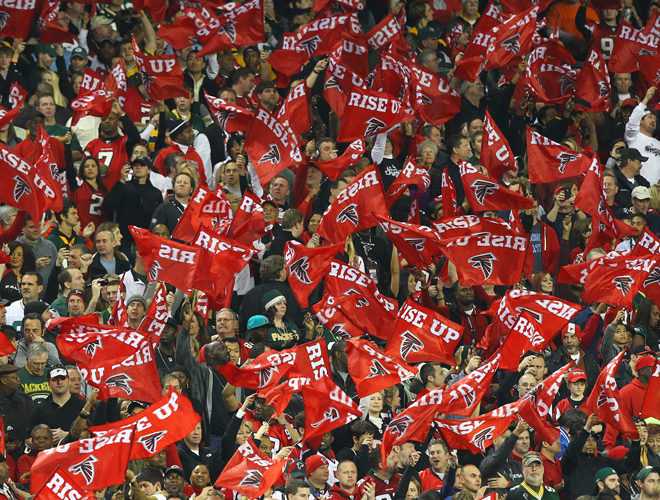
Atlanta Falcons fans wave “Rise Up” flags during an NFL Divisional Playoff game against the Green Bay Packers on January 15, 2011.

Those who have watched, read, and listened to the sports media over the last couple of years have been inundated with NFL stories that will “officially, and unquestionably, begin the ending our enjoyment of the NFL.” When those stories come out, and we don’t abandon the game, the sports media moved onto that next story “that will tick the general public off so much that I don’t see how the NFL survives this without lasting damage to their product.” Even after the members of the media make that proclamation, and the next one, the numbers don’t decrease in the least. We stubborn, fans keep watching the game in record numbers.

The NFL is still the king of all sports. It’s so far ahead of the other professional sports, still, that the competition might need a James Webb Space telescope just to read their corporate strategies, and this is in the wake of three-to-four years of almost nonstop, negative media coverage. What is going on, these sports reporters keep asking. The answer is that the NFL is big, and huge, but not so huge that it affects the daily lives of people watching the sport to the point that they care.

To illustrate this, we need only look at the contrasting conditions that exist in the socially conscious world. In the socially conscious world, socially conscious consumers care. Socially conscious consumers now have websites, blogs, apps, and podcasts devoted to informing them of the latest socially conscious gossip. The socially conscious pay attention, they scour various information resources before making financial decisions, and they punish those who don’t fall in lock step. It’s become a huge business for those “who care” about what they care about, a business that much to the surprise of the socially conscious in the sports media, the common NFL fan takes no part in.

In the socially conscious world, the media are king makers. They can make or break a corporation, or an individual, with a couple lines here and there. With the right story, or an accumulation of stories, the media can drive a corporation out of business. The corporation may try to adjust their practices to fit in with the prevailing winds of our culture, but in the socially conscious world once the damage is done, it’s done.

When socially conscious stories encroach upon the stature of the NFL, it attempts to adjust to the prevailing winds of our culture accordingly, as any other corporation worried about the prospects of their product will. They sit players for infractions large and small, they fine them, and then they blast their socially conscious reactions out into the worldwide media for contrition. Few NFL fans care one way or another. Few of them care about the transgressions in the report. Few care about the contrition. And the confusing simplicity of this is, few care about the NFL. They just want to watch football.

Most common, NFL fans are not socially conscious consumers, and I write that in the most complimentary manner possible. They are mostly male, between the ages of 35-54, making less than 100k a year. They are hard-working people who pay little attention to politics, world affairs, or social issues in general. Opponents may charge that they are head-in-the-sand ostriches, and that may be true in a larger sense, but in a more revealing scope, I think we can surmise that they don’t pick and choose the social issues to care about. They don’t care about any of them. They are one of our most consistent demographics in our country. They tend to their backyards, and they expect you to do the same, whether you are their neighbor or the NFL. They may think a little less of you when you don’t weed and water properly, but that doesn’t mean that the next time you lean over the fence, they’re going to avoid you.

The common NFL fan may know a few of the players’ names. Some of them may know the high draft pick at left tackle, the weak side linebacker that can cover as well as he can tackle, and the 4.2, 40 star cornerback, and everyone knows the quarterback, but for the most part NFL games are won and lost by players whose names they will never know. They’re not as attached to these players as the media believes, in other words. Their kids might be, but they have created enough distance from the players that no one player can ruin the game with their off the field activities. The love of the game is not as in-depth for fans, as it is for reporters. For fans, it’s just football, and it really isn’t all that complicated.

Those in the sports media make the mistake of assigning their own “age of enlightenment” social conscious worldview to their audience. They believe that socially conscious consumers are indicative of the evolved, new earthling, or at the very least that this idea of a socially conscious consumer has made its way to the NFL fan. They’re “wrong”, as Greg Cote says. “All of it.” We love the game of football. We appreciate watching talent at its highest level, but we don’t care about the NFL in a manner that if they don’t handle their controversies better, we’re going to abandon them. We’re not going to boo them when they take the field, depending on the charge, and we’re not going to applaud them when they come back … unless the collective they manage to violate one of our core tenets. 

We tune out when the NFL pregame shows start their broadcast with the latest “weight of the world” drama that has the whole NFL shook up. We don’t want to hear the perspective of this story from all four on-air personalities, and the sideline reporters’ latest quotes from the team’s equipment manager. We also don’t care about the human interest stories that follow these negative stories to inform us that not all NFL players are not as bad as inmate number 6843107347. We don’t care about the good, the bad, or the ugly. We want to watch a game of football, unless the collective they show display some sort of ingratitude for the fan that he or she can feel.

For the devout fans’ desire to learn X’s and O’s analysis, injury reports, and the occasional trash talk, we now have to turn to the internet. We turn to the place that allows us just the facts, or if they don’t, we have the option of only clicking on stories that provide just the facts and figures we want to know more about.

If I were a network programmer, I would experiment with a novel idea, a show called “Just Football!” It would be a jam-packed half hour (22 minutes with commercials) that contained two to three experts talking exclusively about the game. If a player was out, due to some drama, the anchor would say, “(That player) is out for the week!” He would say this with no more drama, and no more depth, than he would with a player that is injured for the week.

“No emotion,” would be the intro to my show’s commercial promo, “No political proselytizing, no jocularity between hosts, and no human interest stories!”

“Just football!” another, more charismatic voice would say to outro.

Word would get those two words out in the common NFL fan community, and the ratings would go through the roof.

We watch the NFL to escape the social studies of our culture. We don’t care if “our guy” is a good guy or a bad guy. We just want to know if he has the talent, and the physical or mental prowess, to get across a line, or to stop the other guy from getting across a line. If he committed a transgression, he should be punished accordingly, but we don’t care about the story, the intricacies of the story, or the social pressure that needs to be exerted to get these people to change. We just want football. It’s not complicated.

We’re not going to stop watching the game because someone did something bad, in other words, and we’re not going to start watching a game because a guy did something good. We’re not socially conscious viewers. If that were the case, we would’ve stopped watching this game long ago, because some of these players use excessive force when they hit one another.

Greg Cote, of the Miami Herald reports about this with some surprise:

“Voraciously, sports reporters and broadcasters keep sounding the first notes of the death knell of professional football. Forebodingly, they warn of the sport’s eroding credibility. Ominously, they say that player wrongdoing and Commissioner Roger Goodell’s missteps and mismanagement have served to fracture the public trust.

“Wrong, all of it.

“It turns out the public hardly cares.”

Greg Cote goes onto report, with an undercurrent of some surprise that NFL fans care about football.

The fan of the game didn’t care about concussion gate. All of the former NFL players –that now have on air personality jobs– preened themselves of the guilt of playing a contact sport by saying that they wouldn’t allow their children to play this violent game. This is now called virtue-signaling, and the anchors saying this were big time stars in their day. Those saying these things were the faces of the game … Pffft! didn’t make a dent.

We didn’t get mad at these former players, however, as we knew that their “look at me” editorials were simply attempts to establish their bona fides as a broadcaster that would help them transition away from being identified solely as a former-player. Those who lasted through the sermon, without flipping the channel, probably didn’t hold it against the former players. They likely didn’t care one way or another.

It also turns out, much to Mr. Cote’s surprise, that:

“Fans don’t need to trust (NFL commissioner Roger) Goodell to love football any more than most Americans need to adore a sitting president to love their country.”

Due to Goddell’s actions over the last couple of years, you would be hard-pressed to find too many common fans who haven’t heard of Roger Goddell, but you would also be just as hard-pressed to find many fans who care about him. I don’t pay attention to such things, but I’m guessing that if you polled NFL fans about the latest press release from the commissioner’s office, you would see figures like .04% see it as a positive for the league, .96% see it as a negative, 4% haven’t heard of it, and 95% don’t care.

Socially conscious consumers care about CEOs. They scour the position papers of these CEOs, and they read the analysis provided by socially conscious writers they trust. They focus a great deal of their attention on the CEO’s gender, race, and flossing habits. Most NFL fans don’t even know Roger’s middle name (Stokoe), because they don’t care. He’s not on the field, he’s not designing a defense, or an offense. He’s not the fan’s friend, or the fan’s enemy. He’s the commissioner of the NFL, equivalent to that fire hydrant on the end of their block. We know it’s there, and we know what it does, but we probably haven’t spent more than one accumulative minute of our lives thinking about it.

Some fans may have a love/hate relationship with Goddell, based on the players he and his commission decides to take off the field, but they’re not going to allow him to influence their enjoyment of the game. When the commissioner does step on the field to do a coin-flip, or whatever a commissioner does during the pregame, we might hear some cheers and some boos, but listen carefully to those boos. Those boos build, as the fans wake out of their pregame slumber. Every pregame ceremony involves three to four names, and 90% of the fans don’t hear the names being mentioned. They only look to the countdown clock that informs them when the game begins. When the booing begins, son turns to dad, dad turns to other fan, until heads around the stadium turn to the scoreboard to try and figure out why everyone’s booing. They join in, they laugh, and it’s fun. He’s an authority figure, and it’s fun to boo authority figures, but no fan of the game cares about him, unless he were to take part in violating the core tenets of the NFL’s core fan. My guess is if the more involved fans didn’t start the booing, the viewing audience at home would hear nothing as this lawyer/bureaucrat walks on the field. 

Greg Cote describes the bad seeds that have littered the headlines as “weeds in the garden, things to be uprooted”. I would go one step further. I would say that they’re checkers. Checkers, as opposed to chess, in that no individual pieces in the game of checkers are irreplaceable. The quarterback could be said to be irreplaceable for a game, or even for a year, but when that quarterback does go down, and his career is deemed over, the devout NFL fan’s focus shifts to the prospect of getting a great prospect in the next draft. That fan may visit that former player’s car dealership, or car wash, in the years that follow. He may even shake that man’s hand and thank him for providing the area’s fans so much joy over the years. For the most part, however, that fan will have already moved on to the next guy, and no member of the media, no commissioner, and “surprisingly” no player can taint that relationship they have with the game. Most of them know this. Most of the players, coaches, and fans know it’s not about them. The only ones confused by the conundrum of why the NFL remains so popular, regardless what they do, are those in the media, and they’re apparently up in arms about it.

[Editorial Update:] We still believe many of the tenets of this article, written on 8/15/2015, but recent evidence suggests this piece requires an asterisk. A complete rewrite is not necessary, in my humble opinion, as we still believe that no player, no matter how moral or immoral, can break the bond the NFL fan has with professional football, but we now add the asterisk that states, “Unless said player, or players, shows a level of ingratitude that the average fan considers a violation of said fan’s core tenets.”  

Most NFL stars have been stars for most of their lives, and they know a level of adoration most sports’ stars never will. These stars might assume that that love is unconditional, and for the most part it is, but as recent evidence suggests there are some principles that NFL fans consider such a staple that even their favorite star cannot violate it.

The average adult fan now knows that NFL stars are never going to be grateful to them for being a fan. The NFL star might pay symbolic homage to the fan, but we know that they take us for granted. We’ve come to accept this as the nature of the beast. As witnesses now know, it is possible to fray the bonds that seal this relationship. This article contains a note that suggests that no player, or players, can damage the bond NFL fans have with the league, but we now know that is not true.  

The media can try to make a dent, and the NFL commissioner can attempt to resolve that issue, and most NFL fans won’t care either way, but if the player shows an unprecedented level of ingratitude, most fans will leave, and some may never come back. We’ve all witnessed those TV’s permanently turned into the “off” position, on Sunday afternoons for a couple years now, even at Thanksgiving, and I don’t know when, or if, they will ever be turned back on. Congratulations, NFL players, you’ve proven me wrong. There is a way to do what I thought couldn’t be done. The otherwise ambivalent and apathetic fan base is now awoke, and they care more than I thought they would about a social issue.