Falling Down Manholes


“Tragedy is when I stub my toe. Comedy is when you fall into an open manhole and die.” –Mel Brooks

I’ve never fallen down a manhole, but I have to imagine that it hurts. “Um, yeah,” Mel might say, “That’s what makes it funny.” So, to be truly funny, someone has to get hurt. “Well, you put it like that, it sounds sadistic. It’s not sadistic, it’s human nature. It’s the fuzzy line between comedy and tragedy that dates back to Aristotle and Ancient Greece.”

It might be a little humorous to see a faceless entity falling into a manhole on one of those video montages, but what if we know the guy? Does that make it funnier or more tragic, or is there a middle ground that reveals this unusual relationship between comedy and tragedy? If we find a tragic incident like that funny, what is funny, what’s tragedy, and what’s the difference?

Laughing at other people’s pain is just kind of what we do. We might not want to admit it, but in many cases it’s so funny that when someone calls us a heartless SOB, we can only laugh with acknowledgement. Is it our dark side coming out, or is it just human nature?

I’ve met the opposite, the few, the proud who don’t laugh, because they don’t think it’s funny. They don’t even smile or joke about it later. They’re not virtue-signaling either. They just don’t think it’s funny. One of the few I met was a first responder who she witnessed so much pain and sorrow that she no longer considered even trips and stumbles humorous. What’s the difference between a first responder and the rest of us, they run into a burning building, and we run away. There are very very few who would actually stand outside a burning building and laugh, but seeing another’s worst moment can be so shocking that some of the times we don’t know whether to laugh or cry, and laughter is our go-to. If we worked with tragedy as often as first responders, would it lead to a certain diminishment of this shock factor, or are those who deal with tragedy on a daily basis attracted to their professions because they are inherently more compassionate?

I’ve never seen someone fall down a manhole, but odds are against them falling clean, in the manner Yosemite Sam does, and most of them aren’t mumbling comedic swear words on the way down either. Most of them fear that they are going to damage something severely by the time they hit bottom, and that fear will probably produce blood-curdling screams. They might not have enough time to fear death, but anyone who has fallen from a decent height knows that it’s scary, and they probably aren’t going to be able to laugh about it for quite some time. The question is will we, the witnesses of the event, be laughing? If we weren’t there, and our only attachment to their incident is their harrowing retelling of the moment, will we be laughing? 

If our friend walks away from the fall with some superficial bumps and bruises, that might be funny, but what if he chipped a tooth? What if he took a nasty knock on the head, or broke an ankle? What if his injuries were so severe that he required first responders to free him? Does the severity of the moment, and the eventual injuries, align with the comedy, the tragedy, or does it brush up against our definition of the fuzzy line that we try to erect between the two to try to keep them separated?

Before you answer, think about how you might retell the story. When we tell a story, we might not always be looking for a laugh, but we want a reaction. To get the best reactions, standup comedians advise to always be closing. A great closing involves a great punchline of course. If punchline is the wrong word, how about punctuation, and what better punctuation would there be than adding that the subject of our story was forced to endure a prolonged hospital stay that involved tubes and machines to keep the victim alive? “They’re saying that the nasty knock on the head could leave him mentally impaired for the rest of his life?” That might be extreme, as few would find mental impairment funny, but where is the line or the lines of demarcation that define comedy and tragedy in this matter?

The initial sight of Jed lying at the bottom of the sewer might be funny, unless he’s screaming. What if he’s hurt? How can he not be? We laugh. We don’t mean to laugh. We don’t want to find this funny, but we can’t stop. Some of us might wait to find out if Jed’s okay before we laugh, and some of us might wait until he’s not around, so when we can retell the story of his fall and laugh with others. Most of us will laugh at some point though. It’s our natural reaction to something tragic.

Laughing, or otherwise enjoying, another person’s pain is so common, that the Germans, developed a specific term for it: schadenfreude. Is our laughter fueled by the relief that it’s not happening to us, is it human nature, or is it the result of comedies and comedians molding our definition of what’s humorous by twisting dark, tragic themes into something funny? The advent of slapstick comedy occurred long before we were alive, but I don’t think anyone would argue that comedy has grown darker and more violent over the decades. We now consider some truly brutal acts hilarious. Have comedy writers changed our definition of humor, or are they reflecting the changes in society? It’s an age-old question. Would the Abbot and Costello fan consider it hilarious if someone fell in a manhole, what would the Mel Brooks fan think, or a Will Farell fan? Are such incidents funny in a timeless manner, or have comedians upped the ante so much, and so often, that our definition has darkened with it? Whatever the case is, incidents such as these reveal the relative nature of humor, the fuzzy line between tragedy and comedy, and how we find comedy in others’ tragedies. The purposeful melding of the two even has its own genre now: tragicomedy.

Emergency: Tongue Stuck on Pole
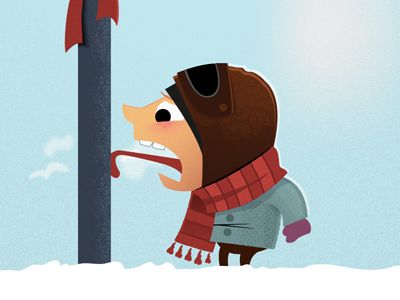
My personal experience with the fuzzy line between comedy and tragedy, didn’t involve falling into a manhole, but licking a pole. I was in the fifth or sixth grade, old enough and smart enough to know better, but young enough and dumb enough to do it anyway on one of the coldest days in February. I wasn’t old enough, or sophisticated enough, to consider the fuzzy, philosophical line between comedy and tragedy, but I knew everyone would be laughing uproariously if they saw me stuck on that pole. I also knew an overwhelming number of my classmates would not share a “Well, at least you’re okay” sentiment when it was over. I knew this wasn’t one of those types of mistakes. I didn’t know a whole lot about human nature, but I knew how much we all crave stories of pain and humiliation, because I did. I laughed harder than anyone else when Andy walked into a pole, and he hit it with such force that the impact broke his glasses in two. I just happened to be in the perfect position to see the incremental progressions of Andy’s instinctual reactions. I saw Andy’s eyes close on impact, followed by the scrunched expression of pain. In the midst of my laughter, Andy’s face turned from pained to embarrassed as everyone else attempted to soothe and coo him back to respectability. Andy’s embarrassed expression focused on me, the only person laughing, and I couldn’t stop. When his embarrassed expression evolved to one pleading me to stop, I just walked away, because for reasons endemic to my evil nature his mental emotional pain proved more hilarious to me than the physical.   

Some might call it heartless, others might suggest that anyone who would even smile at such a thing is lacking some levels of compassion, but I think it’s just kind of who were are and what we do to one another, and we don’t always do it with malice either. Some of the times, we laugh because that’s just what we do. 

I didn’t stand there and think about all this while stuck in the moment of course. The only things I thought about were how am I going to rip myself free and how much is it going to hurt? When I thought about the physical pain, though, I knew it would pale in comparison to the emotional and mental anguish that would occur soon after someone saw me like that. I ripped my tongue off the pole. I don’t remember exactly how long my it hurt after I ended up ripping several layers of my tongue off, but it hurt so bad that I thought I should’ve given more thought to an alternative. I also thought that even if I went on to accomplish historically great things, and I came back to my grade school to meet my classmates, one of them would’ve said, “Weren’t you the guy who was stuck on a pole when we were kids?”

I’ve since read local news stories of other kids stuck on a pole, and they always include a photo or a video of the kid from The Christmas Story in it. One of these stories involved a kid notifying his teacher, and the teacher, who presumably failed to consider the idea that a warm cup of water could free the kid, ended up calling first responders to set the kid free. I still cringe when I put myself in that kid’s place, and I think of all the people standing around this kid. I cringe when I think about the teachers who would never forget this incident, and while they may have been more compassionate in the moment, they probably couldn’t help but laugh behind a hand every time they saw him. This information would’ve eventually filtered out to the students, because how many times does a big old fire engine pull up to a school, and when it does everyone would want to know why, and someone would find out. The first and last question I’d have for this kid if I ever met him is, what were you thinking?

I have to imagine that this victim was either much younger than I was at the time, or that the severity of his incident was much worse. For if all of the circumstances were even somewhat similar, then I have to ask him why he didn’t just rip themselves free? My empathy goes out to him if he feared how painful that would be, but he had to consider all the ridicule, teasing, and bullying he would endure in the aftermath. Even if he feared the pain so much that he wanted an adult to come along and find a less painful solution for them, I would love to ask him if it was worth it. 

Does getting a tongue stuck on a pole compare to falling down a manhole? It does not, when comparing the possible injuries, or other painful consequences, but I would submit that it does when it comes to the probability of embarrassment. I write that because the embarrassment of getting your tongue stuck to a pole has a storied tradition of humor, a tradition enhanced by the movie A Christmas Story. The humor is now an agreed upon universal, further enhanced by the relatively minor, but painful lessons attached to it.  

One of the first faces I pictured when I got stuck to that pole was Steve’s. I knew Steve would be waiting with bated breath for any details of my tragedy, and I knew his audience wouldn’t be able to restrain themselves from laughing at his displays of cruel and clever creativity. I didn’t know what nicknames or limericks Steve would develop, but I knew he would develop something. Steve was our class clown, and he was always developing material on someone. I considered all the excruciating pain I experienced in the aftermath of ripping off layers of my tongue off worth it for all the reasons listed above, but most of all I knew Steve wouldn’t have this material on me.

We’ve all heard talk show guests talk about how they were the class clown in their school. We all smile knowingly, picturing them as children dancing with a lampshade on their head and coming up with the perfect sarcastic responses to the teacher that even the teacher considered hilarious. When we hear this, we nod, because we figure he was the class clown, because no one gets that funny overnight. They explain that they discovered an internal need to hear laughter, by whatever means necessary, at a very young age. Those of us who knew a class clown, like Steve, saw some of this good-natured humor, but we also saw what happened when Steve ran out of good-natured and fun material. We all knew the minute Steve ran out of material, he would begin looking around for victims, and I was always one of his favorite targets. Anyone who has spent time around a class clown, or a group of class clowns, knows that their stock and trade involves insults. I didn’t spend ten seconds stuck on that pole, but picturing Steve’s mean-spirited smile, after delivering a dagger that had its tip dipped in this material was the image that consumed me and convinced me that I made the right decision later.    

We all enjoy making people laugh, but some of us have a deep psychological need to make people laugh, and they don’t care who has to get hurt in the process. Based on my experiences with class clowns, I can only guess that those who would fashion a career out of it, such that they were so successful that they ended up in a late night talk show chair talking about it, probably learned early on that no matter how you slice it, if someone falls down a manhole, or gets their tongue stuck to a pole, there’s comedy gold in there waiting to be excavated. They may be too young to know anything about the complexities inherent in the symbiotic relationship between comedy and tragedy at the time, but at some point they realized that anyone can get a laugh. To separate themselves from the pack of those vying for the title class clown, those who would use that title to future success in comedy learned that they would have to spend decades learning the intricacies and complexities of their craft, as everyone from the Ancient jesters to Mel Brooks did. They also learned that for all of the complexities involved in comedy, one simple truth they learned in fifth to sixth grade remains, if one wants to go from humorous titters to side-splitting laughter someone has to get hurt.

Don’t Go Chasing Eel Testicles: A Brief, Select History of Sigmund Freud


We envy those who knew, at a relatively young age, what they wanted to do for a living. We may have experienced some inspirations along the way, but we either lost interest quickly, or we never follow through. Whatever the case was, no one I know read medical journals, law reviews, or business periodicals in our formative years. We preferred reading the latest NFL preview guide, a teenage heartthrob magazine, or one of the many other periodicals that offer soft entertainment value. Most of us opted out of reading altogether and chose to play something that involved a ball. Life was all about fun for the kids in our block, but there were other, more serious kids, who we wouldn’t meet until we were older. They may not have known they would become neurosurgeons, but they were so interested in medicine that they devoted huge chunks of their young lives to learning everything their young minds could retain. “How is that even possible?” we ask. How are they able to achieve that level of focus when they were so young? Are we even the same species?

At an age when we’re so unfocused, some claim to have had tunnel vision. “I didn’t have that level of focus,” some said to correct the record, “not the level of focus to which you are alluding.” They might have diverged from the central focus, but they had more direction than anyone we knew, and that direction put them on the path of doing what they ended up doing, even if it wasn’t as specific as we might guess.

The questions regarding what we should do for a living has plagued so many for so long that comedian Paula Poundstone captured it with a well-placed joke, and I apologize, in advance, for the creative paraphrasing: “Didn’t you hate it when your relatives asked what you wanted to do for a living? Um, Grandpa I’m 5. I haven’t fully grasped the importance of brushing my teeth yet. Now that I’m forty, I’ve finally figured out why they asked that question,” Paula Poundstone added with a comedic pause. “They were looking for ideas.”

Pour through the annals of great men and women of history, and you’ll find that some of the greatest minds of science didn’t accomplish much of anything until late in life. Your research will also show that most of the figures who achieved success in life were just as dumb and carefree as children as the rest of us, until something clicked. Some failed more than once in their initial pursuits, until they discovered something something that flipped a switch.

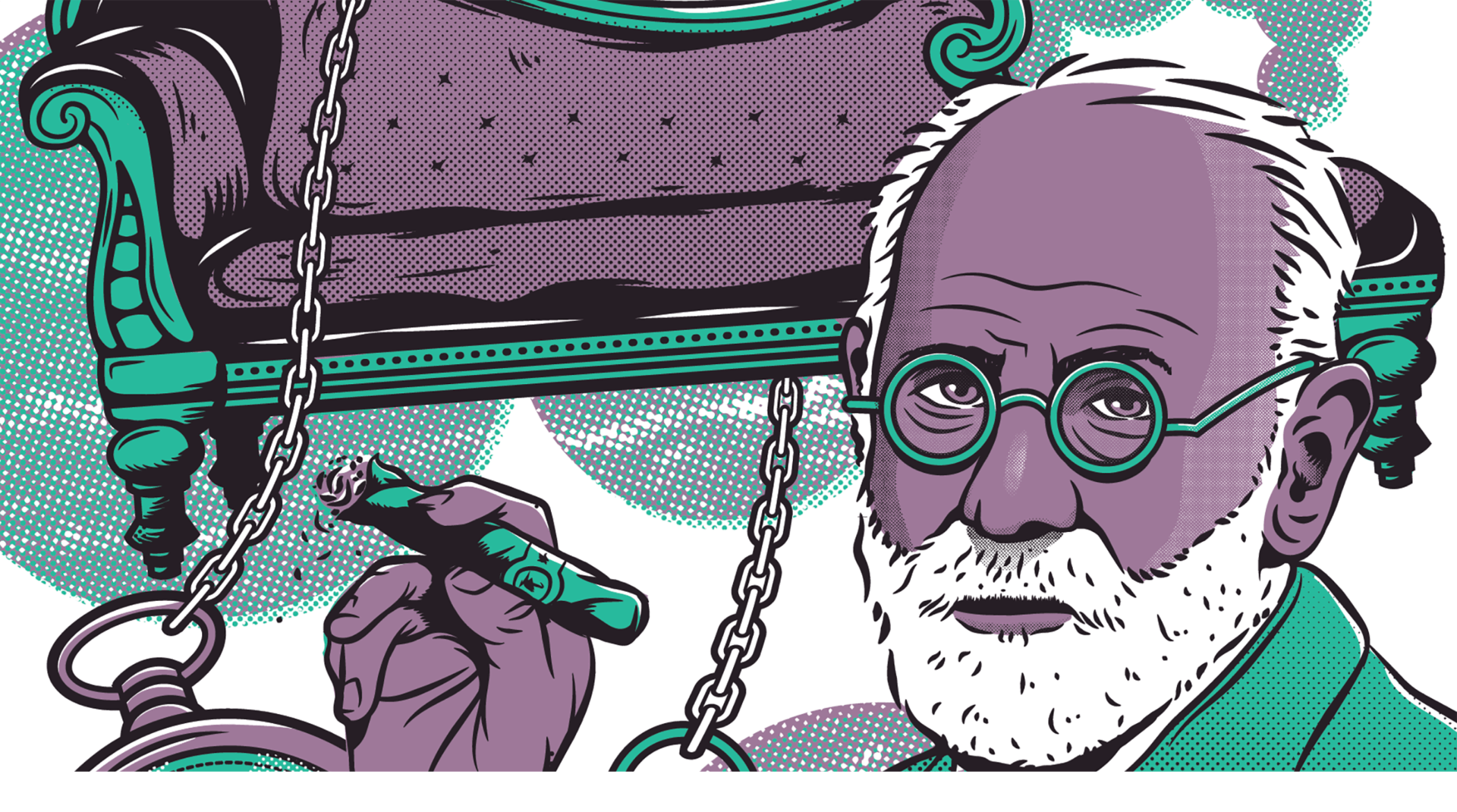
Even those who know nothing about psychology, know the name Sigmund Freud. Those who know a little about Freud know his unique theories about the human mind and human development. Those who know anything about his psychosexual theory know we are all repressed sexual beings plagued with unconscious desires to have relations with some mythical Greek king’s mother. What we might not know, because we consider it ancillary to his greater works, is that some of his theories might have originated from Freud’s pursuit of the Holy Grail of nineteenth-century science, the elusive eel testicles.

Although some annals state that an Italian scientist named Carlo Mondini discovered eel testicles in 1777, other periodicals state that the search continued up to and beyond the search of an obscure 19-year-old Austrian’s in 1876.[1] Other research states that the heralded Aristotle conducted his own research on the eel, and his studies resulted in postulations that stated either that the beings came from the “guts of wet soil”, or that they were born “of nothing”.[2] One could guess that these answers resulted from great frustration, since Aristotle was so patient with his deductions in other areas. On the other hand, he also purported that maggots were born organically from a slab of meat. “Others, who conducted their own research, swore that eels were bred of mud, of bodies decaying in the water. One learned bishop informed the Royal Society that eels slithered from the thatched roofs of cottages; Izaak Walton, in The Compleat Angler, reckoned they sprang from the ‘action of sunlight on dewdrops’.”

Before laughing at these findings, we should consider the limited resources those researchers had at their disposal. As is oft said with young people, the young Freud did not know enough to know how futile the task would be when a nondescript Austrian zoological research station employed him. It was his first real job, he was 19, and it was 1876. He dissected approximately 400 eels, over a period of four weeks, “Amid stench and slime for long hours” the New York Times wrote to describe Freud’s working conditions. [3] His ambitious goal was to write a breakthrough research paper on an animal’s mating habits, one that had confounded science for centuries. Conceivably, a more seasoned scientist might have considered the task futile much earlier in the process, but an ambitious, young 19-year-old, looking to make a name for himself, was willing to spend long hours slicing and dicing eels, hoping to achieve an answer no one could disprove.

Unfortunate for the young Freud, but perhaps fortunate for the field of psychology, we now know that eels don’t have testicles until they need them. The products of Freud’s studies must not have needed them at the time he studied them, for Freud ended up writing that his total supply of eels were “of the fairer sex.” Some have said Freud correctly predicted where the testicles should be and that he argued that the eels he received were not mature eels. Freud’s experiments resulted in a failure to find the testicles, and he moved into other areas as a result. What kind of effect did this failure have on Freud, professionally and otherwise? 

In our teenage and young adult years, most of us had low-paying, manual labor jobs. We did these jobs to get paid when no one else would pay us. We bussed tables, took bags to hotel rooms, parked cars, and did whatever we had to to get paid. Our only goals in life were to do the job well enough to keep the boss off our back. We had no direction, and no one I know did what they did to end up in the annals of history. When we got fired or quit, we just moved onto the job that paid us more. We didn’t think about rewarding or fulfilling. We just knew we didn’t want to do that (whatever we did in the first job) anymore. 

Was Freud’s search for eel testicles the equivalent of an entry-level job for him, or did he believe in the vocation so much that his failure devastated him? Did he slice the first 100 or so eels open and throw them aside with the belief that they were immature? Was there nothing but female eels around him, as he wrote, or was he beginning to see what plagued the other scientists for centuries, including the brilliant Aristotle? There had to be a moment, in other words, when Sigmund Freud realized that they couldn’t all be female. He had to know, at some point, that he was missing the same something that everyone else missed. He must have spent some sleepless nights struggling to come up with a different tactic. He might have lost his appetite at various points, and he may have shut out the world in his obsession to achieve infamy in marine biology. He sliced and diced over 400 after all. If even some of this is true, even if it only occupied his mind for four weeks of his life, we can imagine that the futile search for eel testicles affected Sigmund Freud in some manner.

If Freud Never Existed, Would There Be a Need to Create Him

Every person approaches a topic of study from a subjective angle. It’s human nature. The topic we are least objective about, say some, is ourselves. Some say that we are the central focus of speculation when we theorize about humanity. All theories are autobiographical, in other words, and we pursue such questions in an attempt to understand ourselves better. Bearing that in mind, what was the subjective angle from which Sigmund Freud approached his most famous theory on psychosexual development in humans? Did he bring objectivity to his patients? Could he have been more objective, or did Freud have a blind spot that led him to chase eel testicles throughout his career in the manner Don Quixote chased windmills?

After his failure, Sigmund Freud would switch his focus to a field of science that would later become psychology. Soon thereafter, patients sought his consultation. We know now that Freud viewed most people’s problems through a sexual lens, but was that lens tinted by the set of testicles he couldn’t find a lifetime ago? Did his inability to locate the eel’s reproductive organs prove so prominent in his studies that he saw them everywhere he went, in the manner that a rare car owner begins to see his car everywhere, soon after driving that new car off the lot? Some say that if this is how Freud conducted his sessions, he did so in an unconscious manner, and others might say that this could have been the basis for his theory on unconscious actions. How different would Freud’s theories on sexual development have been if he found the Holy Grail of science at the time? How different would his life have been? If Freud found fame as a marine biologist with his findings, he may have remained a marine biologist.

How different would the field of psychology be today if Sigmund Freud remained a marine biologist? Alternatively, if he still made the switch to psychology after achieving fame in marine biology, for being the eel testicle spotter, would he have approached the study of the human development, and the human mind from a less subjective angle? Would his theory on psychosexual development have occurred to him at all? If it didn’t, is it such a fundamental truth that it would’ve occurred to someone else over time, even without Freud’s influence?

We can state, without fear of refutation, that Sigmund Freud’s psychosexual theory has sexualized our beliefs about human development, a theory others now consider disproved. How transcendental was that theory, and how much subjective interpretation was involved in it? How much of the subjective interpretation derived from his inability to find the eel testicle? Put another way, did Freud ever reach a point where he began overcompensating for that initial failure?

Whether it’s an interpretive extension, or a direct reading of Freud’s theory, modern scientific research theorizes that most men want some form of sexual experience with another man’s testicles. This theory, influenced by Freud’s theories, suggests that those who claim they don’t are lying in a latent manner, and the more a man says he doesn’t, the more repressed his homosexual desires are.

The Williams Institute at UCLA School of Law, a sexual orientation law think tank, released a study in April 2011 that stated that 3.6 percent of males in the U.S. population are either openly gay or bisexual.[4] If these findings are anywhere close to correct, this leaves 96.4 percent who are, according to Freud’s theory, closeted homosexuals in some manner. Neither Freud nor anyone else has been able to put even a rough estimate on the percentage of heterosexuals who harbor unconscious, erotic inclinations toward members of the same sex, but the very idea that the theory has achieved worldwide fame leads some to believe there is some truth to it. Analysis of some psychological studies on this subject provides the quotes, “It is possible … Certain figures show that it would indicate … All findings can and should be evaluated by further research.” We don’t know in other words, there’s no conclusive data and all findings and figures are vague. Some would suggest that the facts and figures are so ambiguous that Freud’s theories were nothing more than a provocative and relatively educated and subjective guess.[5]

Some label Sigmund Freud as history’s most debunked doctor, but his influence on the field of psychology and on the ways society at large views human development and sexuality is indisputable. The greater question, as it pertains specific to Freud’s psychosexual theory, is was Freud a closet homosexual, or was his angle on psychological research affected by his initial failure to find eel testicles? To put it more succinct, which being’s testicles was Freud more obsessed with finding during his lifetime?


[1]https://en.wikipedia.org/wiki/Eel_life_history

[2]http://www.theguardian.com/environment/2010/oct/27/the-decline-of-the-eel

[3]http://www.nytimes.com/2006/04/25/health/psychology/analyze-these.html

[4]https://en.wikipedia.org/wiki/Demographics_of_sexual_orientation

[5]http://www.pbs.org/wgbh/pages/frontline/shows/assault/roots/freud.html

Dumb Guy’s Disease


“Taken care of me? Mike, you’re my kid brother, and you take care of me? Did you ever think of that. Ever once? Send Fredo off to do this, send Fredo to take care of that… take care of some little unimportant night club here, and there; pick somebody up at the airport. I’m your older brother Mike and I was stepped over! … It ain’t the way I wanted it! I can handle things. I’m smart. Not like everybody says, like dumb. I’m smart and I want respect!” –Fredo from The Godfather II

“What happened?” we ask ourselves. “I thought I was going to be one of the smart ones. I know, I was a disinterested student in school, and I probably cared too much about partying for far too long in the afterlife (the life after high school), but I thought I would’ve gathered enough wisdom by now that someone, somewhere would consider me wise, but I have to face it. I have a mean case of dumb guy’s disease.”

Dumb guy’s disease doesn’t necessarily mean that the carrier is dumb, but that they are not as smart as they thought they would be at this point. We all know dumb guys, those men and women who by social calculations don’t know enough to enter into the league of intelligence. We never considered ourselves one of them, until someone far more intelligent than us gave us a condescending “you don’t know do you?” smile. We would love to dismiss that look with the notion that they had an agenda, but we know we choked in crunch time, because we didn’t know. When enough of these moments happen, we conclude that we’re not half as bright as we thought we would be at this point in our lives.

To prove ourselves to us, we sought less structured forms of education. We thought this might result in us becoming what smart people call autodidact, or a self-taught person. (Yes, I had to look that up.). We might begin reading better websites and better books, we might watch more documentaries, and listen to a wide array of podcasts. No matter what venue we choose, we will focus our renewed thirst for knowledge on defeating the structured concepts we failed to learn in school. This is our way of putting all those poor grades behind us by rejecting traditional, accepted knowledge as a form of intellectual rebellion.

“Everything they taught you in school is wrong,” is click bait for dumb guys who hope to succeed beyond the fools in school who regurgitated accepted facts back to the teacher. We dumb guys learn the truth, but this version of the truth should not be confused with the truth, in most cases, but rather a subjective truth that various authors spend decades writing in various forms and incarnations. This is one of the many attempts dumb guys make to rectify the past.

***

“Too many lyricists attempt to write a song, as if it’s a college thesis,” a musician replied. “I just write lyrics that fit the music.”

That’s pretty much it, right there, I thought. We dumb guys spend the rest of our afterlives (those years after high school) focused on informing the world that we’re not as dumb as everybody thought we were in school or in the immediate aftermath where the focus of their life was partying. The musician’s quote informed me that when I injected politics and music appreciation into my fiction, I was writing my college thesis to impress upon my peers in high school the idea that I was not as dumb as they thought I was. Some big name fiction authors make political overtures to enlighten their readers, and they attempt to woo us into listening to their favorite groups with forays into music appreciation. I used to write about my main character’s appreciation for my favorite group of the moment, in the manner the big name authors do. My modus operandi was if they can do it, why can’t I? My second thought was they could get away with it, because they were big names in the fiction world, and I wasn’t. I knew their music, everyone did, it was ZZ Top, AC/DC, The Ramones, and just about every tired, formulaic classic rock group we hear every day on classic rock radio. The author’s point was to instill in our minds the idea that his character was risqué, because he enjoyed listening to rock and roll. I enjoyed the author’s brand of rock and roll back when I was trying to define myself by listening habits, but I grew tired of the classic rock monochromatic formulas. This author obviously didn’t, and it defined his work for me. In his attempts to appear hip, naughty, and rebellious through his rock choices, I also saw his attempts to appear meaningful, thoughtful, and intelligent for what they were, and I realized that he was writing his college thesis for ushis big name author didn’t introduce his political, or music, preferences as well as I thought he had when I was blinded by his big name.

In the years I spent trying to prove I was not a dumb guy, I never heard the notion that intelligence and brilliance should be considered different strains of intellect. (I realize that in the strictest sense of the terms, some might consider another so intelligent, in a structured manner, that they consider them brilliant, but for the sake of argument let’s say that brilliance and intelligence are parallel roads.) The two strains of intellect could be broken down to left-brain versus right brain, as in one type of brain has a natural aptitude for math and science, while the other is more of a creative type. One could also say that an intelligent person knows the machinations of a saxophone so well that they can fix it and tune it while the other knows how to play it brilliantly, and while both can learn how to accomplish the other’s feat, neither will ever do it as well as the other, for their brains work in decidedly different ways.

This idea applies to dumb guy’s disease, because some creative types do not discover their aptitude for creativity, until the afterlife, the life after school. We recognize some forms of artistic expression, such as an ability to draw or play an instrument, early on, while an aptitude for creative writing often occurs later in life. The math and science types discover an aptitude for the structured learning, memorization, and problem solving in school, and it puts them in the upper echelon of learners, whereas the young, creative types live outside the bubble, looking in with jealousy. Screaming, as Fredo did in The Godfather II, “I’m smart. Not like everybody says, like dumb. I’m smart and I want respect!”

***

“You’re not already there,” would be the first piece of advice I would give a younger me if I could go back in time and give my younger self some advice. “You’re not special,” I would add, “and you don’t know how to play basketball already.” These are the pathogens of dumb guy’s disease, and the bacteria reproduces and multiplies rapidly infecting every matter it comes across.

I would also advise myself to find a way to learn the structure of the system and succeed within it, but I was never adept at structured learning–I’m still not–so, that would be pointless. What I would say instead is learn more about yourself, who you are and how you can succeed with your gifts and talents while keeping an eye on your limitations. 

I would also ask myself to work harder to acknowledge that there’s nothing special about me. I wouldn’t tell myself to stop watching Tom Cruise movies, but I would suggest that I stop watching them, thinking that the theme of those movies applies to me. “You’re not the chosen one, or the one that shouldn’t have to accept mediocrity. Accept mediocrity. Learn it, love it, and live it, until you can surpass it.”

I wasn’t a better athlete, student or employees because I thought I already was, and the frustration I felt when faced with the fact that I wasn’t, was tied to that idea that I thought I was already there, or should’ve been. When I failed in athletics, it was such a mystery to me that I threw temper tantrums, because I was frustrated that I wasn’t as great as I thought I was. It was also a message I sent to my teammates that that wasn’t me. That was but a snapshot of my abilities, and I was so much better than that. The problem for dumb guys is that oftentimes the message is enough. We don’t feel the need to get better, because “We already know how to play basketball.”

We get in front of ourselves at times. We never learn how to slow our roll long enough to work within the confines of who we were to succeed within the constraints of who we are. 

If I could advise myself thirty years prior, I would say slow down, realize who you are when you’re doing it. Analyze your shot in basketball and try to figure out how to make the shot more often, and when some tries to give you some advice, don’t shoot them down by saying, “I already know how to play basketball.” 

You’re not the all star athlete you think you are,” I would add. You’re not a great employee, and you’re not near as smart as you think you are. You’re actually pretty dumb, because you refuse to listen to people, like that obnoxious 50-year-old waiter who nodded at everything you said, because he said he used to say those same things.

He was a waiter, a 50-year-old waiter, so what the hell does he know about life?” my younger self would argue. He was an oafish, avuncular type, who was always kind of a fool.”

“Until he got you alone, away from all your friends, and he turned all serious on us, saying, “You’re doing it wrong, and the only reason I know is because I was doing it wrong at your age, the same way as you. I was a dumb kid, just like you, but I knew better. I knew how to play football already, and I was good enough at Math to pass the stupid class that I probably would never use anyway. I didn’t get good grades, and I thought it was kind of funny, and I fell asleep in study hall too. I did just good enough in school to keep everyone off my back, so I could go out, enjoy my youth and have some fun in life, and here I am a 50-year-old waiter. If I could somehow switch places with you, right here, right now, I’d do my life differently.”

Now that the roles are flipped, what would we do differently? I’d drop the whole Tom Cruise “I could be the chosen one” mindset, because Michael Jordan wasn’t the chosen one, until he sculpted himself into it. I’d drop the whole “I already know how to play basketball” mindset and listen to those teaching me the “finger tips, rotation, follow through” tedious mechanics of the game. I know those mechanics now, now that it’s too late. I was never an adept student with all that structured learning, and I’m still not, but if I would’ve had more patience with myself and learned more about myself earlier, I might’ve been able to chip away at the granite stones I placed in my path to create something, as opposed to inviting that I’m already there’ pathogen that caused my dumb guy’s disease.