It’s not complicated. It’s football.


Sports reporters, sports broadcasters, and the sports media, in general, are up in arms. They don’t understand how you, the common NFL fan, can avoid caring about all these stories they’ve created to open your eyes to the true nature of the NFL. After all of the hard work they’ve put in to characterize your favorite players, your favorite team, the commissioner of the league, and the institutional culture surrounding them, you keep watching with your eyes wide shut. You don’t care. It’s the strangest thing.

This may be based on the fact that we don’t care about the NFL. We love the game, we love the games, and the teams and individuals who play those games, but we have disassociated them from the NFL, the league, and the daily soap opera that surrounds it. Perhaps that’s a small price that the NFL has paid for being so huge that some of us can do all of that and love the game, and not feel like we’re contradicting ourselves.
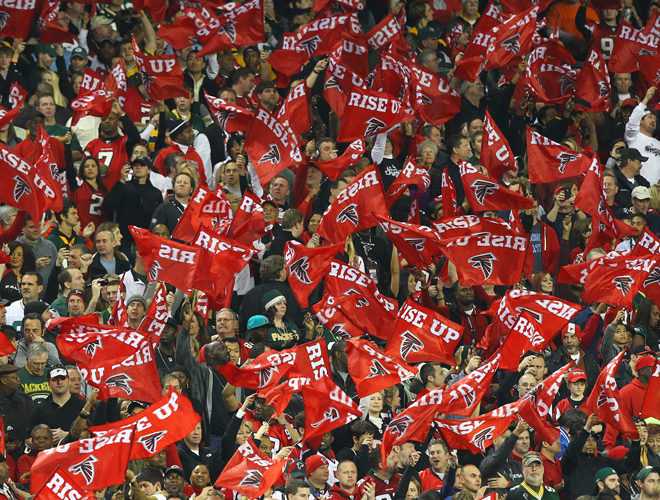
Atlanta Falcons fans wave “Rise Up” flags during an NFL Divisional Playoff game against the Green Bay Packers on January 15, 2011.

Those who have watched, read, and listened to the sports media over the last couple of years have been inundated with NFL stories that will “officially, and unquestionably, begin the ending our enjoyment of the NFL.” When those stories come out, and we don’t abandon the game, the sports media moved onto that next story “that will tick the general public off so much that I don’t see how the NFL survives this without lasting damage to their product.” Even after the members of the media make that proclamation, and the next one, the numbers don’t decrease in the least. We stubborn, fans keep watching the game in record numbers.

The NFL is still the king of all sports. It’s so far ahead of the other professional sports, still, that the competition might need a James Webb Space telescope just to read their corporate strategies, and this is in the wake of three-to-four years of almost nonstop, negative media coverage. What is going on, these sports reporters keep asking. The answer is that the NFL is big, and huge, but not so huge that it affects the daily lives of people watching the sport to the point that they care.

To illustrate this, we need only look at the contrasting conditions that exist in the socially conscious world. In the socially conscious world, socially conscious consumers care. Socially conscious consumers now have websites, blogs, apps, and podcasts devoted to informing them of the latest socially conscious gossip. The socially conscious pay attention, they scour various information resources before making financial decisions, and they punish those who don’t fall in lock step. It’s become a huge business for those “who care” about what they care about, a business that much to the surprise of the socially conscious in the sports media, the common NFL fan takes no part in.

In the socially conscious world, the media are king makers. They can make or break a corporation, or an individual, with a couple lines here and there. With the right story, or an accumulation of stories, the media can drive a corporation out of business. The corporation may try to adjust their practices to fit in with the prevailing winds of our culture, but in the socially conscious world once the damage is done, it’s done.

When socially conscious stories encroach upon the stature of the NFL, it attempts to adjust to the prevailing winds of our culture accordingly, as any other corporation worried about the prospects of their product will. They sit players for infractions large and small, they fine them, and then they blast their socially conscious reactions out into the worldwide media for contrition. Few NFL fans care one way or another. Few of them care about the transgressions in the report. Few care about the contrition. And the confusing simplicity of this is, few care about the NFL. They just want to watch football.

Most common, NFL fans are not socially conscious consumers, and I write that in the most complimentary manner possible. They are mostly male, between the ages of 35-54, making less than 100k a year. They are hard-working people who pay little attention to politics, world affairs, or social issues in general. Opponents may charge that they are head-in-the-sand ostriches, and that may be true in a larger sense, but in a more revealing scope, I think we can surmise that they don’t pick and choose the social issues to care about. They don’t care about any of them. They are one of our most consistent demographics in our country. They tend to their backyards, and they expect you to do the same, whether you are their neighbor or the NFL. They may think a little less of you when you don’t weed and water properly, but that doesn’t mean that the next time you lean over the fence, they’re going to avoid you.

The common NFL fan may know a few of the players’ names. Some of them may know the high draft pick at left tackle, the weak side linebacker that can cover as well as he can tackle, and the 4.2, 40 star cornerback, and everyone knows the quarterback, but for the most part NFL games are won and lost by players whose names they will never know. They’re not as attached to these players as the media believes, in other words. Their kids might be, but they have created enough distance from the players that no one player can ruin the game with their off the field activities. The love of the game is not as in-depth for fans, as it is for reporters. For fans, it’s just football, and it really isn’t all that complicated.

Those in the sports media make the mistake of assigning their own “age of enlightenment” social conscious worldview to their audience. They believe that socially conscious consumers are indicative of the evolved, new earthling, or at the very least that this idea of a socially conscious consumer has made its way to the NFL fan. They’re “wrong”, as Greg Cote says. “All of it.” We love the game of football. We appreciate watching talent at its highest level, but we don’t care about the NFL in a manner that if they don’t handle their controversies better, we’re going to abandon them. We’re not going to boo them when they take the field, depending on the charge, and we’re not going to applaud them when they come back … unless the collective they manage to violate one of our core tenets. 

We tune out when the NFL pregame shows start their broadcast with the latest “weight of the world” drama that has the whole NFL shook up. We don’t want to hear the perspective of this story from all four on-air personalities, and the sideline reporters’ latest quotes from the team’s equipment manager. We also don’t care about the human interest stories that follow these negative stories to inform us that not all NFL players are not as bad as inmate number 6843107347. We don’t care about the good, the bad, or the ugly. We want to watch a game of football, unless the collective they show display some sort of ingratitude for the fan that he or she can feel.

For the devout fans’ desire to learn X’s and O’s analysis, injury reports, and the occasional trash talk, we now have to turn to the internet. We turn to the place that allows us just the facts, or if they don’t, we have the option of only clicking on stories that provide just the facts and figures we want to know more about.

If I were a network programmer, I would experiment with a novel idea, a show called “Just Football!” It would be a jam-packed half hour (22 minutes with commercials) that contained two to three experts talking exclusively about the game. If a player was out, due to some drama, the anchor would say, “(That player) is out for the week!” He would say this with no more drama, and no more depth, than he would with a player that is injured for the week.

“No emotion,” would be the intro to my show’s commercial promo, “No political proselytizing, no jocularity between hosts, and no human interest stories!”

“Just football!” another, more charismatic voice would say to outro.

Word would get those two words out in the common NFL fan community, and the ratings would go through the roof.

We watch the NFL to escape the social studies of our culture. We don’t care if “our guy” is a good guy or a bad guy. We just want to know if he has the talent, and the physical or mental prowess, to get across a line, or to stop the other guy from getting across a line. If he committed a transgression, he should be punished accordingly, but we don’t care about the story, the intricacies of the story, or the social pressure that needs to be exerted to get these people to change. We just want football. It’s not complicated.

We’re not going to stop watching the game because someone did something bad, in other words, and we’re not going to start watching a game because a guy did something good. We’re not socially conscious viewers. If that were the case, we would’ve stopped watching this game long ago, because some of these players use excessive force when they hit one another.

Greg Cote, of the Miami Herald reports about this with some surprise:

“Voraciously, sports reporters and broadcasters keep sounding the first notes of the death knell of professional football. Forebodingly, they warn of the sport’s eroding credibility. Ominously, they say that player wrongdoing and Commissioner Roger Goodell’s missteps and mismanagement have served to fracture the public trust.

“Wrong, all of it.

“It turns out the public hardly cares.”

Greg Cote goes onto report, with an undercurrent of some surprise that NFL fans care about football.

The fan of the game didn’t care about concussion gate. All of the former NFL players –that now have on air personality jobs– preened themselves of the guilt of playing a contact sport by saying that they wouldn’t allow their children to play this violent game. This is now called virtue-signaling, and the anchors saying this were big time stars in their day. Those saying these things were the faces of the game … Pffft! didn’t make a dent.

We didn’t get mad at these former players, however, as we knew that their “look at me” editorials were simply attempts to establish their bona fides as a broadcaster that would help them transition away from being identified solely as a former-player. Those who lasted through the sermon, without flipping the channel, probably didn’t hold it against the former players. They likely didn’t care one way or another.

It also turns out, much to Mr. Cote’s surprise, that:

“Fans don’t need to trust (NFL commissioner Roger) Goodell to love football any more than most Americans need to adore a sitting president to love their country.”

Due to Goddell’s actions over the last couple of years, you would be hard-pressed to find too many common fans who haven’t heard of Roger Goddell, but you would also be just as hard-pressed to find many fans who care about him. I don’t pay attention to such things, but I’m guessing that if you polled NFL fans about the latest press release from the commissioner’s office, you would see figures like .04% see it as a positive for the league, .96% see it as a negative, 4% haven’t heard of it, and 95% don’t care.

Socially conscious consumers care about CEOs. They scour the position papers of these CEOs, and they read the analysis provided by socially conscious writers they trust. They focus a great deal of their attention on the CEO’s gender, race, and flossing habits. Most NFL fans don’t even know Roger’s middle name (Stokoe), because they don’t care. He’s not on the field, he’s not designing a defense, or an offense. He’s not the fan’s friend, or the fan’s enemy. He’s the commissioner of the NFL, equivalent to that fire hydrant on the end of their block. We know it’s there, and we know what it does, but we probably haven’t spent more than one accumulative minute of our lives thinking about it.

Some fans may have a love/hate relationship with Goddell, based on the players he and his commission decides to take off the field, but they’re not going to allow him to influence their enjoyment of the game. When the commissioner does step on the field to do a coin-flip, or whatever a commissioner does during the pregame, we might hear some cheers and some boos, but listen carefully to those boos. Those boos build, as the fans wake out of their pregame slumber. Every pregame ceremony involves three to four names, and 90% of the fans don’t hear the names being mentioned. They only look to the countdown clock that informs them when the game begins. When the booing begins, son turns to dad, dad turns to other fan, until heads around the stadium turn to the scoreboard to try and figure out why everyone’s booing. They join in, they laugh, and it’s fun. He’s an authority figure, and it’s fun to boo authority figures, but no fan of the game cares about him, unless he were to take part in violating the core tenets of the NFL’s core fan. My guess is if the more involved fans didn’t start the booing, the viewing audience at home would hear nothing as this lawyer/bureaucrat walks on the field. 

Greg Cote describes the bad seeds that have littered the headlines as “weeds in the garden, things to be uprooted”. I would go one step further. I would say that they’re checkers. Checkers, as opposed to chess, in that no individual pieces in the game of checkers are irreplaceable. The quarterback could be said to be irreplaceable for a game, or even for a year, but when that quarterback does go down, and his career is deemed over, the devout NFL fan’s focus shifts to the prospect of getting a great prospect in the next draft. That fan may visit that former player’s car dealership, or car wash, in the years that follow. He may even shake that man’s hand and thank him for providing the area’s fans so much joy over the years. For the most part, however, that fan will have already moved on to the next guy, and no member of the media, no commissioner, and “surprisingly” no player can taint that relationship they have with the game. Most of them know this. Most of the players, coaches, and fans know it’s not about them. The only ones confused by the conundrum of why the NFL remains so popular, regardless what they do, are those in the media, and they’re apparently up in arms about it.

[Editorial Update:] We still believe many of the tenets of this article, written on 8/15/2015, but recent evidence suggests this piece requires an asterisk. A complete rewrite is not necessary, in my humble opinion, as we still believe that no player, no matter how moral or immoral, can break the bond the NFL fan has with professional football, but we now add the asterisk that states, “Unless said player, or players, shows a level of ingratitude that the average fan considers a violation of said fan’s core tenets.”  

Most NFL stars have been stars for most of their lives, and they know a level of adoration most sports’ stars never will. These stars might assume that that love is unconditional, and for the most part it is, but as recent evidence suggests there are some principles that NFL fans consider such a staple that even their favorite star cannot violate it.

The average adult fan now knows that NFL stars are never going to be grateful to them for being a fan. The NFL star might pay symbolic homage to the fan, but we know that they take us for granted. We’ve come to accept this as the nature of the beast. As witnesses now know, it is possible to fray the bonds that seal this relationship. This article contains a note that suggests that no player, or players, can damage the bond NFL fans have with the league, but we now know that is not true.  

The media can try to make a dent, and the NFL commissioner can attempt to resolve that issue, and most NFL fans won’t care either way, but if the player shows an unprecedented level of ingratitude, most fans will leave, and some may never come back. We’ve all witnessed those TV’s permanently turned into the “off” position, on Sunday afternoons for a couple years now, even at Thanksgiving, and I don’t know when, or if, they will ever be turned back on. Congratulations, NFL players, you’ve proven me wrong. There is a way to do what I thought couldn’t be done. The otherwise ambivalent and apathetic fan base is now awoke, and they care more than I thought they would about a social issue.    

A Simplicity Trapped in a Complex Mind


“That’s David Hauser,” my friend Paul said when I asked about a man who sat in the corner of the liquor store talking to himself. “He’s crazy, an absolute loon. Went crazy about a year ago. People say he got so smart that he just snapped one day, like that!” Paul added snapping his fingers.

I loved The Family Liquor Store, because I loved anomalies, and The Family Liquor Store was a veritable breeding ground for them. I knew nothing about anomalies before I started going to The Family Liquor Store. I thought I did, but the patrons there informed me that I had no idea. I knew people who succeeded and others that failed, but my definition of the two measures was relative to my dad’s. We considered his friend’s promotion to department store manager the pinnacle of success. I knew as little about the definition of success as I did the depths of failure and despair I encountered in the liquor store owned by my friend Paul’s parents, where Paul was employed.

Even while immersed in that world of despair, I encountered pride, coping mechanisms, and lies. A customer named John told me that he once played against Wayne Gretzky in a minor league hockey match, Jay informed me of the time he screamed “Go to Hell JFK!” to the man’s face, and Ronny told me of the various strength contests he won. The fact that I flirted with believing these tales informed the regulars in The Family Liquor Store that I was as hilarious as the fools that told them.

“Why would they lie about things like that?” I asked to top off the joke.

“Wouldn’t you?” they asked when they reached a break in their laughter. “If you lived the life they did.”

The unspoken punchline to this ongoing joke was that I might be more lacking in street smarts than any person they ever met. The answer to the question that was never asked regarding my standing in their world was that a thorough understanding of their world could be said to be on par with any intellectual study of the great men of the book smarts world, in that they both involve a basic understanding of human nature.

“You see these guys here,” Paul’s father confidentially whispered to me on another day at The Family Liquor Store. “I could introduce you to them, one by one, and they’d tell you wild stories of success and failure, but the one thing you’ll hear, in almost every case, is the story about how a woman put them down. They all fell for the wrong woman.”

Knowing how this line would stick with me, I turned back to him in the moment, “What’s the wrong woman?” I asked.

“It varies,” he said. “You can’t know. All you can know is that you don’t know, because you’ll be all starry-eyed in the moment. Bring them home to meet your dad, your grandma, and all your friends, and listen to what they say.”

I met a bunch of fussy fellas, since hearing that advice. Some of them wouldn’t even look at a woman below an eight, on the relatively superficial scale of physical appearance. Others looked for excessive class, intelligence, strength and weakness, and still others were in a perpetual, perhaps unconscious, search for their mama. For me, it’s always been about sanity. I’ve dated some phenomenal women throughout my life, and I’ve also had an inordinate attraction to that sassy mama-who-could-bring-the-drama, but when those ultimatums of increased involvement arrived that sage advice from Paul’s father wormed its way into my calculations. I wouldn’t limit this warning to women, however, as I would put just as many men through the FrootLoopery index I developed for those with whom I choose to surround myself.  I did this, because as much I like crazy, and I do enjoy their company in near-spiritual manner that could only be called a like-minded bond, I did not want to end up in an incarnation of my personal visage of hell, otherwise known as The Family Liquor Store, where it appeared a wide variety of bitter, lost souls entered, but none escaped.

For all of the questions I asked in The Family Liquor Store, and I asked a ton of them, there was one question that I dare not ask: Why would a normal family, with normal kids, want to open a liquor store on the corners of failure and despair? I never asked this question, even as a young man with an insufferable amount of curiosity, because I knew that the answers I received would reveal some uncomfortable truths about the one who answered. One harsh answer I learned, over time, was that if we surround ourselves with failure and despair, we feel better about ourselves and our meager place in the world.

“How does someone become so smart that they go crazy?” I asked Paul, still staring at David Hauser, the man who appeared to be having full-fledged conversations with himself.

“I don’t know,” Paul said. “They say he had a fantastic job, prestige, and boatloads of money, but he got fired one day, and no one knows why. His wife divorced him when he couldn’t find other work, and he ended up sitting in the corner over there, talking to himself for hours on end, drinking his brew.”

Among the possibilities he listed was the idea that a woman might have led to David’s fall. I latched onto that possibility, because it bolstered Paul’s summation of the men in The Family Liquor Store. I was satisfied with the answer, but Paul and those who informed him, said it was more complicated than that. They wouldn’t let that too-smart angle go in regard to David Hauser’s condition. They declared that was the, “The nut of it all.”

Talking to yourself was a common practice of The Family Store patronage. Those who didn’t do so were the ones who stood out. The interesting and defining factor that separated David Hauser from the pack was that he not only talked to himself, he listened, and he appeared to be a good listener in those one-sided conversations, a characteristic that made him an anomaly in a world of anomalies. There were times when David looked to a speaker no one else could see, but he reserved those shared glances with the speaker for the introductory portion of the speaker’s conversation. When the purported speaker’s dialogue progressed, David Hauser’s gaze took a diagonal slant, and it morphed into an outward glance, followed by an inward one that suggested he was contemplating what the other was saying. At times, David Hauser and the purported speaker said nothing at all.

Prior to David Hauser, I assumed that everyone who spoke did so to fill a void. In a world of people with no listening skills, most intangible friends are excellent listeners. David Hauser filled that void, but he and his companion created other voids, what some might call seven-second lulls. At times, the lulls in those conversations ended with active-listening prompts on David’s part. This display suggested that the purported speaker ended the lull, and David’s listening prompts encouraged the speaker to continue. At other times, David stopped speaking abruptly, as if the purported speaker just interrupted him.

I was intrigued with David Hauser when he first sat down to discuss whatever he felt compelled to discuss with his imaginary friend, Paul’s description of the man’s fall fascinated me, but the more I watched the man and studied his progression, the more obsessed I became with him. I knew Paul would mock me for it, and I knew he could be brutal, but I couldn’t take it anymore. I had to know what this guy was saying.

“I have to know what he’s saying,” I told Paul.

“Oh, for God’s sake,” Paul said. “Why?”

I thought of telling him that I thought it was funny, but I tried that in the past and Paul spotted the ruse for what it was. He knew I was always on the hunt for primary source information that I couldn’t learn from books. I went through a whole cavalcade of excuses in the brief pause between us, and I came out of that saying, “I don’t know,” which was about the most honest answer I could’ve said, because I didn’t know why I was doing what I was doing, but I knew I had to do it. 

What I think I needed to know was if David Hauser needed to talk to an imaginary person to help him through this moment of devastating failure in his life, or if that moment led him to become mentally impaired “Like that!” as Paul described it. Did David Hauser speak to himself to sort through internal difficulties, as a form of therapy? Did he recognize how odd it seemed to us on some level, and he needed it so much that he didn’t care what we thought, or did he genuinely believed he was talking with someone else.

I didn’t know what I would see or hear to satisfy my questions, but I knew I wouldn’t be able to sleep at night if I didn’t pursue this matter to a satisfactory conclusion. Is there a word that can inform another that a person genuinely believes another person is there? I wondered. Is there a word, or series of words, that will inform an observer that a person has manifested another person to satisfy their needs? The latter was so far beyond my comprehension that I didn’t want to spend too much time thinking about it, but I figured David’s mannerisms, his tone, and the context of his active-listening prompts would form some sort of conclusion for me.

“Be careful,” Paul said after mocking me. Those two words slipped out as if he was repeating a warning he received when he considered investigating David Hauser further. To pound his warning home, Paul dropped some dramatic repetition on me, “Be careful.”

I thought of mocking him for being so cinematic, but I couldn’t shake the idea that Paul’s warning held some merit, and my curiosity in this matter might prove dangerous. “Why?” I asked.

“I don’t know,” he said. “What if he says something so intellectual that it gets trapped in your brain and you go insane trying to figure it out?”

“Could that happen?”

“How does a guy go insane by being too smart?”

Paul could’ve been messing with me, and my obsession with David Hauser kept me from seeing it, but it was more likely that he believed it. We were both avid fans of the horror genre, and we were both irrational teenagers who still believed in various superstitions, black magic, curses, elements of dark art, and the supernatural. Our minds were just beginning to grasp the complex, inner workings of the adult, real world, but we were still young enough to believe that that there could be a reality occurring in our world that operated from an altogether different premise.

Long story short, Paul’s attempts to warn me, followed by his questions, did set me back, and I did try to avoid the subject of David Hauser for a spell. I was not what one would call an intellectual young man. My curiosity was insatiable, and I was an observant sort, but tackling highbrow intellectual theory or highbrow literature was beyond me. I was ill equipped for that, ill-equipped, naïve, and vulnerable to the idea that a thought, like a corruptible woman bent on destroying, could leave a man incapacitated to a point that they frequent a low-rent liquor store for the rest of their days speaking to non-existent people.

In the brief moment that followed Paul’s warning, I focused on this idea that David Hauser reached some sort of intellectual peak and went over it. What is an intellectual peak, I asked myself. It seemed like one of those foolish, theoretical questions we ask ourselves just to be provocative, but I found it fascinating, and as Paul said I had a real life example of it before me.  If there was an intellectual peak, I figured that I hadn’t even come close to mine at that point in my life, but I thought that I should work through the dynamics of it in the event that I ever brushed against that border. Will a person know when they’ve arrived at the border of an intellectual peak? I wondered. Is there a maximum capacity one should be wary of crossing? If they do cross it, do they risk injury, similar to athletes who push themselves beyond the limits of their physical ability? I thought of a pole-vaulter, sticking a pole in the ground, attempting a jump he should have reconsidered and the resultant physical injuries that could follow.

When I put those irrational fears aside, other irrational fears replaced those, as I walked over to David Hauser. Paul’s “Be careful” played in my head, along with the realization that prior to building the courage to step near David Hauser my fear of him was speculative in nature. It dawned on me that all I was doing was braving the fears of the unknown. I had no idea how I would deal with whatever reality lay ahead, but I braved those fears and began to cautiously approach David Hauser.

David Hauser’s volume lowered a bit, as I neared his sphere of influence. I considered that a coincidence and I progressed, pretending to look at something outside the window behind him. As I neared closer, his volume dropped even lower, until he stopped talking. I didn’t think that was a coincidence, but I wasn’t sure. I wondered if he was trying to prevent me from hearing what he was saying.

Whatever the case, I couldn’t hear what he was saying, and I was more than a little relieved. I felt brave for nearing him even though I was afraid. I was wary of getting too close, because I feared the idea of having one of his overwhelming theories implanted in my brain. I assumed such an implantation might be equivalent to an alien putting a finger on a human head and introducing thoughts so far beyond that brain’s capacity that it could cause the victim to start shaking and drooling, like what happened to that kid in The Shining. I considered it plausible that I could wake in a straitjacket with that theory rattling around in my head, searching for answers, until I ended up screaming for a nurse to come in and provide me some relief in the form of unhealthy doses of chlorpromazine to release the pressure in my head.

I later learned that David Hauser achieved an advanced degree in some subject, earned from some Northeastern Ivy League school. I never found out if that was a fact or not, but if it was, it placed him so far above those trapped in this incarnation of hell, known as The Family Liquor Store, that I figured everyone involved needed a way to deal with his story, and everyone loved the story.

I wasn’t there when David Hauser told the story of what happened to him, so I don’t have primary source information I wanted regarding his fall from grace, but the secondhand stories of how this once prominent man, of such unimaginable abilities, fell to a level of despair and failure was on the tip of the tongue of everyone that heard it. “Like that!” they said, with a snap of their fingers to punctuate the description. Bubbling beneath that surface fascination were unspoken fears, confusion, and concern that if it could happen to him, it could happen to any of us. David was also our symbol for impairment, and the idea that the luxury of physical and mental health frees us up to achieve the luxury of individuality. This isn’t to say that impaired individuals can’t achieve individuality, but that they’re more distracted by trying to maintain health. We don’t appreciate this luxury as much as we fear the possibilities of the opposite. In doing so, we search for answers. No one knew who came up with our answer first, and no one questioned if that person knew what they were talking about when they dropped their prognosis, but no one truly cared whether it was a fact or not. We just needed an answer, or some way to cope with the enormity of it all.

My guess was that even if we could’ve convinced David Hauser to sit down, in a clinical setting, or create some sort of climate that would assure him that no one would use his answers to satisfy some sort of perverse curiosity, we still wouldn’t get any answers out of him, because he probably didn’t have any.

The man who spent most of his life answering the most difficult questions any of us could imagine, hit a block, a wall, or some obstacle that prevented him from finding the answer that could prove beneficial to his continued existence. His solution, therefore, was to talk it out with a certain, special no one for answers.

That led me to wonder if that had anything to do with David Hauser lowering his voice and silencing as I neared him. If David Hauser’s mind was once as strong and complex as those in The Family Liquor Store suggested, and he had one question stuck on repeat in his head, to the point of needing to manifest another presence to help him work through it, how embarrassing would it be for such a man to have an eavesdropping teenager, who knew so little about the world, find that answer for him? 

I had an answer for what happened to David Hauser, we all did, but I’m quite sure our answer didn’t come anywhere close to solving the actual question of how a man could fall so far. I’m quite sure it was nothing more than a comfortable alternative developed by us, for us, to try to resolve the complexities of such an complicated and intricate question that could’ve driven us insane “Like that!” if we tried to figure it out and it trapped itself in our brain.

If you enjoyed this piece, you might enjoy the other members of the seven strong:

The Thief’s Mentality

He Used to Have a Mohawk

That’s Me In the Corner

You Don’t Bring me Flowers Anymore!

… And Then There’s Todd

When Geese Attack!

Scorpio Man II: The Second Entry


My life has taken quite a turn, since last we spoke. I might continue to experience some unease when confronted with the dark shadow of my fixed, archetypal Scorpio male leanings, when the moon is in the north node of my chart, and people ask what Sun I was born under, but I now understand that this is due to years of patriarchal conditioning bred into my psyche.

Those of you who read the previous entry may deem me irretrievable, and I may be, but I am focusing all of my energy on progressing through the three totems of this Scorpio archetype. To suggest that I achieved evolvement, or that I’m progressing toward change, would be harmful to my progress, but suffice it to say that my wonderful Natural Psychologist, Ms. Maria Edgeworth, informs me that I’m more open to balancing my summer and winter now.

“This is an accomplishment most associate with the Pisces,” she said, “and you’re moving closer to a center than any of the Scorpio Men I treat, who remain stuck in the first level of Scorpio Evolvement, the Scorpion totem.” That’s a direct quote, and I don’t mind posting my progress here. As someone once said, “If you done it, it ain’t bragging.”

Yet, as I work my way through this, I am still going to lie about my archetype, as I said I would in my previous testimonial. I wish I didn’t have to do it, but I find that this temporary lie cleanses the palate for those who worry that Mars, the god of war, and Pluto, the god of the underworld, might still rule me, while I undergo intense Level 1 training to face my limitations in order to transmute and evolve passed them.

My hope is that we all find a way to move passed our prejudicial and unconscious displays of emotional security that take the form of a silent scream when we find ourselves trapped in enclosed spaces, such as an elevator, with a Scorpio Man. The act of lying about my essence is counterproductive to my therapy, of course, but it’s just so frustrating that I haven’t witnessed corresponding progress in others. I want to tell these people, these silent screamers, that I’m working on it, but that I’m not yet to the point where I can harness the discordant elements of my power. Until I’ve achieved that level of confidence, I’ve decided to just take the stairs.

The always-positive Ms. Edgeworth tells me there is hope, however, and that all of the expensive and intensive hours we put into these sessions to purge the limitations of my past and foster growth, will pay dividends in the form of spiritual fulfilment of my aura that will eventually become evident to all.

Ms. Edgeworth proclaimed that controlling the criminal element of the Scorpio Man is the most difficult aspect of Scorpio Evolvement, for those seeking to achieve the enlightenment found in the second stage of Scorpio Evolution, The Eagle Totem. “But you’ve made such great strides in this regard,” she said. “The idea that you’re spending so much of your free time around such a helpful soul, without giving in to the impulsive desire to harm her in all of the sadistic ways to which the Scorpio man is predisposed, suggests that you may already be on the cusp of advancement.” Ms. Edgeworth added that she “thinks sexual congress with this woman may be an ideal method to metamorphose some of my limitations.”

That’s right! Scoop! I have a woman with whom I now spend my evenings. Her name is Faith Anderson, and she and I have been getting along quite well.

Faith told me that she was a Pisces on our first date. She said it while we were playing a game of pool. I should’ve been suspicious, but it wasn’t until she sank a frozen to the rail cut shot, using a medium stroke in our very first game of eight ball. I gave her look, but I managed to keep my suspicions in the off position, thinking that we often see things that aren’t there. When she proceeded to sink two ninety-degree cut shots in the game that followed, however, I was totally onto her. I knew she was harboring secrets only a fellow Scorpio would. No Pisces could sink a frozen to the rail, cut shot, after calling it, and walk away as if nothing happened. I didn’t hold it against her though. I mean, I was lying to her too. I told her I was a Virgo, so she couldn’t know that I have the same powers she does of detecting when people are playing mind games. She would later tell me that she was onto the fact that Mars the god of war, and Pluto the god of the underworld ruled my world too, the moment she caught wind of the articulate nature of my dark sense of humor.

As I stated in my previous testimonial, society places largely unspoken, but relatively intense pressure on Scorpio Men to conceal their nature, but what I didn’t know until I met Faith is that women face some of the same reactions. Perhaps it was my male need to protect a woman, but when we began to feel some pressure in the room directed at her, I was angry at no one in particular and everyone at the same time. I wanted people to feel ashamed that we scorpions felt the need to conceal our identity no matter how hard we worked to control our predispositions. I wanted to tell the people at the bar that night that this innocent and sweet woman felt the need to deceive them into believing something she’s not. “And do you want to know why?” I would’ve asked in a confrontational manner befitting such a launch. At that point, I would’ve asked them if they dined already, because my rant would’ve taken so long that I would’ve heard their belly gurgle long before I was done. Long story short, I identified with her need to lie to me and tell me she was a Pisces, until I came to know her better, and she felt comfortable discussing her vulnerabilities.

“I just wanted a chance,” she confessed when she finally opened up to me, “a non-discriminatory, judgment-free chance to find acceptance and love.”

“I know,” I said. “I know.”

Our connection was so strong that when Faith finally agreed to metamorphose my limitations, she did so saying, “As long as you continue to work with Ms. Edgeworth to confront your pre-existing limitations and make a commitment to grow passed them.”

“It’s as important to me as it is you Faith,” I said.

She relented, but I could tell she had misgivings. “You swear,” she said, stopping me in the moment. “This isn’t just talk? You swear to seek a balance between summer and winter, while acknowledging that you’re predisposed to cling to your blossoming previous life at the same time? We need you to interact with others to delve beneath the surface and prepare for a more spiritual and fertile future.”

I said, “I do,” to each of these questions.

“And you can’t just rely on me,” she continued, “or even Ms. Edgeworth. You can’t become dependent on either of us to achieve the highest expression of Scorpio, beyond the Eagle Totem to The Phoenix Resurrected Stage, and quit saying I do to everything I say. These aren’t wedding vows.”

“You don’t need to worry about me Faith,” I said. “I’m striving to advance beyond all this.”

“I believe you are,” she said, holding my face in her hands. “I believe I’ve finally met a man who, like that mythical Phoenix, will rise from the nature of your being and overcome it all.”

It was a glorious moment for both of us, but it didn’t last long. I don’t remember if it was the next day, or the next week, but we were fighting like cats and dogs. Imagine that, two people ruled by Mars the god of war and Pluto the god of the underworld argued. Ha! Our argument involved an incident in which I exited a packed movie theater aisle, to go to the bathroom, facing the people in the aisle.

“That was definitely a microagression,” she informed me. I said I didn’t know what a microagression was, and she explained the concept to me.

“Okay, how was exiting a movie theater aisle a microagression then?”

“You put your … front side to the people sitting in the aisle, and in such close quarters.”

“Front, back, what’s the difference?” I asked.

“You are, essentially, putting your … maleness right in their face,” she said. There was some exasperation in her voice, as she saw that I would need further explanation. “You are essentially raping the space between you and them. It’s called hyper toxic masculinity.”

“But if I didn’t intend to do anything of the sort-”

“Look up the term microagression,” she added, “and you’ll see the word ‘unintended’ listed as one of the first words in the definition.”

We went back and forth through various incarnations and details, but the import of it was that while she was a little disturbed by my action, she was “completely mortified” by my failure to acknowledge how my derogatory action was directed at people rooted in marginalized groups, and until I confronted my offense, we were “totally incompatible”.

The argument extended into the night, and it included an impenetrable silent treatment that ended with the threat that I might never have my limitations metamorphosed again. I was confused. I knew Faith’s belief system, and even though I didn’t fall in lock step with them, I did my best to respect them. I was so confused that I brought the issue to Mrs. Edgeworth in our next session.

“Welcome to primacy of the secret intensity of Pluto’s bearing on the Scorpio archetype’s personality,” Ms. Edgeworth said when I detailed this argument for her.

“Pluto?” I said. “Don’t you mean Mars? Don’t you mean the fires of Mars?”

She laughed in a soft, polite pitch. “Most people think that,” she said. “I think that misconception is based on the fact that Pluto is a relatively new planet, dwarf planet –or whatever they’re calling it now– to us. I would not say that you, or anyone else for that matter, are wrong on this matter. I would just say that because we didn’t discover Pluto until the 20th century, it’s relatively new to our interiority, and we haven’t evolved our understanding of the quietly driving effect its strange elliptical orbit can have on a Scorpio, like Faith. It can alter the characteristics in a manner some call a manifestation magnet that acts in conjunction with the more consistent, more understood fires of Mars acting in a manner that when Pluto is in the Scorpio node two, and Saturn is in Scorpio 10, opposing the Taurus moon, and squaring Venus in Leo and Jupiter in Aquarius. The effects of this magnet can lead to a manifestation you might view as out of character reactions in the Scorpio archetype. Some might use this alignment against themselves and others, attracting destructive outcomes through hyper-awareness and obsessing on negative observances, but when two separate and distinct Scorpio archetypes begin interacting under the same manifestation magnet conjunction, it can lead to some intense energies that result in either the darkest shadows or the bravest, brightest lights.

“My advice,” Ms. Edgeworth continued. “Is try talking to her in a non-manipulative manner. Explore the dynamics of power and powerlessness in your relationship and coordinate those with your patterns of behavior, and her desire to invest future emotions in you. You may find that you’ve accidentally introduced the darkest aspects of the Scorpio archetype into your psyche that have manifested a situation of non-growth, and stagnation, which result in her lashing out in a manner that just happened to occur in the movie theater, but could’ve occurred just about anywhere in any matter of substance.

“If you can somehow tap into undistorted expressions of the matriarchy,” she continued. “To heal your relationship and connect to the healing process of absolute and undistorted femininity you two will achieve a plane above limitations and find deep communion with the higher levels of the Scorpio archetype that are full of healing, grace and compassion.

“It’s up to you of course,” she concluded. “But I have always found that the intense nature of the Scorpion archetype nature can be distorted and misunderstood, but beneath all that is a desire to get to the bottom of things, the real truth as it relates to the soul.”

Ms. Edgeworth was right, of course, as Faith agreed to work with me toward a greater understanding and a brighter future. I can tell you now that under their guidance, I have never been as happy, or as confused, as I am right now, but if there’s one thing to take from this testimonial let it be this: there’s no substitute for a well-informed partner providing a thorough, and subjective, reading of your charts. Not even a wonderful Natural Psychologist can provide such assistance in intensive and expensive, five-day-a-week, hour-long sessions. For those, like me, who spend so much of their time now struggling to understand their charts to escape the first totem, Scorpion level of the Scorpio archetype, who no longer have time for sports, sitcoms, or beer with the buddies, I have empathy. I will tell you, however, that I haven’t found a better method of achieving spiritual fulfilment, or your life’s goals, than sitting down with a partner who can help you find your individualistic method of transmuting passed your pre-existing limitations in a caring and non-manipulative manner.

Scorpio Man

Scorpio Man III