That’s Me In the Corner


I never considered the possibility that I might be witnessing a physical manifestation of me –that speculative writers might call a doppelganger– dancing on the dance floor. I did not expect this kid to take to a corner, open up an NFL preview guide and eat an entire bag of soda crackers, while listening to the band Kiss. I don’t know what I would’ve done, if that happened, as I had already reached a frequency of thought I might never have reached on my own –thanks to that near impenetrable, crusted shell of good and bad memories that prevents, and protects, the human mind from seeing who we were when we weren’t paying attention– just watching the kid. By watching the kid, to the point of an unusual, momentary obsession, some part of me thought I might be able to answer some unanswered questions I had from my youth.

I wasn’t watching the kid at first. He was the bride’s son, from a previous marriage, and as distant from my attention as every other participant in the wedding ceremony. He did little to nothing to stand out, in other words, until he took to the dance floor.

“Look at the kid,” I heard some wedding patrons whispering to others. “Look at Kevin!” I heard others say. I was already watching him. I thought everyone was. How could one avoid it, I wondered, this kid was putting on a show.

There was a ‘something you don’t see every day’ element to this kid’s step that challenged the audience to look away. He didn’t look out into the audience, he didn’t smile, and he did not attempt to communicate with us in a manner I suspect a well-trained dancer might. There was, however, an element of showmanship in his step that should not have occurred in a normal nine-to-ten-year-old’s “conform as opposed to perform” step.

The kid’s shoulders dropped low in his dance step. I don’t know what this suggested exactly, but he did appear more comfortable on the floor than any of the other kids his age. His handclaps were also a little harder than the other kids were. I don’t know if it was the volume of Kevin’s claps, but the other kids appeared to be struggling to follow the beat, or his beat. His gyrations were so out of step with the rest of the participants that those of us not in the wedding party had trouble stifling our giggles. This kid was dancing.

“Who’s the kid?” I asked my uncle.

“That’s Kevin,” he said. “The bride’s son.”  His smile mirrored mine, and those of all of the whisperers watching.

After I asked that question, I realized I was one of those whispering and pointing at Kevin. My initial assumption was that everyone watched this kid in the same manner I was, with one bemused eyebrow raised, but the sheer volume of whisperers called to mind the first time I heard Miles Davis’ Kind of Blue. Some consider that album a masterpiece. Some called it Davis’ Sgt. Peppers. I liked it, but I wasn’t sure it was a masterpiece. The structure seemed so simple. I discovered its simplistic brilliance after repeated spins, but the point is I may not have listened to it a second time if group thought hadn’t conditioned me to believe that there was something I was missing out on.

It was this fear of missing out, FOMO in common parlance, that prompted to continue to watch this kid. I knew as little about dance as I did jazz, so I figured it was possible that I was missing something.

“Why are we watching this kid?” I asked my uncle.

“Because it’s cute.”

My Uncle gave me a look that informed me that we shouldn’t try to make more out of it than what it was. He then went back to watching the kid, and he even regained an appreciative smile after a spell.

There was no simplistic brilliance going on in this moment, in other words, it was just cute to watch a young boy carry on in a manner that suggested he knew what he was doing. The kid didn’t know how to dance, most nine-to-ten-year-old boys don’t, but the effort he put into it was cute.

Anyone that focused attention on the kid’s step –as opposed to the surprising amount of bravado he displayed by attempting to dance– knew that the kid didn’t know what he was doing. He had no rhythm, no choreography, and no regard for what others might think of the fact that he had no knowledge of the crucial elements of dance. The latter, I think, was the point, and it was the reason we were watching him.

My guess was that at some point, someone somewhere had informed him that free form dancing has no choreography to it. You just get out there, lower your shoulders a bunch of times, throw your arms about, pick your feet up, and jiggle every occasionally. It’s free form dancing. A trained chimp could do it.
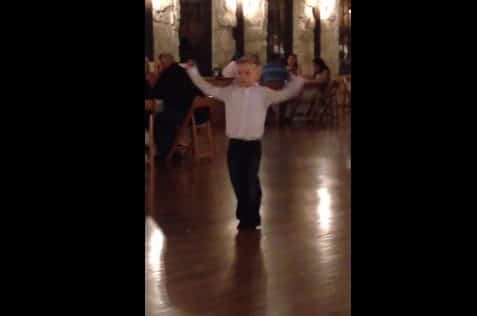
When the kid made a beeline to his chair the moment this obligatory dance concluded –a dance I assumed his mother had forced him to participate in– I imagined that some people might have been shocked at the manner he exited. I laughed. I thought it added to the spectacle. I laughed loud, believing that those that laughed while he danced would share my laughter. They didn’t. I received confused looks from those around me. His beeline exit did not elicit shock, or any other response. They’d moved on. I tried to, but I was fixated on this kid.

Some may have characterized this kid’s exit as a statement regarding what he thought of the art of dance, but I didn’t think that captured it. I thought that a desire to watch how this party would unfold fueled this kid’s exit.

The kid’s exit suggested that he was one that preferred to watch. It was aggravating to those of us that watched his initial dance steps and thought he had something to offer to this otherwise routine wedding reception. He didn’t appear to be the least bit embarrassed by his performance, so why would he prefer to watch?   

Psychologists state that we have mirror neurons in our brain that seek enjoyment from another’s perspective, and that that enjoyment can be so comprehensive that we may reach a point where we convince ourselves that we’re the ones performing these actions. Others describe it as a frequency of thought, or a through line to a greater understanding of being: being funnier, more entertaining, and better in all the ways an insecure, young man thinks that his elders are better. Honing in on this frequency is something that TV watching, video game playing nine-to-ten-year-olds know well. It goes beyond the joy of watching others make fools of themselves, for entertainment purposes, to a belief that when watching better performers attempt to be entertaining, we’ve achieved that level ourselves without having to deal with all the messy details involved in the trials and errors to get to that point.

I knew, even while I was doing it, how odd others might find it that I was obsessing over the actions of a nine-to-ten-year-old boy, in such an innocuous moment of the boy’s life, and I attempted to look away several times. Every time a member of the party made some kind of misstep, however, this kid would draw my attention by laughing harder than anyone else would. My guess was that the relief that he wasn’t one of those in the position to commit such errors fueled that raucous laughter. This kid would laugh so hard at every joke that it was obvious he wanted to be louder than any others laughing.

“He’s attempting to cross over,” I thought.

“What’s that?” my uncle said.

“What?” I said. “Nothing.” 

My uncle’s ‘What’s that?’ is often characterized by a preceding pause. The pause suggests that either they know that you’re talking to yourself, and they’re looking to call you out on it, or they believed the comment was situational, until they chewed on it for a bit and realized they couldn’t place it.

Whatever the case was, I hadn’t intended for anyone to hear that thought. I was embarrassed. I was embarrassed, but I also wondered if I intended to think that aloud, so that I might have it on the record if it went down the way I thought it would.

What I would not tell my uncle, for fear of being deemed one that is far too interested in self-serving minutiae, was that this ‘cross over’ is the Houdini milk can of the observer’s world. It is an attempt to establish one’s self as a participant in the minds of all partygoers without participating.

The initial stages of a crossover are not a difficult to achieve. Anyone can shout out comments, or laugh in an obnoxious and raucous manner that gains attention. The crossover does require some discretion, however, for it can be overdone. When one overemphasizes an attempt, they could run the risk of receiving a “We know you were there. You wouldn’t shut up about it” comment. The perfect crossover calls for some comments and/or attention getting laughter interspersed in the emcee’s presentation to lay the groundwork for the stories the subject would later tell others regarding his participation.

“He knows what I’m talking about,” the groom, acting as the emcee of the event, said at one point. He was alluding to Kevin, and Kevin’s over-the-top laughter.

It would be almost impossible for me to know if this kid achieved a total crossover, for I had no familiarity with the family, and I would have no opportunity to hear the kid’s after-party stories. The kid did accomplish an excellent first step, however, thanks to a groom that, I assume, had spent the last couple years trying to have the kid accept him as an eventual stepfather.

The answer to why I was so obsessed with a 9-to-10-year-old crystallized soon after the groom’s comment. Kevin’s mother called upon Kevin for increased participation. The kid waved her off. He waved her off in the manner I waved off so many of my own calls for increased participation. It dawned on me that my preference for observation went so deep that it was less about fearing increased participation and more about a preference for watching others perform that was so entrenched that any attempts to have me do otherwise could become an obnoxious distraction.

That’s me in the corner I thought. That’s me in the spotlight, losing my sense of belonging.

“You were just integral to the party,” I wanted to shout out to that kid with such vigor that I would’ve revealed myself. “Why would you prefer to sit on the sidelines of your mother’s wedding?”

Could it be that this preference for observing has something to do with the idea that we’ve all been participants and observers in the audience at various points in our lives, and we’ve all witnessed this idea that those roles can somewhat interchangeable in people’s memories? Unless the participants are so over-the-top funny, entertaining, or in all other ways memorable, observers have can manipulate the memories of participants, if they know how to enhance their role as an astute observer.

When one is an athlete, for example, the members of the audience may cheer their athletic exploits in ways that display the pride they might feel through vicarious connections. When an athlete commits an error, or underperforms in any way, they may feel sorry for the athlete, but they won’t associate with them in any meaningful way. They may not disassociate themselves from the athlete, depending on the error, but the error allows them to believe that put in the same position as the athlete was at the time of the error, they would not have committed it. ‘All you had to do was catch the ball,’ is something they may say, ‘and it was hit right to you.’

Some may view the desire to view an activity, as opposed to partaking in it, as a bit of a cop out. It may have been a cop-out for this kid, just as it may have been for me, but I do have fond memories of various events that I refused to participate in, in the same manner this kid might have of his mother’s wedding. I laughed with my fellow party goers, as we all recalled those past events that took place with fondness, and I did offer funny anecdotes to those conversations, but my role was often limited to that of an observer. Actual participation in these events was the furthest thing from my mind.

If this kid shared as many traits with me, at nine-ten-years-old, my guess was that he was already documenting stories that he would retell for years. Some of these stories might involve slight exaggerations regarding his role in them, but my guess is that few listeners would have the temerity, or the memory, to dispute him. Some of his versions of the story may offer interesting insights, and if those little vignettes involve creative, entertaining nuggets, they might become a part of the narrative in a manner that listeners to join him in making the leaps of re-characterizing his actual involvement.

If this kid manages to accomplish this, and he gets so good at it that others start corroborating his version of other events, he may make the leap to an almost-unconscious discovery of a loophole in his interactions that provide him a future out on all requirements of participation.

If he already does this, on a conscious level, and his evolution is so complete that he’s already choosing vicarious participation over actual participation on a conscious level, then that is where the similarities end. I thought he was too young for all that however, but I did consider the idea that he might be slipping into an all too comfortable position where he is neglecting the importance of participation on purpose.

The problem that I foresaw for him, a problem I now see as a result of watching him act out a page in the first chapter of my autobiography, was that he was learning what to do and what not to do through observation alone. I considered this portal equivalent to the type of learning one can experience while watching too much TV and playing too many video games, with all the same vicarious thrills of victory and dissociative feelings of failure. I also thought that he would come to a point where he had problems learning the lessons, and making the vital connections, we only make by doing. If I had been in a position to advise this nine-to-ten-year-old of the lessons I’ve learned, but did not heed at his age, I would’ve shouted:

“Get back on the dance floor, kid! I don’t care if you were already out there. Get out there and do it. Then get out there and do it so often that you tailbone is on the line and you’re making an absolute fool out of yourself. Then, when that obnoxious observer steps up to laugh at you for making such a fool of yourself, you can turn on them and say, ‘At least I was out there. Doing it! What were you doing? Sitting on your can watching me!’”

If you enjoyed this piece, you might also enjoy the other members of the seven strong:

The Thief’s Mentality

He Used to Have a Mohawk (This is not a prequel to this piece, but it is another story that occurred in the same wedding.)

A Simplicity Trapped in a Complex Mind

You Don’t Bring me Flowers Anymore!

… And Then There’s Todd

When Geese Attack!

Faith No More: Sol Invictus


Three things that are consistent with just about every review of Faith No More’s (FNM) latest output Sol Invictus: It’s been 18 years since 1997’s album Album of the Year; the single Epic was their greatest hit; and the boys in the band were considered zany back in the day.  The rock critics also make the leap from that latter point to suggest that that zaniness eventually created a rap/funk/rock movement that we’re all familiar with today.  (Side note: Anthony Keidis, and the Red Hot Chili Peppers have hotly contested the idea that FNM created this movement.)  Most of the critics also speak of the multitude of projects that the band members have been involved in since the 1997 album, and the fact that the album is named after a Roman Sun god.  What is not stated in any of these reviews is that the very idea of an FNM reunion is emblematic of the dire straits of the music industry as a whole.

Faith-no-More-Sol-Invictus-Cover1This isn’t to say Sol Invictus is a money grab, or at least it doesn’t sound like it was.  Yet, the reunion is evidence of something that members of this band, Pavement, and to varying degrees Soundgarden, Blur, and The Verve, said would never happen.  Or, if they never said “never”, they suggested it would be a cold day in hell before they even considered it.  FNM fans would probably argue that the reunion was spawned by how well the members of the band got along together in their most recent European, reunion tour.  If we conceded that point, and we have to to some degree, we could hit those same fans with the question: why did they get together for that tour in the first place?

In the eighteen years that have followed the dissolution of the FNM, lead singer Mike Patton was often asked about the possibility of them ever getting back together again, and on one occasion he said, and I paraphrase:

Every so often, a guy will approach me with a suitcase full of money and a plan for how the reunion of Faith No More will work.  Maybe if they would offer us two suitcases we could talk.” 

To be fair, Patton never hinted that there was animosity within the band, and he never said never, but he did leave the impression that it would be a cold day in hell.  Those of us that pined for a reunion, and parsed Patton’s words for hope, read him speaking about fond memories, and a recognition that none of what he did after FNM would’ve been possible were it not for FNM.  We read interviews in which he said he learned so much about the craft from those days, and that he was eternally grateful for the opportunity they gave him (my words).  We also read him say that he had learned to put the past behind him, and that he felt that they had all reached a creative peak with one another on their last album, and we read lines that amounted to him hoping that no one would hold it against him, but that he was just not interested.

Unless, perhaps, the industry fell to such a level that no one could make money anymore?  Unless the dire straits of the industry reached a point where wives were approaching the former band members with employment brochures from the local life insurance company?  Hell may not have frozen over, as it did with the Eagles, but there is an apparent point where even the most stubborn artist can no longer laughingly reject that guy with one suitcase full of money.

It may seem like unnecessary cynicism to include such a point, and it may be sad to think that it reached that point for these gifted musicians, but there does come a point where pole dancing around the elephant in the room becomes so tedious that someone’s got to jam a thumb in it.

One, almost universal complaint of the album Sol Invictus, from these rock critics, is that it is not breathtakingly original.  The track Sunny Side Up was singled out for the theme of criticism leveled at the album as an example of how FNM followed their soft-loud-soft formula a little too closely.  Any fans of the lead singer Mike Patton know that the man has not followed a formula in many of his works, and that he has numerous artistic, and largely inaccessible albums in his catalog.  My contention is that once you’ve established your bona fides as a risk-taking, boundary-breaking artist, you can go ahead and make more accessible albums.  There is a trade-off, in other words, in which a true artist shows that he can nimbly cross borders without doing damage to his artistic core.  And while Faith No More may be more accessible, and more formulaic, than many of Patton’s other projects, FNM’s definition of accessible and formulaic is far more creative and artistic than the many other, computer generated artists in the modern day lists of music.

The one track that some of these reviews list as a standout in originality, on the Sol Invictus album is: Matador.  Consider me too well-versed on 80’s hair metal bands if you want, but I consider this song to be heavily influenced by the Warning and Rage for Order-era Queensryche albums.  While this track may be original in the FNM catalog, it is not breathtakingly original as far as I’m concerned.  I do understand that most people don’t have a thirty-year reference base, but one would expect someone from the world of rock critics to pick up on this one.

One decent excuse for wanting the material on Sol Invictus to be more original comes from Ms. Zoe Camp from Pitchfork.com:

There’s nothing necessarily wrong with a band repeating itself. But because Faith No More have such a long history, and their members are responsible for music in a staggering array of styles, it’s hard not to expect more, to wish that they might in some way top themselves, or at least change direction.”

Among the influences that Zoe Camp, and Adam Workman of The National, list for Faith No More (FNM) is Nirvana?  Nirvana?  How could anyone listen to any FNM song and think Nirvana?  FNM actually came out before Nirvana is a point that I would make in this argument.  There’s absolutely nothing wrong with Nirvana, of course, but comparing the two sounds is like comparing Neptune and Venus.  They’re both planets, and their existence is influenced to varying degrees by the Sun, but the comparisons really end there.  I realize that one of the members of FNM was friends with Kurt Cobain, but unless these critics are privy to information I don’t have, I don’t know how anyone could list Nirvana as an influence.  One song Star A.D., was supposedly an homage to Cobain, but lead singer Mike Patton has denied even that.  Perhaps these two reviewers were attempting to frame the era in which these two bands were popular, but other than that I don’t see a Nirvana influence in any FNM songs or albums.

Most FNM fans, aching for new material, were a little disappointed by the November 2014 single MF.  For those unacquainted with the single, the full name of the single is the swear word.  We feared that this was a hint of the material to come.  The song itself is decent, but we feared that FNM was trying too hard to be racy, naughty, and that it was a cover for a lack of creative ingenuity in the manner that a stand up comedian with subpar material tries to tap into the audience’s preference for a tableau that is titillating and exciting through swears.  Not only that, but there was the “act your age” element to it that led some of to believe that these fifty-something rockers were trying too hard to sound young.

When the Superhero track was released, some of us were relieved.  Did it sort of plagiarize other material in FNM’s back catalog?  Or, could it be stated that it was a Patton-influenced Tomahawk-like track?  Whatever the case, it was an excellent re-introduction to the FNM sound.

Some of the reviews focus some of their space on Mike Patton’s lyrics.  In my opinion, as I’ve stated in a number of music reviews, when you isolate most lyrics from the music, they are actually pretty mindless.

Lyrics,” as Patton has said many times, “simply fit the music.  Lyrics, or vocals, at their best, should be used as nothing more than another instrument in a song.  No more, no less.”  (Paraphrase.)

If you are still a Mike Patton fan, at this point, you’re not one that demands that he fulfill some sort of unquenchable thirst for knowledge and philosophy you have in his lyrics.  A fairly decent chunk of his output involves non-verbal, guttural sounds, and some of it is even in a foreign language.  Some of the great lyricists in rock history have stated that they were surprised by the effect their lyrics had on people. The reason for this, we can only guess, is that it was not their intention to be thought-provoking, as much as it was to provide “cool” imagery in word collages made famous by William S. Burroughs, and later used by David Bowie.

Most lyricists are not trying to be philosophers, social commentators, or poets, and they’re not trying to write that college thesis that they never had the chance to write after dropping out of school to pursue the dream of being a musician.  The import given to most rock lyrics occurs in the creative minds of rock critics mining the material for something they can expound upon.  If I had the ear of a rock journalist for one minute this would be my plea, get over your obsession with lyrics, they mean far more to you than anyone else.

Chris Conaton of Pop Matters writes that:

Sol Invictus probably isn’t going to top Angel Dust or The Real Thing on most fans’ lists of favorite Faith No More albums, but it’s a step up from Album of the Year and holds its own with the strong but slightly bloated King for a Day, Fool for a Lifetime record. This is a solid comeback album that succeeds on its own terms. Namely, the whole band sounds engaged and enthusiastic to be working together, and that’s good for everyone that’s ever had a vested interest in Faith No More.”

The very idea that anyone that follows what “most FNM fans” think would consider The Real Thing for their top FNM albums’ list reveals that that person has no idea how most hard-core, longtime FNM fans think.  Most of them don’t even mention The Real Thing on FNM discussion boards.  Perhaps those that are just now learning of FNM, or those only familiar with FM radio’s version of FNM would consider that album for their top two.  For most of us, however, The Real Thing put FNM on the map, and we’ve moved past it to such a degree that unless we’re bit by the retro bug, it is growing dust in our basement.  Most true fans would surely agree that Sol Invictus is not going to cause anyone to forget Angel Dust, however, and the point about King for a Day, Fool for a Lifetime would probably lead to some debate, but Mr. Conaton’s greater point about Sol Invictus appearing to be more of a creative interest for the band, than a purely financial one appears to be a strong one.

Reading through the critical reviews of this album, and all album reviews, this reader gets the sense that most rock critics are less concerned with you actually buying the album, in question, than they are getting you to scroll up to see the writer that wrote the review.  They use huge, lofty words to describe the band’s history, and they use flowery language to describe the intricacies of the music involved on the album.  It is, of course, incumbent on them to prove some mastery of both in any album review, but some critics get so out of hand that it can appear a little self-indulgent at times.  Sol Invictus is a hard rock album that will remind you why you fell in love with the artistic brilliance of Faith No More in the first place, and just about everything that Mike Patton has involved himself in over the past twenty-five years.  The fact that the music therein will never cause the hardcore, longtime fan of FNM to forget Angel Dust; coupled with the fact that the lyrics will never cause you to forget Robert Frost should not deter you from purchasing an album that someone finally approached them with two suitcases (or the one that is now more valuable in the current climate of the music industry) shouldn’t deter you from purchasing what happens to be a damn good, hard rock album.

Anti-Anti-Consumer Art


I may be in the minority, but I prefer the work of angry, bitter artists who are unable or unwilling to adjust to cultural norms. If I deign to offer an artist my bourgeoisie, Skittle-eating, domestic beer-drinking, and modern TVwatching opinion on their artistic creation, and they don’t hit me with a red-faced, spittle-flying, “Your opinions are excrement!” rebuttal, I might begin to question if they have the artistic temperament I require of those who lack any other means of venting their rage on the world than through artistic creation.

If I am to view their art in a serious manner, they had better view me as a symbolic substitute for the America-loving, God-fearing, football fan of a father they had, the man who ruined everything they held dear in their youth. I want them to view me as a symbolic substitute for the art critic who deigned to call their work pedestrian, the fellow artist who told them, “You’ll never make it in the art world,” or the art teacher who advised, “You might want to seriously consider changing your major to economics.”

The path to artistic purity is different for every artist, of course, but for most true artists, the primary motivation is not to create pieces consumers enjoy. For the great majority, the struggle of artistic expression is to locate and expound upon their individualistic interpretation of nouns (people, places, and things). While the idea that others may share a love for their interpretations might be exciting and fulfilling, it is not why they feel the need to express themselves. Outside adulation is of secondary concern to them, but it is also gravy. Some, however, create complicated pieces of literature or other forms of art for the expressed purpose of airing their complications. For these artists, the loathing they harbor for the common man’s opinion is so complete that they’re often looking at something else before we can complete our second sentence. Even authors of bestsellers, writing for the sole purpose of writing a bestseller, will argue until they bleed that their intention was not to create something consumers love. “I just happened to accomplish that,” they might argue, as if popularity was an inadvertent side effect of the quality of their creation. No matter how much we might disagree, we really can’t blame them for if they state that they intended to create a product of mass appeal, few would consider them serious artists.

If a starving artist declares how much they love their fans in their artistic statement and they’re hoping to one day see their art exhibited in a New York City gallery, they may do well to avoid the heartache, and headaches, and just consider another profession. If they have that mindset, it might behoove them to try out for the Atlanta Falcons instead. The chances are probably better that they’ll make that team than any team of artists considered for an exhibit in a New York City art gallery. A true artist can say they value input from those who have experienced their work, but they must word these critiques in such a manner that adamantly avoids any form of fan appreciation.

The best chance an artist has for achieving a spot in a prestigious gallery is to condemn everything purported by the consumer standing before them. Their best bet, in fact, is to find an artistic method of denouncing everything everyone believes in, to generate and work from an anti-consumer theme.

The anti-consumer theme has a timeless quality about it, one that goes to the heart of the artist. Its provocative nature does not yield to pop culture winds. It is anti-pop culture and a hot ticket in any era that appreciates its artists.

Little old ladies, in a blatant attempt to appear young and hip, will walk up to an artist in these galleries and try to find some way to tell the artist they find the most disturbing pieces in their portfolio, “Wonderful”, “Amazing”, and “Wonderful and amazing!”

“You are so not my demographic,” a true artist of an anti-consumer piece of art might say in the wake of such comments coming from a little, old lady. A vehement rejection of this sort could enshrine the artist in the word-of-mouth halls of the art world, and their opportunity for such prestige might increase if they added some sort of exclamation to that rejection, such as a healthy stream of spittle dropped on the little old lady’s shoes.

Receiving a compliment from a little, old lady must put an anti-consumer artist in an awkward place. Most artists feel a reflexive warm glow rising whenever they receive a hard-earned compliment from anyone, but the non-conformist artist knows better than to concede to some display of it. The intention of their creation was to reject everything most consumers hold dear, its purpose was to disturb the little old ladies of the world, and its goal was to shake up her conformist mindset. To hear that such a woman allegedly gets the artist’s attempt to disavow and denounce her generation –the generation that the artist purports screwed us all up with their toys, and wars, and unattainable gender-specific imagery– must be vexing for the artist.

Thus, the best way to handle such a situation might be to spit on her shoes. An enterprising, young, anti-consumer artist might even want to create such a scenario in which such an opportunity will arise. They might want to use a found-footage, shaky cam method of capturing the scene for a publicity junket. The artist who pulls such a situation off might just become the talk of the town if she managed to pull it off.

“Did you hear what happened when some old bag complimented Janice on her anti-fifties piece?” other artists would say to one another. “She spit on her shoes.” If such an incident made it through the artist community grapevine, it could become part of the artist’s folklore.

Criticism from some remnant of the 1950’s would be the next-best reaction for the angst-ridden, bitter, angry, anti-conformist artist. “Good, it was meant to unsettle you,” the artist could say. “Its purpose was to cause you to reexamine all the harm your generation has caused us.”

If the patron is not of the fifties generation and they deign to criticize anti-consumer art, they might want to consider the idea that they might be part of the problem. The artist might instruct them to venture outdoors more often to find out what’s going on in the world, or they may want reexamine the full scope of the artist’s narrative. The sociopolitical theme of anti-consumerism invites and hopes to incite criticism, because it is immune to most criticism by its very nature. If that were true, why wouldn’t a curator want their gallery lined with anti-consumer pieces?

The anti-consumer artist doesn’t have to worry about using current products in their projects either, for an anti-consumer artist can employ whatever consumer-related products are necessary to denounce the ethos of an era. A pro-consumer piece does not have such allowances, for to try to create an artistic expression that professes an enjoyment of Superman cereal, the consumer must have some experience with Superman cereal, in order to relate to the theme. That piece will likely evoke little more than some elements of quaint nostalgia. If the artist is unwilling to include some underlying, angst-ridden subtext regarding all the ways in which eating Superman cereal created unrealistic expectations in the patron’s mind and thus messed up that patron’s childhood the artist can be sure the piece will not fetch the kind of price that a bitter, condemnation of being forced to ingest the cereal (and thus the ideals of Superman as well), will.

Is there a sliding scale on anti-consumerist statements? I’m sure many anti-consumer artists would love to know it. If their piece contains subtle, sophisticated irony in its anti-consumer theme, with an ironic twist, what kind of return can they expect for their time? Are vehement declarations of such themes more profitable? Does the price point increase in conjunction with bullet-point adherence to the sociopolitical, anti-consumer theme?

The amount of anti-consumer art for sale in a gallery can be overwhelming, for this has become the most consumer-related, rebellious, radical theme for starving artists to pursue. In fact, “What are you waiting for?” might be the question that fellow artists and curators have for those who hold out. They might even inform the holdouts that anti-consumer art has become the safest theme to explore for any artist that wants to have their work exhibited.

Curators don’t have to worry about fads or trends in the art world, for the very idea of fads and trends violate the anti-consumer artist’s tenets. All a curator has to do is rotate collections of anti-consumer art year round, and their gallery can exist in the radical, counterculture milieu 365 days a year.

How long have anti-consumer pieces held primo spots in top galleries around the nation? One would think the ubiquity of this anti-consumer theme in art galleries would invite a rebellion that would expose it as the market force it purports to detest. It would take a rebel willing to expose the counterculture in their work, regardless of how it affects their pocketbook, because the current art world would not view their work favorably.

As such, framing the concept of their piece would provide an obstacle for the rebel. The rebel would have to word their artistic statement carefully, for it would be career suicide to have their anti-anti-consumer art confused with pro-consumer art.

Grimace-e1414637657704
“Eat at McDonald’s”

“It says ‘Eat at McDonald’s,’” a curator might say with absolute disgust.

“Right on,” the anti-anti-consumer artist would reply. “It’s my attempt to highlight the stereotypical art of anti-consumerism. My portrayal of the McDonaldland character Grimace is used as a vehicle for the larger idea through which I attempt to explore the tendency our counterculture has to use social media and propaganda to prescribe narrow, contrived definitions of art to individuals and the nation.”

The hip, avant-garde patrons of an art gallery would be prone to view the anti-anti-consumer artist’s piece as a stab at consumerism that contains sophisticated irony. They might consider it quaint, hilarious, and an incredible salvo sent to consumers around the world, the people who really don’t get it.

If this anti-anti-consumer artist was available for a Q&A session, and the artist made the mistake of imploring their artistic friends to accept their anti-anti-consumer theme for what it is, the hip, avant-garde smiles would likely flatten. Some might consider the piece obnoxious, and they might even consider the anti-anti-consumer artist a whore for corporate America.

“I just want to celebrate the history and tradition of the McDonaldland character Grimace,” the anti-anti-consumer artist’s intro would be. “My painting is an effort to explore all the joy and happiness Grimace has brought to so many lives.”

“Is that sophisticated irony?” the patrons would ask.

“No. It’s an anti-anti-consumer theme that I am attempting to explore here.”

“So it’s … a pro-consumer statement?” one of the more obnoxious patrons might say to intrude upon the artist’s pitch.

“Good God, no!” the artist must respond, if they hope to generate the amount of interest that might result in a sale.

If the anti-anti-consumer artist has the artistic temperament of one who doesn’t care about the sale, however, and they’re able to maintain focus on the artistic theme, they might have to engage in a substantial back-and-forth with the patrons of their piece before they conclude that the artist isn’t putting them on or being obnoxious.

As stated earlier, being obnoxious in an anti-consumer theme is not just acceptable it’s expected. Stubbornly pursuing an anti-anti-consumer stance, however, will cause others to deem the artist obnoxious and pro-consumer.

Thus, attracting patrons to the anti-anti-consumer exhibit would not even represent the beginning of the artist’s problems, as no self-respecting curator would deign to display their work. I’m guessing most curators aren’t bad people, and they might even have some sympathy for this anti-anti-consumer artist’s frustrations. If the curator’s knowledge of the industry was such that they knew enough about it to be objective, they would probably sit the artist down to inform them of the inner workings of the industry.

“I know you are a passionate artist,” the curator might say, “but you really should reconsider this whole anti-anti-consumer theme. I know you built it to counter the counter, but you should know that this will not play well over the long haul. If you want serious cachet in the art world, there are two genres to consider. These genres include art built on an anti-consumerism theme and the anti-consumer works that are vehement in their theme. I suggest you drop this whole anti-anti-consumer artistic statement and make it known that your work contains a subtle, sophisticated irony with an anti-consumer twist, if you ever hope to sell anything.”

If the anti-anti-consumer artist somehow managed to achieve some degree of success with their theme, they would likely become the scourge of the art world. At some point, fellow artists would also approach the artist, as a coalition of condemnation for the audacity of the anti-anti-consumer theme. “You’re ruining this for all of us. Why would you do this to us? What do you think you’re doing?”

The anti-anti-consumer artist should look them in the eye and ask, “Is that subtle, sophisticated irony?”