“Who would win in a fight Godzilla or King Kong?” was a question that was asked by just about every kid I knew growing up. “What about Batman versus Superman, or how about The Six-Million Dollar Man and Big Foot?” With that mindset forever entrenched in my skull, I was intrigued when I learned that one of our society’s most popular satirists would be taking on one of our most popular philosophers.
Larry David’s Clear History is a satirical comedy, not a philosophical treatise, so the movie should be given some artistic license when it attempts to deconstruct, refute, or simply poke fun at one of Ayn Rand’s most famous books The Fountainhead. The question that every viewer should ask themselves is where does that artistic license end, and the requirement of factual refutation begin? As it has often been said, a satirist can be humorous when poking fun at various institutions, but he can be hilarious if he adds an element of truth to his satire. In this vein, Clear History is not hilarious.
Some would say that those who are so bothered by the content of a movie that they can’t enjoy something as simple as a simple comedy without analyzing it to death, need to relax, get out more, or have more relations with the opposite sex. It’s a fair point, but isn’t it also a fair point that if these movie makers are going to attempt to satirically refute one of the most famous books of all-time (Ayn Rand’s The Fountainhead) that the material might be more effective if they did so in a more accurate manner? Why even mention the book, much less make it an ongoing theme of your movie, if that wasn’t their goal? If the screenwriters simply wanted to provide light humor, why didn’t they just invent a book, and that book’s writer, for Will Haney character’s inspiration? They could then more easily refute any claims of inaccuracy by those who believe that they didn’t properly represent the book in question.
Even if the writers wanted to avoid the heavy handed task of providing exact refutation, and their work of light humor was only going to trim the edges of Ayn Rand’s philosophy, for the purpose of providing their audience a base from which light humor and sight gags would spring, we should require those satirists to get the subtext of her philosophy correct, for proper, albeit humorous refutation. If that satire’s main character is going to portray an anti-Rand character (Nathan Fromm), shouldn’t we require his adversary (Will Haney) to properly represent the Rand character, if for no other reason than to have a proper adversarial relationship … Even if it’s for no other reason than to have humorous exchanges, or to have a subtext that hints at those philosophical differences?
There are moments in the movie where it appears as though the writers purposely avoided representing the Ayn Rand philosophy accurately, that they don’t understand the greater import of her message, or that they simply wanted to provide their “impossible to grasp” interpretation of it. One of the few direct interpretations of The Fountainhead’s main character, Howard Roark, involves a swear word that characterizes Roark as one of the meanest characters in the history of literature.
Teenagers use this swear word, in this manner, to provide their listeners with an all-encompassing dismissal of the chosen object of their scorn, and that’s all other teens need to follow a fellow teen’s dismissal of their subject. Adults often need more. Adults may allow the speaker to dismiss a person with a swear word, especially for the sake of humor, but they often require more if they are going to join the speaker in their attempts to dismiss a person, or an idea. Even if said adults aren’t willing to join the speaker in the condemnation of a subject, they usually enjoy the blows delivered in an epic battle, but even then, even for the purpose of satirical refutation, most adults prefer to have an element of truth added for added amusement.
When I learned that a mighty satirist would be taking on a mighty philosopher, I thought of all of those speculative epic battles that we talk about in our youth. When I saw my satiric hero had another character in the movie deliver a blow below the belt, characterizing Ayn Rand’s character Howard Roark with a swear word that was supposed to define him as one of the meanest characters in the history of literature, I knew this wouldn’t be a fair fight. Even though I knew that the protagonist’s adversary (Ayn Rand) in this epic battle was no longer alive to counter punch, I knew the fightwould be called early.
It strikes me that when we create a satirical piece, we have one shot. We have to combine a substantive take with clever inserts of humor. It’s a juggling act that allows some room for error, as long as the premise is true. Doing otherwise leaves the audience thinking, “Ok, you don’t like Ayn Rand, or the Fountainhead. We got it. Now tell us why we shouldn’t.”
Then, when I realized that this below the belt punch was going to be the best blow in the arsenal of one my favorite satirists, watching the rest of Clear History proved to be as sad, and as depressing, as watching Muhammad Ali battle Larry Holmes and Mike Tyson battle Lennox Lewis at the end of their careers. This isn’t to say that I think Clear History spells the end of Larry David’s career, or that he’s in any way past his prime, but that he had one awful match in which he proved to be out of his weight class.
“The reason we struggle with insecurity,” notes Pastor Steven Furtick, “is because we compare our behind-the-scenes with everyone else’s highlight reel.”
Some quotes educate us on matters we know nothing about, but the ones that stick take a matter we know everything about and puts a clever twist on it that changes our perspective. We all know failure, or some level of it, at various points of our life. Some of those failures have shaped us in profound ways that we assume everyone remembers them the moment we enter a room, and some people will, but will they remember their own, or will they compare our failings to their highlight reels.
Pastor Steven Furtick
“Acknowledging failure,” Megan McArdles writes in the book The Up Side of Down: Why Failing Well is the Key to Success, “Is a necessary first step in learning from it.”
Some of us are old enough to remember the severe penalty for missing a rung on the monkey bars. An erroneous grab, at the very least, could land a victim center-of-attention status, as we attempted to find our feet. At worst, it would cause the pack of onlookers to send an emissary to the office with a call for assistance. These everyone-is-looking-at-you moments are so immersed in embarrassment, and pain, that few can see any benefit to them.
Most of those liable for such situations, have lowered the monkey bars, and made the ground so forgivable that one would have to fall from a skyscraper to receive any pain. Thanks to these and other technological advances, fewer children get hurt on playgrounds, fewer playground manufacturers get sued, and everyone is much happier. There is one casualty, however, the pain of failure.
No one wants to see a child cry, and we should do everything we can to prevent it, but pain teaches us.
After a near fall in a supermarket, the checker complimented me on the agility and nimbleness I displayed to avoid hitting the ground. “It could be that,” I returned, “or it could be said that only someone so well-practiced in the art of falling knows how to avoid it.”
I eventually did touch ground a short time later, at a family reunion. I also touched a parked car, and then I touched the ground again. Among the lessons I learned is that pain hurts. Had it been a simple fall, it would be hardly worth noting. This was one of those by-the-time-this-ends type of falls everyone will be looking, some will be concerned, and most will be laughing. I thought I corrected my trajectory a number of times, but I was moving too fast. By the time it was finally over, I silenced just about everyone in the vicinity. The kids around me laughed, as kids will do when anyone falls, and my age-denying (Not Defying!) brother laughed, but if the Greg Giraldo line, “You know you’re getting old when you fall down, no one laughs and random strangers come running over acting all concerned,” is true, then I am getting old.
Most lessons in life are learned the hard way, and they are often learned in isolation, in that even our closest friends and family members distance themselves from us in these moments, so that they have no association with them. These dissociations range from laughter to sympathy, but the latter can be just as dissociative as the former if it’s done a right. The point is, no matter how we deal with these moments of failure, we usually end up having to deal with them alone.
The point is that the lessons learned through pain and embarrassment, are lessened by lowering the monkey bars, providing a forgiving ground, and instituting zero tolerance bully campaigns. The point is that those of us that see little-to-no benefit derived from bullying, or that any benefits are inconsequential when compared to the damage done by the bully may eventually see the fact that few lessons in life are learned by the individual, until those kids enter adult arenas.
A quote like Pastor Steven Furtick’s, also tells us the obvious fact that we’re not alone in having moments of failure, but that those that can deal with them in the proper perspective might actually be able to use them to succeed on some levels.
Artistic Creations
Any individual that attempts to create some form of art knows more about comparing another’s “highlight reels” to their “behind-the-scenes” efforts better than most.
How many times did Ernest Hemingway grow insecure when comparing his behind-the-scenes efforts to the shining lights that preceded him? How many times did he fail, how many times did he quit, and give up, under that personally assigned barometer, before finally finding a unique path to success?
Even in the prime of his writing career, Hemingway admitted that about 1 percent of what he wrote was usable. Think about that, 1 percent of what he wrote for TheOld Man and the Sea, was publishable, worth seeing, and that which Hemingway considered worthy of the highlight reel that we know as the thin book called The Old Man and the Sea. The other 99 percent of what he wrote, proved to be unpublishable by Hemingway’s standards. Yet, this highlight reel of the Old Man and the Sea writing sessionsare what has inspired generations of writers to write, and frustrated those that don’t consider all of the behind-the-scenes writing that never made it in the book’s final form.
Mark Twain
“Most of what Mark Twain wrote was dreck,” writes Kyle Smith.{1}
Most of us know Tom Sawyer and Huckleberry Finn, the highlight reels of Mark Twain’s writing. We know the infamous Twain quotes that occurred in the numerous speeches he gave, and the essays that he wrote, but it is believed that he wrote as many as 50,000 letters, 3,000 to 4,000 newspaper and magazine articles, and hundreds of thousands of words that were never published. Twain also wrote hundreds of literary manuscripts—books, stories, and essays—that he published, and then abandoned, or gave away. Almost all of it has been discovered over the last century, and placed in a home called The Mark Twain Papers.{2}
Very few of us are so interested in Mark Twain, or any of his writing, that we want to read his “dreck”. Very few of us are so fanatical about Twain that we want to know the material he, and his publishers, deemed unpublishable. Yet that “dreck” ended up fertilizing the foundation of his thought process so well that he churned out two highlight reels that many agree to be historic in nature. Similarly, very few would want to want to watch a Michael Jordan, or a Deion Sanders, practice through the years to tweak, and foster their athletic talent to a point that we now have numerous three to four second highlight reels of their athletic prowess. Their behind-the-scenes struggles may provide some interesting insight into their process, but they’ve become a footnote at the bottom of the page of their story that no one wants to endure in total.
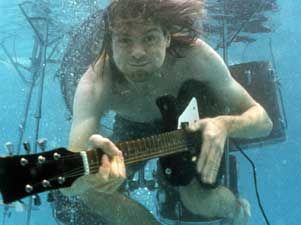
Kurt Cobain
When we hear the music contained on Nirvana’s Nevermind, we hear a different kind of genius at work. We hear their highlight reels. We don’t know, or care, about all of the “dreck” Kurt Cobain wrote in quiet corners. Most of us, don’t know, or care, about the songs that didn’t make it on Nevermind. Most of us don’t know, or care, about all the errors he committed, the refining, and the crafting that went into perfecting each song on the album, until the final form was achieved. We only want the final form, the highlight reels, and some of us only want one highlight reel: Smells Like Teen Spirit.
On an album prior to Nirvana’s Nevermind, called Bleach, Kurt Cobain penned a song called Floyd the Barber. “Where does the kernel of a song like that start?” Soundgarden’s Chris Cornell asked. Cornell may not have come from the exact same background as Cobain, and he may not have been influenced by the exact same artists as Cobain, but he presumably felt like his creative process was so close to Cobain’s that he couldn’t fathom how the man achieved such divergence from the norms of musical creation. Those familiar with Cobain’s story also know that he was heavily influenced by the music of Soundgarden, and that fact probably confused Cornell all the more.
Other than Soundgarden, Cobain also loved Queen, The Beatles, The Pixies, The Melvins, and a number of other lesser known bands. How much of his early works were so similar to those artists that no one took him seriously? As I wrote earlier, it’s a major part of the artistic process that every artist goes through to attempt to duplicate influential artists in some manner. It’s a step in the process of crafting original works. When that artist duplicates those that came before them often enough, the artist (almost accidentally) begins to branch off into building something different … if they have any talent for creation in the first place.
Divergence in the artistic process
Few artists can pinpoint that exact moment when they were finally been able to break the shackles of their influences, for it happens so progressively that it’s almost impossible to pinpoint. Most artists do remember that moment when that one, somewhat inconsequential person said that some aspect of their piece wasn’t half bad however. At that point, the artist becomes obsessed to duplicate, or replicate, that nugget of an idea. Once that nugget is added to another nugget, those nuggets become a bold idea that wasn’t half bad. Once that is achieved, another bold idea is added, until it all equals a “halfway decent” compendium of ideas that may form something good. At that point, the artist believes he has something that others may consider unique enough to be called an artistic creation in its own right. When enough unique, artistic creations are complete, the artist may eventually achieve their own highlight reels.
When did Cobain finally begin to branch off? How did he become divergent, and creative, and different on a level that made him an organic writer to be reckoned with? How many casual statements, spray paintings on walls, and other assorted personal experiences had to occur before Kurt Cobain had the lyrics for Nevermind? How many different guitar structures did Cobain and company work through, until he arrived at something usable? How many Nevermind lifted music or lyrics from other failed songs, casual strummings in a closet, and offshoots of other guitarists? What did Floyd the Barber, Come as You Are, and Pennyroyal Tea sound like in those moments when they first found their way from notepad to basement practice sessions? How many transformations did these songs go through in those practice sessions, until they were entirely original, and transformative, and legendary additions to the albums they were included on? If Cobain were alive to answer the question, would he acknowledge that Nevermind is a 1% highlight reel of about a decade of work? Most of us don’t care, we only want to hear the highlight reels, so we have something to tap our finger to on the ride home from work.
Cobain’s highlight reel, Nevermind, proved to be so popular that record execs, and fans, called for a B-list, in the form of the album Incesticide. That album proved Cobain’s B-list was better than most people’s A-list, but what about the D-list, and E-list songs that proved to be so embarrassing that no one outside his inner circle ever knew they existed?
The point is that some of us are so influenced by an artist’s highlight reels that we want to replicate it, and duplicate it, until we become equally as famous as a result, and when we don’t, we think that there is something wrong with us. The point is that the difference between a Mark Twain, a Hemingway, a Cobain, and those that compare their behind-the-scenes work to an influential artist’s highlight reels is that while these artists recognized that most of what they did was “dreck”, they also knew that their behind-the-scenes struggles could be used as fertilizer to feed some flowers.
So, the next time you sit behind behind-the-scenes of your computer keyboard, tattered spiral notebook, or whatever your blank canvas is, remember that all of those geniuses —who so inspired you to be doing what you are doing right now— probably spent as many hours as you do staring at a blank page, or a blinking cursor, trying to weed through all the “dreck”, that every artist creates, to create something different, something divergent from all those creations that inspired them to create. You now know that they succeeded in that plight, but you only know that because the only thing you want to see, hear, and read are their highlight reels.
The Rilality for Album of the year goes to… Sufjan Stevens Illinois. I know it came out in 2005, but with every critic going bonkers over it back then, I decided I would hate it circa 2005-2006. In 2013, I realized I was wrong.
Runner up: Secret Chiefs Book of Souls Folio A. The most original album of the year by a mile. Folio A, like all Secret Chiefs’ albums, has very few lyrics. So, if you’re a lyrics guy, this album isn’t for you. It does have some of the most complex arrangements I’ve heard on an album since… the last time Trey Spruance decided to put out a Chiefs’ album in 2004.
In the age of iTunes, it appears that either it’s difficult for some artists to make complete albums, or it’s become increasingly difficult for me to listen to them, because iTunes has spoiled me into making my own shuffle albums out of the artists’ best individual tunes. ITunes has also opened my eyes to the filler that an artist loads his albums with, and I don’t listen to those individual tunes as often as I once did, just because they’re from “my guys”.
2013 was also a year where I moved past some of my guys, and once you’ve made the move past some of your guys, it’s difficult to go back. I used to hate it when people told me that they’ve just moved past Led Zeppelin. “They’re great and all, and I spent years listening to them, but I’m just done with them.” How can one move past Led Zeppelin I wondered. Then I did, and then I moved past Radiohead, Alice in Chains, Verve, and Soundgarden. The latter three groups regrouped, and I tried to get back into them, but I realized that in some manner that’s hard to describe, I’ve moved on. I moved on in a manner that if they came out with the most brilliant album they, or anyone else, could produce, I wouldn’t think it wasn’t as good as the body of work they produced back when they were my guys. The groups I listen to now may not be better, in the truest sense of the word, but they’re different, and when you move past a group you need something different.
The Rilality for Book of the Year goes to… You are Not so Smart by David McRaney. Again, it came out in 2011, but I’m not a professional critic, and as such I’m not held to time constraints.
Runner Up: I Wear the Black, by Chuck Klosterman. I disagreed with Klosterman as often as I agreed with him, and that’s exactly what everyone should want in a book. Klosterman is not meek when offering his opinions, unless he is criticizing staples in our society… like Bruce Springsteen.
The Rilality for the book of the year, next year, will probably go to: Going Clear by Lawrence Wright. The award winning writer of the terrorism tome The Looming Tower may have even topped that book with this one. I’m about halfway through this exposé on the religion, called Scientology, and I am obsessed. Wright is a ‘Just the facts ma’am’, Hemingway type of writer. For those that enjoy writing more in the Doris Kearns Goodwin mode, you may not enjoy this style of writing. For those curious about this religion –that were too young when the actual revelations occurred– this book is an account that is proving to be invaluable to this ever-curious reader that enjoys the ‘just the fact ma’am’ Jack Webb approach.
There are very few fiction writers that shocked me with their modus operandi in 2013. The last one to do so was Chuck Palahniuk. He was shockingly good, but something shocking isn’t always good. It may be that Palahniuk, and all other fiction writers have simply tripped my tripwire so often that I cannot be shocked by their prowess anymore, but I couldn’t find any piece of fiction shockingly well written in 2013.
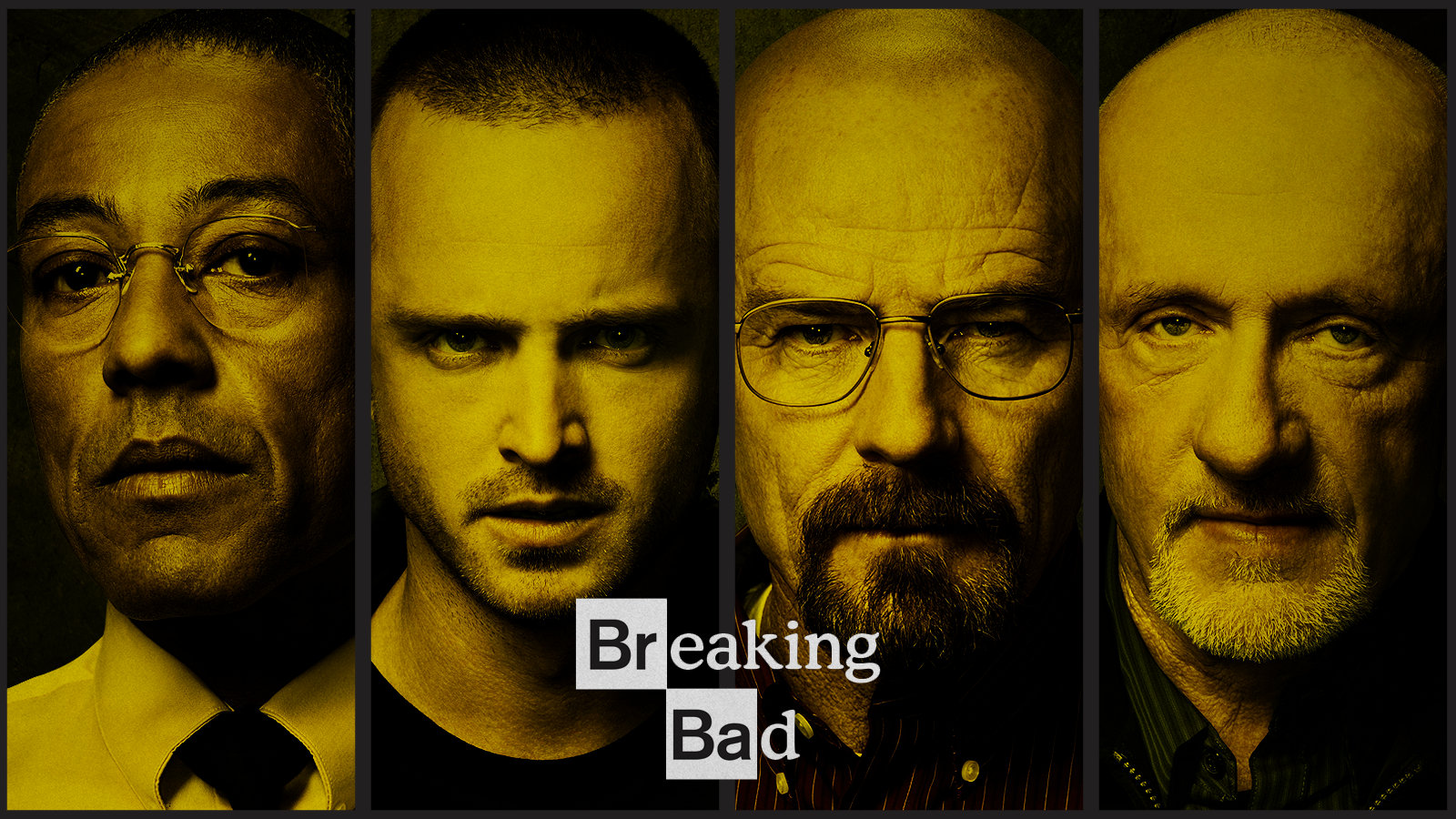
The Rilality for TV show of the year goes to… Breaking Bad. I would love to tell you the line that put the show over the top for me. I refer to it as the line, because the more I digested the subtext of what Walter White just said, the more my jaw continued to drop. Entertainment Weekly, Rolling Stone, and TV Guide focus on the moments of TV, but I focus on lines, and this was the best of the year in my humble opinion. It was such an incredible line that I wondered if Vince Gilligan, and his writers, had been sitting on the line for the past few seasons. I also wonder if Gilligan used the line in his pitch to the networks, as a way of summing up the series. I would love to tell you what this line is, but I don’t want to ruin it for all those people just now watching the series on Netflix, or DVD. The line needs to be heard, chewed, and digested individually for maximum effect. The line was so elemental to the series, that it separated Breaking Bad from all the gritty, new age style TV shows I have loved over the years, including, but not limited to, The Sopranos, Mad Men, and Justified.
One interesting nugget from the general reviews of this show was that some of the seasons were filler. My guess is that they probably were, but I have to wonder what the general perception of the show would be if it were but a three season series. “We want more,” might be the general outcry, and the five season arc seems more satisfying. I think The Sopranos followed a similar arc. The first two seasons are action packed, the studio AMC and HBO respectively, cried out for more seasons, and the writers happily complied by introducing filler seasons to complete the previously planned three seasons. It’s just a theory, of course, but I think all parties concerned feel more satisfied with five to six seasons than they would three.
Runner up:Justified. Boyd Crowder may be one of the most original, and finely crafted, bad guys ever created for TV. I know, I know, Crowder was created by Elmore Leonard for the short story Fire in the Hole. I read that story, and I recognized the gestational elements of the Crowder character there, but Justified’s writers Graham Yost, Chris Provenzano, Fred Golan, and actor Walter Gogginshave taken the Boyd Crowder character to a level I’m guessing Leonard had to find impressive. (Leonard obviously didn’t see the same possibilities of the Crowder character that the show’s writers did, as Leonard killed the Crowder character off in that short story.)
The other characters—Marshall Raylan Givens, played by actor Timothy Olyphant, and Chief Deputy U.S. Marshal Art Mullen, played by Nick Searcy—are also great, and dynamic, and almost as impressive, but the deliniations between great movies and shows is always the bad guy, and there aren’t any better on TV today than Goggins’ Boyd Crowder.
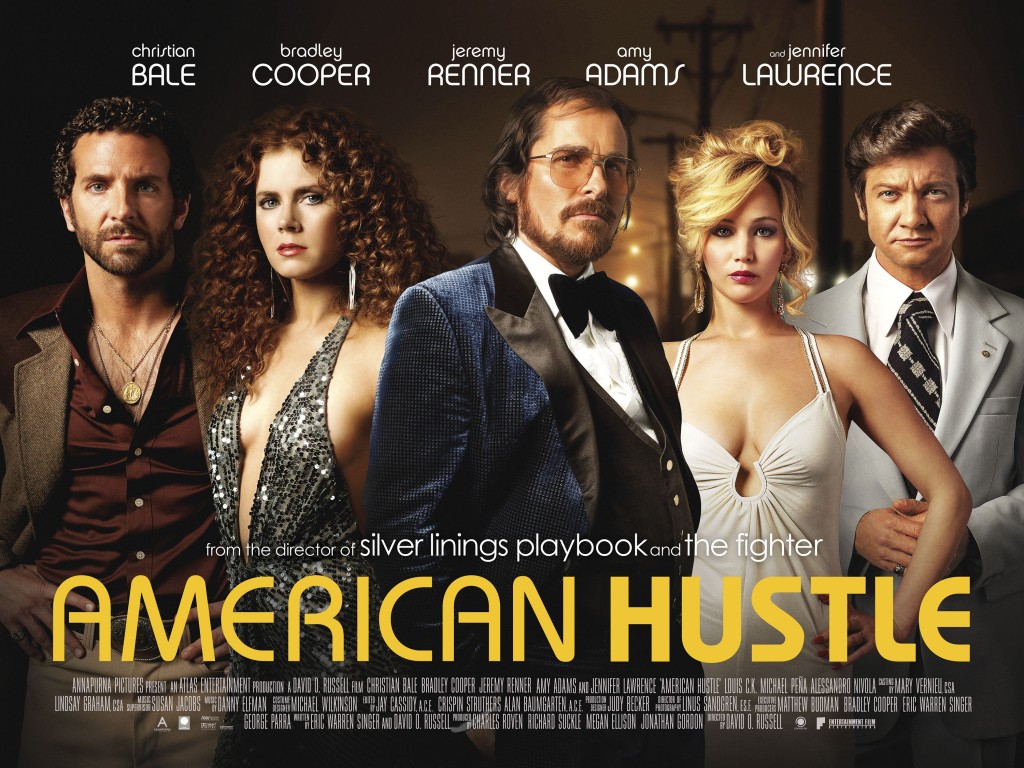
The Rilality for movie of the year goes to… American Hustle. The movie wins based largely on the fact that I didn’t go to a lot of movies in 2013, and I wasn’t overly impressed with those I did. Bradley Cooper turned in a good performance, but Christian Bale did something different. It seems he does in just about every role he accepts, and that makes him the current, best actor in movies today.
Runner up: Blackfish. I may be biased in this area, since I’ve loved killer whales, Orcas, for most of my life, but when I started doing research on the elements in this movie, I knew that the movie makers reached me on a level that most don’t.
I’ve watched too many movies to continue to enjoy the important movies that I’m supposed to like, and I no longer watch actor vehicles that are done to impress Oscar voters. Most dramas seem to be as reductive in their problems as they do in their solutions. Action movies have a way of leaving me with the idea that I’ve already seen this movie so many times before. I see the formula from another action movie that influenced this movie, while I’m watching it. I spend the entire ninety minutes trying to shake off the idea that the original was better. This may give the reader insight into my age. It may also give readers some insight into what my fellow movie watchers, and TV show watchers, go through with me, but I have a problem shutting it off for just a little bit to enjoy most modern movies. Comedy, in general, is so derivative, and subjective that most movies now feel the need to go over the top to make their mark. Over the top can be funny, of course, but it’s difficult to maintain that level for an entire movie, and most of them do not do this well.
This may not be the best “best of” list for those seeking the best ofs, and if you want to consider it the cynical “best of” have at it, but I don’t consider most entertainment vehicles “must have, must see, must read, and must hear” anymore, and I find that the marketing departments that promote their vehicles in this manner tedious.
 Larry David’s Clear History is a satirical comedy, not a philosophical treatise, so the movie should be given some artistic license when it attempts to deconstruct, refute, or simply poke fun at one of Ayn Rand’s most famous books The Fountainhead. The question that every viewer should ask themselves is where does that artistic license end, and the requirement of factual refutation begin? As it has often been said, a satirist can be humorous when poking fun at various institutions, but he can be hilarious if he adds an element of truth to his satire. In this vein, Clear History is not hilarious.
 There are moments in the movie where it appears as though the writers purposely avoided representing the Ayn Rand philosophy accurately, that they don’t understand the greater import of her message, or that they simply wanted to provide their “impossible to grasp” interpretation of it. One of the few direct interpretations of The Fountainhead’s main character, Howard Roark, involves a swear word that characterizes Roark as one of the meanest characters in the history of literature.




 Rilaly