Abraham Lincoln is No Longer The Great Emancipator?


Some no longer view Abraham Lincoln as The Great Emancipator, because they’ve read some quotes, and learned some facts about the man that suggest the man he was a bit more equivocal about ending slavery than originally believed. Yet, anyone that has read a book on Lincoln, perused his letters, or listened to documentarians speak on him, know that ending slavery was one of the primary drivers of his life.

As a kid, Abraham Lincoln used to watch slaves parade past his backyard, and he wrote of the inhumanity he saw in their treatment.

“That sight was a continued torment to me; and I see something like it every time I touch the Ohio (River), or any other slave-border.”

The great Abraham Lincoln
The Great Abraham Lincoln

The fact that we now learn that Lincoln exhibited some restraint in his beliefs on slavery has many of us believing that he was not as adamant about ending slavery as we all believed.

“You know I dislike slavery. I confess I hate to see the poor creatures hunted down, and caught, and carried back to their stripes, and unrewarded toils; but I bite my lip and keep quiet.”{1}

“Why would he keep quiet?” we ask. “Why would he bite his lip? He was the President of the United States. He could’ve used his bully pulpit to bring about more immediate change, and if he felt more passionate about the topic he would’ve.” First of all, a review of the history of America in the 1860’s reveals that the states weren’t exactly a united front in this regard. Second, he viewed The Constitution, and its limits on his power, with more reverence than modern presidents do today, and he also, as described below, wanted to persuade the nation to his point of view. The best way to change minds on a substantial subject, so that the change survives in a manner an executive order might not, is to methodically persuade the public, so they call upon their state legislators, congressman, mayors, governors, et al. to change the way they vote. An executive order will work in the short term, but if the voters disagree, they can just vote in another president to nullify the prior executive order.    

There was also an event that occurred six weeks after Abraham Lincoln became as president. This event is historically called The Civil War in which half of the country disagreed with Abraham Lincoln’s personal opinions on slavery. Between his election and his first day in office those who presumably assumed Lincoln would abolish slavery left the Union. The reason that Lincoln used restraint, and bit his lip, and kept quiet is that he wanted to try to do whatever he could to preserve this Union that we call the United States today, and in doing so he believed slavery would eventually end.

Abraham Lincoln hated slavery. He claimed in an 1858 speech at Chicago to hate it “as much as any Abolitionist.”{2}

Yet Lincoln was no abolitionist. He wanted slavery to end, but that was never his first priority. Here’s how he explained his position in an 1864 letter to Albert G. Hodges, a Kentucky newspaper editor:

“I am naturally anti-slavery. If slavery is not wrong, nothing is wrong. I cannot remember when I did not so think, and feel. And yet I have never understood that the Presidency conferred upon me an unrestricted right to act officially upon this judgment and feeling. It was in the oath I took that I would, to the best of my ability, preserve, protect, and defend the Constitution of the United States.”

Lincoln, in essence, was torn between ending the bondage of the institution of slavery and abiding by the Constitution, and saving the nation. With the latter, we repeat, eventually bringing about the end of the horrible institution. 

“Lincoln said during the Civil War that he had always seen slavery as unjust. He said he couldn’t remember when he didn’t think that way,” explains historian Eric Foner. “The problem arises with the next question: What do you do with slavery, given that it’s unjust? Lincoln took a very long time to try to figure out exactly what steps ought to be taken.”

In a letter to the editor of the New York Tribune, Abraham Lincoln responded to the editor’s charge that Lincoln’s administration lacked direction and resolve. 

“If there be those who would not save the Union, unless they could at the same time save slavery, I do not agree with them,” wrote Lincoln. “If there be those who would not save the Union unless they could at the same time destroy slavery, I do not agree with them. My paramount object in this struggle is to save the Union, and is not either to save or to destroy slavery. If I could save the Union without freeing any slave I would do it, and if I could save it by freeing all the slaves I would do it; and if I could save it by freeing some and leaving others alone I would also do that. What I do about slavery, and the colored race, I do because I believe it helps to save the Union; and what I forbear, I forbear because I do not believe it would help to save the Union. I shall do less whenever I shall believe what I am doing hurts the cause, and I shall do more whenever I shall believe doing more will help the cause. I shall try to correct errors when shown to be errors; and I shall adopt new views so fast as they shall appear to be true views. I have here stated my purpose according to my view of official duty; and I intend no modification of my oft-expressed personal wish that all men everywhere could be free.”

Prior to taking office, Lincoln switched from the political party called The Whigs to the Republican Party, and this move was based on the fact that that Whig party sought a softer stance on slavery so as to win elections in an otherwise volatile nation with volatile passions on both sides of the fence. Lincoln chose to align himself with those people in the Republican Party, who weren’t afraid to lose elections based on the fact that they had a volatile passion for ending slavery. Based on this fact, it should not enter the discussion that Lincoln did not lead the North’s fight in The Civil War against the South, and continue to fight against overwhelming forces, for the sole purpose of ending slavery.

We can continue to list Lincoln quotes, and we can find some that reveal his thoughts on the African-American. The latter do not paint him in a favorable light historically. We can argue over the merits and demerits of his character in this light, but what we cannot do is place ourselves in Lincoln’s time period, and in his time period some Southern states decided to secede from the Union after Lincoln’s election and the Civil War broke out six weeks after he assumed office. At the very least, we could say that the South’s actions, should suggest to all parties involved what Abraham Lincoln represented to those who elected him to office. 

Another complaint specifies that Lincoln’s Emancipation Proclamation did not call for an immediate end to all slavery in the South, but only to those who had already escaped the South. Again, we must say he was focused on preserving the Union of the North and the South, and he didn’t want to further the anger the South felt in losing the Civil War by bringing an abrupt end to slavery, but he believed that the individualistic nature of the country would bring about the eventuality of freedom of all men. And again, The South saw this eventuality as well, or they wouldn’t have seceded in the first place. In other words, Lincoln saw it as his duty to preserve the nation first and foremost, and put his personal views on matters such as slavery on the back burner, until the former was achieved.

Another myth perpetuated against Republicans of the day in general, and Abraham Lincoln in particular, was that Republicans wanted slaves counted as 3/5ths a person in the Three Fifths Compromise. This charge is levied to counterpoint everything Republicans of the day did to free the slaves. The counterpoint suggests that if Republicans wanted to free the slaves, they wanted to do so in a manner that left African-American slaves as partial human beings forever more. First of all, Lincoln and the Republicans of the era, did not enact this compromise. This compromise was achieved during the 1787 Philadelphia convention, seventy-four years before Lincoln took office. Second, the compromise was reached with the long-term goal of lessening the power of the pro-slavery Democrats in the South in the House of Representatives and in the Electoral College. If the Northern Republicans lost this compromise, and the slaves were counted as full people, the Southern Democrats would’ve have had overwhelming representation in the House of Representatives and the Electoral College. Gouverner Morris also believed that counting slaves as full people might further encourage slave trade by the Southern states to increase their representation on Congress. Some could say that the Three Fifths Compromise was a cynical ploy by the Northern states to level the playing field of representation, but it could also be said that if they had not achieved victory in this cynical ploy, slavery would not have been ended as early as it did.

Frederick Douglass

Frederick Douglass was an immediate abolitionist. To attribute a modern adage to Frederick Douglass’ motivations, he wanted slavery to end yesterday. As a result, Douglass despised President Abraham Lincoln in the beginning. As a former slave, Douglass considered Lincoln approach to ending slavery too methodical. He said slavery, “Was simply evil, an offense against God and all decency.” 

Frederick Douglass’ feelings about Abraham Lincoln did not waver in the beginning, as he declared Lincoln’s refusal to mount a full and furious campaign against human bondage was “nothing less than craven capitulation to the slave states for the sake of trying to hold them in the Union.” These early Douglass writings, and the many others linked to in the page below, likely propel the modern characterizations Lincoln’s actions as something less than a warrior in this fight, and many of Lincoln’s letters, interviews, and statements admittedly suggest that he was not the single-minded warrior Douglass was. Yet, that is only half of the story. 

The other half occurred 12 years after the assassination of Lincoln, at the unveiling of The Freedmen’s Monument in Washington, D. C. on April 14, 1876, Douglass gave a speech that writer Ronald E Franklin characterizes as, “celebrating Lincoln as the perfect, God-appointed man for a task that, had the abolition of slavery been his first priority, he could not have accomplished.”

“[Lincoln’s] great mission was to accomplish two things: first, to save his country from dismemberment and ruin; and, second, to free his country from the great crime of slavery. To do one or the other, or both, he must have the earnest sympathy and the powerful cooperation of his loyal fellow-countrymen. Without this primary and essential condition to success his efforts must have been vain and utterly fruitless. Had he put the abolition of slavery before the salvation of the Union, he would have inevitably driven from him a powerful class of the American people and rendered resistance to rebellion impossible.”

My more modern translation: If Lincoln wasn’t able to save the Union, slavery in the North and South of this land may have continued unimpeded. Lincoln had to do what he did to keep his approval ratings up, so that he had a mandate from the people to encourage lawmakers to follow suit. If he put the abolition of slavery before the salvation of the Union, his approval ratings would’ve allowed lawmakers to avoid Lincoln’s attempts to set the agenda for this country, and they would’ve felt free to continue to ignore abolitionists. 

Douglass continued: “Viewed from the genuine abolition ground, Mr. Lincoln seemed tardy, cold, dull, and indifferent; but measuring him by the sentiment of his country, a sentiment he was bound as a statesman to consult, he was swift, zealous, radical, and determined…

“Taking him for all in all, measuring the tremendous magnitude of the work before him, considering the necessary means to ends, and surveying the end from the beginning, infinite wisdom has seldom sent any man into the world better fitted for his mission than Abraham Lincoln.”

Writer Ronald E Franklin concludes a piece he wrote Why Frederick Douglas Despised, then Loved Abraham Lincoln writing:

“In the end, the impatient firebrand who would settle for nothing less than “abolition now!” realized that had Abraham Lincoln been the anti-slavery zealot activists wanted him to be, he would have failed in his mission. Frederick Douglass came to value the wisdom, skill, and necessary caution that allowed Abraham Lincoln to deftly navigate through extremely turbulent political waters to both save the Union and end slavery.

“Like Frederick Douglass, I believe no other man of that time, or perhaps of any time, could have done better.”

Imagine for a second if Lincoln ceded to Douglass’ request that he use a heavy hand in a manner that history now requires. Imagine, as I wrote, how many powerful people he would’ve lost. Slavery, we can only guess would’ve eventually imploded, but slaves and the African-American community in general, might have viewed Abraham Lincoln as their last, best hope. Violence and mayhem would’ve surely followed and perhaps a second Civil War pitting African-Americans, freemen and slaves, against The South. The incidents and conflict are unimaginable, and they were avoided by the strategies and persuasions put forth by Republicans, the Lincoln administration, and Abraham Lincoln. So quibble with the mindset and the attitudes of the era, but recognize in the end what these people accomplished.  

If you do extensive research on Lincoln, and his views on slavery, you will find some letters and statements made by Lincoln that suggest he wasn’t as hard-lined on slavery as others, and that he sought to save the Union above all else. You will find that Lincoln wanted to compensate slave owners for their loss of product (slaves), and you may find that Lincoln treated African-Americans as pawn pieces in legislation, commands to his generals, and in personal letters to friends, but you will also find an overarching theme that suggests that Lincoln thought that preservation of the Union meant that the abolition of slavery would eventually occur under the weight of the individualism banner of the Constitution, and the will of the people in the United States of the day.

You may also find writings that suggest that Lincoln believed white men to be superior to black men, and that he wasn’t an advocate for black voting rights, or blacks abilities to sit on juries, and that Lincoln believed that the freed black men should be forced out of America to colonize a different colony based on the fact that blacks and whites could not live in harmony in those post-Civil War United States. This has been listed by historians as controversial, based on a limited amount of personal writings in Lincoln’s second term as president. Regardless the finer points found in Lincoln’s positions, the theme remains that Lincoln did not think that a civil union could be maintained with the worm of slavery eating away at her core.

Abraham Lincoln was a politician, a president, and a man who dealt with some of the most combustible forces any president has. He had Constitutional limits on his power, and an overwhelming desire to save the union we now call The United States of America. As such, there were moments in his presidency when he had to capitulate to opponents and soften the blow of the The Civil victory over The South to welcome them back to the union without the harsh feelings that might have led to something like a Civil War II, or some other horrible inevitability. 

When we look at the actions of Lincoln, and the Republicans of the day, we do so from the vantage point of hindsight.  We know that the North won The Civil War, and we wonder why Lincoln didn’t pursue the spoils of victory more. We think that if Lincoln was the crusader against slavery that history tells us he was, he would’ve gone hard line with the South, but again Lincoln wanted to preserve the Union, and he believed that welcoming the South back into the Union was more conducive to maintaining the Union long-term than forcing them to immediately comply 100% to the North’s ways. We believe Lincoln should’ve backhanded the South at the conclusion of the Civil War for committing such a sin against humanity, but we do so without realizing the rage the South had at the conclusion of the Civil War. We don’t celebrate Lincoln’s restraint and patience in this regard, based on our own rage over the horrors that occurred in our beloved country. We live in an immediate satisfaction society that lists those who might slightly disagree with our current views on race and our current ways of dealing with matters as haters, but those of us who criticize the manner in which Lincoln achieved victory over the South, preserved the Union, and abolished the institution of slavery haven’t achieved 1/100th of what Lincoln did over the course of four years. It took a very steady hand, and a man who was willing to patiently accept the fact that he couldn’t exert his own opinion and will on a people immediately to accomplish what he did. As Ronald E Franklin writes of Lincoln, “No other man of that time, or perhaps of any time, could have done better.” If Lincoln was too firm, or too weak, in regards to his actions to save the union, follow the Constitution, and eventually end slavery, there would’ve been grave ramifications to his actions. To those who want more immediate statements from Lincoln about race, and a firmer hand in regards to the abhorrent institution that was slavery, the question that we should ask ourselves how many countries have they saved?

Kinesthetic Learning in Sports


“Who is the best athlete of all-time?” That question, this debate, can be as intoxicating as watching the athletes perform. Who’s the best boxer of all-time, Muhammed Ali, or Mike Tyson? Was there a professional athlete more exciting to watch than Walter Payton? Does Michael Jordan have a peer in basketball? If you grew up in the Bill Russell, Will Chamberlain era, you think he does. Some avid fans could probably list off twenty to thirty athletes on their personal Mount Rushmore of sports, who are not listed here, but the greater question is not who is the best athlete, but how did they achieve elite, Mount Rushmore status? 

Personal preferences often play a role in a person’s list. There are also those who achieved rarefied air during their era that sportswriters often find criminally underrated in the historical record. Once we eliminate those two groups, we find a short list of elite athletes. What is the difference between the professional athletes who achieved rarefied air in their era and that small pack of elite athletes that we consider the best of all time? How does an elite athlete appear to execute to perfection every single time out, while another phenomenal athlete executes a majority of the time? What’s the difference between the natural gifts of a supreme athlete, like Allen Iverson versus a gym rat like Michael Jordan? One word. Practice. We’re talking about practice.

The theme of such bar stool discussions often centers around the physical exploits of said athlete, but as author David Wallace suggests, in a posthumous collection of his essays Both Flesh and Not, the physical may no longer be as instrumental as it once was in the separation between those in the upper echelon and the elite.

Most of us have participated in organized sports at one time or another in our lives, and most of us have experienced a point, in practice sessions, where we’ve withered under the demands of a demanding coach who pushed us to levels some may consider cruel and inhuman.

Kinesthetic learning (also known as tactile learning) is a style of learning devoted to physical activity, rather than listening to a lecture or watching a demonstration. These types are inclined to learn more by doing than they ever will by studying, contemplating, or actualizing. Those who learn in this kinesthetic manner are learners we call “do-ers”.

Even most doers do not have a level of internal discipline necessary to achieve an elite level. Most parents attempt to cultivate the creative and physical gifts their children display, and those parents seek to keep that focus varied and well rounded. For the purpose of this discussion, such desires may prove harmful. As the child may have trouble achieving the tunnel vision necessary to achieve a level of discipline required to achieve what those in the field call “autonomic responses”. In the wide variety of concerns a parent may have for their child, achieving autonomic responses might not be in the top 1,000. They want their children to succeed, but not so much that they deprive them of the joy of being young.

The creative mind needs constant stimulation, nuance, variation, and entertainment. A creative mind can suspend that need for creativity to learn the basics of anything, when that something is new, fresh, and exciting. Once that knowledge loses its “newness”, it no longer excites the child. At that point, they may begin to tune out much of the information that follows. Learning sports is fun, and athletic achievement can be exciting to a young child, but every child experiences a breaking point when they learn that if they are going to succeed in sports they must learn to avoid their creative inclinations.

Achieving success in sports requires an acute focus on the muscles involved in, say hitting a baseball, and there is little in the way of variation for how to approach to the ball, the point of contact, or the follow through. The creative mind may acknowledge the teacher’s bona fides in the quest to become proficient, but the more they cede to the creative portion of their brain, the more difficult it will be to fight the urge to personalize their play a little. The creative mind does not want to be an automaton, in other words. They want to look cool, they want to have fun, and they want to introduce some creativity in the process of their swing. If the child achieves some success on the playing field, they may begin to believe that they achieved that level of success on their own, and this may lead them to ignore their coaches on some level. They might want to introduce some individual nuance into their game. They might develop creative desires that lead to ideas on how they can succeed. The ability to ignore such desires or to learn the problems inherent in falling prey to them leads to what some might call an inhuman, machine-like mind, enhanced with massive amounts of discipline, such as that of a Roger Federer, to achieve levels of success in sports, and maintain it over time.

How did Roger Federer learn how to return a serve, how did he learn to return a 130 mile per hour (MPH) serve, and how did he learn to return such a serve in a manner that he could place it in a specific, and strategic, corner of the other player’s side of the court? In a David Foster Wallace essay, we receive a description of Federer’s exploits that have left tennis aficionados with their mouths hanging open for decades. Wallace terms these moments, moments when Federer separated from the pack of the phenomenal athlete to an elite status, as “Federer Moments”.

“Returning a 130 MPH tennis ball, in a successful manner, requires what’s sometimes called the kinesthetic sense, meaning the ability to control the body and its artificial extensions through complex and very quick systems of tasks. English has a whole cloud of terms for various parts of this ability: feel, touch, form, proprioception, coordination, hand-eye coordination, kinesthesia, grace, control, reflexes, and so on. For promising junior players, refining the kinesthetic sense is the main goal of the extreme day-to-day practice regimens we often hear about. The training here is both muscular and neurological. Hitting thousands of strokes, day after day, develops the ability to do by “feel” what cannot be done by regular conscious thought. Repetitive practice like this often appears tedious, or even cruel, to an outsider, but the outsider can’t feel what’s going on inside the player — tiny adjustments, over and over, and a sense of each change’s effects that gets more and more acute even as it recedes from normal consciousness.

“The upshot,” Wallace Continues. “Is that pro tennis involves intervals of time too brief for deliberate action. Temporally, we’re more in the operative range of reflexes, of pure physical reactions that bypass conscious thought. And yet an effective return of such a serve depends on a large set of decisions and physical adjustments that are a whole lot more involved and intentional than blinking, jumping when startled, etc.” 

The key, in other words, is to practice so often that the creative mind, and even conscious thought, do not enter into play. A player can return a serve with some creativity, by turning a wrist flat to achieve a flat return, and they can get a little top spin on a return by twisting the wrist a little at the point of impact. These descriptions of the proper return are what many consider elementary, even to those who only play tennis for recreation. For most tennis players, most of these elementary aspects of a proper return go out the window when a serve is flying at them at 130 mph. Even most of those listed in the top 100 seeds of professional tennis are satisfied just to return such a serve of that speed, but the elite athletes can return such a serve strategically. How does one achieve the degree of mental mobilization necessary to return such a serve with a left turning topspin that hits the weakest point of their opponent’s court? The short answer is that the kinesthetic learner has achieved a point where they’re no longer thinking, a result of what Wallace says others may perceive to be inhuman, cruel, and youth stealing hours, months, and years of practice to achieve a kinesthetic sense.

To suggest that this degree of kinesthetic learning is exclusive to tennis or exclusive to the return of a serve is an oversimplification of the comprehensive idea of kinesthetic learning, for it is now taught in every sport and in numerous situational events within those sports, until the student learns autonomic actions and reactions without thought.

“Do, or do not, there is no try,” says Yoda.

If Star Wars were to attempt capture the basics of kinesthetic learning to a point where Luke could use this kinesthetic sense, i.e. the force, against all of Darth Vader’s actions, the movies would’ve portrayed Luke in training for, at least, the first three episodes of the series, or episodes four, five,  and six for Star Wars purists. They would’ve wanted to age him, and portray him as doing nothing but training for these episodes. This wouldn’t have been very entertaining, of course, but it would’ve properly portrayed how intense this training can be.

Most people don’t have the aptitude to achieve a kinesthetic sense on this level, and they don’t have the discipline to endure exhaustive years of practice. Most will also never know such levels for they also don’t have the natural talent required to achieve Federer-level results from kinesthetic learning.

Sports, in America, used to be mano y mano. It used to be the ultimate, physical confrontation between a Bob Feller against a Ted Williams. The mental aspects of baseball, tennis, and all sports have always been a factor, as one athlete attempts to overpower his opponent with mental and physical prowess. There has also always been some association with this process among top tier athletes, but one has to wonder if the current prominence placed on psychological domination of a sport, in the manner Wallace describes, would shock even Ted Williams, the well renowned hitting aficionado of his day. He might have practiced more than others, and he may have studied his opponents for tendencies and signs of weakness, but did he practice to levels that some may consider inhuman, cruel, and youth stealing levels? Many considered the hours he spent honing his game legendary, in other words, but would he be shocked at the new levels of learning put forth by current sports’ psychologists?

Williams had mentors, and others who helped him focus on the intricacies of his swing, but this new focus on the “tiny adjustments, over and over, and a sense of each change’s effects that gets more and more acute even as it recedes from normal consciousness” probably did not enter into his world. This acute focus on kinesthetic learning in baseball, tennis, football, and all sports and kinesthetic learning has ticked up to levels that Ted Williams and Bob Feller may have found astounding. Williams may have watched Bob Feller’s game, and he may have detected some tendencies in Feller’s play, but he didn’t spend the mind-numbing hours watching game film that a Tony Gwynn did with his opponents. Tony Gwynn, and others, changed sports a little with intense tape study, but our current understanding of the process involved in succeeding in sports through this acute focus on repetitious kinesthetic learning has progressed to a science.

This psychological concentration on minutiae goes beyond the positioning of the thumb on a driver in golf, the tweak of the forearm in the tennis stroke, and all of the muscles involved in the follow through. It goes beyond the pure physical aspects of sports to the mental. We have known about some of these concentrations for eons, and the general idea behind them might not be a shock. The acute focus on the actions and reactions has increased tenfold over the decades, until the game no longer involves mano y mano confrontations at the plate, but one well-honed machine conditioned to the psychology of the game versus another equipped with the same.

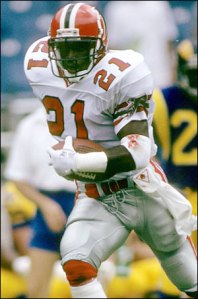
deion1What separated Michael Jordan from the second best player in his era? What separated Deion Sanders from the second best cornerback of his era? I used to marvel at the athletic exploits of the Atlanta Falcon’s cornerback in his day. People would say that Deion isn’t a tackler, and that he was a liability on the Atlanta Falcons defense. “Why should we consider a defensive player great, if he isn’t a great tackler?” They would add that he was a liability against the run. “Who cares?” I said. “Do you see what that guy can do when the ball is in the air?” The hundreds of little snapshots that most people either don’t see, or talk about often define an athlete’s career, just like anyone else’s career. These moments are the moments of crunch time, when the ball is in the air. A professional athlete practices for such moments, they think about them, they eat and drink them, until they reach a point where they’re no longer thinking about them when they occur, and they’re acting and reacting with autonomic responses.

Most normal humans haven’t engaged in any activity to the point of achieving autonomic responses. Most normal humans engage in athletic activities for casual enjoyment, and they involve their kids in sports for the purpose of the character definition it can provide. Most do not subject themselves, or their kids, to the kind of “cruel, and inhumane” amount of practice that could steal a young person’s youth. As a result, most of us cannot comprehend how a man could return a serve of 130 mph and place it in that tiny spot that is his opponent’s greatest after serve weakness on a consistent basis.

Those involved in the science of sports clocked the 130 mph serve at .41 seconds, or the time it takes you to blink twice in rapid fashion, or a speed that defies the natural facilities of human reaction. On the flip side, there are other, more deliberate moments in sports. The time it takes a quarterback to throw to a receiver that a Deion Sanders is covering, for example. Depending on the quarterback, and the length of the throw, this could take a couple seconds from the time the quarterback releases the ball to the moment it hits Deion Sanders’ area. What happens in those seconds? I call this moment the blank space. In the blank space, athletes on every level know what to do, but they may not be able to accomplish it on a consistent basis. They might panic. Even the greatest of athletes panic in this small window of time, and this might cause them some confusion as they try to come to grips with the fact that their minds and body didn’t act in unison during that crucial moment in time. They had such belief in their ability, they thought they worked as hard as anyone to prepare for that moment and they failed. After the years and decades they spent practicing, they didn’t execute in the manner they know they should have. It can be painfully confusing. After reading Wallace’s description, and the descriptions of Federer’s workouts, these players may not have worked out to the point that some characterize as exhaustive and cruel amounts of practice required to reach a kinesthetic sense, or an autonomic response, to the ball being in the air. What we’re talking about here is practice. As much as former NBA great Allen Iverson tried to tell us it isn’t about practice, it’s pretty much everything. 

Those interested in this subject might also be interested in:

The Conspiracy of the NBA Western Conference Finals, in 2002

The Psychology of the Super Sports Fan

What’s So Funny?


Why do we laugh? Why do we cry? “Confusion,” suggests author Kurt Vonnegut. “Laughter is similar to crying,” he said, “in that, in some cases, these are the only reactions we can find to react to that which otherwise confuses us.” How many times have we laughed at something shocking? How many times have we laughed when we didn’t know what else to do? How many times did we laugh, without taking the time to figure out the gist of the joke? How many times have we laughed and followed that up with a “Wait … What?” 

“What’s black and white, and red all over?” was a joke I found on a Bazooka Joe wrapper. “A newspaper!” I repeated that joke a number of times. I went into the punchline with what I believed to be the perfect pitch, and I hit that punch line perfectly, but I had a little secret: I didn’t get it. I asked those in my inner circle –those I knew would gracefully illuminate me how and why it was funny without attaching the public ridicule I probably deserved– to explain it to me. They couldn’t. They didn’t get it either. One person told me that they thought the ink newspapers use comes from a red-base. It didn’t think that was funny, but I was relieved that I finally had an answer. It was years later when someone finally told me that the joke involved the homophone spellings of red and read. Read, as in the in the past participle read, as in while a newspaper may have a white base, and black print, it is read all over, as opposed to the color red. If you got that joke right off the bat, congrats, but I assume that there has to be at least one joke that you retold that you didn’t get. The point is that we may actually laugh harder at jokes we don’t get than those we do, and that laughter may be an instinctual, fallback position to those things that confuse us.

How many of us asked a joke teller to explain a joke? We hate to do it, because we know it reveals us, and we hate to ruin another person’s joke by asking for an explanation, but some of the times, we need explanations. How many times has the explanation confused us to more and led to more laughter? Were we using this laughter to cover for the fact that we didn’t get it, or were we –as Vonnegut suggests– laughing more in conjunction with our confusion? Has this progression ever led us to find a joke genuinely hilarious without ever understanding it in the first place?

The relative nature of humor is obvious to anyone who has attempted to crack a joke, but the extremes are noteworthy. There are some universal truths to comedy, but for the most part comedy may be our most subjective art form. Individual experience leads us to finding relative humor in a subject, but it would be impossible for a comedic artist to try to relate to all of his audience members. Thus, it is incumbent on a qualified comedic artist to create funny.

Falling is funny. We all love a great fall, and no one is confused by its comedic value. Seeing Chevy Chase do what he did in the 70’s was a brand of humor he never had to explain. Stupid is funny. Abbot and Costello, John Ritter, and the Airplane/Naked Gun writers proved that by creating timeless humor with people falling and doing stupid things. Most comedians began their careers by falling, doing stupid things, and imitating famous people, but most of them realized, at some point, that they could only do those things for so long before they started to become a parody of themselves.

***

I was too young to see Richard Pryor’s gestation cycle in comedy. I didn’t know the middlebrow, Bill Cosby-like Richard Pryor. I only knew the racial and radical comedian that launched himself from the pack to the stratosphere of comedy, but that didn’t mean I understood his brand of humor. I didn’t understand George Carlin or Cheech and Chong either. Knowledge and experience have taught me that Carlin and Pryor are funny, but how did I arrive at that answer? I have to imagine that Pryor and Carlin struggled to reach audiences when they first attempted to stretch their comedy beyond the border. I have to imagine they experienced pratfalls on their road to the hip, cool, dangerous, and edgy titles that their work would eventually assume. There had to be an inclusive group that “got it” that everyone wanted in on. Those people then had to teach other people, until those other people taught my people, and my people taught me that I if I didn’t “get it” too I faced ostracizing.

Cheech and Chong followed Carlin and Pryor through the doors they opened. They introduced some of their own elements to the brand, but for the most part, they owed a deep debt of gratitude to Carlin and Pryor. I learned these comedians were funny by watching my friends and my friend’s parents watch them. I was young and impressionable. I wanted to be hip and cool, and I wanted to understand adult humor. I learned that this material was innovative, and a tour-de-force and I learned that if I wanted to be all that I was hoping to be in life, I would have to laugh to tears at the things Cheech and Chong did.

“Man, you have got to see Up in Smoke,” my friends would say, “That thing is hilarious.” I watched it, but I didn’t get it. I didn’t get it, because I knew nothing about the drug world. I didn’t want people to know that, so I pretended to get it, and I put a lot of effort into pretending, because I didn’t want to be that naïve, little kid who didn’t understand. Later, while watching it with friends, I made sure to laugh in all the right places. I still didn’t get it, but they didn’t have to know that. They didn’t have to know I wasn’t hip or cool. It was my little secret.

I learned that drugs and sex were funny. Cussing was even funny after a while, because cussing was naughty. I became an adult, I had my own individual adventures in life, and I eventually learned that cussing, sex and drugs were funny because they were naughty. Naughty is funny, but it is playground funny. It is base humor, and some are satisfied providing base humor, but an artistic comedian needs to make it situational.

Situational humor is the: “I can’t believe he did this while doing that?” brand of humor that we all have to learn in life if we want to be cool and hip. Sex is funny, especially if you do it wrong and you’re willing to be self-effacing about it in front of a group of people. Farting is funny no matter where it occurs. Most of our most embarrassing biological functions are funny, because we all do them, and we can all relate, but if you can mix in a dash of the “Doing that while doing this?” element to the story, you can achieve hilarity. “I farted in church.” Funny? Maybe. It might be funnier than farting in Walgreen’s. “I farted in church after the priest said, this is the body of Christ, and I farted so loud everyone in the vicinity heard it.” That’s hilarious my friend. Time and place, my friend. Time and place. Stories of drug abuse are just as funny, as long as the we’re not currently doing it. We’ve agreed that it’s sad if someone is currently chasing demons, but if they say they did it in the past “while doing that” the next thing they will have to do is hire a manager to handle their bookings.

The guy under the Darth Vader mask, David Prowse, once admitted that he did more cocaine during the filming of the Star Wars movies than there is snow on Hoth. That’s not great comedy, until you factor in that Darth Vader was a character kids adored, and that Prowse did cocaine while playing the character … that’s funny. Really? Why? Because he was doing that while doing this. That’s hilarious. Because Prowse pulled the ultimate naughty … doing drugs while doing that? If someone says a joke about a mean mama, and your mama was mean, the comedian can reach you on your level, but how many of us have snorted a line of coke, or injected heroin in our veins, and why do we laugh so hard about that? The current strain of “doing that while doing this” involves adult comedians cussing in front of children? We love it when someone shocks us by breaking taboos, but George Carlin basically warned us that breaking taboos should be done carefully and strategically. He basically said that societal standards should always be respected and taboos should be carefully and gradually broken down, for once they’re all obliterated comedians will have nothing left to mock.

“If I fall down a manhole, that’s not funny. If you do, that’s funny,” Mel Brooks once said.

Jay Leno once mused that he didn’t understand why social, highbrow comedians felt a need to shake their audiences’ foundations and breakdown barriers. He said that he didn’t understand comedians bringing high-falootin’ sensibilities to their comedy. He said being a comedian is a wonderful profession that has two basic components: telling jokes and getting paid for it. “Well,” Larry David responded, “You (Leno) can think that, because you were good at it.”

Bob Hope and Jack Benny told jokes and got paid in their day, but theirs were different jokes, safer jokes, that appealed to fathers and sons alike. Benny and Hope did not seek to break boundaries or expose the culture’s sensitive underbelly. There were no sensibilities brought to their brand of humor. One would think that they would probably have a lot of trouble breaking through the ranks today. Hope told some risky jokes about Raquel Welch and Loni Anderson, but they were never so bold that they would offend a parent. Benny’s self-effacing humor would land him gigs in Omaha and Des Moines, but if he wanted in the upper echelon, he probably would’ve have to do some border stretching today. The difference between a Bob Hope and a Sam Kinison, or an Andrew Dice Clay, shows that humor evolves and changes over time.

Richard Pryor started out wanting to be the next Bill Cosby, but he realized there were limits to that, so he carved a niche out for himself. His primary goal was to tell jokes and get paid, but there came a point in his career where he realized that ultimate success could not be achieved through those traditional avenues. George Carlin was also one who could’ve stayed safe doing hippy, trippy weathermen, but he realized there was other territory out there for him to mine. Jim Carrey was a master impersonator, but he saw an end game to it, so he reinvented himself and his comedy. Andy Kaufman could’ve never made the stage with traditional comedy sets, so he decided not to be funny, and he hoped that we would laugh instinctively at the confusion he created.

These comedians, and others, have broken down barriers in our society. They’ve shaken our sensibilities and made us laugh at ourselves, and they’ve shaped our politics, our views on religion and music, how we treat our children, what we think of our parents, how we define our sexual mores, and if we were going to have a puritanical or a more permissive society. One could say that the power comedians wield in our society dates back to court jesters and beyond. Yet, even those court jesters had a pecking order that divided the talented from the untalented. We can assume that some of those jesters were so talented that they could tell a joke and get paid. Others recognized that they weren’t as talented, and they needed to carve out a niche for the untalented that didn’t rely on imitating and falling, and they most likely had to teach the king a new brand of comedy that relied on the natural human instinct to laugh when confused.