Some of my favorite artists are dead now, and some of them are just gone. What do we do when one of our favorite artists die. When they die at twenty-nine-years-old, it’s a time for mourning, and a time to think of what they could’ve been. When they’ve already been, and they haven’t been relevant for over forty years, and we learn that they had grandchildren, and in some cases great-grandchildren, it feels a little odd to mourn their passing. They gave us some great music, and perhaps the greatest homage is to simply listen to what they did and appreciate it for what it was way back then. It’s also weird to go back to their catalog and realize they haven’t come out with new music in thirty years. When we listen to them often enough, or they manage to keep their name out there is various ways, it can seem like they were putting out music as far back as a couple years ago.
Before dying, or finally leaving the stage after their fourth or fifth reunion tour, some of them braved “the age thing” and put out a new album. We went to their concert, because we loved them so much at one time, and we knew they were going to play their new songs, because they wanted to sell their last gasp album, but we wanted to hear their classics … until we heard them, and saw them sing that song we loved so much forty years ago. The reason that song was so compelling is that it was fun, obviously immature, and a rock-your-buns off classic. After the euphoria of hearing our favorite song from them died out, we realized that the man onstage is a seventy-year-old trying to recapture what made them “special” in their twenties.
***
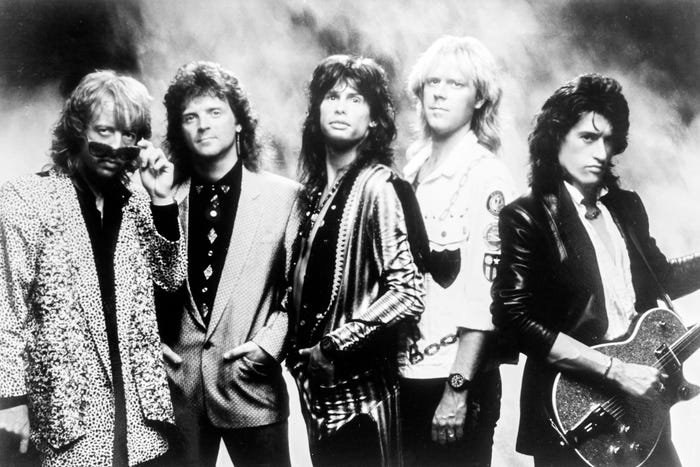 Dating back to an era so long ago that I now feel so old writing about it, I played the song Toys in the Attic in my car so often that my girlfriend’s three-year-old daughter could sing the refrain. She probably had a vocabulary of less than 300 words, but she knew those lyrics from that song. I also named my first dog Tyler. Seeing as how this was between their creative peak, the Toys in the Attic and Rocks era, and their Permanent Vacation commercial peak, I might have been one of the few who had Aerosmith in his tape deck nonstop. Now that they’re done as artists, we can look back and think they should’ve been so much more. Would their creative output have doubled if they decided not to experiment with drugs? That’s impossible to know and probably unfair. Even if they stayed clean throughout, they probably would’ve experienced creative highs and lows, and how many relatively clean artists came out with five straight top-to-bottom incredible albums? I can think of two. There was a time when I thought Aerosmith might be one of them, the elite of the elite. They weren’t, but I still think they could’ve been so much better if they didn’t fall prey to chasing the dragon. Yet, that was the nature of the beast, back then.
***
Was there a rock artist who did more with less than John Michael “Ozzy” Osborne? We all know the icon that Ozzy became, the charismatic frontman who could put on some theatrical shows, but when we strip those elements away, we have a relatively untalented man who ruled rock music for over 50 years. He didn’t have great vocal range. Even his most ardent fans would admit that while Ozzy could sing, and he had one of the most distinctive voices in rock, his vocal range was extremely limited. His appearance, though suited for the role of a “Prince of Darkness”, was not what anyone would call pin-up material. According to his primary lyric writer early on in his solo career, Bob Daisley, Ozzy Osborne came up with melodies, but he didn’t write lyrics. Even with all that, I had friends and family who were diehard fans, and they said, “There’s Ozzy, and then there’s everyone else.”
 There was no one quite like Ozzy Osbourne before he became “Ozzy!” He basically created this character, embellished it, and built it into something that no one will ever try to do again.
He was a one-of-a-kind, charismatic showman who could dwarf just about anyone who stood on stage with him, but if we strip away the legendary aura that surrounds him, we have a giant in the industry who wasn’t very talented.
As a young man, Ozzy met a gifted lyricist named Terence Michael Joseph “Geezer” Butler, and they invited a guitarist named Tommy Iommi to join them in a band they eventually called Black Sabbath. Tommy ended up writing the music for the band, and Geezer Butler wrote 95% of the lyrics for the Black Sabbath songs. Ozzy did, according to those who’ve worked with him, have a gift for creating melodies for the songs that others wrote, and some say these melodies were often one of the reasons the songs and albums proved so successful. He’d often hum to the music, and his writers would write accordingly. So, John Michael “Ozzy” Osborne didn’t have dynamic vocal range, he couldn’t write lyrics, and wasn’t very good looking, but he ended up playing a prominent role in music that sold over 100 million albums. He was inducted in the U.S. and UK Hall of Fame, and he was honored with stars on the Hollywood Walk of Fame, and the Birmingham Walk of Stars. No one will deny that Ozzy was charismatic and a great showman, but he and his wife Sharon’s greatest talents may have involved spotting talented individuals and collaborating with them. To this day, I look at the man, listen to him talk, and consider his oeuvre, and I still cannot believe that he succeeded to the degree he did.
***
One of Ozzy Osbourne’s writers, Ian Fraser Kilmister, AKA Lemmy, would go onto form his own bands, Hawkwind and Motorhead. Lemmy Kilmister was another shouldn’t have been. As he proved with Ozzy, Lemmy could write lyrics. Other than that, he may have been further removed from pin-up boy than Ozzy. Those of us who try to figure out what women find an attractive man are often incorrect, but my guess is that few women would ever find Lemmy Kilmister an attractive man.
The music of Motorhead had harmonies, but they would never be confused with the pleasing harmonies of The Beatles or an Air Supply. When we hear him sing, we imagine that that’s probably what zombies would sound like, if they existed. This is probably the sound that vocal cords, damaged by death, might sound like. If the listener prefers the pleasing sounds of a David Bowie or Thom Yorke harmoniously developing a relationship with the music, they probably wouldn’t understand how others could prefer Lemmy.
 He has the type of voice, similar in some ways to Tom Waits, though Waits found a way to make his gravel, growl, and guttural vocals harmonious and beautiful. We could also compare Lemmy’s gargling motor oil vocals with Captain Beefheart’s fragmented expressive vocal stylings, but Lemmy was more about brutish attitude and utter defiance than artistic technique.
“What is that?” is our reaction to hearing Lemmy sing for the first time. We might even consider it so bad as to be a joke, but Lemmy carved out an ever-expanding fanbase that put him in a relatively successful level that I doubt anyone would’ve predicted at the nascent of his career. He was also not a great interview for the softhearted types who favor artists that say wonderful and nice things.
There were no A&R guys in Lemmy’s camp early on in his career, and he had to almost do it all himself. I’m sure he had some undocumented assistance throughout his career, but by almost all accounts, Lemmy had to do it all himself. He was a self-made man. He expressed his disappointment in this regard when his career was eventually commemorated, and company men lined his audience. Lemmy did the opposite of thanking them for being there. “Where were you guys?” he asked them. We have to have some sympathy for those A&R guys though, because how could they sell this man to the public? If Lemmy wasn’t the most original and unique musical artists you’ve ever heard/seen, then you know far more about this world than I do. If Lemmy wasn’t an original, he gave new meaning to the Oscar Wilde quote, “Be yourself, everyone else is taken.”
***
Billy Joel was Billy Joel for those of us who were young in the 70s and 80s. He was so ubiquitous that we never really considered him a man who just happened to be an artist. We’ve all heard about how many records the man sold, and we just kind of yawned. Every time he cranked out another song, we all heard too often on the radio, it was but another Billy Joel song that we loved, but it left you with a “What do you want me to do with this?” response. When we’re there, in the moment, we don’t recognize how hard it is to keep creating great songs. We all thought it was just something Billy Joel did. Some men wash dishes for a living, others prepare taxes for others, and Billy Joel writes songs that stick in your head like peanut butter.
Seeing these songs chronicled in the And So it Goes documentary on Billy Joel, as opposed to hearing it in yet another greatest hits compilation, gave us a new perspective on this man. We watched it with a “I forgot about that song” and “That’s right, he wrote that one too” reaction that struck me as if I never considered that he wrote all of those songs. Billy Joel was so prolific for about twenty-two years, at a near album a year pace, that he defined a generation.
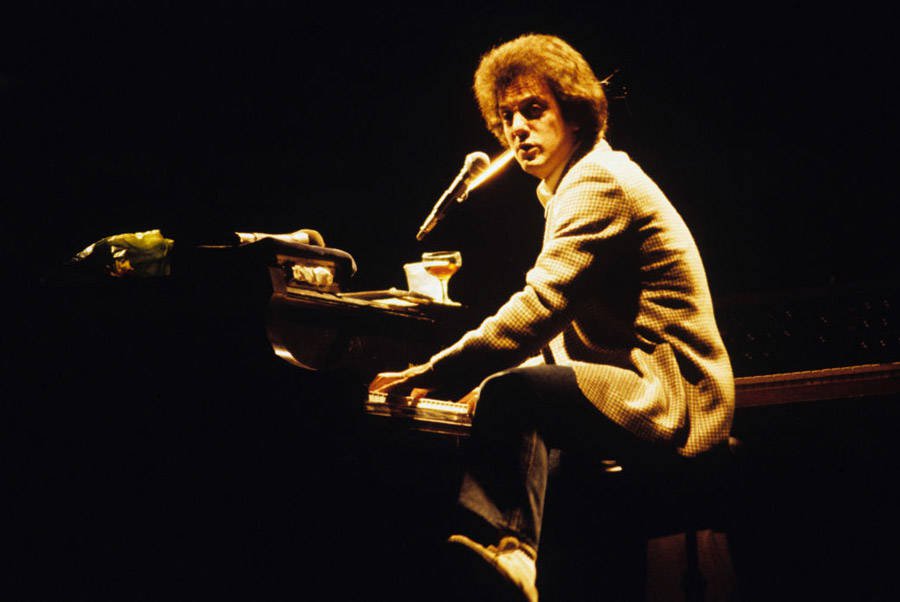 Billy Joel was also trapped in the 70s and 80s when we could say there were so many great artists coming out with new music nearly every year. Even in that vein, Billy Joel was one of the few pillars of commercial dominance. He is the fourth bestselling solo artist in U.S. history, his Greatest Hits I and II still ranks as one of the bestselling albums of all time, and he’s in the Rock and Roll Hall of Fame.
The market was so stratified back then that we were all satisfied; the pop fans, rock fans, punk rockers, new wavers, etc., all had their favorite artists. It was such a prolific era that we can only appreciate in hindsight. I loved it at the time, but it also felt like it was just that way, and it always would be. At the risk of sounding like an old man, I think it’s just different now.
Even after watching And So It Goes, I still wouldn’t put Billy Joel in my personal pantheon of greatest musical artists of all time, but the magnitude of his discography, as displayed in And So it Goes, makes a compelling argument that he was one of the best of his generation, and if you told me you thought that before I saw this documentary, I probably would’ve scoffed at you. My biggest takeaway from this documentary was that this 70s/80s era was just packed with so many great artists coming up with song after song and album after album that we thought this was just the way things would be forever. It hasn’t worked out that way, but what an incredible time it was to be a kid listening to all of that incredible music for the first time. Those artists seemed like machines, but documentaries like this one, and others, remind us that real humans did this, and that we should cherish them for what did for us back then.




 Rilaly