The Nonconformity Market


Cool dudes are out there, and nonconformity is their thing. They seek out that which others consider odd. They know that they are trendsetting fashionistas, and that everyone they know, knows it too. They know it better than we do, and they know that they’re not rebelling. They don’t care for labels. This is just who they are. They preach their nonconformist tastes to every fake nonconformist in their inner circle, and they get off on the fact that we don’t understand them. They are the only true nonconformist they know. They don’t fall prey to the whims of the Man, that fat cat, or the Scooby Doo bad guy, CEO that smokes cigars he lit with $100 dollar bills. They are an individual with selective, refined tastes that supersede everyone else’s tastes, and this is your status in their world. They are the true nonconformist.
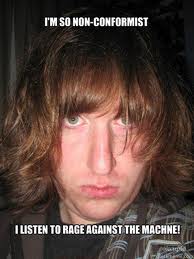
noncomWhat they don’t understand is that the world is immersed in nonconformist rebels, and that they are so numerous that there are nonconformist rebel markets created for nonconformist rebellious consumers that rebel against conformity. What they don’t understand is that the capitalist pig system abhors conformity for the most part, for if nonconformity didn’t exist there would be very few stores in a mall, there would be little stratification of prices in each store, and there wouldn’t be the large number of products in the large numbers of stores in every mall.

In our youth, it was possible for supermarket chains to have multiple items in the breakfast row. They had the cereal section, in that row, and that was bracketed by other breakfast-related items. The variety of cereals have grown so varied that there is but little room in that side of the aisle for Pop Tarts and other breakfast related items. A shopper is more apt to find maple syrup, and other smaller items on the opposing side of the aisle, or in another aisle altogether.  

Walk into any cell phone store, and we’ll see a number of phones that conform to the function of nonconformity, but we’ll probably see that store for what it is after a while. We’ll start to realize that these stores appeal to our sense of non-conformity, or our elevated knowledge of the technology of one phone versus another that we’ll end up skipping that store to go to the one three stores down that appeals our knowledge and our sense of non-conformity. If we are so well informed that we know that neither of these stores provide the degree of technology necessary to suit our needs, boy, have we got a store for you online.

If you’re willing to pay a little bit more for a socially conscious store, we have a whole line of products for you, and they are friendlier to the environment, they have “We support Green Peace” stickers on all of their products, and anything and everything we abhor about what is being done in the South American rain forests. Let those poor suckers continue to buy their inferior products from store A, but they should do so with the knowledge that they are not down for the cause.

The capitalist pigs of the cell phone industry, the clothing industry, the electronics industry, and the leather wallet industry know more about your selection process than you do. They know that our discerning, refined tastes are such that we would never buy a candle wax that is distilled from “Big” oil. Our preferred candle is composed of a wax carefully removed from honeycombs created by bees, so as to not disturb their honey making process or their larvae storage. They also know that to cater to their clientele, they will be required to provide an example of this process to all concerned consumers in a video on their website. These stores know, probably more than any other outlets, that the success of their niche market depends on making their customers feel more socially conscious, more knowledgeable, and more empathetic, and as such it will be required of them to provide their customer base an outlet through which they can further detail their pleasure, or complaints, with the products they sell in their store. As such, they will have some sort of comments section on their website that they will have to monitor on a daily basis, for even the most simple reply to the comments on the website will substantiate the long-held beliefs of their customer base. All they will have to say is something along the lines of “You’re right Doogie Howser232, we will address your valuable information at our next meeting.”

We are all victims of our own knowledge of markets and political consciousness. We make decisions in life, based on what we read and know. Our discerning tastes based on knowledge are studied and commented on in board meetings, and there is nothing special about us. We are members of a demographic, and if we do manage to somehow become an outlier in anyway, there will be a new market created to suit our new stratified needs and desires.

This new market will want to know how much we now “know” about phones and clothes, and they will soon find a way to appeal to us on a new, knowledge level. They want to understand what shaped our new knowledge, and why we think that way, and they want to have that perfect product ready for us when we’re ready to open up our pocketbook.

But I am a true nonconformist, rebels that doesn’t give a durn about any of that nonsense. The capitalist pig machine can shrivel up and die for all I care, but you’re adding to it poopy bear. We’re all creating, and adding to, a diversified and stratified market that has existed longer than we’ve been alive. We can say we’re rebels, but the month after we claim a new discerning taste, a rebel store will open up with all kinds of new, rebel paraphernalia to appeal to us. You’re a punker you say? Well, where did you get all your punker gear? Did you make it by hand? No, well, what else do you have in that Punkers R’ Us bag?

It’s called consumer rebellion, and it’s become such a primary staple in the capitalist pig, American system that capitalist pigs have opened up a store in just about every mall in America just for us? We wear a constant, nonconformist snarl, how can a capitalist pig sell a snarl? We can’t, but we can give you everything you need to bracket that snarl. We can sell a suitable get up that frames that snarl in such a way that it can make it more powerful during rebellious consumption. We can buy a tongue stud at this store, but for those who want spikes in the shoulder pads of their leather jacket we may have to go to the store three doors down and across the hall, and to buy the latest rebellious, nonconformist punk rock album, we’ll have to go down to the first floor. The current, capitalist pig system in America today needs you! and your rebellious consumerism to survive and thrive.

Tattoos were once the epitome of rebellion. An individual could define himself as an outlier with one simple, strategically placed tattoo that was somewhat visible, but not so visible that it was obvious. An individual with a tattoo attained instantaneous conversation status. Everyone has one now, so the true rebel got two, then three, and finally four, until four wasn’t enough, and the whole body art market rose from the back alley to strip mall status. How embarrassing is it to thee true rebel, tattoo aficionados that this market rose to the level where a consumer in Omaha, Nebraska found that tattoo parlors began to compete with Burger Kings in the total number of locations?

People, from the lowest marketer go to the fat cat CEOs, want to know what we’re buying and what we’re consuming, so they go to our favorite Euro bar to find out what the latest nonconformists are wearing, drinking, eating, and in all ways consuming. There’s a whole lot of consuming going on out there, and it takes a whole team of studious marketers to understand it all. These studious marketers then present their information to that fat cat CEO, with that mighty bank account, to create a fashion line that brackets your snarl and appeals to that nonconformist ethos that we have to tell the world that we just don’t give a durn about nothing.

The 50’s and 60’s were a relatively homogenous era that built a fairly homogenous market. It was the Leave it to Beaver, Dragnet, Davy Crockett era. It was an era where fat cat CEOs dictated to the populous what was hip and fashionable. If they wanted everyone and their brother or sister to buy what they were selling, they had Marilyn Monroe and Marlon Brando wear it. They had The Beatles sponsor it, they had Milton Bearle smoke it, and it all gave birth to the ‘keeping up joneses’ meme. Marketing and commercialization have always dictated style of dress, home décor, and artistic tastes, but the power they had back then was considerably stronger before the late 60’s. The late 60’s were a time of nonconformist sophistication that brought forth some degree of individualism, at least when it came to clothing and music, but the markets didn’t sit around and lick their wounds over the power they lost. They adapted. The nonconformity market was born. It was a submarket that up and coming, risk-takers, otherwise known as entrepreneurs, adapted to, and they left the conformists in the dust, until the nonconformist consumers adapted and bucked the current nonconformist trends, and the market adapted again and again, until they started appealing to the nonconformist goth with a snarl. These sub markets were all created to appeal to those that marketing and commercialization didn’t. Up and coming, risk taking entrepreneurs saw dollar signs in tie dye shirts and bell bottom pants, and Ocean Pacific shirts, and Vans shoes, and on and on, until there was a market for every form of nonconformity a hip, nonconformist dude could think up. Our level of nonconformity is actually conformity in America today, and we are no more special than the nonconformists that we are laughing about here.

As David McRaney states in his book, You are Not so Smart: “Poor people compete with resources. The middle class competes with selection. The wealthy compete with possessions. You sold out long ago in one way or another. The specifics of who you sell to and how much you make – those are only details.”

The Expectation of Purchasing Refined Tastes


“One of the worst things a person can be,” purveyors of social commentary say in various ways, “is a consumer, and I say that word in the most condescending manner possible.”

Such statements often receive wild applause and raucous laughter from esoteric, refined consumers in the audience. An overwhelming majority probably consider such statements brave and bold, but they don’t consider the idea that the condemnation is directed at them too. No one, in such an audience, would stand up and say, “Hey, I’m a consumer. How dare you crack on my people?” These people probably picture that consumer they know, that ooky sap who actually purchases consumable products. They know that they purchase products too, but they’re not consumers in the sense that they appreciate capitalism. They define themselves against a mark of exaggerated contrast, and they’re often not objective enough to understand that the authors of such quotes intend to include everyone but the author.

“What is the difference between consumers who deign to purchase consumable products sold at McDonald’s and those sold at the local mom-and-pop shop?” I would love to ask such authors. The answer, of course, would be that one while one may be a consumer, the other is a consumer, and we are to pronounce the latter in the most condescending manner possible. This distinction became clear to me when I informed some friends of mine that blind taste tests showed that McDonald’s coffee tested as high as the coffee found in some of the small mom and pop coffee shops the more erudite visit.

“Pshaw!” they said without using that aristocratic word. They opted for more refined and somewhat polite (see condescending) words, but the message of their response was that they are more cultured than those involved in blind taste tests, and more posh and eclectic. They eat sushi and Thai, and they broaden their minds by listening to exotic podcasts and watching obscure documentaries.

I confessed to them that I probably couldn’t taste the difference between the beans, and most of the products I consume would be more at home on a 1950s table, before the research on food taught us what we now know. I confessed that I enjoy some broadcast television and I enjoy reading mainstream books sometimes. I may as well have admitted to being a Neanderthal.

These people are coffee aficionados. They enjoy an exotic bean exclusive to urban coffee shops that I’ve never attended. Their homes come equipped with exotic coffee makers that require minimal mixing times, gentle air pressure pushes, and low brewing times for professional cuppers and true coffee connoisseurs. I am not welcome in their world.

Their world involves community venues (see coffee shops in the Neanderthal’s lexicon) with artistic geniuses throwing brilliant ideas at one another under exotic Matisse paintings, all while learning to love various styles of coffee beans that are beyond me. Some of the community venue customers have goatees, and others have cornrows and dreadlocks, but they are all very Euro. They also feel a little sorry for bourgeoisie like me, who know little beyond the pleasures of a mundane McDonald’s cuppajo. “Pshaw,” they say, but they would never actually say pshaw, as I mentioned, for elitists say, “Pshaw,” and they abhor elitists.

They feel at ease when bracketed, alongside fine wine drinkers. They eat Foie Gras, black pudding, and organic foods. The posh, eclectic types don’t eat caviar anymore, beluga or otherwise. “Caviar is a product consumed by consumers with wealth,” they say in the most condescending manner possible. Their condescending caricature of consumers with wealth mirror those found in episodes of Scooby Doo, Captain Planet, and Gilligan’s Island. Caviar doesn’t provide prestige in community venues. Foie Gras is the new caviar.

“But Globe and Mail listed blind taste tests conducted by various institutions, including Consumer Reports and other online Canadian websites, and they found that the coffee offered at McDonald’s and Dunkin’ Donuts tested better than the products sold at Starbucks or Tim Horton’s,” I told my friends.

This didn’t shock them, as they heard tell of similar blind tests done with similar products, but that never led them to question their beliefs. They were confident that their tastes were more refined than Americans’ taste. (A phrase to read in the most condescending manner possible).

They answered my follow-up clarification with, “Oh, no!” and a titter almost leaked out in reaction to my lack of knowledge. That condescending titter may have made it out of the less refined. It was obvious to all of us that I knew nothing of coffee, and they appeared to be a little embarrassed on my behalf, for being so clueless to attempt to step foot onto their home turf.

“We don’t like Starbucks,” they said, “And we’ve never heard of Tim Horton’s.” 

They missed the general point I was trying to make, but it wouldn’t have mattered if the magazines performed specific blind taste tests on their specific brand of coffee. They would continue to consider themselves exceptions to the rule. They are posh and eclectic. I couldn’t know to whom I was talking when I was talking to them. No one could.

✽✽✽

In his book, You are Not so Smart, author David McRaney cites such blind tests with professional wine sippers. “The tests incorporated cheap wines as well as expensive, exotic wine to see if the connoisseurs could tell the difference. The results were quite shocking. Not only did they exhibit an inability to discern between the chintzy and the pricey, but the brain scans of the professionals also revealed that they were not lying when they stated their preferences. Their brains actually altered with excitement when they drank the more expensive wine. One particular test asked controllers to place the same wine in two different bottles. They informed the professional sippers that the wine in Bottle A was expensive and exotic, while Bottle B contained a bargain brand. The subjects’ brain scans lit up in response to the contents detailed in Bottle A, allowing the conclusion that the professional sippers grew more excited by the expectation of sipping something more expensive.”[1]

Elevated expectations are not limited to Pepsi drinkers, domestic beer drinkers, or those consumable products developed by corporations that spend billions on marketing to achieve brand name recognition. Some just prefer imported beer, expensive wine, and Colombian coffee. These allegedly high-end products define them in a manner they find pleasing, but we’re all products of marketing, packaging, and environment. Expectation might also lead us to believe a product we believe in.

“Have you tried the latest lager from Djibouti?” Gucci asks Dior. “You simply must! It exhibits an exceptional respect for the ancient art of brewing. It is a highly fermented lager with a light malt, corn, water, hops and a yeast that gives it a bright, golden hue with dazzling reflections.” When Gucci concludes his exotic narrative, Dior must have it. Is Dior so excited to try it because Gucci’s narrative elevated his expectation? Maybe, but he also wants the aura and the identity inherent to drinkers of lager from an exotic sounding place like Djibouti. He wants that prestige, coated on his epidermis for the attendees of the next party he attends to see. The fact that those who have even heard of Djibouti could not spot it on a map makes its lager even more alluring. Even if Dior doesn’t know anything about Djibouti, what’s a little pregnant pause between friends?

These types wouldn’t be caught dead sipping a McCafé drink, as those consumers who prefer a community venue that offers exotic coffee beans with exotic flavors for the exotic mind would define drinking that as consumerism in the most condescending manner possible. If they entered a community venue that offered an exotic coffee bean, and they saw paintings of cartoon clowns on the walls, my friends would consider the bean inferior. If, on the other hand, that same venue had Matisse paintings on display and all the consumers donned goatees and dreadlocks, I’m quite sure they would be sipping on that same bean with a satisfied smile.

The advertisements for such products might not show sports heroes clinking glasses or horses kicking field goals, but that’s not who they want to be anyway. As they pass by their local McDonald’s, en route to the community coffeehouse that offers an environment more suited to someone with esoteric and refined taste, they scoff at American consumers who are susceptible to such blatant marketing. They do this without recognizing that the stratified American marketplace appeals to consumers and consumers.

If an individual attempts to open a McDonald’s franchise, the franchise adviser will inform them that all McDonald’s franchises must be X number of miles from the next nearest McDonald’s location. They base this notion on the fact that the marketplace cannot sustain two such facilities too close together. Those in charge of mapping out franchise locations would inform a potential franchisee that the optimal location would consist of no fast food restaurants within X miles of the franchisee’s desired location, but with the ubiquitous nature of fast food restaurants they concede that is becoming a logistic impossibility. If that franchisee wants to open a McDonald’s right next to a community venue, however, the franchise locator will inform them that this is much more feasible, as they appeal to such different demographics. The point is that those who believe they are not susceptible to the crass marketing schemes employed by the famous Golden Arches franchise may be right, but those marketing schemes are too immediate for Foie Gras eaters. They prefer a more subtle marketing scheme that appeals to quieter sensibilities, an environment tailored to their personality, and a presentation that speaks volumes with no slogans. They are different from consumers, but they are really just another link in the chain of this huge, monolithic beast we all call capitalism.

There may be a difference between the taste of the exotic Kopi Luwak bean and the beans used in McDonald’s coffee, but most don’t know the difference, at least not to the degree that they can tell in a blind taste test. That may be an exaggeration of the extreme. Perhaps the Kopi Luwak coffee berry that passes through the digestive system of the Peruvian Civet Palm Cat, and is then picked out of that cat’s dung, is so refined that there is a discernible difference between that and McDonald’s coffee. On a more linear scale (say Starbucks) McDonald’s coffee proves comparable in blind taste tests, if not superior.

Even if I presented this information in conjunction with the tests that suggest McDonald’s provides a superior cup of coffee, I’m sure these friends would pshaw me. Whether or not they’ve ever tried a selection on the McCafé menu, they would know it to be an inferior product. Their pshaw would contain elements of the messenger within a message, for they would assume that it was Americans who were involved in those blind taste tests, and those Americans were likely truck drivers and church goers from Iowa or Nebraska. They would know that everyone they know knows better. They know I know little about coffee, and they know I have no idea to whom I’m talking when I’m talking to them.

I prefer to think I’m not one of these people. I prefer to think I’ve made conscientious choices that have made me a Bud man and a Pepsi drinker, based on the flavor of those drinks. I understand that the feds prohibited Budweiser and all alcohol producers from visually representing humans consuming alcohol in their TV commercials. In reaction to this prohibition, marketers of such products began selling a lifestyle to those who might consume their products. We all watched those commercials, and we even enjoyed a few of them. Some of us might have unconsciously selected our brand based on the lifestyle those commercials projected, but did we enjoy the products more because we enjoyed the affiliation? My friends would pshaw at such reflection, for they know who they are. They know they’ve made conscientious choices in the products they’ve decided to consume, but the fundamental question remains: Are we buying products based on flavor, discerning tastes based on trial and error, or a level of refinement we gather with experience and age. Or, are we all susceptible to the purported lifestyle the marketing arms sell to consumers and consumersWhen we begin to purchase a product to a point that we establish some level of brand loyalty, are we making the statement that we are informed consumers who choose one product over another based on our refined individual tastes, or are we attempting to purchase a lifestyle that some part of us knows we’ll never achieve, until we purchase it so often that we do?

[1] McRaney, David. November, 2011. You Are Not So Smart. New York, New York. Penguin Group (USA) Inc.