“How many grown men in the audience tonight grew up wanting to be their dad? If TV is anywhere close to the truth, previous generations revered their fathers. They didn’t call them their dad, they called them father. They did everything they could to impress their father. My dad often talked about how much he respected his father, and how the image he had of his father shaped his maturation. Those days are gone. They just are. We now actively work to disappoint our fathers by becoming artists, influencers on YouTube, writers and standup comedians. We don’t even mind disappointing our whole family now. Is that weird? I don’t know one guy, in his 20’s or early 30’s, who wanted to be anything like their dear old dad when they grew up. Our goal was to be everything but. I’m not just talking money, success, or anything like that. I’m talking about everything.
 “Have we changed this dynamic, or did our dads? The dads on those old fifties and sixties shows never had a hair out of place, and they wore a suit and tie at all times, even to dinner. It’s TV, idyllic images, all that. I got it, but if you talk to people from my dad’s generation, you’ll hear them talk about how different things were in their day. We all make fun of such talk now, but things were so different back then. They respected the people, places, and things around them. They respected personal property. I had no idea why our neighbor, Sam, kept yelling at me for stepping his grass. It’s grass, why do you care? They wore suits to work, to church, on airplanes, and at restaurants.
My dad, I’m not sure if he owned a pair of underwear that didn’t have at least one stain. I’m pretty sure he didn’t buy them that way. He just missed opportunities so often that he didn’t have one 100% clean pair of underwear in his wardrobe. I also think he committed every violation of decorum he could think up on an ear of corn. He’d breathe through his nose while eating it, he had to, because he’d suffocate if he didn’t. There were a couple of occasions when our eyes met, while he was doing it. It was so uncomfortable. “Take it easy on that thing Dad,” I said. “It’s not trying to get away.” Why would I strive to be that man?
“Then there were the farts. The opportunity to hear my dad fart was one of the primary reasons I had friends. They didn’t get in line to hear them, but once he started in, they didn’t want to leave our house. “This is funnier than anything on TV,” they agreed.
“How many times can you hear a fart and still think it’s funny?” I asked them. It was an endless source of amusement to them, and my dad loved them as much as they did. He built material around his gastric releases. “I just blew her a kiss,” was his favorite. He said that once, when he accidentally let a loud one go on some innocent, unsuspecting woman in a grocery store, and my friend was laughing so hard he couldn’t walk right for minutes.
“Dad also learned what he considered an award-winning phrase, following any expulsion of gas from his intestines, “Better to let it out and bear the shame than hold it in and bear the pain.” It rhymed, so Dad thought he was doing Robert Frost or Shakespeare. It was as close as my dad ever came to citing poetry. I don’t know who came up with that phrase, but I’d have fantasies of doing vile, disgusting things to them, and I am not a violent man. I don’t view violence as a way of dealing with confrontation, but after decades of hearing that phrase, I developed some empathy for those in a desperate search to find something to end their pain. I’ve heard some talk about getting in a time machine to kill Hitler to save humanity from what he inflicted upon so many in the world at the time. I’ve thought the same about the originator of this phrase. Whenever my dad would say it, my friends would just devolve to gales of laughter, and those vile, disgusting thoughts of violence seemed like the only solution to me.
“When they’d turn to me with their laughter, I basically said, “I find him absolutely vile.” Yeah, I was the priggish old woman to my dad’s Rodney Dangerfield character in a movie. If you’ve ever seen one of those old movies, a rich, snobby old woman would say, “I find you utterly repulsive,” with her nose up in the air. Rodney would say, “It’s a party babe, loosen up.” To which the woman would punctuate her disgust with some final sound of revulsion. My dad was the Dangerfield character who stuck his thumb up the arse of the institution, and I was his institution.
“I heard so many farts by the time I hit my teens that I could no longer find humor in the fart as a teenage boy. Does that strike you as profound, because I think about all the great jokes I missed out on, because I was so tired of the fart joke.
There was one time when our teacher, a prim and proper nun, let one go in church, and it was loud, and it was during the service. That’s funny now, right? To 99.9% of the pre-teen, male demographic that’s not just funny, it’s once-in-a-lifetime, you-had-to-be-there hilarious. Church is one of those places where every pre-teen gets the giggles over the dumbest stuff, but a nun farting in church might qualify as the most shockingly hilarious event in a pre-teen boy’s life, and to the 99.9% contingent, it is. There is a .1% of grade school-era boys who have heard so many farts in life, so many fart jokes, and so much fart laughter that our reservoir of fart laughter is so dried up that we can’t even smile at a prim and proper nun farting in church. We know each other too, we .1 percenters. We spot one another, down the pew, and we nod one of those closed-eye nods, amidst all the other students gasping for air. It’s the we-have-the-same-dads nod. We’re members of this very exclusive club we wanted no part in, so we smile and force laughter, all the while knowing that our flatulating fathers deprived us of our golden era of the fart joke.
***
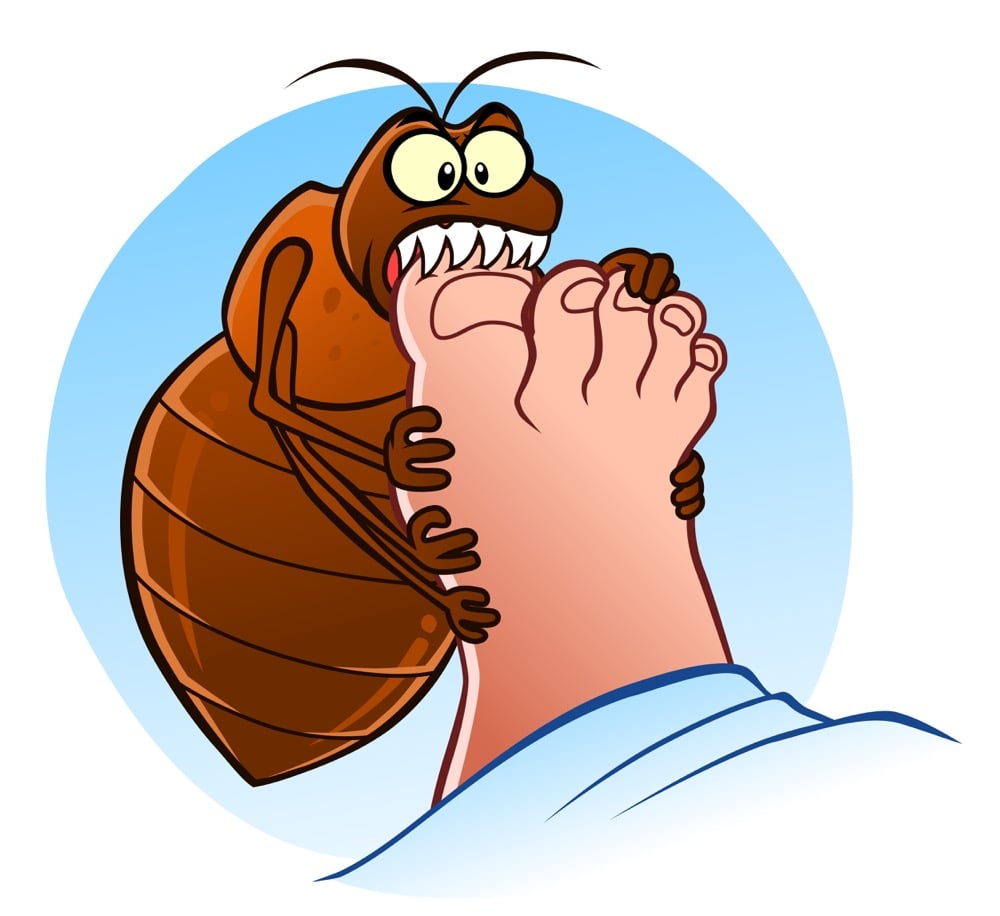 “My mom had her quirks too, and she had her own unusual sayings and traditions. The traditions she learned and passed down had nothing to do with farts, or anything as revolting as my dad’s. She was our version of a normal person, and we needed her dose of normalcy to combat everything being thrown at us. She used to read to us every night, she tucked us in, and gave us one of her sweet, motherly kisses before heading to the door. Then, right after she told us how much she loved us, and before she closed the door she’d say, “Sleep tight, and don’t let the bedbugs bite.”
“I didn’t even know what bedbugs were back then. Are there really tiny, little bugs crawling all over my bed and my body? Is this common, and what do we have to do to prevent them from biting me? She didn’t intend to introduce this horrific thought into our already creative minds. She thought this familiar, little rhyme conveyed sentiment. I love you, and have a good night’s sleep. Oh, and don’t let the bedbugs bite. This was my mom’s idea of punctuating love. She did it so often that by the time I started thinking about what it was she was saying, it was already an accepted part of our parting ritual at the end of a night. I also think she just liked the phrase, because it rhymes, “Sleep tight, and don’t let the bedbugs bite.”
“What you may not know, because I didn’t, is that fossils and early writings discovered that bedbugs date back to ancient Egypt and Rome and industrialization and colonization brought them here. So, when ancient Egyptians issued such warnings, they meant it. The mattresses they slept on were made of straw and feathers, and they were held up on a series of latticework ropes. The origin of the phrase sleep tight was probably made in reference to the parents warning their children to tighten their ropes to prevent sagging. Bedbugs cannot jump or fly, but they probably didn’t know that. Another theory speculates that sleep tight referred to keeping pajamas tightly wound to prevent bedbugs from getting in, but all these theories involve speculation over the origin of the phrase. The point though is that it’s possible that some form of this phrase could be hundreds to thousands of years old.
“If we took a step back to realize what we’re saying about bedbugs, before we close the door to immerse our kids in total darkness, where their unusually creative minds spin just about everything we say into some form of horror that causes them insomnia and nightmares, we might want to give some thought to ending the tradition that suggests these nasty, little germ-ridden insects are probably going to bite us unless … unless they somehow don’t let them. That’s a question I never asked “How do I go about not letting them?” Seriously? “Are there proactive, preventative measures I should employ here, and why are you requiring me to do this alone?” Isn’t this basically what we’re saying when we say, good night, sleep tight, and don’t let the bedbugs bite? We’re saying that we’ve found proactive, preventative measures pointless, and you’re kind of on your own here. Now, good night, and don’t let them bite. Slam! We may have found the answer for why Joey always sleeps with his cute little Mattel swords and shields, he’s preparing for battle.
“Traditions are what they are, thoughtless traditions,” Barry said, “but they are also an inner node of our family tree that we consciously, and subconsciously, use to connect us to our mothers, our grandmothers, and their definition of love. There’s also that added ingredient, in some weird and inexplicable way, that we see it as a definition of quality parenting. We don’t think about it. We just do it. It’s a set of parental instructions or system of rules written into our code and our peculiar programming language. It’s as much a part of our fabric as familial tales of our cranky old uncle swearing every time he has to stand up, the way our grandpa makes noises when he sits, and playing cars with our cousins on kitchen tile in our pajamas.
***
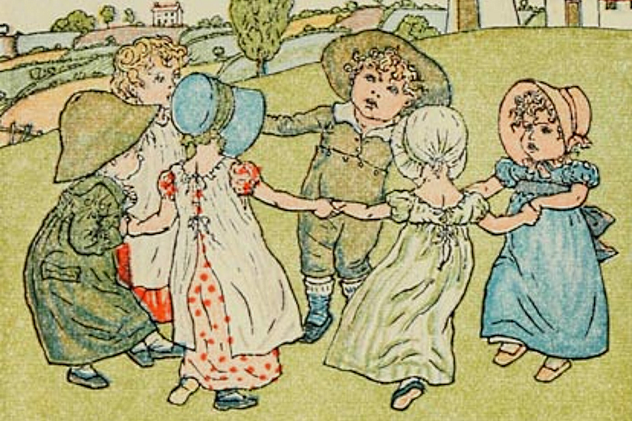 “These generations-old, odd traditions that influence and enhance who we are surfaced when I picked my kid up from school. Some kids, somewhere on the playground, began singing the borderline horrific song Ring around the Rosie. Everyone knows this singalong song, right? Why do we all know it, and who taught these kids this tradition? We did. Who taught us? We just sort of pick it up from somewhere, and no one remembers where. It’s a tradition that was, is, and probably will always be. I smiled when I heard them sing it. Ring around the Rosie, sing it with me now, pocket full of posies, ashes ashes, we all fall down.
“Apparently, there are numerous versions of this song sung around the world, and some of you might know a different one, but that’s the one we sang in my pocket of the world. For as many versions as there are, there are nearly as many interpretations of the lyrics. As kids we sang it just to sing something while we did something else, but some folklorists suggest the lyrics ‘ring around the rosie’ might have developed as a result of kids teasing other kids when they spotted a red owie on their arm. Any owie, I assume, was subject to ridicule, and if you know a kid, you know they can get bruises, bumps, and red spots walking through an aisle at Walgreen’s. “Where did you get that bruise on your arm? Joey” “I don’t know,” and they don’t. They really don’t. It’s as much a mystery to them as it is to you.
“When one of these 1665-era kids of London spotted an owie on one of their friends arm, they sang Ring Around the Rosie to tease him that he might want to consider the idea that he might have …. the plague. The plague! Some call it The Great Plague of London, others called it Black Death, and historical chroniclers called it last major epidemic of The Bubonic Plague in England. Some trace the origin of this little song to this Bubonic Plague that slaughtered over 100,000 Londoners at the time, and the total population of London, at the time, was around 460,000. So, it killed nearly one in four Londoners.
“Ring around the Rosie! Yeah, we saw your little owie, Joey, and we’re pretty sure that means we’re going to be throwing your body in one of the local burning, plague pits soon.
So many people were dying from the plague that they couldn’t keep up. If you’re from an area of the country that can be affected by wintry conditions, you know that there are times when police won’t respond to minor car accidents. They tell you to exchange information, and drive on. This is what was happening in 1665-England. If a loved one dies, just wait till nightfall and give them to a corpse carrier, who would stroll through the night with his agricultural cart, yelling out, “Bring out your dead!” Fans of Monty Python’s 1975 movie Holy Grail know this scene well. When his cart was full, the corpse carrier would take his load to a plague pit to burn and bury the corpses. 1665 England didn’t bother with funerals, ceremonies, caskets, or graves. There were just too many corpses in too short a time. So, unless you had the money to get a proper service, they threw your corpses in a plague pit, and we can only guess that little Joey probably saw a few of his cousins, aunts, and friends thrown onto the corpse carrier’s cart or into the pit. We all use various mechanisms to deal with the horror happening around us, and kids are more sensitive, thus more brutal, in trying to prevent the horror from getting inside their head, so they developed this cute, little rhyme to suggest that their friends, or that kid who sits two seats up and to the right in class, is headed for the burning corpse pit soon. Isn’t that just the cutest thing? What do you say we teach our kids to sing that for the next three hundred, plus years?
“Some folklorists suggest that the ‘pocket full of posies’ verse was used to mock those kids whose parents believed that if their Joey carried flowers in his pocket, it was a homeopathic remedy to prevent the onset of the plague. So, this portion of the song basically says, “Even though you had a pocket full of posies, you still caught the plague, Joey, SUCKER!”
The conclusion of the song might be the most horrific, as the “Ashes, Ashes, we all fall down” lyrics suggest that Joey’s tormentors realized that they were acknowledging that they were going to get it too, we all will, and we’re all going to die en masse. One would think that in the age of COVID, we should consider ending the tradition that involves a sing-a-long about catching plagues, airborne or otherwise, that could slaughter hundreds of thousands.
“I’ve heard that the folklore surrounding these interpretations of the lyrics might not be true, but even the most obnoxious, cellphone-checking sleuths will have to admit that there’s enough speculation among folklorists who’ve examined the lyrics of the song that we should probably stop teaching it as a sweet, pleasant “singalong” rhyming song our kids can sing on a playground. I mean, how can anyone spin “Ashes ashes we all fall down?” as anything other than a relatively disturbing dystopic image? A creative, young mind might even spin the lyrics as a warning for all participants to prepare for a nuclear winter?
***
“Almost everyone here tonight is a complex, fully formed adult who has lived through several different, complicated eras of life, met thousands of different people, and read at least a few books,” Barry said. “Yet, we don’t know what we’re doing anymore than our parents did when it comes to parenting, and even if we did, we wouldn’t know what to do about it. I’m sure some of you are more confident in your parenting skills, have a master plan, or whatever, but most of us are just making it up as we go along.
Have you ever had another parent look to you as a model of good parenting? It’s unnerving. You’re looking to me for some sort of guide for good parenting? What kind of dysfunctional and confused parent must you be to look to me? Good God man, I’m a mess. My model for everything I do, as a parent, is my dad, and he didn’t know what the hell he was doing. I mean, look how I turned out. I’m this big ball of the contradictions, hypocrisies, and family traditions that involve dystopic songs and nighttime warnings of bug infestations that my parents taught me. The greatest thing my dad ever taught me was independence, and there are a vast number of merits to teaching your children how to solve their own problems, play alone, and to prepare them for the reality that they’re going to spend most of their time alone, but the constant refrain of my dad’s parenting was, “You’re on your own kid.” I learned most of the strengths and weaknesses of total independence at 11. “Don’t get in trouble, keep your grades up, and don’t touch my stuff.”
“One interesting byproduct fell out of my dad’s relatively dysfunctional definition of parenting, and that was that I learned that he didn’t care about me near as much as I thought he did. He didn’t attend my sporting events, so he wasn’t cheering me on from the stands, but he wasn’t booing either. This led me to the notion that no one’s cheering us on from the proverbial stands either. We’re on your own here. They might applaud an accomplishment of ours in the moment, but they really don’t care near as much as we think. But, and here’s the element of life it took me decades to fully comprehend, no one cares as much as you think about our failures either. It’s one thing to say people don’t care much about our success. That’s yours to love, cherish, and celebrate, but when we fail, we’re sure that everyone from our parents to that guy in the checkout line at The Supersaver knows too. The truth is, they’re not paying near as much attention as we think. This is not only a bizarre way of thinking, it’s wrong, right?
The fact that people don’t pay as much attention as we think, or fear, is actually documented in various psychological studies. They’ve performed tests that involved a student walking in front of a huge college classroom to interrupt a professor and ask them a question. That student, in question, was wearing one of the loudest T-shirts he could find. The result, 10% of the people noticed that shirt. When a separate but similar test was done with a student wearing the finest suit known to man interrupting a class to ask the professor a question, 10% noticed that suit. We’re not paying as much attention as we think, and they aren’t either.
Some might find it depressing to learn that we’re all alone in the world, but if you turn that study around, you might find that it frees you up to try things we otherwise wouldn’t if we thought anyone was paying attention. If you latch onto the idea that no one’s near as much attention to what you do, who you wear, or those silly jokes you tell, then just do what you do with the knowledge that no one’s really paying any attention.
 Rilaly