“I’m Just Too Dumb!” 


“Hey Patrick come over here and check out our sinkhole,” Hector said when he spotted his neighbor walking outside. Patrick walked over and looked, because who wouldn’t want to look in a sinkhole? He looked from a careful distance, made a comment that I can’t remember, and he began walking away. “Wait, Patrick, you really gotta see this thing,” Hector urged. “C’mere.” 

“I saw it,” Patrick said. “It’s a sinkhole Hector. I’ve seen sinkholes before. It’s not a circus exhibit.”

“C’mon,” Hector said, “I’ll hold your hand, if you’re afraid of falling in.”

“You don’t understand, I will fall in. I’m just that dumb,” Patrick said, dropping his new favorite line on those of us standing around the sinkhole.

“No, you won’t. They’ve cordoned off the dangerous spots, so we know how close we can get,” Hector said, noting that he already called the police, and they put yellow tape around the weak spots. “Just don’t cross the tape.”

“Trust me,” Patrick said. “I’ll fall in. I’m just too dumb.” 

Patrick loved that line. He dropped it so often, in so many situations, that it kind of  became his catch phrase. Why did he love it? I wasn’t there when he first heard it, but I wonder if he thought it was so hilarious that he would start using it. Did he think it was so hilarious because he could relate to it? Did he think it applied to him so well that he thought he should start using it? He might have started using it because he found it funny, but he began using it so often that I think he now believes it. 

“Be careful what the brain hears you say,” a friend of mine said when I told her this story. “It might start to believe it.” 

Others can convince us of just about anything, if they repeat it often enough, but can we convince ourselves of something if we repeat it often enough? If we hear someone else’s schtick, and we love it for being such a great, self-deprecating line, can we accidentally convince ourselves that of something like being so dumb that we might do something that could cause ourselves irreparable harm? It’s possible of course, but is it probable? I would say this is not a joke, but it probably started out that way to Patrick, until he accidentally convinced himself that not only is he dumb, he’s so dumb that if he doesn’t check himself, and his brain, he’s probably going to end up in an emergency room saying, “I told you. I told you how dumb I was. Why didn’t you listen? Why didn’t I?” 

I’m not exactly sure why I considered Patrick’s “I’m too dumb” joke so funny. He dropped this line on me several times, in casual conversations, and I always enjoyed it. We’ve all heard people drop variations of self-deprecating humor, but Patrick’s delivery was so pitch-perfect that I can’t but think he believes it on some level. He was so flat and straight, and nothing about his presentation suggests that he’s seeking laughter. Does that make his joke better, yes it does, but does he deserve credit for his ability to deliver a joke, and is it possible for someone to deliver a joke that well without some belief in it?  

To arrive at answers that plagues us, we need a control group. When research scientists attempt to arrive at answers regarding psychological complexities, they divide their group into subjects and a control group. Patrick is a jokester, always telling jokes, and he’s a pretty funny guy, but he has one flaw. He laughs harder at his jokes than anyone else does. To understand if he is kidding, and by how much, we need to study the methods, patterns, and reactions he has when telling his other jokes. Following his other jokes, he drops a “I mean, C’mon, right?” followed by laughter. He pumps his head back, and his eyebrows go high on his head as he laughs. When he drops his “I’m too dumb” jokes, however, he doesn’t laugh, and his head goes down in the manner a dog’s might to signify submission. Is this part of his schtick? Does he do that to sell the joke better? Patrick is funny, but he’s not that funny. He does not apply such subtle intricacies to any of his other jokes, even the other self-deprecating jokes he tells. I don’t think it would take a team of research doctors to find that the reason Patrick tells this joke so well because he believes it. 

For all the reasons listed below, reasons I imagined later, this instance at the sinkhole struck me as particularly hilarious. Patrick added to the comedic nature of his joke by putting greater distance between he and the sinkhole. He walked away from Hector’s home, and off Hector’s lawn, and he then went into his home. I don’t know if he locked the door, but my guess is he did to presumably place one more obstacle for him to cross to get back to the hole. I presume Patrick did this, because he no longer trusts his brain to help him avoid an impulse that might cause him harm. Those of us standing around this sinkhole in Hector’s lawn could only presume that Patrick lost all faith in his brain’s ability to protect him from harm.  

I flashed to Patrick falling in the hole, a near bottomless pit in Patrick’s imagination (it was about three feet deep), looking up at us saying, “See, gawdangit, I told you how dumb I was.”

“Listen, I have two kids to raise, and they count on me to be there for them in so many ways,” I imagine Patrick pleading if Hector pressed him further. “If I start following whatever impulses my insufficient brain provides, I’m going to leave my wife a single-parent, and I’m not going to do that to her or my beloved children. I have to learn to reject whatever temptations I encounter to protect my body, so I’m there for them throughout their maturation.” 

We’ve all heard psychologists talk about a person being at war with their brain. It’s a deep, complex topic they use to describe those with seriously troubling psychological issues. Patrick doesn’t have those, but he does appear to be in conflict with his brain on a level that he describes with repetitive jokes. At one point in his life, I think Patrick decided to wage a cold war against his brain. A cold war, by our definition, involves “threats, propaganda, and other measures employed just short of open warfare.” Or, as others put it more succinctly, “Waging war without firing a shot.” At some point, Patrick’s internal forces decided to mount an internal coup against the brain, because those mechanisms decided that the brain no longer had their best interests in mind. 

One of the primary directives of the brain is to protect us. It protects us from heights, guns, and the prospect of encountering large, man-eating animals through chemical compounds that induce fear. When we fear, we learn to employ various defensive measures, including creating distance from the temptation, to prevent what the brain suspects could cause bodily harm. Over the years, we learn what to eat and drink, and what we do and think to prevent bodily harm. The brain instinctively knows, and learns, what can cause death. What isn’t so obvious are the irrational fears we develop for the dark, ladybugs, and inanimate objects.

Why are we so afraid of insects, even relatively harmless insects such as the ladybug, at a young age? We don’t know what a ladybug is when we’re young, or if we do on some rudimentary level, we don’t know the extent of their abilities. This is the fear of the unknown. As we age, we learn that most animals and insects have an instinctual fear of humans, and it  provides us a level of comfort when we’re walking down the sidewalk, and they clear the way for us. Some of the times, insects occasionally land on us in their confusion, and our young, fantastical mind can interpret that as purposeful, especially when the ladybug begins to crawl up our leg in a manner we could further interpret as a purposeful violation of the parameters we thought we had with insects. We convince ourselves that they’re not afraid of us anymore. They’re crawling up our legs with a specific purpose in mind that we don’t even want to imagine, and that leaves us paralyzed with fear.  

At some point in our maturation, our brain learns the parameters of threats against the body. There’s nothing to fear from ladybugs, even those that appear to violate the parameters of the relationship we have with insects. We’re quite sure that there are some anecdotal tales of a ladybug causing human deaths, but they’re so few that we know there’s little to fear from them. There are, however, a number of tales told of spiders causing death, but not as many as those from the mosquito archive. Yet, the number of people who fear spiders far outweighs those who fear mosquito. The whole world of fearing spiders involves their creepy nature, their physical appearance, and the techniques they use to poison their fellow insects and eat them.     

At some point in our search of what to fear and what we learn is relatively harmless, the brain plays tricks on us. We fear the relatively harmless, clowns and cotton, yet we don’t fear some of the things that can actually harm us, and kill us, like driving ninety miles an hour down the interstate. 

“I like to tease my fears,” a friend told me. “I prefer to live dangerously. It’s a rush to put your life on the line by skydiving from a plane, or bungee jumping, and bungee jumping is actually a lot more dangerous than people know.”

“So, you consider jumping from 50 to 500 feet with nothing but a cord tied to your ankle dangerous?” I asked sarcastically. The fact that she felt the need to tell me that bungee jumping was dangerous suggested to me that most people she knows have tried to argue against her position, and if that ain’t the brain messing with people, I don’t know what is. 
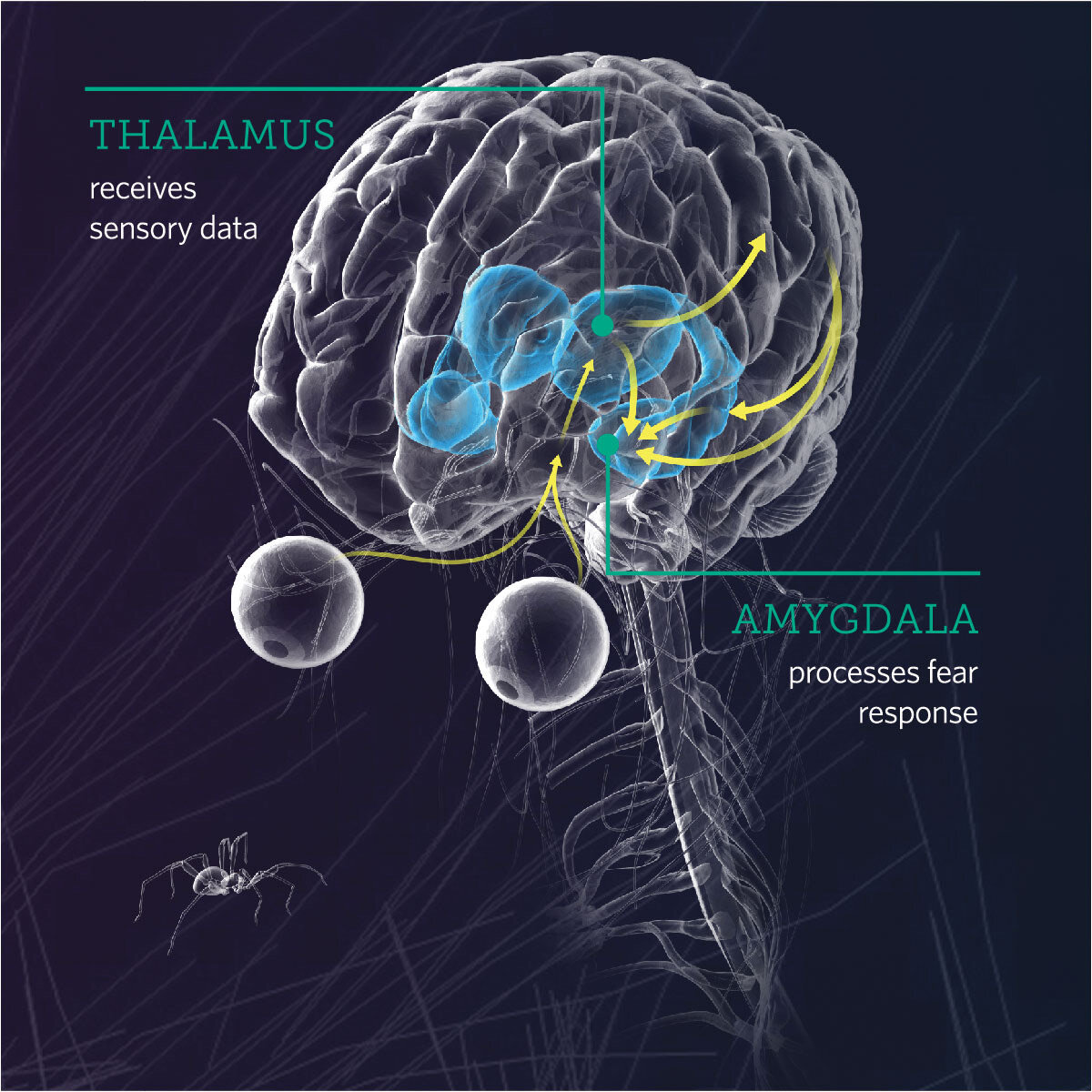
Patrick’s brain has obviously spent a lot of time messing with him in this manner, trying to convince him that nothing is as dangerous as they say, and his brain has obviously done this so often that Patrick just doesn’t trust it anymore. We’ve all heard that those working a police beat believe half of what they see and none of what they hear, but I’ve always assumed that was intended to illustrate their trust of what others do and say. Others can deceive us into accepting what we know is not true, but can we do this to ourselves? Are we at war with our own brain in relatively benign situations such as our approach to a sinkhole? There’s knowing and not knowing, of course, but as Patrick said he’s seen sinkholes before, so he presumably knows how to approach it. He just doesn’t trust his instincts, and he’s skeptical of what he might do. 

We all engage in self-deprecating humor, and we all enjoy the fruits of a person showing that he doesn’t take himself too seriously. As I’ve written many times and many ways, be careful with this comedic tool, because your audience might begin to believe it. Patrick’s use of self-deprecating humor seemingly adds another layer of caution, be careful how often you use it, because you might start to believe it.   

Patrick is not a dumb man, and if we are ever tempted to join him in the belief that he is, all we have to do is talk to the man for about forty-five minutes to learn how knowledgeable he is on so many different and diverse topics. Somewhere along the line, Patrick heard someone say that they were “so dumb” that they might not be smart enough to prolong their health and well-being. Patrick obviously considered that so funny that he began using it, and he saw how this exaggeration of the typical self-deprecating joke comforted his audience. It obviously comforted him too, to a degree, to think that he wasn’t all that. At some point, he began to fear that he might actually be “so dumb” that he could find a way to convince himself that he might cross that yellow, police tape to end up in a bottom of a sinkhole without knowing how it happened or why he did it, because his brain is now so deficient that it might lead him to him harming himself in some life-altering manner. Faced with such internal strife, Patrick decided that it was just safer for him to walk away, enter his home, and lock the door to try to prevent his kids from being fatherless children. “Trust me, I will fall in,” he warns us, and presumably himself, “because I’m just that dumb.”  

Fear’s Veil: Decoding the Leadership Mystique


“You’re getting a detention for that,” were the scariest words we could hear between fifth grade and eighth grade. To avoid hearing that from a teacher, the principle, or any of the other authority figures who stalked the halls of my school, I walked straight lines, stood as straight as I could, and I didn’t respond to neighbors who whispered something funny that required a rejoinder. We were not only scared, we were terrified to the point of anxiety attacks when the teacher would give us the pre-detention eyeball. 

A detention required us to spend one half-hour after school. Thirty minutes. You might think that serving a mere thirty minutes after school would lead an overwhelming majority of us to think, “Hey, that wasn’t so bad after all.” No, it was so terrifying that some of us had nightmares about being caught in the act, the teacher writing out the detention, and the din of silence that followed with everyone staring, looking away, and staring again. Thinking back, it’s almost funny to think how powerful the culture of fear was, but we all knew it, and we all participated in it in our own individual ways. 

The tradition of forcing a student to stay after school, as a punishment for bad behavior was not new, or unique, to us. This punishment has probably been handed out for hundreds of years, the world over. It was also not unusual for us to fear getting in trouble in grade school, nor was it unprecedented that the kids in my grade school were absolutely terrified. This article isn’t about the silly effort of trying to suggest that our experience in grade school was worse than yours, better, or any different. We’re far more interested in the culture of fear that some institutions, such as my grade school, instituted to modify behavior.    

As scary as our principal was, and Mary Jane Meyer (aka Mrs. Meyer) was as scary, and as angry, as any individual I’ve met in all the decades sense. You might suggest that she thought she had to be to keep the hundreds of grade-school-aged kids in line.

“And if you just happened to catch her tending to her garden on some sunny day, she was probably a sweet, elderly woman.”

I just can’t picture it. I can’t picture her being gracious, warm, or even smiling. I’m sure she was quite pleasant to certain people, but I can’t picture it, and I don’t think any of my fellow students who attended this grade school during her reign of terror could either.  

Mrs. Meyer provided us a more tangible fear of God, and she was the wizard behind the curtain who orchestrated the culture of fear we knew. If we messed around in class, our teacher might scold us. If that wasn’t enough, she could threaten and/or give us a detention. That was enough for an overwhelming majority of us, but there were a few, and aren’t there always a few, for whom that wasn’t enough. For them, there was the ever-present threat of being sent to Mrs. Meyer’s office. That was enough for just about everyone else.

As scary as she was, however, Mrs. Meyer couldn’t have created the level of fear we knew on her own. She delegated much of the responsibility to her teachers, but they couldn’t have terrified us to the degree that some of us had anxiety issues, and others had such horrible nightmares they couldn’t sleep at night. For that level of fear, the institution needed compliance, our compliance. It needed our participation, and our promulgation of the culture that suggested that getting a detention was the most awful thing that could ever happened to a human being. No matter what they did to establish this climate, it wouldn’t have been half as effective as it was if we didn’t participate and fortify it. We did that to ourselves.   

“Did you hear that Gretchen and Marla got detentions?” someone would say in conspiratorial whisper.

“No way! For what?” No matter what the conspiratorial whisperer said there, the gossip mill spun the threads out to ultimately characterize the alleged perpetrator as the most horrible person of the day, and they often had a difficult time recovering their reputation in the aftermath.

When we approached one of the pariahs to get their perspective on what happened, they usually broke down like a politician in the midst of a career-ending scandal. Some tried to maintain a strong façade, but most couldn’t. Their defense usually devolved to those scared, uncontrollable tears. We empathized, because we knew firsthand the idea that nothing this bad had ever happened to them before.

It was our fault that she felt that way, because when she’d walk down the aisle to receive her detention, she felt our eyes on her, and she heard our whispers. The minute she turned around, we’d turn away and go silent. When it came to defending herself against the mob, she’s lie, obfuscate, try to shift the blame, and try anything and everything she could to salvage her reputation. We empathized here too, because what else are you going to do? 

We did more damage to her than the teacher, the principal, or any of our other authority figures could to demonize her, the detention of the day. We did it to ourselves. We policed our own and promulgated the culture of fear that surrounded the detention.

The idea that we cultivated their culture of fear wasn’t apparent to me in the moment, of course, because I was too young to grasp such complicated concepts, but it was crystallized in the form of a transfer student named Billy Kifferly. I knew Billy Kifferly before he transferred to our school, he was a friend of a friend, so when he got a detention I was the emissary sent to find out what happened, and how he entered into our dominion of the damned.

I asked him about it in the most empathetic manner a ten-year-old could. “… And it’s fine if you don’t want to tell me …” I added. I was fully prepared for his tears and/or the anguish that followed, and I had my shoulder all ready for him to cry on.

Not only did Billy not cry, or show any signs of fear of remorse, he told me all of the damning details of his detention, as if … as if they didn’t really matter. He didn’t try to wriggle out of it, or spread the blame. He said, “I did it. It was all my fault and all that, but it’s a half hour, so, big deal, right? I could do that standing on my head.”

That put me back a step. I couldn’t understand how he could be so blasé about it. As his only friend and confidant, I wanted to say, ‘Billy, you don’t understand,’ but Billy’s reaction to it informed me that there was something larger going on here that I didn’t understand. I didn’t get the fact that he was more accustomed to getting in trouble, or failing to meet the standards. He just got expelled from his prior school, so on that scale, a detention, or a half-hour after school, was nothing to him. I also didn’t understand that I was not only a part of the institutional culture of fear, but a promulgator of it

“It’s just a half-hour,” he said, and he was right, but ‘It’s so much more than that’ I wanted to say. I couldn’t back that up though, because I was too young to understand the nature of authority, rebellion, and Billy’s far too mature definition of the system-is-a-farce reaction. I knew Billy was the rebel, on some complicated level, I knew I’d become the standard bearer for the status quo if I said anything further.  

By not fearing the institutional hierarchy, and the elements that propped it up, Billy essentially informed me that the whole system was a farce. “Why should I fear spending a half-hour after school so much?” was essentially what he said. I thought of instructing him in our ways, but I was too young to understand the nature of our ways, and I was also far too immature to understand that we weren’t just ceding to authority, we were contributing to it.  

***

We can now all laugh at this kid, I call me, now. We’re sophisticated adults now with a more sophisticated understanding of authority, rebellion, and the balance of the two that forms a foundation that helps maintain a system, but when we look back at our naïve, immature understandings of an authoritarian world, we laugh. While we’re laughing, we should also take a look at how we sophisticated adults not only cede authority to authority figures in our lives now, we contribute to the underpinnings of their authority?

We call certain individuals in our culture authoritative experts, and we allow them to dictate their facts and opinions in a manner that changes the direction of our lives. “Why?” we ask rhetorically, “because they are more informed.” Are they? “Sure, they use the scientific method to arrive at dispassionate theories based on empirical data.” We learn from their research that there is “there is no conclusive evidence” for what we see and hear. How can that be? “After exhaustive research, the team at (fill in the blank) has determined that there is no conclusive evidence to suggest that’s true.” We learn to accept what they say, until we develop a level of faith in their point of view, their expertise, and their authority on the issue. We learn to accept their values through their lens. Are they right? “They’re experts, what are you asking here?”

Analysts call the dynamic of subjects contributing to expert analysis and authoritative dictates the leadership mystique. We now have unspoken requirements of our leaders to which they must adhere. We require them to exhibit, display, and provide some semblance of leadership qualities to fortify the facade. What are these requirements? They vary, but anyone who knows anything about icebergs knows that 90% of an iceberg is underwater. It could be argued that we create 90% of the foundation of leadership mystique for us, and we contribute to it in our interactions with other, fellow subjects.

We see this at play in the workplace when someone everyone considered an oaf yesterday, receives a prominent promotion today, and we agree to their leadership qualities tomorrow, characteristics that we never saw previously. Our authority figures obviously saw something special in them, and that’s enough for us, for some of us, and the onus is on us to help others see, accept, and promulgate their authority tomorrow.

Coupled with our concessions and contributions to authority figures and their rules and punishments, is the inherent recognition that even if we disagree with all of the above, we can’t choose our leaders. We are subjects who are subjected to those who make the rules, and we don’t even know who to blame when those rules prove silly. We blame our supervisor for imposing a rule passed down by a manager; we blame the policeman for carrying out a silly law passed down by a state legislator or federal official. We blame the person who is in our face, enforcing the rules, because most of us don’t dig through the layers to find the person who is to blame for drawing up the rules/laws, and those who pass them. 

The United States citizen lives in a Representative Republic that permits us to choose those we deem our authority figures. Yet, how many of us choose a representative of what we want to be as opposed to who we are. An overwhelming majority of us live within our means, and we’re quiet, unassuming types. We’re more like the character actor who quietly assumes the characteristics necessary for a role, but we prefer to vote charismatic game show hosts types into office. That guy looks like someone who would be fun to hang around. If that’s our choice for a leader in a Representative Republic, who are we? Who do we deify and assign leadership qualities to satisfy our role in the leadership mystique? How many of us assign such qualities to the manager of our local Wendy’s? We don’t, we hold them accountable for producing an inferior product.

Most of us don’t condemn representatives we charge with voting the way we would or the manner in which they spend our money. We direct our ire at those who don’t pay enough in taxes instead. We police our own. The governments can levy fines, put liens on our property, and take away our freedom if they determine that we didn’t pay enough taxes, but they cannot convince us to condemn our neighbor as a pariah for not paying what we deem enough. That’s our job, and we relish it.    

This article is not about the rebels or the figures of authority in our lives, though those would be interesting pieces. It’s about us, and our amenable and compliant ways of helping authority figures establish and maintain a level of authority in our lives. It’s about ceding elements of our lives to authoritative experts who sit behind a type writer telling us how to live our lives, raise our children, and go silent when they need us to just be quiet. 

In grade school, we were little kids who were easy to manipulate and cajole into carrying out institutional planks, but how many adults aid in the culture of fear of government edicts on paying “enough” taxes? We’re not half as concerned when our government officials spend our money in foolish ways, as we are the CEO of a company not paying what we deem enough in taxes. We not only cede authority to government officials. We contribute to it by condemning our neighbor for not paying enough.

As someone who has been on both sides of the paradigm, on a very, very minor scale, one thing I recognized when given an relatively insignificant level of authority was that my level of authority was not recognized or appreciated by my fellow authoritative figures. As a huge Letterman fan in the 80s, I’ve always found some inspiration in his idea that he was a bit of a joke. You can be king of the world, and he was in his own little way, but you’re still that goofy kid from the Midwest who had some really stupid notions about the world. His influence led me to consider myself a bit of a joke, and I saw the joke in everyone around me too, especially those in leadership positions. Everyone enjoys hearing that what they’re doing is important and substantial, and they don’t mind laughing at themselves, but they do no enjoy hearing that they’re kind of a joke too. When I learned to control my comedic impulses, and I ceded to their authority, they began to appreciate and contribute to my comparatively meager mystique. 

“It’s called reciprocity,” a friend of mine said, “I scratch your back, you feed my need!”

Was Y2K an Unfixable Problem, Hysteria, or an Easy Fix?


“You never get credit for the disasters you avert,” Technology forecaster Paul Saffo told the New York Times in 2013. 

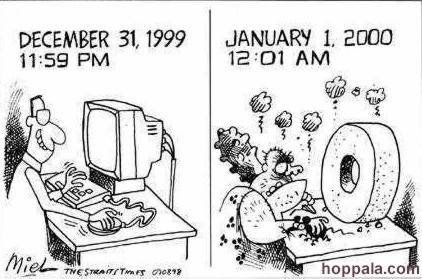
The greatest fear of the Y2K (Year 2000) bug was the fear of the unknown. In 1999, we thought the unfixable” Y2K bug was a first step in our dystopian future. We can all have a laugh about it now, but very few of us were laughing in December 1999. We didn’t know, and that’s what scared us.

The crux of the fear, for those who didn’t live through it, was that computer programmers didn’t bother listing the full four numbers of a year. 1995, for example, was listed by most computers as 95. 1996 was listed by computers as 96, and so on and so forth. The fear was that when the calendar flipped from 1999 to 2000, computers might not be able to distinguish between 1900 and 2000, because computers, in computer-reliant industries, might not be able to distinguish between the years, since they had, to this point, only listed years as two digits.

If it was fixed, did it require a collective effort from private companies, government expenditures that some estimate in the range of $400 to $600 billion, and independent engineers, or was this largely exaggerated problem a relatively easy fix? Was the problem greatly exaggerated and overhyped?

Some of us had our own, internalized doomsday clock in December of 1999, because we feared the unknown. Did we fear it from the comfort of our own home, because we were told to fear it? We were told it would affect every human’s daily life in one way or another. Large or small, we thought every day life wouldn’t be as great as it once was in December 1999. Some of us thought the electricity grid might go down, we heard planes might fall from the sky, our cars and unprepared computers would become inoperable, and our bank’s automatic teller machines (ATMs) would not dispense money. We all laugh about it now, but some maintain that tragedy was averted, and when tragedy is averted without a noteworthy event, we quickly forget how tragic it could’ve and probably should’ve been.

If any problem solver fixes a problem before it ever becomes a problem, they receive no credit for it. If they’re concerned with receiving some form of credit, the most advantageous route is to forestall a solution to allow noteworthy events to occur, and then fix it and save the world. As we all know, this did not happen in the Y2K scare.

I knew people who stocked their pantries with bottled water and grain pellets, I knew others who withdrew extra cash from their bank’s ATM, and I knew a number of people who bought Y2K software updates for their computers. No one knew everything, but we all knew some things, and everyone knew that we had to be prepared for anything. Our reaction to the scare defined us in 1999, but it further defined us on January 1, 2000, as it was noteworthy what we did to avoid becoming a victim of something that never happened. Whatever you did became the subject of ridicule.

The theoretical question we asked one another in 1999 was not when it would affect us, because we all knew that. The question was how much would it affect our daily lives? Few reasonable and rational adults asked the question if it would affect us. Due to the fact that computers were still relatively new to us, we considered it a fait accompli that it would affect us. We grew up with science fiction movies that revolved around a plot that that which can help man today could one day, and in some way, ruin man in a dystopian manner that no one saw coming.

In those movies, the proverbial, street corner bell ringer was always the best-looking actor in the movie (which lends their character more gravitas) warning the less attractive (and thus less aware) side characters of impending doom. None of the average-to-ugly actors in the movies recognized the true, impending threat for what it was until it was too late. We didn’t want anyone to consider us average-to-ugly, so we mentally prepared for the day when an attractive person lofted a preposterous notion to us.

In 1985, someone posed a theoretical question about how Y2K might affect computers when the century switched, but the problem for us was we didn’t know how attractive that theoretician was, so we didn’t take it seriously. Their theoretical notion hinged on the idea that for decades computer programmers wrote the year in shorthand. They didn’t write out the year 1985, they wrote 85. Some claimed the shorthand was done to save memory space. Thus, when the year flipped from 99 to 00, we feared that all of our computers would believe the year was 1900, 1800, or even year 00? Most of us didn’t believe that computers would transport us bedside, next to the baby Jesus, but we feared that our computers would fail to recognize the logic of the switch, and that the bug it created might introduce such internal confusion in the computer’s mainframe that they would simply shutdown. We feared any human input introduced to combat this inconsistency would prove insufficient, and that human interference could lead to some unforeseen complications, and we feared our computers would be unable to sort it out? The theoretical question reached hysterical proportions in the fourteen years between 1985 and 1999, as America grew more and more reliant on computers for everything from its most important activities (travel) to its most basic (ATMs and the electrical grid).

My guess is that the recipient of that first theoretical question brought it to a closed-door boardroom, and some of those board members took that question out to other parties, until someone in the media heard the question and thought it might prove to be an excellent ongoing question to ask an audience in ongoing features every week. They could start a Tuesday Tech story of the week in which they asked the informed and uninformed what they thought of a problem that wasn’t a problem yet, but could be a problem when the calendar flipped.

Media figures play two roles in our lives, they tell us what we need to hear, read, and see, and they tell us what we want to hear. We don’t want to hear eggheads talk 1s and 0s, unless they can make it apply to our lives with a quality presentation. That, in my opinion, provides stark clarity on our mindset, because we prefer the presentations inherent in science fiction to the hard science of the actual factual.

“Nobody cares about computer programming,” we can guess a network executive informed that ambitious reporter’s Tuesday Tech proposal. “Why should I care about this?”

“The angle we’re proposing is more granular,” this reporter said. “The first network focused on the larger question of computer technology in their Tech Tuesday reports. In our Tech Thursday features, we’ll explore how much of our lives are now dependent on computers. Our energy grid, the tanks at the gas station, and the ATMs. We plan on bringing this theoretical problem home to where people live. We will say this Y2K bug is not just going to affect Silicon Valley and Wall Street, it could have far-reaching implications for citizens watching from Pocatello, Idaho to Destin, Florida, and here’s how …”

As usual with hysterical premises of this sort, the one component most news agencies, and the word-of-mouth hysteria that follows, fail to address is human ingenuity. Rarely, do we hear a reporter say, “We’ve all heard the problem called the Y2K bug, but we rarely hear about proposed solutions. Today, our guest Derrick Aspergren will talk about proposed solutions to comfort the audience at home.” The problem for news agencies is that the Derrick Apergrens of the world are often not very attractive or charismatic, and they speak in ones and zeroes. Even though most computer problems and solutions involve a lexicon of ones and zeroes, no one wants to hear it, and few will remember it. As a result, news agencies rarely give Derrick Aspergrens airtime, and they focus on the dramatic and provocative, proverbial bell ringers standing on a street corner.

In 1999, we rarely heard the question, can hardware engineers and electrical engineers fix a problem they created? The learned fear we’re conditioned to believe, based on the plot lines of so many science fiction movies, is that if we dig deep enough, we’ll discover that this isn’t a human problem at all, but a problem generated by a scary conglomeration of ones and zeroes we call AI (artificial intelligence). We knew little-to-nothing about the potential of AI in 1999, but we feared it, and its potential, because we feared the unknown. “AI is here, and there’s nothing we can do about it!” was (and is) the battle cry of conspiracy theorists on radio, in our neighborhoods, and in our work place. The truth is often much less dramatic.

The truth, we now know, was somewhere south of the hype. The truth lived somewhere in the question of whether the Y2K fear was real. If it required a big, worldwide fix, as some suggest happened, how come there were no Nobel Prizes handed out? “That’s because it required a collective effort from so many minds, around the world that there was no individual to accord credit.” Or, was the fix so easy that any hardware engineer, worth half of his college tuition payments, was able to do it?

Was the Y2K scare a tragedy averted by hardware engineers enduring mind-numbing hours of editing, or was the entire affair hyped up through media mis, dis, or mal-information? I don’t remember the reports from every media outlet, but how much focus did the round robin hysteria generated by the media place on possible and probable fixes? Some suggest if there was a need for a fix, it could be easily accomplished by hardware programmers, and others suggest it was never this world-shaking threat we thought it was.

The problem for us was that the problem was so much more interesting than the fix. Take a step back to December 1999, and imagine this news report, “Here we have a man named Geoffrey James, who says, “If Y2K experts (some of whom have a software background but none a hardware background) ask some electrical engineers about date checking in embedded systems, they will learn that only a complete idiot would do anything resembling the conversion and comparison of calendar dates inside a chip. We use elapsed time, which is a simple, single counter; it takes ten seconds to add to a circuit.

“I may oversimplifying but ultimately the reasoning doesn’t matter,” Geoffrey continues, “the unfixable system problem either isn’t real or isn’t significant enough to spawn a disaster. Because there aren’t any.” That rational and reasonable explanation from someone purportedly in the know would’ve gone in one ear and out the other, because for some of us there are no absolutes, and there are no quick fixes. When someone dangles the prospect of a simple solution to the simplest problems, we swat them away:

“You mean to tell me that all they have to do is add to a circuit. I ain’t buying it brother, and if I were you, I wouldn’t buy it either. I wouldn’t go out into the world naked with the beliefs of some egghead. We all have to prepare for this, in one way or another, we must prepare.”

Some of us thought the Y2K bug would force us to back to the primal life of the cavemen, or at least to the latest and greatest technology of the McKinley administration of 1900. Friends of mine thought those of us who know how to hunt and forage for food would once again take their rightful place atop the kingdom of those who grew so accustomed to the comfy life of a visit to the neighborhood grocery store. More than one person I knew thought our appliances might explode, and that Americans might finally know what it’s like to live in the poorest third-world nations in the world. They thought we would return to our primal life, and our TV shows and movies reflected that fear, anxiety, and (some say) desire to return to our primal roots.

News reports stated that hardware engineers and other electrical engineers were working on the problem, but they’re not sure they’ll have a workable in time. We knew the line: “For every problem there is a solution,” but when you’re in the midst of hysteria, lines like, “This was a man-made problem that requires a man-made solution” provide no comfort. We all know that tangled within mankind is a ratio of geniuses who not only know how to propose solutions, but they know how to apply and implement them. We know this, but humans suffer from an ever-present inferiority complex that suggests no mere mortal can resolve a crisis like this one. We know this because no self-respecting science fiction writer would ever be so lazy as to suggest that a mortal, whether they be a military leader with a blood lust who wants to detonate a warhead on the monster, a policeman who believes that a bullet can kill it, or an egotistical scientist can resolve this particular dystopian dilemma.

Even though this was a man-made problem, few outside the halls of hardware engineer offices believed man could solve the problem. We heard about geniuses who brought us incredible leaps of technology so often that it was old hat to us. We knew they could build it, but there was this fear, borne in the human inferiority complex, and propagated by the sci-fi movies we loved, that technology had spiraled so out of our control that it was now beyond human comprehension to fix it.

Was Y2K overhyped as an unfixable problem, was the solution so elementary that it simply took a mind-numbing number of man hours to implement it, or was it a simple hardware fix? I don’t know if the numerous media outlets who ran their Tech Tuesday features ever focused on the idea that the Y2K problem, of two digits vs. four, was generated by a theoretical question someone asked fifteen years before, but I told my terrified friends as much. “If this whole thing is based on a theoretical question, what is the theoretical answer?” With fellow uneducated types, I furthered, “And if we search through the theoretical answers, we might find an actual one.” The theme of my response involved the hope that we weren’t so terrified by the questions that we failed to seek answers, and I was shouted down. I was shouted down by uneducated types, like me, and I was, am, and forever will be woefully uninformed on this subject. They told me that I didn’t understand the complexities involved, that this situation was far more serious, and that I was underestimating it. I’d love to say that I adjusted the focus of my glasses, as I attempted to adjust theirs, but when the screaming majority in your inner circle is convinced to consensus those who are relatively uninformed either silence or buckle. I cowered, and I regrettably conformed to some of their fears, but I didn’t know any better. None of us did. The one takeaway I have from the hysteria we now call Y2K is that we should use Y2K hysterica’s fears as a precedent. If we have theoretical questions based on theoretical questions we should ask them of the more informed, more educated “experts”, because theoretical questions could eventually lead to some actual answers. The alternative might result in us shutting down the world over some hysterical fear of the unknown.