Was Y2K an Unfixable Problem, Hysteria, or an Easy Fix?


“You never get credit for the disasters you avert,” Technology forecaster Paul Saffo told the New York Times in 2013. 

The greatest fear of the Y2K (Year 2000) bug was the fear of the unknown. In 1999, we thought the unfixable” Y2K bug was a first step in our dystopian future. We can all have a laugh about it now, but very few of us were laughing in December 1999. We didn’t know, and that’s what scared us.

The crux of the fear, for those who didn’t live through it, was that computer programmers didn’t bother listing the full four numbers of a year. 1995, for example, was listed by most computers as 95. 1996 was listed by computers as 96, and so on and so forth. The fear was that when the calendar flipped from 1999 to 2000, computers might not be able to distinguish between 1900 and 2000, because computers, in computer-reliant industries, might not be able to distinguish between the years, since they had, to this point, only listed years as two digits.

If it was fixed, did it require a collective effort from private companies, government expenditures that some estimate in the range of $400 to $600 billion, and independent engineers, or was this largely exaggerated problem a relatively easy fix? Was the problem greatly exaggerated and overhyped?

Some of us had our own, internalized doomsday clock in December of 1999, because we feared the unknown. Did we fear it from the comfort of our own home, because we were told to fear it? We were told it would affect every human’s daily life in one way or another. Large or small, we thought every day life wouldn’t be as great as it once was in December 1999. Some of us thought the electricity grid might go down, we heard planes might fall from the sky, our cars and unprepared computers would become inoperable, and our bank’s automatic teller machines (ATMs) would not dispense money. We all laugh about it now, but some maintain that tragedy was averted, and when tragedy is averted without a noteworthy event, we quickly forget how tragic it could’ve and probably should’ve been.

If any problem solver fixes a problem before it ever becomes a problem, they receive no credit for it. If they’re concerned with receiving some form of credit, the most advantageous route is to forestall a solution to allow noteworthy events to occur, and then fix it and save the world. As we all know, this did not happen in the Y2K scare.
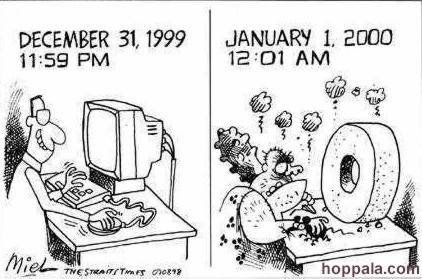
I knew people who stocked their pantries with bottled water and grain pellets, I knew others who withdrew extra cash from their bank’s ATM, and I knew a number of people who bought Y2K software updates for their computers. No one knew everything, but we all knew some things, and everyone knew that we had to be prepared for anything. Our reaction to the scare defined us in 1999, but it further defined us on January 1, 2000, as it was noteworthy what we did to avoid becoming a victim of something that never happened. Whatever you did became the subject of ridicule.

The theoretical question we asked one another in 1999 was not when it would affect us, because we all knew that. The question was how much would it affect our daily lives? Few reasonable and rational adults asked the question if it would affect us. Due to the fact that computers were still relatively new to us, we considered it a fait accompli that it would affect us. We grew up with science fiction movies that revolved around a plot that that which can help man today could one day, and in some way, ruin man in a dystopian manner that no one saw coming.

In those movies, the proverbial, street corner bell ringer was always the best-looking actor in the movie (which lends their character more gravitas) warning the less attractive (and thus less aware) side characters of impending doom. None of the average-to-ugly actors in the movies recognized the true, impending threat for what it was until it was too late. We didn’t want anyone to consider us average-to-ugly, so we mentally prepared for the day when an attractive person lofted a preposterous notion to us.

In 1985, someone posed a theoretical question about how Y2K might affect computers when the century switched, but the problem for us was we didn’t know how attractive that theoretician was, so we didn’t take it seriously. Their theoretical notion hinged on the idea that for decades computer programmers wrote the year in shorthand. They didn’t write out the year 1985, they wrote 85. Some claimed the shorthand was done to save memory space. Thus, when the year flipped from 99 to 00, we feared that all of our computers would believe the year was 1900, 1800, or even year 00? Most of us didn’t believe that computers would transport us bedside, next to the baby Jesus, but we feared that our computers would fail to recognize the logic of the switch, and that the bug it created might introduce such internal confusion in the computer’s mainframe that they would simply shutdown. We feared any human input introduced to combat this inconsistency would prove insufficient, and that human interference could lead to some unforeseen complications, and we feared our computers would be unable to sort it out? The theoretical question reached hysterical proportions in the fourteen years between 1985 and 1999, as America grew more and more reliant on computers for everything from its most important activities (travel) to its most basic (ATMs and the electrical grid).

My guess is that the recipient of that first theoretical question brought it to a closed-door boardroom, and some of those board members took that question out to other parties, until someone in the media heard the question and thought it might prove to be an excellent ongoing question to ask an audience in ongoing features every week. They could start a Tuesday Tech story of the week in which they asked the informed and uninformed what they thought of a problem that wasn’t a problem yet, but could be a problem when the calendar flipped.

Media figures play two roles in our lives, they tell us what we need to hear, read, and see, and they tell us what we want to hear. We don’t want to hear eggheads talk 1s and 0s, unless they can make it apply to our lives with a quality presentation. That, in my opinion, provides stark clarity on our mindset, because we prefer the presentations inherent in science fiction to the hard science of the actual factual.

“Nobody cares about computer programming,” we can guess a network executive informed that ambitious reporter’s Tuesday Tech proposal. “Why should I care about this?”

“The angle we’re proposing is more granular,” this reporter said. “The first network focused on the larger question of computer technology in their Tech Tuesday reports. In our Tech Thursday features, we’ll explore how much of our lives are now dependent on computers. Our energy grid, the tanks at the gas station, and the ATMs. We plan on bringing this theoretical problem home to where people live. We will say this Y2K bug is not just going to affect Silicon Valley and Wall Street, it could have far-reaching implications for citizens watching from Pocatello, Idaho to Destin, Florida, and here’s how …”

As usual with hysterical premises of this sort, the one component most news agencies, and the word-of-mouth hysteria that follows, fail to address is human ingenuity. Rarely, do we hear a reporter say, “We’ve all heard the problem called the Y2K bug, but we rarely hear about proposed solutions. Today, our guest Derrick Aspergren will talk about proposed solutions to comfort the audience at home.” The problem for news agencies is that the Derrick Apergrens of the world are often not very attractive or charismatic, and they speak in ones and zeroes. Even though most computer problems and solutions involve a lexicon of ones and zeroes, no one wants to hear it, and few will remember it. As a result, news agencies rarely give Derrick Aspergrens airtime, and they focus on the dramatic and provocative, proverbial bell ringers standing on a street corner.

In 1999, we rarely heard the question, can hardware engineers and electrical engineers fix a problem they created? The learned fear we’re conditioned to believe, based on the plot lines of so many science fiction movies, is that if we dig deep enough, we’ll discover that this isn’t a human problem at all, but a problem generated by a scary conglomeration of ones and zeroes we call AI (artificial intelligence). We knew little-to-nothing about the potential of AI in 1999, but we feared it, and its potential, because we feared the unknown. “AI is here, and there’s nothing we can do about it!” was (and is) the battle cry of conspiracy theorists on radio, in our neighborhoods, and in our work place. The truth is often much less dramatic.

The truth, we now know, was somewhere south of the hype. The truth lived somewhere in the question of whether the Y2K fear was real. If it required a big, worldwide fix, as some suggest happened, how come there were no Nobel Prizes handed out? “That’s because it required a collective effort from so many minds, around the world that there was no individual to accord credit.” Or, was the fix so easy that any hardware engineer, worth half of his college tuition payments, was able to do it?

Was the Y2K scare a tragedy averted by hardware engineers enduring mind-numbing hours of editing, or was the entire affair hyped up through media mis, dis, or mal-information? I don’t remember the reports from every media outlet, but how much focus did the round robin hysteria generated by the media place on possible and probable fixes? Some suggest if there was a need for a fix, it could be easily accomplished by hardware programmers, and others suggest it was never this world-shaking threat we thought it was.

The problem for us was that the problem was so much more interesting than the fix. Take a step back to December 1999, and imagine this news report, “Here we have a man named Geoffrey James, who says, “If Y2K experts (some of whom have a software background but none a hardware background) ask some electrical engineers about date checking in embedded systems, they will learn that only a complete idiot would do anything resembling the conversion and comparison of calendar dates inside a chip. We use elapsed time, which is a simple, single counter; it takes ten seconds to add to a circuit.

“I may oversimplifying but ultimately the reasoning doesn’t matter,” Geoffrey continues, “the unfixable system problem either isn’t real or isn’t significant enough to spawn a disaster. Because there aren’t any.” That rational and reasonable explanation from someone purportedly in the know would’ve gone in one ear and out the other, because for some of us there are no absolutes, and there are no quick fixes. When someone dangles the prospect of a simple solution to the simplest problems, we swat them away:

“You mean to tell me that all they have to do is add to a circuit. I ain’t buying it brother, and if I were you, I wouldn’t buy it either. I wouldn’t go out into the world naked with the beliefs of some egghead. We all have to prepare for this, in one way or another, we must prepare.”

Some of us thought the Y2K bug would force us to back to the primal life of the cavemen, or at least to the latest and greatest technology of the McKinley administration of 1900. Friends of mine thought those of us who know how to hunt and forage for food would once again take their rightful place atop the kingdom of those who grew so accustomed to the comfy life of a visit to the neighborhood grocery store. More than one person I knew thought our appliances might explode, and that Americans might finally know what it’s like to live in the poorest third-world nations in the world. They thought we would return to our primal life, and our TV shows and movies reflected that fear, anxiety, and (some say) desire to return to our primal roots.

News reports stated that hardware engineers and other electrical engineers were working on the problem, but they’re not sure they’ll have a workable in time. We knew the line: “For every problem there is a solution,” but when you’re in the midst of hysteria, lines like, “This was a man-made problem that requires a man-made solution” provide no comfort. We all know that tangled within mankind is a ratio of geniuses who not only know how to propose solutions, but they know how to apply and implement them. We know this, but humans suffer from an ever-present inferiority complex that suggests no mere mortal can resolve a crisis like this one. We know this because no self-respecting science fiction writer would ever be so lazy as to suggest that a mortal, whether they be a military leader with a blood lust who wants to detonate a warhead on the monster, a policeman who believes that a bullet can kill it, or an egotistical scientist can resolve this particular dystopian dilemma.

Even though this was a man-made problem, few outside the halls of hardware engineer offices believed man could solve the problem. We heard about geniuses who brought us incredible leaps of technology so often that it was old hat to us. We knew they could build it, but there was this fear, borne in the human inferiority complex, and propagated by the sci-fi movies we loved, that technology had spiraled so out of our control that it was now beyond human comprehension to fix it.

Was Y2K overhyped as an unfixable problem, was the solution so elementary that it simply took a mind-numbing number of man hours to implement it, or was it a simple hardware fix? I don’t know if the numerous media outlets who ran their Tech Tuesday features ever focused on the idea that the Y2K problem, of two digits vs. four, was generated by a theoretical question someone asked fifteen years before, but I told my terrified friends as much. “If this whole thing is based on a theoretical question, what is the theoretical answer?” With fellow uneducated types, I furthered, “And if we search through the theoretical answers, we might find an actual one.” The theme of my response involved the hope that we weren’t so terrified by the questions that we failed to seek answers, and I was shouted down. I was shouted down by uneducated types, like me, and I was, am, and forever will be woefully uninformed on this subject. They told me that I didn’t understand the complexities involved, that this situation was far more serious, and that I was underestimating it. I’d love to say that I adjusted the focus of my glasses, as I attempted to adjust theirs, but when the screaming majority in your inner circle is convinced to consensus those who are relatively uninformed either silence or buckle. I cowered, and I regrettably conformed to some of their fears, but I didn’t know any better. None of us did. The one takeaway I have from the hysteria we now call Y2K is that we should use Y2K hysterica’s fears as a precedent. If we have theoretical questions based on theoretical questions we should ask them of the more informed, more educated “experts”, because theoretical questions could eventually lead to some actual answers. The alternative might result in us shutting down the world over some hysterical fear of the unknown.

The Fear of Getting Punched in the Face


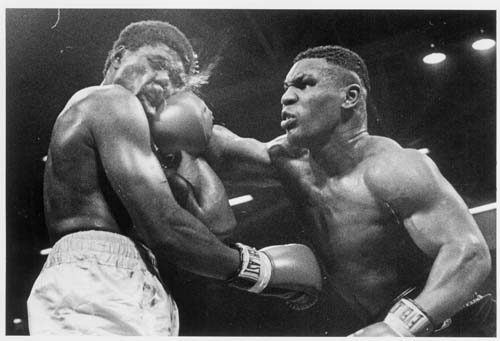
“I just hit that guy as hard as he’ll ever be hit,” a professional boxer said of his opponent. “I don’t see that as mean or cruel. I see it as liberating him from the fear of being punched in the face, because no one else will ever punch him that hard as long as he lives. He’s free now, as I see it, and I hope he uses it.”

That is so over-the-top, it’s almost funny. Even those of us who aren’t funny understand that the quality of a joke increases with the level of truth. The harder we shake our head, the harder we laugh. Those of us who don’t know how to punch or take a punch can also see the logic in what the man said, until we see it as a universally agreed upon truth. It also helped the comedic value of this line that when the boxer delivered this line, he appeared to be serious.

I don’t care what you say, the guy had to be delivering that line tongue-in-cheek, or ridiculing the opponent he just hit in some pseudo-serious way. It sounds like something Muhammed Ali might’ve said to try to further humiliate Joe Frazier. It sounds like a verbal version of Ali looming over Sonny Liston.”

I understand you think that, but even if it was delivered tongue-in-cheek, the audience at home could tell that this believed it so much it was a part of his constitution. He spoke as if he were spreading the gospel. (It wasn’t Mike Tyson, though he did say something similar.) When we’re done laughing at this, we acknowledge that the difference between funny and hilarious is that this fella delivered this unusual, unorthodox philosophy as if he believed it. The more we laugh, throwing our own bits in rounds, we realize that what makes such a line even more funny is that there might be some sort of twisted logic to it.

Speaking in public might be listed number one on everyone’s list of their greatest fears, followed by death, heights, spiders, and a general sense of the unknown. The fear of getting punched in the face might factor low on that list, especially among adult respondents who know that law enforcement will deliver harsh penalties to those who cannot control their impulses. Among the younger contingent, the teens and early twenty-somethings in particular, this fear likely rates much higher. Think about how often a hit to the face, and the threat thereof, governed our day-to-day interactions with our peers.

A hit to the face, no matter what the situation, or how hard it hits, is personal. A little kid hit me in the face recently to punctuate a joke. I immediately went into cool-down mode, “Don’t do that,” I instructed him, in my calmest voice. “Not to the face.” He assured me that he was just joking. I acknowledged that and reiterated, “Not to the face.”

What did we do to avoid any situations that could lead to a fight and a punch to the face? Most situations, even among testosterone-fueled, confusion-laden, and king-of-the-hill youth do not escalate to an actual punch. There’s usually a lot of screaming, and threats, but an actual fight rarely occurred in the schools most of us attended. The fear of it, however, influenced so many of our interactions. How liberating would it have been, back then, to have no such fears? If we were well-trained and well-schooled in the art of combat, how different would our interactions with bullies have been back then? If, as I say, most confrontations often don’t escalate to the physical?

How many of us have dreamed of standing tall and hitting our bully back? How many of those daydreams involved our bully flying back into the wall with an explosive, haymaker that had anime graphics behind it?

In our dreams, enhanced by cinematic indoctrination, the bully takes our bone-crushing blow, and he reaches out to shake our hand. “That, my friend, was a quality blow. Didn’t know you had it in you. Will you be my friend now?” The reality, for nerds like us, is our best punch probably would’ve felt like a duck down pillow landing at moderate speed. The truth is it probably would’ve encouraged our bully to show his friends how hard he could actually punch, and if you think they might feel bad about putting someone in the hospital, you had nicer bullies than I did. My bullies would’ve put that on their personal resume for the next time someone challenged them to a fight.

The contrarian response might be, “How about we gather together to stop encouraging kids from punching each other kids in the face?” Hey, I’m all hands up over here. All for it. I just live with the notion that there’s something in that young, testosterone male that no matter how much we encourage alternatives or discourage, we’ll never be able to quell. There are some people, kids, adults, and everyone in between who enjoy punching people in the face to resolve disagreements, and they use it to help them define their character both internally and externally. “There’s little you can do to quell the nature of the beast, especially among teenage boys,” a priest once said in one of my classes. “The best method we’ve found is to try to redirect all that hostility, rage, and aggression they have into sports. Football, wrestling, boxing and any other sport that provides young males an outlet.”

We’ve all met the exceptions to the rule, but most people will do anything and everything to prevent children from being harmed, intimidated, or bullied in any way. The reality is that the playground is the jungle. There are docile creatures who only eat vegetation and there are meat-eating predators. The vegetarians hide, they develop techniques to camouflage their weakness, and they develop their own maneuvers to thwart predators.

The vegetarians’ parents develop rules and codes of conduct, they put on seminars to reinforce rules, and they have one-on-one sessions with children who continue to violate those rules, but they don’t understand the rules of the jungle. The number one rule of the jungle is he who isn’t afraid to throw the first punch, or has the reputation thereof, often wins the argument. The second, and perhaps more important, rule of the jungle is he who is not afraid to take a punch has power equal to, and greater than, he who isn’t afraid to punch. To my old-fashioned, dated mind that deals in generalities as they apply to human nature, this prize fighter’s twisted logic actually makes a lot of sense.

We can all try to change the rules of the jungle, and we should, but when adults attempt to micromanage a kid’s world, the first and last question they should ask is, “And then what?” In my day (insert old fogey voice), the first and last thing we did, in our teens, was try to violate every rule we could find. We treated finding a way around the rules our high school administrators passed as an inmate might the rules of a penitentiary. So, if we try to engineer and re-engineer human behavior, do we change the nature of the rebel, or do we make those who still rebel more powerful? Do we accidentally make those who still aren’t afraid to punch and be punched more powerful?

Aside from the pain involved, there is something shocking about getting punched in the face. If the same person delivered the same blow to the stomach, it might hurt just as bad, but it’s not quite as shocking or personal.

If we didn’t receive such a blow by the time we graduated high school, it’s likely we never will. When we were younger, however, the perceived threat of being punched in the face was the fear of the unknown. Most of us didn’t have an older brother, a neighborhood kid, friends, or enemies to diminish this fear, so no one ever liberated us from this fear in the manner the prize fighter proposed.

We never heard the theory that a punch to the face could be liberating, when we were young vegetarians in the jungle, but the absence of it, and its subsequent qualities of the unknown, influenced our every day … until they approached the guardians at the gate. No matter how small, passive, and invisible some vegetarians might be, everyone has a threshold.

***

By the time Sean (the bully in this production) whipped a wadded up piece of paper at my face I’d already had enough. I just didn’t know it yet. The hit was so perfect that it achieved Sean’s goal of impressing Dave, the all-star defensive tackle at our school.

Dave never had anything to prove to anyone in high school. “The bigger they are, the harder they fall!” those who love to fight love to say, but when a man Dave’s size walks toward them, fighters part for him. He was one of those very few gargantuan human beings who have trouble holding pencils, because their fingers were the size of most teenage calves. When I asked these thrill-seeking fighters if they would fight someone as big as Dave, they said, “Well, there’s no sense in getting yourself killed.” Dave never had anything to prove to anyone in high school.

Sean did. He was a medium-sized guy who was always looking for ways to prove himself. Those of us near him, on the hierarchical totem pole, often received his proverbial boot to our face, so Sean could define himself worthy of the respect and friendship of his superiors, someone like Dave. The proverbial boot to the face, in my case, was a wadded up ball of paper that landed so flush that Dave considered it hilarious.

If I gave my reaction some thought, I might try to characterize it as brave, but it wasn’t. It was an impulsive, blind rage that drove me to pick up that ball of paper and throw it back in Sean’s face. I then, again without thinking about it, loomed over his desk.

“Knock it off!” the scariest teacher in our school yelled. “Return to your seat!” he said, yelling my name. It took me about five seconds to cool down, and I did after this scary teacher screamed at the top of his lungs again. He had one of those deep, baritone voices that called to mind the power of the bass in a live, Motley Crue song. I sat back down, and I tried to cool off. “You two, see me after class,” the teacher said, calling out our names, in his deepest baritone.

“You think you’re a tough guy don’t you?” the football superstar, Dave, whispered to me when class was over.

“I don’t,” I said. “I really don’t, but I’m not going to put up with that.”

What Sean and Dave didn’t understand was that I put up with such incidents for years from Sean and others, and I never did anything about it, because I feared I might not fare well in the final confrontation.

Mike Tyson once said, “Everyone has a strategy, until they get punched in the mouth.” It’s true, but how many failed strategies do we employ to avoid getting punched in the mouth? How many bullies proceed unimpeded with the implicit threat of that punch to the mouth? “We both know you’re not going to do anything about it, because you don’t want to get punched in the mouth.”  

Getting punched in the mouth hurts, and losing fights is so embarrassing that we do whatever we can to avoid it. In the cushy world our parents provide us, by sending us to quality schools, we never had to fight before, and we feared that the guy, challenging our manhood, might expose that.

In the high school arena that I call the jungle, we witnessed the non-confrontational tactics our fellow vegetarians tried to employ to end their torment. We saw them laugh with their bullies, to try to convince them that they were in on the joke. That tactic involved the nerd basically saying, “Your shot at my character not only failed to hurt my feelings, I thought it was actually pretty funny.” That never worked. We’ve also witnessed some nerds laugh when their bully picks on another nerd in a desperate quest to form some level of solidarity with their tormentors. This calls to mind another Tyson quote, “A man that’s a friend of everyone is an enemy to himself.” We empathize with the nerds’ efforts of course, as they desperately tried everything they could think up to end their torment, but those of us who survived high school know that nothing works better than finding a way to prove that we don’t fear that final confrontation. We nerds learned, from other nerds, to avoid overdoing our defense too, for that exposes the effort for what it is. We nerds need to muster up the courage to look the bully in the eye (and that’s essential) and confidently say something that suggests we don’t fear being punched in the mouth as much as they think. I wish I could give my fellow nerds a great line to end it once and for all, but those lines are almost always situational.

By the time Sean tested my boundaries, I’d had enough. That wadded up ball of paper blasted through my threshold in such a way that I wouldn’t have cared if it was the 6’5”, 250 lb., star defensive tackle who threw that ball of paper at me. I didn’t think of it in the moment, but I think I would’ve risked the hospital stay, and a month spent in traction just to send a message that I was done with it all. I was done with fearing a punch to the face. I was done taking it on the chin, figuratively speaking, because I feared that the other guy might have had older brothers who taught him how to punch, how to take a punch, and how to fight. This whole idea that I feared the unknown world of fighting just didn’t have the mystique it once did for me, when the alternative involved me continuing to allow them to do whatever they wanted to do to me.

I’m a smaller than average male now, but I was even smaller back then, and I wasn’t one of those scrappy little guys who knew how to fight either. In the few scrapes that came my way, I proved that I didn’t know what I was doing. There is, however, that flirtation we all have that if driven to the extreme, we might surprise them all with a sweeping haymaker that shocks the world. The truth, if we ever found out, is that our most devastating punch will probably come off as uninformed and untrained as we fear, BUT, more often than not, so will the other guy’s.

How many of us wish we could go back in this world and redress the wrongs done to us? I changed the course of one incident, and as you can probably tell I’m quite proud of it, but it was the result of silently putting up with so many other defamatory and embarrassing incidents that I will not provide for your entertainment. I also thought that if I did this to one person, word might spread, and I might not have to put up with others bullying me. Life doesn’t work that way, especially in the jungle. I also thought that if I displayed the temerity necessary to prove myself one day, I might be better prepared to do it again the next day. Again, life doesn’t work that way. Each confrontation is its own separate entity, and each high school student has to deal with each incident accordingly.

How many of us so feared the thought of being punched in the face that we allowed far too many confrontational tests go unchallenged? How many of us would love to go back to that world and say, “I honestly don’t give a crap if you punch me anymore. Punch me! Do it! Let’s just get this whole thing over with. I should warn you, however, that I’m going to help you christen this moment by bleeding and crying all over you.”

That probably wouldn’t diffuse the situation, but I thought of that unusual rebuttal one night, thinking of another incident that occurred so long ago that it is laughable that it still bothers me. When I found out that my sister-in-law thinks about confrontations that occurred decades ago, I didn’t feel so alone. Her confession led me to wonder how many of us think about these character-defining, yet decades-old incidents at three in the morning? How many of us get so tense over these moments that we might as well climb out of bed, pour ourselves a bowl of cereal and watch a sitcom to try to erase that 5th grade memory from our mind. Did we dream about it? We don’t know, but we know we won’t be able to get back to sleep until we rewrite the whole memory in such a way that we end up whipping them with Indiana Jones’ bullwhip. 

The best advice I can give someone facing a similar incident is that your liberation from fear will probably occur a short time after you’ve exhausted every tactic you can think up and every resource available. It probably won’t arrive in the midst of your desperation either. The moment of liberation, in my experience, occurs shortly after you stop giving a fig what might happen. If we do it to get our bullies named Sean in the jungle to respect and like us, we probably won’t be able to muster up the conviction necessary to stop it. Similarly, if we employ desperate, nerd tactics, we perform them with hope, as opposed to belief, that they will stop the carnage. What it took for me to get one of the most hated bullies in our school to leave me alone was being done with all that to the point that I no longer feared the punch to the face, the fight that followed, or whatever the final confrontation entailed. What it took for me was to approach this matter in a relatively fearless perspective, and I only reached that point after years of abuse.

The point of this article is that it’s too late for vegetarian dads to do anything to change their past, but there is something we can do to alter the future of our vegetarian sons. We’re not talking about offensive measures. We’re talking defense. We’re talking about building confidence.  

It’s possible that modern anti-bullying programs have made great strides in ending what we had to endure throughout our youth, but how do they quantify success? I don’t know, but I’m not so confident in them that I’m going to trust that my son won’t have to find some place beyond desperation to end his torment. I also know that with the modern dictum against masculinity, I’m not supposed to encourage my son to do anything more masculine that might help him in the jungle-like climate on the playground. My guess is that even the most modern boys on the most modern playgrounds still exhibit some of the most primal elements I saw on the playground, when the teacher isn’t looking, and that he’s going to zero in on the boys who are afraid to fight. I know most early aged kids don’t fight each other, and most of them don’t punch each other either, and most of them probably don’t even think in such terms. My personal experience in the jungle-like atmosphere on the playground taught me that this changes much quicker than most people know.

My son got punched in the mouth in a controlled setting. The two combatants were padded up, and there was little risk of physical injury. Yet, it was still shocking for him to get hit in the face. It still felt very personal to him, and it hurt his pride. He cried as a result. 

I almost cried with him. I knew that pain, I felt that pain, and I was that little kid getting hit with no one to protect him. My initial instinct was to step in, in some way, as it appeared obvious that this kid, this bully, delighted in my child’s pain. As difficult as it was to restrain myself, I thought about that prize fighter’s quote, and I thought that this controlled environment was the best place for my child to learn how to take a punch, how to fight back, and how to make all of the tiny, mental adjustments he needs to make against a kid who just keeps coming. 

When nerds and vegetarians think about getting hit in the mouth, they fall prey to the notion that all they need to do is counterpunch once, and the whole matter will resolve itself. We fall prey to the conceit that the other guy is simply testing our mettle. Some aren’t. Some love to fight, and they don’t stop. Some stop when they see another kid in actual pain, but that encourages others.  

When we witness it. We know it can be overwhelming, no matter how old they are. Our fatherly instincts kick in, and we don’t think it has to be this violent. We want it to end. We want to end it, but by doing so, we effectively negate the lessons learned in the jungle. We need to stay in our chair and empathize with the lesson we learned so long ago that he’s learning now. There will come a day when youth will pass away, and we won’t be there to protect them. No one will. It’s as scary for us as it is for them to learn that we’re not always going to be around to protect them, but we know this because we learned it. 

We all try to be there for our kids, but we know there is a frustrating extent to it. We also know that we can alert the authority figures in our kid’s school, and we can write emails to school’s district leaders if the more immediate authority figures don’t respond to our satisfaction. We can become that satellite parent who ensures their safety and well-being, but there is a frustrating limit to that too. There’s a frustrating extent to any tactics that we, as parents, can employ. The best tactic available to us is to teach them how to defend themselves in the “best defense is a good offense” mindset. The tactic might teach them what it means to take a punch to the face in some relatively safe, controlled environment.

If the unorthodox, twisted logic of the boxer in the intro of this article holds any weight, one of the elements that impede development is the fear of getting punched, it’s possible that our kids might handle matters differently when the threat of being punched in the face arrives. If we enroll them in boxing schools or one of the various martial arts schools that house heavily cushioned gloves to soften the impact of the blow so that our young kids can experience getting hit in the face without experiencing too much pain or damage, is it possible that we might be able to eliminate some of the stages we went through to defeat our bullies? It won’t spare them the pain of a mean-spirited, shocking bare-knuckled punch, but if we want our children to lead better lives, it could liberate them from that fear of getting punched in the mouth we experienced that influenced our lives so much in our youth, and it might prove to be the best money we’ve ever spent.  

I Hated Myself, and I Wanted to Dye


If you thought you “unliked” me before, wait till you get a load of this? I thought after dying my hair as a freshman in college. It worked for me before, I thought, in grade school. I sent a shot heard ’round my world, in grade school, with one of the weirdest, wildest hairdos anyone had ever seen. They probably thought I forgot to comb my hair the first day, until I walked into school with that hairdo so often that they could no longer characterize it as an accident. By some measures, it was a total failure in that those who didn’t ostracize me prior to the hairdo did after I walked into school with it for six straight days. If they hated that hairdo that much what will these people think of this, I thought of my dye job? If this experiment was a total failure, in grade school, and I hoped to do it again in college. 

My first experiment with shock and failure began when I spotted an older kid on the playground with what I considered a weird and wild hairdo, and I consider it an experiment now, for lack of a better way to describe it. I did not consider it an experiment back then. I thought this was the new me, and I silently forced everyone around me to accept and acknowledge this new me. I loved all of the shock and awe I saw, and I secretly and subconsciously loved the failure. I know that sounds odd, but even in my immature, unformed brain, I found failure more interesting. So, when I look back on it now, I label it my first experiment with self-imposed failure.

When I first spotted that other kid with a shocking hairdo, I thought he was sending a message to us. I didn’t know what that message was, but as I tried to understand it and help him define it, I realized it wasn’t all that important to me what his message was. I thought I might be able to send my own message to those who recently declared me “unliked”, and I considered his hairdo the perfect vehicle. Thus, when I later realized that this kid wasn’t sending a message to anyone, and that he just had a bad case of hathair the day I spotted him, it didn’t take me off course. 

How does he get away with that? was the first thought I had staring at the kid. Doesn’t he realize how difficult it is to escape the impressions others have of us once we do something like that? In my underdeveloped brain, I thought this kid was at the forefront of a movement, an “I don’t care what you think” movement, that I wanted to take part in. I thought the message he was sending us was meticulous and carefully orchestrated. I thought it was so outlandish to have such a hairdo that I considered it a little dangerous, and I knew I had to get me some of that. 

My other reaction to his hairdo was one of anger. You can’t just wear your hair anyway you want. We have conventions and rules, and you’re shattering them. Look at this guy. He’s taunting and flaunting our accepted way of life. I don’t know if I modified my thinking on the playground, on the ride home from school that day, or at home, but somewhere between that day and the next, I decided I wanted people to react to me the way I reacted to him. I wanted my peers to dislike me for my hair the way I disliked him for his. In some deep, dark recesses of my immature subconscious I thought if I gave them a reason to dislike me, it might clear up some of the confusion I had for why they did. I wanted to say they don’t like me, because they don’t understand me. The truth for me, at the time, was that they knew everything about me, and they understood me. They spent five years with me, so their decision to “unlike” me was an informed one, and it stung so bad that I wanted to do something to suggest that I had some control of it.

I romanticized that kid’s shocking hairdo so much that I showed up for school the next day with my own, individual version of it. The difference between my version and his was that he had what I now know to be a typical hathair crimp that pushed the bottom reaches of the hair out a tad. I enhanced that crimp by pushing my hair all the way up and out, until it was pointing out at 90-degree angles. My classmates didn’t understand it, and they weren’t shy about telling me that I needed to fix it. My teacher went so far as to pull me out of class for a private session loaded with pertinent and professional questions about my well-being. 

If some characterize this hairdo as going punk rock, I didn’t even know what punk rock was at the time, and I showed it. Going full-fledged, Sid Vicious punk rock requires one to have all their hair standing up and at attention. Sid Vicious punk rockers wouldn’t have understood my decision to maintain sensible hair down the middle. It was my individual, uninformed version of a mullet, except my business was in the middle, and my party was on the sides. 

So, my statement wouldn’t have fared well in punk rock circles either, and if I knew that I probably would’ve found that delicious in some odd way that I still find a little unsettling and thrilling. I don’t know what it said about my psychological well-being at the time, but I enjoyed the fact that those who didn’t dislike me before were now uncomfortable being around me or associating their reputations with mine. I also knew they now had a justifiable reason for unliking me.

I’ve never been a punk rock fan, but I understand its ethos, and its greater appeal. To be punk rock is to never try to understand your appeal or lack thereof, and any attempt its purveyors make to understand it is something punk rockers regard as selling out. My personal definition of the punk rock ethos involved shouting out confusion in some primal form of therapy that asks everyone else to question their values and social mores in reaction to you, and it also staves off personal introspection and interpersonal answers that can prove painful.  

I also know the origins of the ‘what do you want me to do?’, punk rock confusion. The ‘What do I have to do to get you to like me again?’ war is unwinnable, because if we were to ask them, both parties know their answers would be self-incriminating. So, they wouldn’t want to give us an answer if they had one. How many otherwise insecure pre-teens would answer, “I don’t like you anymore, because I think you’re an …” They don’t answer because most of them are relatively nice people who don’t want to do or say anything awful to people that might come back to characterize them as awful. It’s a no-win situation for them. The idea that they just don’t like us anymore is an unspoken pact that they hope we learn to abide by without further questions. They just don’t like us anymore, one day, because no one else does.

The “unlike” Facebook corollary to my grade school years is apt, if one considers having a Facebook page that everyone follows for years, and then, all of a sudden, for no stated reason, everyone starts to unlike. What do we do in the face of such rejection? An insecure, preteen, assumes their peers have justifiable reasons, or a group rationale, for why, but they don’t want to open that can of worms by asking them. An insecure preteen just assumes this is their new world.

Anyone who has ever been ostracized understands the confusion that starts with people who know us, sitting “together” at different lunch tables. We can’t sit next to them one day, because there are “saved” seats open to everyone but us. When it happens a third and a fourth time, we begin to realize it’s not a coincidence. Our classmates are, for no stated reason, making open declarations that we are “the unliked”. As painful as these declarations are, we can’t say they’re uninformed, because they know everything about us. As much as we say we don’t care what others think of us, the effect of others ostracizing us has lasting effects. We can’t go back in a time machine to ask them what happened. If we ask them why now, they’d say, “That happened so long ago …” We were so confused back then, and we couldn’t understand any of it. We understand some of it now, but it doesn’t diminish the effect.

How many awful things do the they have to say to our best friends, before the foundation of our friendship starts to crack? We thought they were so cool, and that they were the leaders of the thought movement in our world. We thought our friendship was so strong that it should’ve fortified their resolve, but even the greatest arches, built by the most talented civil engineers and architects, have a threshold. We thought everyone wanted to like him, and that he didn’t have to do anything to have others like him, but even the coolest of cool thought leaders eventually have to cut weight if they want others to continue to like them.

In the space of all that confusion, we go punk rock. I don’t know what going punk rock means to anyone else, but I sought out the weirdest and wildest hairdo, and I later dyed my hair, because I couldn’t understand why everyone “unliked” me when I needed them most. As I’m sure the perceptive reader understands, there were many other things going on with this pre-teen to teenage version of me that dwarfed my need for friendship, but I chose to focus on what I thought I might be able to somewhat, sort of control. There were bona fide reasons why they chose to “unlike” me, and it had little to do my personality. If they even flirted with the notion of helping me in anyway, they didn’t know how to go about doing it, so they did what any overwhelmed kid does in such a situation. They tried to avoid the situation by staying away, and as an equally confused teen I didn’t do anything to ease their confusion. I tried to push them further away by physically saying, I don’t need you, and I don’t want to be around you either, and I don’t like you, and I’m going to manifest this shout out with the weirdest, wildest hairdo you’ve ever seen, so we can all fill in these blanks together.