Nerd is the Word


“You are a Nerd!” used to be one of the most damaging things you could say to another. They weren’t fighting words. They were more of a “You’re not one of us” charge that required a “What do you mean, I play sports, and I like girls” defense. If we left it out there, the charge stuck, and we didn’t want something like that sticking to us. The word nerd has experienced quite an evolution in its relatively short shelf life, to the point that we now profess our own nerdy, intellectual interest in the STEM fields (science, technology, engineering and math.) The word hasn’t quite made it to a-good-thing status, as we often use it in a self-deprecating fashion, but it’s no longer one of the worst things you can call another.   

If we look up the history of most words, or their etymologies, we’ll find that most of them derive from Latin, Ancient Greece, Old, Middle and Late English, The Bible, or Shakespeare. Though there is some dispute over its point of origin, the word nerd is American made. 
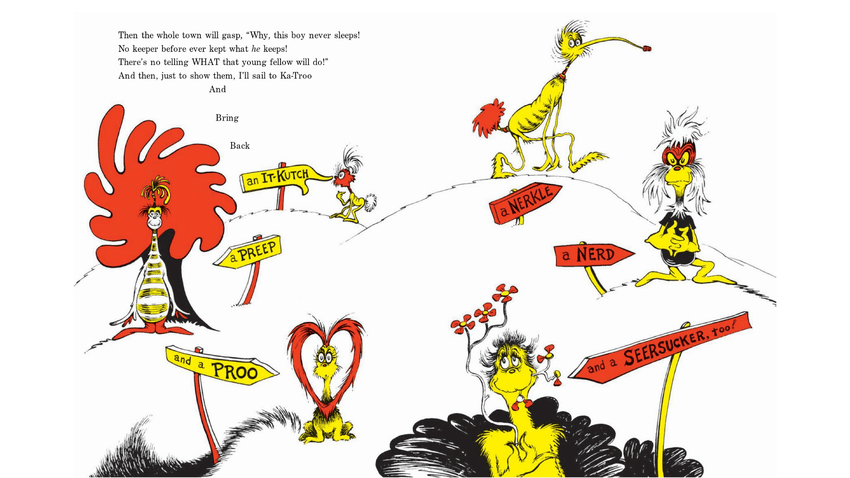
Some suggest nerd first appeared in Dr. Seuss’s 1950 book, If I Ran the Zoo:

And then, just to show them, I’ll sail to Ka-troo
And bring back an It-kutch, a Preep and a Proo,
A Nerkle, a Nerd, and a Seersucker, too!

Others argue that any time a word, or phrase appears in an artistic venue, it was probably in circulation long before it made that appearance, as most artists, Shakespeare included, probably heard the words they used long before they brought them to the masses. After Dr. Seuss brought the word to the masses, it apparently made the rounds, as Newsweek wrote an article that stated that in 1951 Detroit, “Someone who once would be called a drip or a square is now, regrettably, a nerd.” By the 60s the word took off, as it began popping up all over the place in print. 

Those who state that Dr. Seuss didn’t invent the word argue, “Dr. Seuss’s Nerd appears as more of a disapproving grouch than a drip or a square.” The etymologists took that note and began digging further. They found that one of Edgar Bergen’s ventriloquist dummies was named Mortimer Snerd. Modeled on a country bumpkin, “Snerd reminded listeners of a drip, someone who is tiresome or dull, and therefore—according to 1951 Newsweek—a nerd.” 

I don’t have a personal theory regarding the etymology of nerd, but I can tell you how it penetrated the zeitgeist of my generation, and made its way into my neighborhood. Those in my demographic know where I’m headed, for they know that even if the term wasn’t born on the 70s-80s sitcom Happy Days, it was raised there. The etymology suggests that nerd might predate Happy Days by twenty years, which makes sense since the era Happy Days strove to duplicate was the 1950s. 

Those of us who have attempted to pinpoint a word, or phrase, in our personal lives, know what a difficult job etymologists have. When we hear a new word, making the rounds in our inner circle, we ask our friends, “Where did you hear that?”

No one I know says, “My friend Billy says that all the time, and I thought I’d try it out.” Everyone strives to be considered the originator, or original in a more general sense. What do they say? They say, “I’ve been saying that for decades,” or, “Dude, I’ve been saying that for years.” They do not plant a flag in the term or phrase, but there is an implicit challenge to find someone who has been saying it longer than they have. Are they being dishonest? I don’t think so. I think it speaks to the nature of words and phrases, and how we absorb them into our vernacular without conscious thought. When we hear someone use terms, phrases, or sayings once, we might take notice. “Why did you say that?” we might ask. Most of us don’t ask that, because we fear the “If you have to ask…” response. By the time we hear it a fourth or fifth time, often from a wide variety of different sources, we just start saying it. Few can remember the first time they heard them, and even fewer remember the original source, so when it comes to idioms like nerd, etymologists can only source the first time it appeared in print or on the public airwaves.  

Knurds on College Campuses

Most people aren’t interested in the history of words. If you’re at a party seeking party time conversation topics, the etymology of words might get you a lifted eyebrow, and that’s if you do it right. If you deliver what I’m about to tell you with pitch-perfect cadence, and you hit the final point without sounding too nerdy or professorial, you might get nothing more than a half-interested “Huh, I’ve never heard that before,” or some other polite response before moving onto something that interests them more. I did it last weekend. I told them about what I considered one of the most fascinating theories on the origin of nerd I’ve ever heard. I didn’t stopwatch the moment, or mentally document it in anyway, but I think I might’ve received a five-second reaction before someone changed the subject. “That’s it? That’s all I get?” That’s all I got, and I’m sure that one of them probably called me a nerd later for being so interested in something so inconsequential and nerdy. Some are interested of course, some study it so often that they’ve tried to find a way to make some money at it, and some do it so often that it’s grown into some sort of obsession. For the rest of us, it’s a casual, passing interests that serves as a momentary bridge between other topics.

If you’re one of the above, chances are you’ve found numerous academic, professorial breakdowns of the history of a word. Some of these breakdowns are so precise and exact that it’s both an illustration of how much hard work some pour into researching the information and how boring that research must be.

I’ve read through some etymologies, a number of them, and I’ve found them a useful cure for a mean case of insomnia. I understand that they are a ‘just the facts man’ information resource and hiring Jay Leno or Jerry Seinfeld to write for them might confuse their visitors more than anything else. I also understand that the etymologies of words are not fodder for creative writing, but if I were to put such a project together, my mission in life would be to try to breathe some life into their world to try to make them a little entertaining.

Impossible, you say? I introduce you to knurd, or as we know it nerd. Yes, nerd is the word, but one particular outlet posited a theory on the origin of the word that feeds into my notion that just because we’re involved in a scientific study of word doesn’t mean it has to be nerdy.

Nerd is the word we know and love today, and this theory states that the word began on college campuses with college students engaged in the time-honored pursuit of most college students of finding the best way to insult one another.

Quick, other than insulting one another, what’s the most popular activity on college campuses for those who try their hardest to avoid activities that add to the population, or subtract from it? If you were on the Family Feudyour first guess, and the number one answer would be … survey says, “Drinking alcohol.” College students drinking alcohol can, of course, subtract from and add to the population, but those results are rarely the goal. The goal, now that they’re on their own for the first time in their lives, is to try to find the best way possible to disappoint their parents. Drinking massive amounts of alcohol could also be said to be one of the top two ways to do something college students have wanted to do since they were five, run away from home, and they/we think the best way to do that is by destroying the brain cells that remember their childhood.

We’re all now coached to think that drinking alcohol leads to awful things, and it can, but it’s also fun, and it can lower the restraints of our inhibitions. (*Pot might accomplish similar elements, but I wasn’t part of that world.) Alcohol also provides a reason for college students to get together, i.e. parties, and the more they drink, the more fun they have, so they drink to excess. They get drunk, they love every minute of it, and they don’t want to feel guilty about it. The Poindexters of the world, talking about being responsible and reminding them that they’re wasting their college years by drinking so much alcohol that they may not be able to remember much of what they were supposed to learn that week, are the enemy. They’re responsible young men, and the only thing college students hate more than their parents, or the other authority figures in their lives, are responsible young men.  

Responsible students see college as an institution that might be able to provide them the opportunity for a better future, and they fear that drinking too much alcohol might affect their academic performance. This drives drinkers crazy, because their goals are the exact opposite of those who go to college to learn stuff to prepare for the life beyond.

Most drinkers won’t say, “Who gives a crap about the future. I live for the now.” Most people, regardless of age, aren’t that bold, but they loathe responsible students who remind them of their failings in this regard. 

This theory suggests that the drunks on college campuses loathed responsible young men so much that they developed a pejorative to describe those who wanted to refrain from drinking alcohol. They called them knurds. Knurd, as you’ll note, is drunk spelled backwards. Knurd is spelled different than the current incarnation of the word, but all idioms, pejorative names, and terms that penetrate the zeitgeist go through a life cycle in which their meanings progress and change (Think bad, gross, and sick), and some of the times the spelling of these words change. There is no evidence to prove, or disprove, the knurd theory, but it makes so much sense that it appeals, in so many ways, to those of us who enjoyed getting drunk in college and unwittingly carried on the tradition of calling those who didn’t a knurd.  

We all know a nerd. Some of us knew so many nerds, and we liked them so much that we’ve just realized that theres probably a reason we preferred being in their company so much. We were never a knurd, but we were nerds, are nerds, and forever will be, but within the ever-elastic definition is the prototype. We might not have known the history of the pejorative, but we don’t need to read through an etymological history to know a nerd when we see one. When we hear the word now, we picture the prototype: Oily hair, parted down the middle; a short-sleeved shirt, well pressed, with a pocket protector in the pocket of the shirt, loaded with pens, pencils; horn-rimmed glasses (I wore a pair in grades 1-5, thanks Mom!), a pre-pubescent squeak to his voice (and it’s almost always a male), and an overall uncomfortableness that leads them to avoid eye-contact. We all knew someone who fit the parameters, but did we create these extreme parameters to create a little distance for ourselves?  

For all the nerds who went through its first unkind forty plus years, the last twenty have been more kind to them, as the word nerd has undergone a redefinition and a certain renaissance that cannot be denied. The pejorative has progressed from the worst thing you could call someone, to people dropping it casually to describe their unique obsessions, and onto it being a compliment used to describe the erudite and computer-oriented who know how to code and eventually used that knowledge to develop AI to change everything from our TVs, to our kitchen appliances, and our cars. Who would’ve guessed that in a classroom filled with jocks, popular and cool kids, and various incarnations of the class clown that it would be the socially awkward, painfully shy, prototype Poindexter, in the quiet back corner of the room, that we’d all grow up and want to be? 

The Eye of the Fly


In a study published in Journal Science, researchers found that flies have the fastest visual responses in the animal kingdom. The study suggests that this rapid vision may be a result of a mechanical force that generates electrical responses that are sent to the brain much faster, for example, than our eyes, where responses are generated using traditional chemical messengers. The fly’s vision is so fast that it is capable of tracking movements up to five times faster than our eyes.

I realize that the fly would trade this one strength for even twenty-five percent of our brain power, but one has to wonder why the fly was given such an incredible eye compared to our relatively weak one. Why would we be granted the most complex brain in the animal kingdom, and not have the physical advantages inherent in the eye of the fly, the ears of the owl, the various sensory receptors of the snake, or the nose of the bloodhound? Wouldn’t we use those gifts better than those mindless animals, and insects, that don’t know enough to appreciate it?

The obvious answer, from the Darwin perspective, is that humans don’t need these extra senses for survival to avoid predators. The more interesting perspective, I believe, is that having an extra sense would prove such a distraction that it might inhibit the tedious, arduous process of developing the complex human brain.

In every young human child’s development, there is a constant push and pull. Parents and teachers push children to develop habits that they hope will eventually develop that brain as it matures. They know that if that child is going to find any measure of success within the species, they will need to push the child to help them develop that brain to capacity in a manner that can be painstakingly, gradual. Some would argue that no human ever reaches the maximum capacity of the brain, but it’s not much of a reach to suggest that if we were distracted by a super sense we wouldn’t come as close as we currently do.

On that note, this theoretical argument rises whenever I watch a Superhero movie. It’s great that this person (or these people depending on the movie) have these superhuman powers, but shouldn’t there be a countering deficit? If the natural world granted this individual powers we can’t fathom, shouldn’t there be some sort of deficit? Shouldn’t they be dumb as a rock, noticeably awkward socially, or some deficit to counter the natural, biological and/or personal focus?  It could be argued that there have never been more distractions, pulling children away from the painstakingly, gradual process of brain development that provide more instant gratification. Yet, there have always been distractions. It could also be argued that while there are more distractions now, there have always been distractions, and coaching or teaching children how to avoid distractions has remained constant.

I am not a Superman aficionado, but Ma and Pa Kent probably spent their lives developing Clark’s brain before he began relying on his superpowers, Spider-Man was a teen-ager when the radioactive spider bit him, so while his development to adulthood may have been hindered, he likely had a decent foundation. Some of the superheroes, in the various universes, were superheroes since birth. They have various natural powers but no deficit in human development. It just doesn’t seem well-rounded to me. 

Although there are numerous benefits to a young child engaging in athletics, it could be argued that it is an impediment to the optimal development of the brain. There are exceptionally gifted athletes, of course, but most athletes had to kinesthetically learn the craft. They had to do it so often that they developed muscle memory and whatever we call the level of muscle memory that allows them to hit a fastball that is relatively difficult for others on their level to hit. The point is that when a child is focusing so much of their time and energy to achieving on an athletic level, it often leads to less focus placed on academics. There are exceptions to the rule, of course, as some achieve All-American status in athletics and All-Academic in the classroom, but most children learn to focus on one area to the detriment of the other. 

“Keep your grades up if you want to maintain eligibility,” the adults surrounding the gifted athlete will say, but they rarely coach them to achieve academic excellence, and this is eventually displayed in the post-game interviews of those few elite athletes who have achieved the professional level.

The same distractions can be found among the beautiful. Both genders learn that beauty is power, but most would acknowledge that the beautiful female has far more power in the room than anyone else, including the beautiful male. Most beautiful females learn, at some point in their lives, that no matter what they do in the classroom, their mental prowess will always be considered secondary to their physical attributes, and that they would be probably be better off if they just sat there and looked beautiful. They subsequently learn to speak less often, so as to silently soak up the power their beauty wields in the room?

Both of these superficial exaggerations could be called distractions in human development, and those who have these physical characteristics learn to employ their own distractions to keep people from focusing on their lack of intellectual development by criticizing those who wasted their time devoting precious resources to developing the brain.

“Did you read Lord of the Rings when you were a kid?” 

“No,” the beautiful reply, “I was out getting laid.” 

“At fifteen?” the nerdy brainiac asks, “because I read those books at fifteen.” 

“Yes,” the beautiful person responds. 

“You were getting laid so often that you didn’t have time to read?” 

YES!”

That exchange is not a direct quote from the TV show Friends, but it’s close. It encourages the idea that meaningless sex trumps any other activities of youth. “I was out climbing trees, playing football, listening to KISS, and collecting Star Wars cards.” 

“Really, because I was out getting laid.”

Sex between immature individuals should be the goal in life. It is the end game, and the end of the conversation. No one ever thinks to ask, “What did all that sex end up doing for you?” 

“Doing for me? What are you talking about? I was having sex when you were reading Tolkein, the comic strips Dondi and Peanuts, and all of those stupid Chose Your Own Adventures you nerds read.” 

“Did you forge the relationships you had with these people in such a way that helped you have more meaningful experiences that helped shape your life in profound ways in life?” 

“No, I was having sex with them.”

We’re not to question the idea that if we could’ve had more sexual experiences when we were young, we’d be better individuals now, or at least cooler people. Others drop the philosophy that if we had sex more often as young people, we wouldn’t be such a stick in the mud now. Some of us did have such opportunities when we were nine or ten-year-old, but we turned them down because we were scared, and we weren’t ready. So, if we said yes to that incredibly beautiful sixteen-year-old babysitter, we’d be better people now? 

Due to the fact that so many people laugh at such admissions now, we’ve been conditioned to feel shame, regret, and embarrassment about that fact. We feel shame admitting that, and we regret it almost every day. Why, because we have been conditioned to believe that that exchange of fluids would’ve somehow made us better people. This line of thinking gives credence to the idea that we never truly escape high school. We all wanted to be the cool kids in high school, and no amount of rationale will ever defeat this. Even when we reach our forties, and beyond, and we begin to appreciate our nerdy, reading youth for what it was, we still find it difficult to defeat the superficial, hyper-sexual Friends mentality.

On the flip side, no one would say that reading the Lord of the Rings series is an essential component of a child’s development, it does put that child on the road to every parent’s holy grail: The love of reading. A goal made all the more difficult by the instant gratification philosophy put forth by the Friends show. It did not, nor will it ever make a person better or cooler person 

For most of us, the opportunities to be sexually active at a young age were there, but some of us were too busy being kids, doing kid’s stuff, and as I wrote, we were simply too scared. When this Friends joke came along and told us that if we were truly cool, we should’ve been doing that all along, we regretted being that nerd who was too scared, enjoyed reading fantasy books, and mindlessly enjoyed our youth. We thought we missed out on something fundamental that made them better than us. In truth, such a philosophy will eventually catch up to them when the one thing that separated them from the pack, sexual activity, becomes more and more meaningless to them as they age. Like a drug user, they might vie for more and more of it for more meaningful sexual interactions, to try to recapture the euphoria they felt when they were virgins touched for the very first time. At some point, after a number of ruined marriages and meaningless encounters, they might realize that their life has amounted to nothing more than a series of superficial indulgences that have amounted to nothing more than a superficial life.

That’s another question I might have for these Friends’ types, if I agreed to have sex with my babysitter when I was nine or ten, would sexual interactions prove less meaningful throughout my life, or would it prove so meaningful that I developed a sexual addiction? Another question, on the same plane, would sex become such a primary driver for me that the rest of the otherwise normal, youthful activities I experienced between 10 and 18 be rendered comparatively meaningless?   

It is for all these reasons that some of us find it difficult to sit quietly through those superhero movies that depict an exceptionally gifted men and women, gifted with the eye of the fly, the ears of the owl, the various sensory receptors of the snake, or the nose of the bloodhound who are also exceptionally gifted intellects. There is just no way, some of us want to shout. Some of them might be smart, for there are always exceptions to the rule, but not that smart, not that exceptionally gifted in intellectual arenas. There’s always a trade-off, especially if they’ve been an exceptionally gifted, physical specimen since birth. Some may have been trained by their parents, or pseudo parents, to avoid relying on their gifts, but we have to think they would’ve accidentally, or incidentally, relied on their special gifts to the detriment of optimal brain development. There would’ve been some point when they realized that they didn’t need to go through the painstakingly arduous, and at times embarrassing, process of gradual development. In human nature, as in nature, there is always a trade-off in this sense.

An interesting question some sci-fi movies explore is if we only explore 10-13% of our brain, an appraisal some neurologists suggest is a well-travelled myth, what if we trained our focus on attaining the eye of the fly, or the hearing of the owl, or the nose of the bloodhound. Would it be possible if we sent our son to eye of the fly school and our daughter to ears of the owl school, and those schools focused as much effort on those characteristics as they do brain development in school? Even if it were, why would we do it? We don’t need such characteristics for survival, and while they might prove useful in some arenas, it would pale in comparison to the importance of overall development of the brain. The eye of the fly might prove beneficial to some Fortune 500 companies in some way, the military, and the revival of the modern carnival, but it would probably also diminish the place atop the animal kingdom that our brains have attained. 

Let Your Freak Flag Fly!


“Some of the times you just gotta let your Freak Flag fly,” my aunt said to her brother. I had no idea what they were talking about, and I didn’t really care, but I didn’t think any definition of this otherwise illusory idiom could remedy my dad’s issues. If Freak Flag is actually a thing and not something my aunt just made up, I thought, my dad may have been as far from having a Freak Flag as anyone on Earth. His primary goal in life was to fit in, and he did anything and everything he could to make that happen. My aunt was the opposite. She did everything she could to stand out as a hip, cutting edge, and appear young, or her definitions of all of the above. She knew more about the hip artists and songs in Billboard Top 40 than I ever have, she wore hip, cutting edge clothing better suited to women ten years younger than her, and she dropped whatever hip terms she heard young people say. When she dropped the term Freak Flag I thought it was yet another one of her embarrassing attempts to appear hip, but that particular phrase stuck with me for whatever reason. I never used it, but when I later heard someone on a hip, top-rated television show say it, I knew something was afoot. Then, one of my friends said it in school, and a week later I began hearing it everywhere.

“Where did you hear that phrase?” I asked my friend.

“Dude, I don’t know. I’ve been saying it for decades,” he said. Unbeknownst to me, this was the key to keeping it cool in the phraseology universe, for no one ever seems to know where they hear hip, cutting edge terminology first. To be fair, it can be difficult to remember where we first heard a phrase we’ve been saying for a time, but purveyors of this particular phrase appeared to conveniently forget where they heard it to leave the impression that they started it.

There’s apparently a lot of prestige wrapped up in starting a phrase, and if someone gets a taste of it, they don’t give it up willingly. Whatever the case is, when obsessively curious types pursue such matters, we often receive everything from blank faces to evasive and defensive responses. Even if the user just started using the phrase last February, those who are evasive and defensive want us to think they’ve been saying it for so long that they dismiss all questions about its origins as uncool.

If we found a truly reflective individual who didn’t mind talking about the first time they heard the phrase, it might result in a humdrum response, “My Cousin Ralphie is da shiznit, and when I heard bra say it I wanted his awesome sauce all over me.” If this individual were that honest, they might run the risk of being so over as to be drummed out of the in-crowd, for the clique might deem that confession a violation of the binary, unspoken agreement those in the in-crowd have designed for the world of phraseology. In their world, users want their audience to consider them the originator of the phrase, and anyone who insists on pursuing this line of interrogation runs the risk of being drummed out on an “If you have to ask …” basis.

Another unspoken rule in the hip, phraseology universe is that we better hurry up and use the terms we enjoy saying as often as we can before a kool kat steps in to declare that the days of using the phrase are now over. “Stop saying that. I’m trying to get the word out that that is so over. Tell your friends.” We might be disappointed to learn that we are no longer able to use words, phrases, or idioms that we enjoy using, but we know that when kool kats step in to warn us that it’s over, it’s a serious blow in this artificial architecture, and we know that by continuing to use such a phrase, we run the risk of being so over. This begs a question to the arbiters of language who declare they’ve been saying this for decades, how is it that you never encountered some kool kat who declared your favorite phrase so over in that time span? Did you ignore them, and if you did, why should I listen to you?

A work associate of mine attempted to play the kool kat by correcting me in front of a group of people. “Dude, stop saying that,” he said inadvertently using the tired phrase to end phrases. “I’m trying to get the word out that that phrase is over. Tell your friends.” Anytime we hear someone issue such a condemnation, it’s human nature to assume that it’s rooted in something the speaker learned from a person with some authority on the matter. In my experience, however, most of these self-professed arbiters of language consider starting a hip phrase fine but ending one divine. Those with no standing in the hierarchy of cool often take it upon themselves to issue such a condemnation without knowing anything more on the matter than anyone else, but they hope that by pushing us down a notch they might improve their standing in the hierarchy.

Like most of those in the lowest stratum of this hierarchy, I knew nothing about this confusing world of using hip, insider, kool kat language, so I was in no position to question my work associate, but by my calculations this feller was a doofus. He was such a complete doofus that I would no sooner consider seeking advice from him on language than I would his words of advice on dating. I still don’t know if this fella assumed a level of authority on this matter based on the idea that he considered me inferior, of if he heard this news from a more authoritative figure, but I decided he did nothing to earn a seat on my personal arbitration board. That situation led me to wonder how we determine our arbiters of words and phrases. My guess is that most people will not heed such advice from just anyone, as that might unveil their status in this hierarchy. My guess is that we make discerning choices based on superficial, bullet point requirements we have for those issuing them? Put another way, if the doofus was more attractive and a little less chubby, I may have been more amenable to his guidance on the matter.

✽✽✽

For fact checkers, a decent search on “Let your Freak Flag fly” suggests that it first appeared in a Jimi Hendrix song If 6 was 9 in 1967. It was later popularized in a David Crosby song Almost Cut my Hair that he wrote for the Crosby, Stills, Nash, and Young album Déjà vu. Due to the fact that these first appearances occurred in an artistic venue, however, we can guess that the phrase made its way through the “in-crowd” circuit long before Hendrix or Crosby used it in their songs.  

The Urban Dictionary defines “Letting Your Freak Flag Fly” as: “A characteristic, mannerism, or appearance of a person, either subtle or overt, which implies unique, eccentric, creative, adventurous or unconventional thinking.” 2) “Letting loose, being down with one’s cool self, preferred usage to occur in front of a group of strangers. Your inner freak that wants to come out, but often is suppressed by social anxiety.” 3) Unrestrained, unorthodox or unconventional in thinking, behavior, manners, etc. One who espouses radical, nonconformist or dissenting views and opinions that are outside the mainstream. When traveling through the bible belt of the U.S., it’s best not to let your freak flag fly high. Otherwise, you’ll be harassed and attacked by these backwater, backward thinking theocrats.

Typical Freak Flag Flyers make very specific decisions to avoid titles. They tend to be abstract thinkers who believe they fly high over those of us who believe in nouns (i.e. people, places, and things). Freak Flag Flyers tend to know more about those nouns than the average person, “Because those people haven’t done their homework.” Some Freak Flag Flyers base their outlier status on anecdotal information of these nouns to whom others swear allegiance, on the idea that if we knew what they, the Freak Flag Flyers know, we would be just as sophisticated in our skepticism about allegiances.

Most people fly under a flag: Americans fly under the Stars and Stripes; the Irish fly under the Irish tricolor; and the British fly under the Union Jack. There are some people, however, who fly under no flag, and they eagerly provide this information to anyone who asks. Don’t expect them to admit to flying under a Freak Flag either, for the very essence of flying under a Freak Flag is designed to give its flyer an open-ended, free lifestyle persona that doesn’t conform to societal definitions such as allegiance or definition … Even if such a definition extends itself to a Freak Flag. They aren’t proud members of a country, political party, or a coalition of freaks. They’re just Tony, and any attempt we make to define them as anything but Tony –based on what they do and say– will say more about us and our need for definition, than it does them. Freak Flag Flyers tend to be moral relativists who ascribe to some libertarian principles when those political principles adhere to matters they find pleasing –those who suggest, as Dave Mason did, “There ain’t no good guys, there ain’t no bad guys. There’s only you and me and we just disagree”- but they tend to distance themselves from economic libertarian ideals, for that might result in too much libertarianism.

Some Freak Flag Flyers raise their flags in political milieus, but most Freak Flags involve simple eccentricities and peculiarities. An individual who prefers to listen to complicated and obscure music could be said to fly a Freak Flag in that regard, but they usually keep that information close to the vest when their more normal family members and friends are around. An individual who enjoys various concoctions of food, philosophies, and other assorted, entertainment mediums could be said to have a Freak Flag, but most of these people live otherwise normal lives. We can have a Freak Flag without being a freak, in other words, but the general term Freak Flag is reserved for those activities we engage in and those preferences we have that could be embarrassing if they found their way back to our normal friends and family members.

Even if we don’t have what others might call a Freak Flag, we can identify with the mindset of those who once dared to let theirs fly. Now that we’re all normal and stable, we might not remember the days when we strove for some sort of definition, or we may be embarrassed by it, but most of us can recall a day when we dared to be different.

A Freak Flag Flying friend of mine, a Dan, worked in a Fortune 500 corporation, and he was a corporate joe from head to upper calf. To maintain some semblance of his Freak Flag status, however, Dan wore a wide variety of loud socks and skater shoes that appeared out of place with the rest of his business casual attire that it was impossible not to notice. I’m not sure if it enhanced Dan’s Freak Flag flyer status or took away from it, but he did have flames of fire on those Converse Chuck Taylors, and he wore these notoriously short-lived Chuck Taylors for about a decade, so he must’ve purchased them on an annual basis to keep his preferred characterization alive.

When I asked Dan why he wore that ensemble, he said, “I just like it” in the typical “I’m just Tony” Freak Flag Flyer vein. I dug deeper, of course, and I saw a man who wanted to succeed in the corporate climate by being everything his boss wanting him to be while not being a complete corporate sellout. He wanted the best of both worlds, and he thought some flames on his feet allowed him to let Freak Flag fly.

I’ve met the “I’m just Tony” Freak Flag Flyers who can’t articulate their need to fly one, and they attempt to nullify any questions about their nature by asking you why you think they’re different. Some think we’re putting them on trial, and we are, sometimes. Sometimes, we’re just interested in their essence. I’ve met others who were just different people, and they were quite comfortable draping themselves in a Freak Flag. They taught me that the ultimate definition of a Freak Flag flyer is a relative concept defined by the individual. It’s almost the complete opposite of my aunt’s attempts to be younger and hipper than her peers, as the true Freak Flag flyer does not engage in Freak Flag flying, they just are who they are in a manner that is more organic than any character my aunt might dream up.