Trope-a-Lanche: The Serial Killer Movie


How do we know when we’ve watched too many movies? Do you know who dun it, before they dun tol’ you? Have you spotted tropes (recognizable storytelling patterns, familiar devices, themes, character types, or plot moves that audiences instantly understand because they’ve seen it many times before) in movies so often that you now scream “trope-a-lanche!” when the tropes begin to avalanche. Have you disabled the suspension of disbelief for others, because you dissected the filmmakers intent behind plot devices, characterizations, etc, and you accidentally ruined the movie for them. If you’ve done any of the above, you’ve probably watched too many movies.

I initially mistook the ability to track patterns and tropes for intelligence, until I learned that even the sharpest cinematic observation is in service of absolutely nothing. It was a mark I thought should’ve informed my audience that I was so observant, but all it really did was tell them that I’ve watched too many movies. In some social situations, it pays off to watch a ton of movies. When someone asks you if you’ve seen some obscure movie, and you say yes, it can lead to some conversations. “What was your favorite part?” “What did you think of the actor, the twist, or that one scene.” That gratification is fleeting and rare. I used to be quite proud of the totality of the library of movies I’ve watched, and I used to be quite competitive in that regard. If you try to compete with me over most movies watched now, I’m probably going to let you have that crown, because I consider it an odd brag to say I’ve wasted a bigger chunk of my life watching movies than you have. 

A friend successfully bested me once saying: “I’ll bet I’ve watched more movies than you.”  

“Okay,” I said. “I don’t know why you’d brag about that, but I’m going to guess you haven’t.” 

“Do you watch porn?” he asked. 

“No.” 

“I win.” 
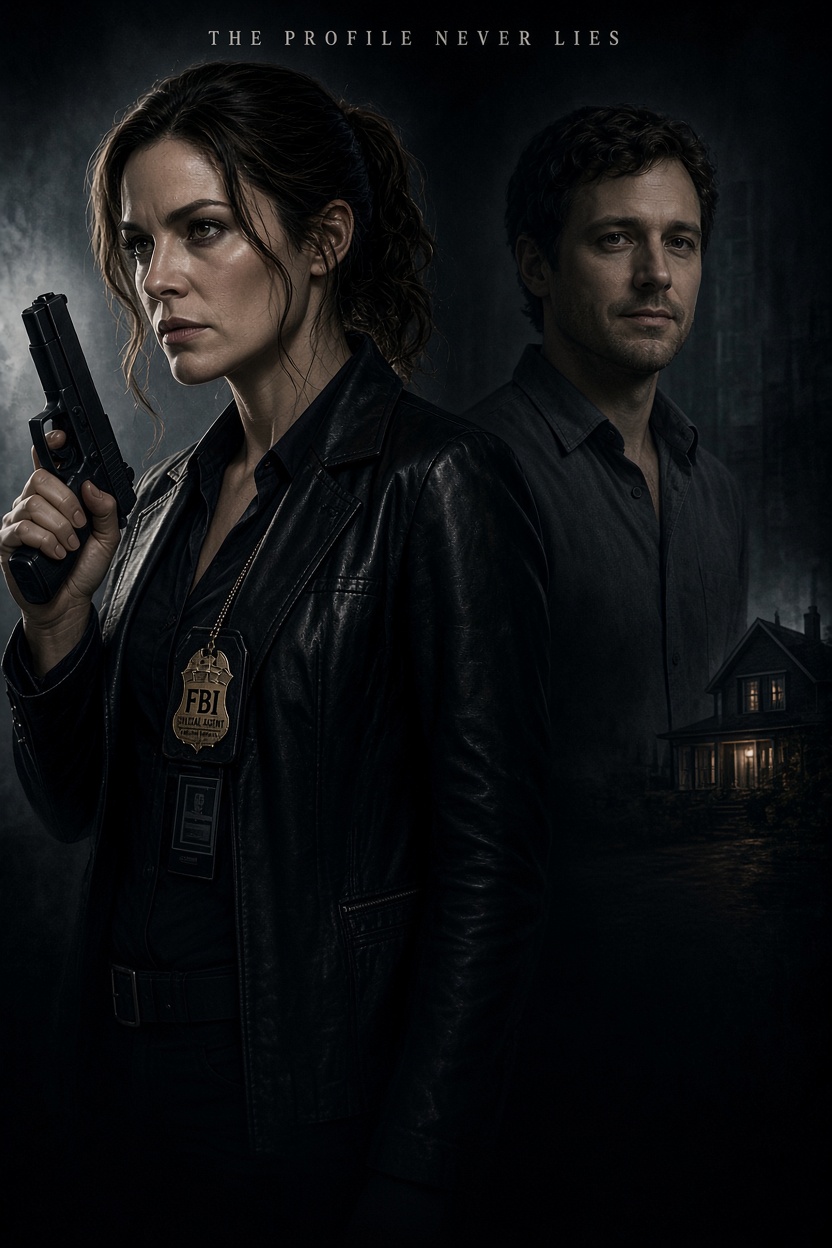
I try to apply the “Everything in moderation” recommendation to every thing in life, and I’ve found some success when it comes to nutrition, but I haven’t found near as much success with popcorn consumption or watching football and movies. The problem with watching too many movies, and obsessing over a subgenre like serial killer movies, is that at some point we’ll reach a tipping point where we’ll be able to characterize every character before they’re fully characterized, know the feng shui of the serial killer’s living room, the state of the abandoned warehouse where they’ll finally locate him, and pretty much how the final showdown will play out. Again, we don’t say this as a brag, as one of the consequences of watching too many movies is that we’ve damaged the joys of suspense and discovery.

The Serial Killer/Profiler Movie 

Unless you’re counting Sherlock Holmes as a profiler, as opposed to a consulting detective, the first cinematic profiler was a character named Will Graham in Michael Mann’s Manhunter (1986), based on Thomas Harris’ Red Dragon. This wasn’t the first serial killer movie ever made, but it was the first one I saw. It was also the first movie to use the art of psychological profiling to catch a serial killer, as pioneered for the FBI by Mindhunter author and Silence of the Lambs consultant John Douglas and author of Whoever Fights Monsters, Robert Ressler. I loved Douglas’ Mindhunter so much that if there was a stock or ETF (Exchange Traded Fund) in 1995 that focused on serial killer vs. profiler movies and books, I probably would’ve bought a couple shares. I’d probably would be a rich man now too, because I now get a new profiler-chasing-serial killer movie listed on my streaming services so often that I won’t watch them anymore, because I know the template they use, the one laid out by Manhunter, Silence of the Lambs, and Mindhunter, so well that I know it too well.

“I need to get inside the head of the killer,” our archetypal Special Agent of the Behavioral Analysis Unit Rhonda Gunderson says. This rhetoric is one of the numerous tropes of the typical serial killer movie, and the process inherent in doing so will come at great personal and/or professional expense. When our archetypal profiler, Special Agent of the Behavioral Unit Rhonda Gunderson, finds the killer’s Rosetta Stone, she uses it to correctly point out who the killer’s next victim will be. Her fellow Law Enforcement Officials (LEOs) won’t believe Gunderson, until her premonitions turn out to be correct so often that they can no longer question her mindmeld.  

1) The serial killer, with a media-style nickname or moniker, is unusually brilliant, erudite, articulate, cultured, charming, and attractive. (The idea that an unattractive piece of trash who didn’t graduate from high school might impulsively slaughter a bunch of people just isn’t as interesting to us anymore.) We want the horror conducted by our serial killer familiar, so filmmakers make them as clean, neat, and organized as we are. We also love the idea that the serial killer could be that quiet neighbor who seemed so nice and neighborly.  
2) The killer will develop an intricate pattern, theme, or a highly sophisticated puzzle that calls upon the investigators to know their arcane and erudite literary or religious references well enough to compete with his unusually brilliant mind. The investigators must decode his message, puzzle, or worldview to prevent another killing, and one of the LEOs, usually our profiler, will have intimate knowledge of the arcane and erudite reference. At some point, in this period of discovery, one of the LEOs will characterize this as, “A race against time.” 

3) The killer will introduce a philosophical concept regarding the blurring of lines that detail a hypocrisy in society, that Special Agent Gunderson has a flaw he characterizes as similar to the killer’s, or the killer will pound home a vulnerability that speaks to society’s moral relativism. “Well, he’s right about that,” someone in the audience will say.   

4) The cat-and-mouse structure will involve a psychological duel as opposed to a physical one. At some point, Special Agent Gunderson will state that she is maddeningly close to “getting inside the head” of the killer, but she will not be able to tap into that level of evil. She will need to find another unusually brilliant genius serial killer who is still bloodthirsty but incarcerated, to give her insight into the mind of the active killer.  

The Final Showdown

A) When they finally track the killer down, he won’t be home, but Gunderson and the LEOs around her will enter his home. The serial killer’s home will be a meticulously curated horror show of his warped, damaged, and “unusually brilliant” psyche.

B) The lighting inside the home will contain insufficient natural light, and it will be so dark that it will require one of the LEOs to flip a light bulb on, but no one will. They will use flashlights to scour the walls completely covered in newspaper clippings of the murders, Polaroids or stolen photos of the victims (alive and dead). The killer will then label each picture with a sharpie to allow the LEOs to know which body part belongs to which victim.  
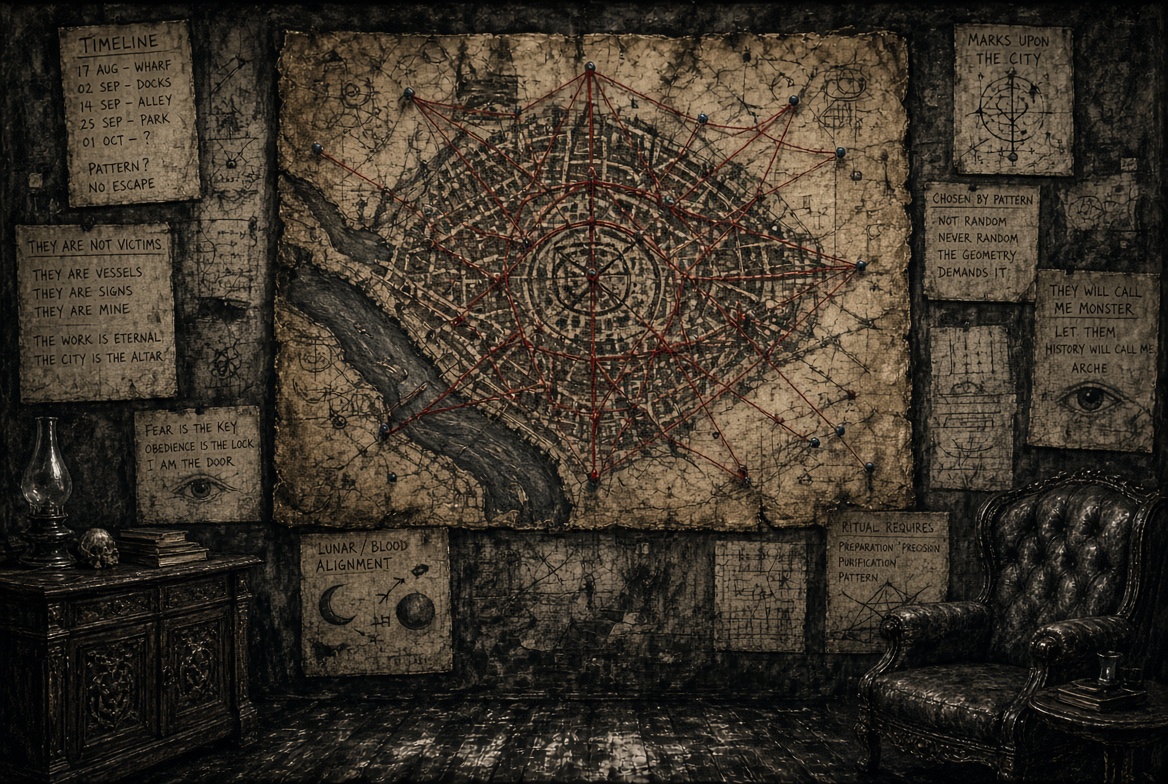
C) To further incriminate himself, the killer will provide an enlarged, elaborate map of the city with multicolored pins and red yarn connecting crime scenes, timelines, and obsessive diagrams. (There was one serial killer movie that used yellow yarn as opposed to red. I was like “What the heck? How does yellow illustrate an obsessive need for blood?” My guess is either the filmmakers couldn’t find red yarn, or they didn’t think anyone would notice.) The configuration of the red yarn hooked around the multicolored pins will form a pentagram, or some image the audience will associate with evil. 

D) The killer will have a trophy collection on the dresser filled with personal souvenirs—locks of hair, jewelry, driver’s licenses, underwear, lipstick, or they will have extreme keepsakes in jars in a freezer that contain fingers, teeth, or body parts carefully preserved.

E) When the LEOs and Gunderson leave the serial killer’s living room, they will find a torture cellar or hidden room that real estate agents sell as a “must have” for all prospective serial killers. (How many of us have multi-room, cavernous areas carved out of our basement?) Inside his torture room, the law enforcement officials find various restraints in their workshop, knives, surgical tools, “how-to” books regarding surgery, a bloodstained table and a captive/victim who is barely clinging to life. 
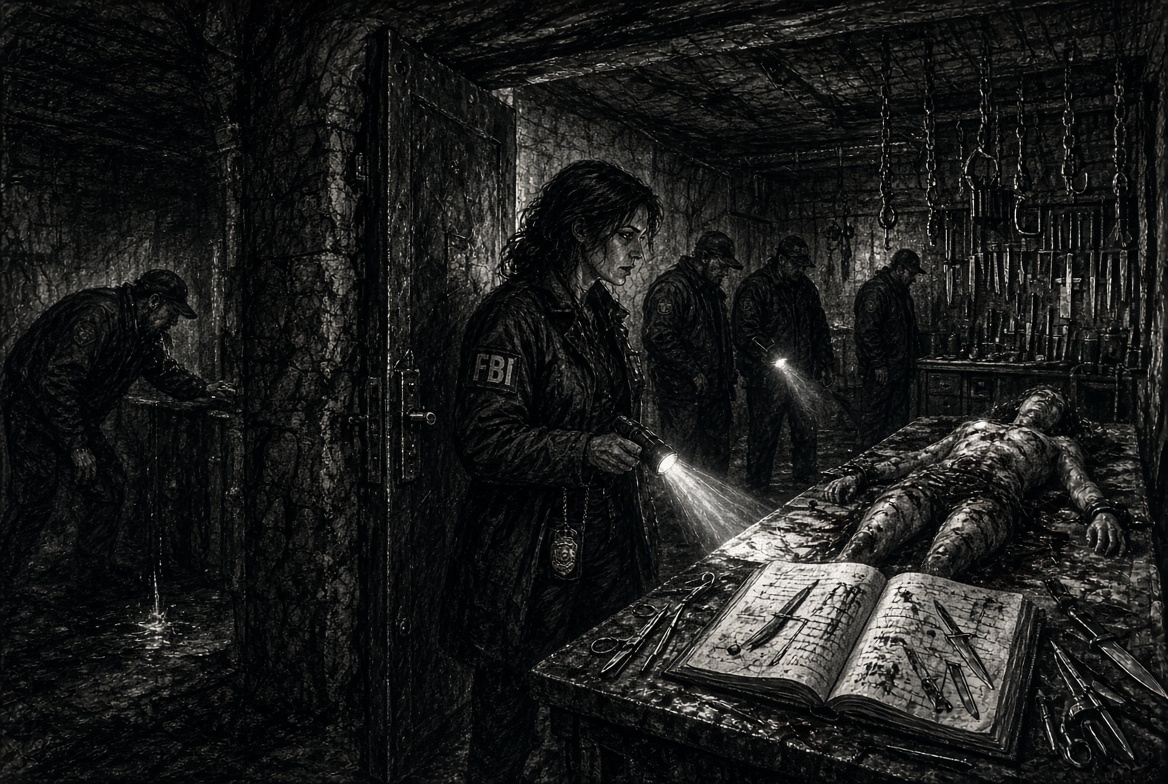
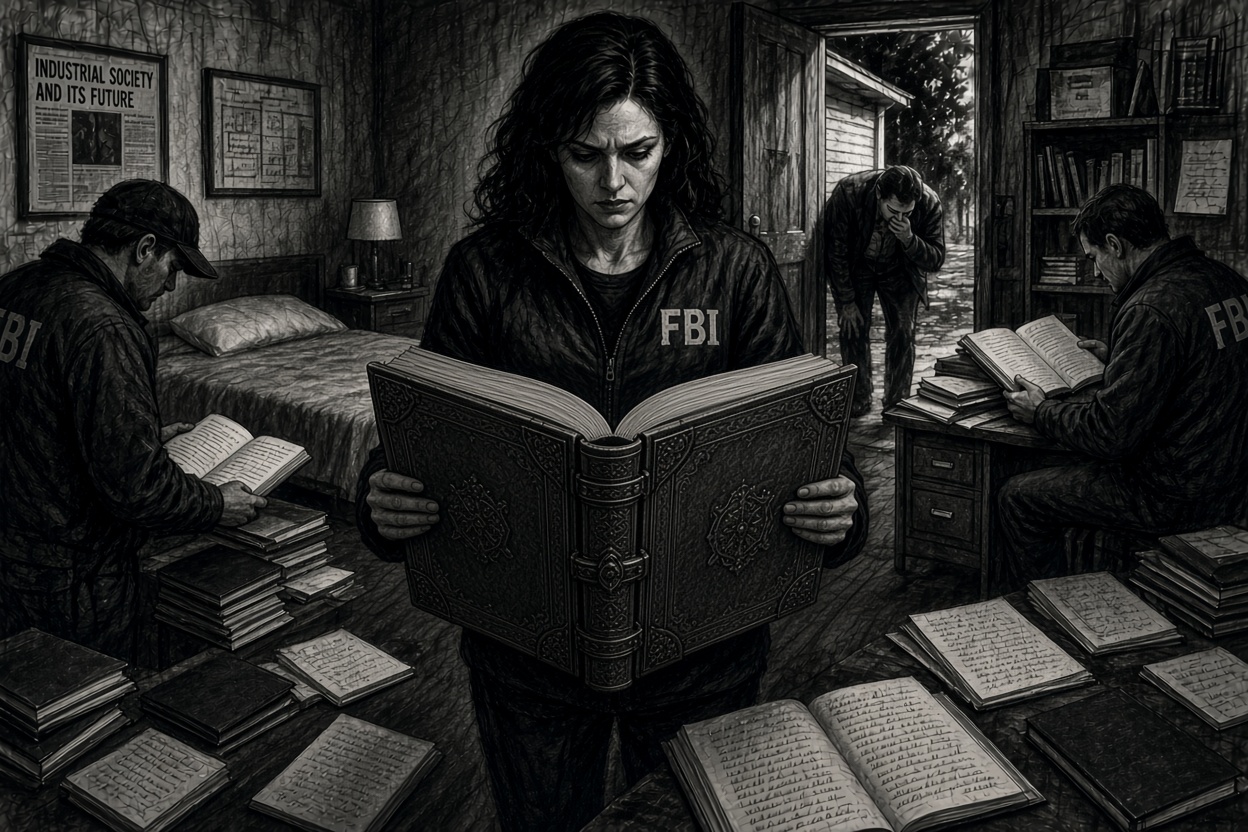
F) In his bedroom, Gunderson and the LEOs find an incredibly incriminating journal with stacks of handwritten notebooks or a single massive ledger filled with detailed accounts of the crimes, philosophical justifications based on literary or religious references, lists of future targets, or pure delusional stream-of-consciousness, Unabomber-style writings. As busy as this room will appear to the naked eye, it be unusually clean, and extraordinary in its tidy, organized manner. One movie even went so far to suggest that its serial killer went to the trouble of developing an almost aseptic quality of sterility. “Why would an impulsive killer worry that much about spreading germs?” we ask. Depending on the over-the-top quality of the production, the serial killer might adorn his room with mannequins posed in victims’ clothes, taxidermy, religious icons mixed with occult symbols, or a bedroom that looks like a shrine. The answer to our previous question will arrive here, as Gunderson suggests that the tidy, organized manner of this man’s rooms illustrate a love/hate relationship the killer has with his domineering mother.

G) The LEOs will also note a chemical smell, usually bleach or formaldehyde mixed with the smell of human decay. To illustrate the smell those of us in the audience cannot smell, one of the LEOs will leave the house to vomit.  

H) Finally, one of the LEOs will say, “You’ll want to see this” to Special Agent Gunderson. The LEOs will all be standing around a board, and they will make room for Special Agent Gunderson. On this board, she will see amateurish photos taken from an amateurish camera. These pictures will be purposefully amateurish with odd angles. After she methodically walks past them, she will finger the last one and whisper, “He’s been watching us all along.”  

As noted, the house will empty, save for a victim clinging to life. The killer will either be on the run, hunting his next victim, or about to return at the worst possible moment, but the house overflowing with proof that the profile the incredibly brilliant and talented Special Agent Gunderson created was right all along. 
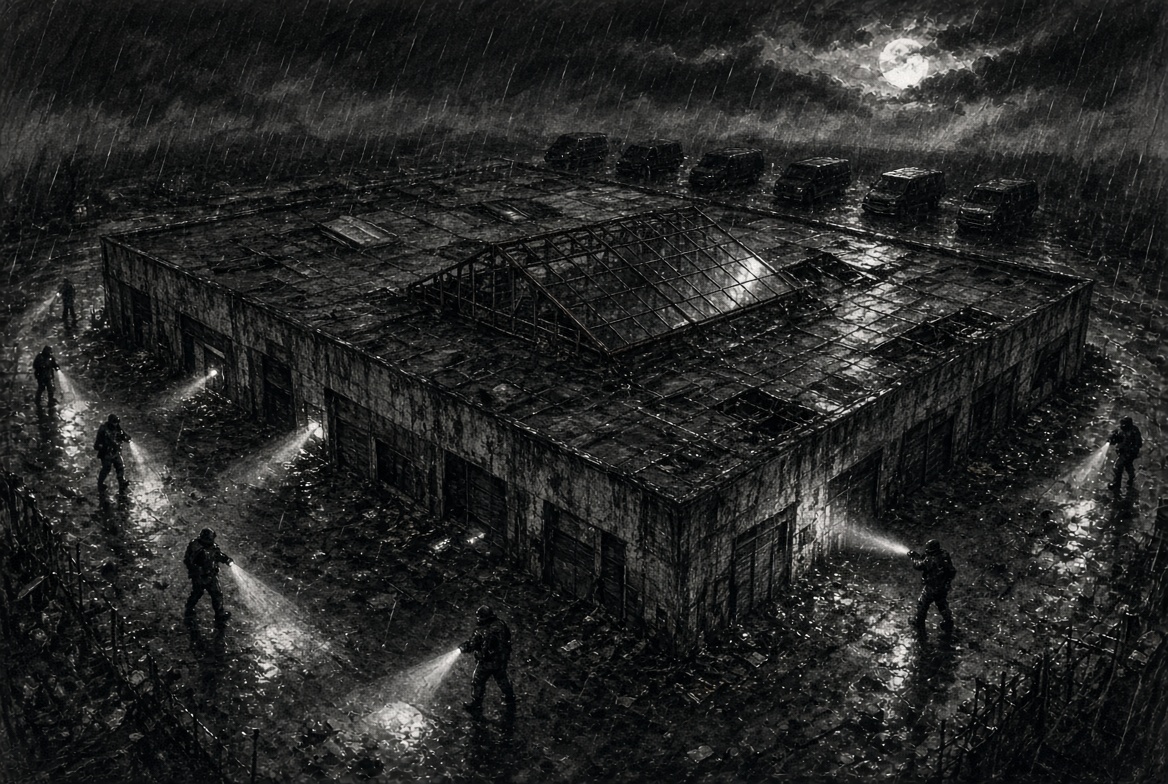
I) An eye-witness account suggests that the serial killer is in an abandoned warehouse. When Gunderson and the LEOs approach, it’s dark out, and there is heavy rain that soaks everything but actors’ hair. When Gunderson and the members of the LEO team she trusts approach the warehouse, black SUVs and SWAT vans roll up quietly. Guns are drawn. Flashlights cut through the darkness. Someone whispers over the radio: “We’ve confirmed his presence. He’s in there. Proceed with extreme caution. We’re on high alert for the possibility of booby traps.” Gunderson will shut off her radio, and she’ll encourage her team to go to radio silence, as they approach the entrance of the warehouse.

The warehouse is entirely empty when they enter, and the natural light shining from the abandoned warehouse roof is broken by the shadows of beams and the occasional bird flying from beam to beam. To break up the spooky silence, a bird will fly too close to Gunderson to provide a jump scare as she walks through the warehouse with her gun poised. At some point in her walk through the warehouse, Special Agent Gunderson becomes separated from her team, as the LEOs begin clearing the various rooms in the warehouse. She will enter the most incriminating room that has evidence in the form of more wall clippings, trophies, and that same lingering chemical smell. She will put the back of her hand to her nose and scrunch her face to illustrate for us how bad this smell is.  
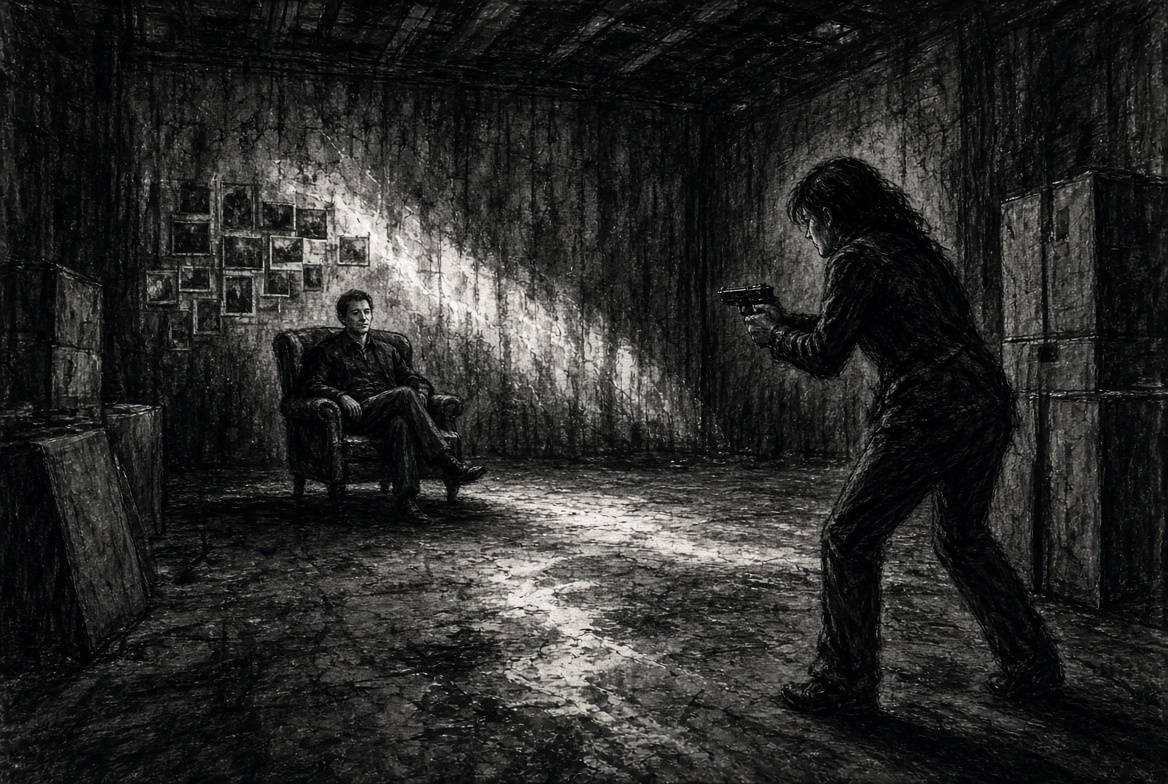
J) The killer appears in the dark corner of this room. He is sitting in a walnut brown Baxton studio Billie side chair. He is not surprised when Gunderson enters. He’s been waiting for her. (I would love to see a scene where one of the LEOs locates him first, and he says, “What, wait a second, who are you? Go get Special Agent Gunderson, and tell her to be taken aback by my calm yet authoritative stance.”) The media monikered serial killer is in a dark room, lit only by limited natural light and occasional flashes of lightning. (In some movies, his face remains in shadow for another beat.) He congratulates Gunderson for displaying her incredible and unprecedented talent and intelligence by finding him, and he further compliments her by saying that only she could understand him well enough to develop the profile she did. He also states that as incredibly brilliant and intelligent and talented as she is, Special Agent Gunderson couldn’t have arrived at such knowledge of him if she didn’t have intimate or familiar knowledge. “No one else can understand us,” he says, explaining how elements of her past leads her to understand his methodology better.

“I’m nothing like you,” the incredibly brilliant and incredibly talented Special Agent Gunderson says. 

“We’re more alike than you know,” he says with a smile. 

K) The media monikered serial killer will then drop a lengthy exposition regarding his methodology, and once that’s complete, we will hear the sounds of boots stomping on the stairs and radios crackling as the LEOs join Gunderson in the abandoned warehouse room. “Hands where I can see them!” they will shout with weapons drawn behind her. The lighting will become more dramatic, as all of the flashlights light the room (or the lightning flashes become more frequent), as the serial killer and Gunderson begin exchanging words (Sometimes they shout, sometimes they whisper. This is one of the few points in the typical serial killer movie where the filmmaker has some discretion.) When Special Agent Gunderson finally reaches her “nothing to lose here” point, she will seek to take action, but the serial killer will stop her in her tracks by revealing the final victim (Either the initial victim that caught Gunderson’s attention, her daughter, or some young girl to whom she’s developed some form of affection) to raise the stakes.  
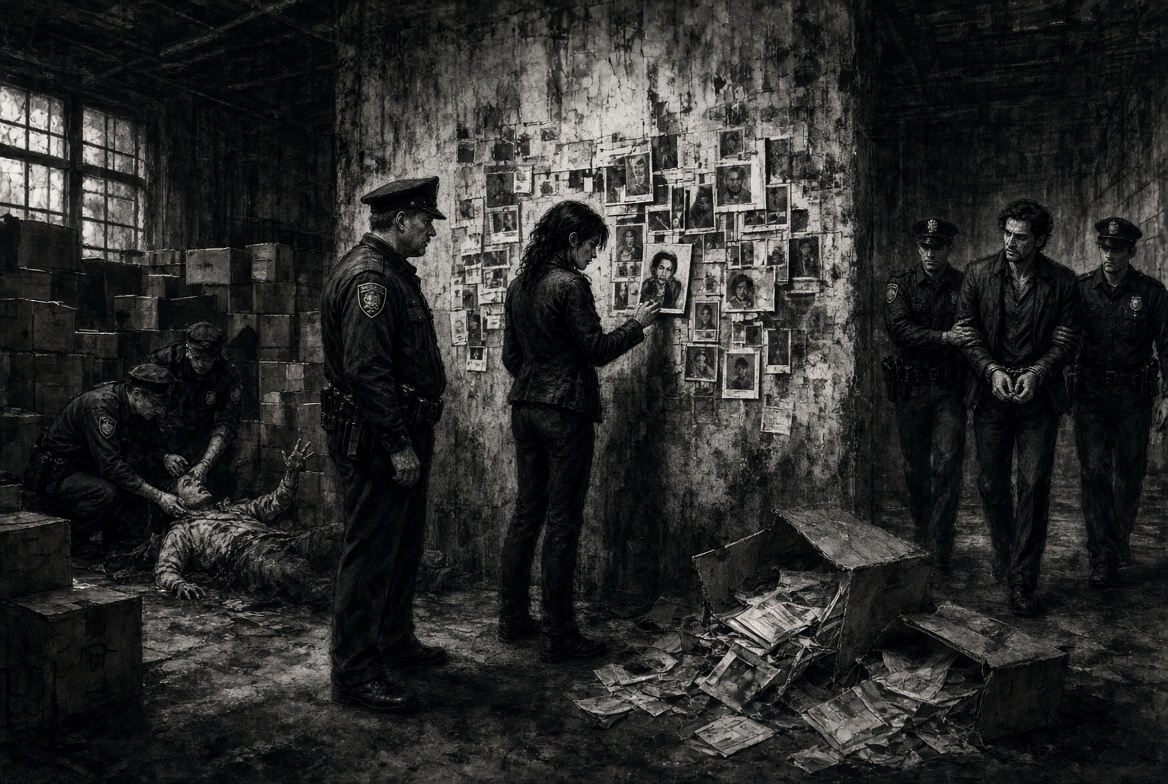
L) A struggle breaks out: a brief, brutal fight in a confined space, knives flashing, a gun sliding across the floor, and Gunderson will begin look around the abandoned warehouse to use something in the warehouse against him. When she finds something elaborate that triggers an elaborate something else that won’t harm the female victim, the killer becomes separated from the victim, and the serial killer is tackled, slammed against a wall or the floor, and cuffed by one of the LEOs. He will smirk an evil little smirk while they’re apprehending him, and he’ll whisper one final line to Gunderson while being taken away, something like, “Society will never truly understand us.” 

M) The scene ends with the killer being led away in the rain under harsh floodlights. Gunderson will remain in the room of the abandoned warehouse for a beat, staring at the wall of evidence or the trophies, looking hollowed-out rather than triumphant. Rainwater drips from the ceiling, and one of the LEOs will congratulate her on doing what he considered impossible. “You are an incredibly brilliant, intelligent, and talented woman,” one of her subtly yet unmistakably misogynist detractors will say. “And I can’t believe you did it, but you did. It’s over, it’s finally over.”

“I wish I could believe that,” Special Agent Gunderson whispers, glaring at something poignant in the serial killer’s display. “I wish I could believe that,” she says fingering it. The camera zeroes in on that poignant artifact that foreshadows the future horror this episode could portend, which everyone who watches too many movies knows is the sequel(s).

Long before I learned about “movie tropes”, my friends and I talked about movie tropes all the time without using a term we had never heard before. We watched so many movies that we could spot the tropes before the movies delivered them. We never turned it into a drinking game. If we had, our brains would be more damaged than they already are, because each genre, and subgenre has an algorithm that one movie maker created to set a precedent. Once that precedent was set, the filmmakers, the studio execs, the investors, and all of the players involved demanded that the creatives involved in the movie follow the same blueprint that the precedent setter set to prevent confusion for the audience. 

Based on the ubiquity of current profiler-chases-serial killer movies, we can guess that they make a lot of money now, but they also cost a lot of money to make. There are low-budget, independent movies of course, but most movies cost a lot to make. Those movies require big budgets, and big budgets require approval from the hierarchy or the greenlight authority to get through the chain of gatekeepers that wield different kinds of power. The director and screenwriter have to answer to all of them if they want to make it to the next stage, and from what I hear these gatekeepers are very generous with notes on how the directors and screenwriters can make their project less confusing for the audience. Filmmakers have been subjected to this process long before I was born, and it will continue to work this way long after I’m gone. Some screenwriters and directors refuse to concede to these notes, and we call them two things: auteurs and unemployed screenwriters and directors. The auteur is an artist whose personal creative vision is strong and distinctive that he might be able to tell the gatekeepers what they can do with their notes. Most auteurs are not welcome in most genre movies, because genre film fans grow accustomed to certain rhythms, rhetoric, and patterns, or what we now call tropes. When one of the auteurs is so talented and brilliant that they find a way to make a decently budgeted movie without conceding to “the notes” those I know and love say, “I just found it confusing. I don’t know why, but it confused me, and I didn’t like it.” Those of us who watched too many movies strive to find movies from auteurs who break the system by refusing to kowtow to notes from production studios and investors. Yet, we know that most movies are so expensive to make that the artistic vision screenwriters and directors prize often gets so diluted by those who know far more than I do about how to appeal to audiences and make a lot of money in the process, but it does tend to make movies very similar to those of us who watch too many of them.  

The Unusually Awful Annie Cook 


Power, Greed, Corruption, and Murder in the middle of Nebraska? Small town, Nebraska? According to reports, the culture of crime, corruption and lawlessness in North Platte, Nebraska was so rampant that it was nicknamed “Little Chicago”. Little Chicago, as in gangsters, as in Al Capone. According to local lore, the town’s law enforcement was so lax during this era, that when various crime bosses and gangsters needed a place to cool off or lay low, they would “vacation” to North Platte, Nebraska.

A woman named Annie Cook (1875-1952) took full advantage of this climate by becoming a bootlegger during The Prohibition Era, a madam of a prostitution ring, and the superintendent of a poor farm that allegedly enslaved and murdered the indigent and destitute who worked on her farm.

Liz Cook and Annie

Annie Cook built such a prosperous criminal empire that at her peak, between the late 1920s and the early 1930s, she was considered her one of the two most prominent criminal figures of North Platte (crime boss Al Hastings being the other). Yet, if we ran into this little woman at one of the church functions she held in her front yard, her smile, her “vanilla voice,” and pleasant demeanor might have reminded us of that cute, little old lady who quietly sits in the back corner of our church.

When I first heard the tale of an unusually awful woman turned gangster, I thought it had bestseller written all over it. When the former and current North Platters dropped the details of her criminal empire, I couldn’t believe no one documented this big secret of the Midwest before. The more they told me about this story, the more my smile faded.

“It wasn’t just innocent people Annie Cook maimed and murdered,” they told me. “Her victims were largely the old, the mentally challenged and the poverty-stricken. She mentally and physically tortured them, and she killed them when they became a financial burden to her.

Prior to hearing that breakdown, I had this romanticized image of Annie Cook as the original female gangster, or OFG. The more I heard, the more difficult it became to imagine how anyone could romanticize her. We love our gangster flicks, because we love bad guys, and we love violence, as long as it’s justified and noble, or relatively noble. 

Don Vito Corleone, the beloved main character of The Godfather, was a bad man, and one of the most famous bad guys in fiction, yet according to Mario Puzo and Francis Ford Coppola he only hurt and killed “those who chose this life.” Yet, if this fictional composite of influential figures in organized crime became the most powerful Don of the five families, what atrocities did he have to commit to get there? If a young, aspiring Vito Corleone vowed to only hurt “those who chose this life” and other dishonorable figures, his leader probably would’ve ordered him to hurt or kill an innocent person as a test of loyalty. When Vito developed his first protection racket, what did he do to the mom and pop store owners who failed to pay on time? We don’t hear any of these messy details of course, because The Godfather is a fictional tale of a composite character, and authors of fictional tales have a literary license to romanticize their characters in anyway they want. Yet, those of us who loved Marlon Brando’s portrayal of Vito Corleone in The Godfather should wonder who Puzo and Coppola used to create the character, and what were the messy, ugly, and horrific atrocities those figures had to commit to get to the top of crime families that ran major cities during their lives.  

As a writer who was deeply influenced by one of the greatest movies ever made, I wondered how an amateur writer could develop The Godmother without going into the messy, ugly, and horrific details of what she did in her path to the top of “Little Chicago”. In this light, I found the tales these former and current North Platters continued to drop on me depressing, as I began to realize that leaving out the messy details of the OFG’s rise to the top was almost impossible. The messy details were the story, and I doubt that even Puzo and Coppola could find a way to omit them in their romanticized gangster tale. 

The fact that Annie was able to break so many laws pretty much meant that at her peak of criminality, Annie Cook was above the law. At one point, author Nellie Snyder Yost, details an insignificant story about a day in which Annie Cook was in a hurry. She instructed her driver to “Blow the stop signs” in town. Who cares if someone blows stop signs? No one, but it illustrates that most beat cops of North Platte likely failed to stop Annie Cook for minor infractions, but those who worked up the courage to pull her over in the past, likely found out that Annie owned judges and other influential characters in town who would expunge her ticket from her record. She was above the law for a time. The other, messy details were so unusually awful that her tale couldn’t be classified as anything but a horror, a true horror, as opposed to the cinematic variety. These details were such that I realized I no longer had a “cool, female gangster who dominated a small, Midwestern town” tale on my hands, but one of a unusually awful woman who enjoyed hurting and killing the helpless, defenseless, and frail. The tale was so awful that I no longer had big, bestseller aspirations, but I still considered Annie Cook’s tale one that needed to be told.

Nellie Snyder Yost

Much to my disappointment, I learned that an author named Nellie Snyder Yost beat me to writing Annie’s story with her Evil Obsession book. I was jealous, but I couldn’t wait to get my hands on it to see if she captured the essence of the Annie Cook story as I imagined it. In my personal review, Ms. Nellie Snyder Yost was good storyteller and an adequate writer, but her research exceeded my expectations with her research, as she uncovered details that I consider some of the most horrific I’ve ever read, and I’ve read my fair share of True Crime books. Her research was also so thorough that she is now considered the foremost expert on Annie Cook, and very few have questioned the legitimacy of her claims (some locals claim the book blends fact with oral history at times.) Yet, if the claims Joe (Martin) Cook and Mary Knox Cauffman testified to in court are true, then Evil Obsession is one of the most uncomfortably disturbing recitation of facts that I’ve ever read, the type law enforcement officials spend a lifetime, often unsuccessfully, trying to forget.

How Little Annie Made it Big  

In 1893, the 19-year-old, Anna “Annie” Maria Petzke thought she met her savior when she met Frank Cook. She thought he was as rich as she thought her family was, because he owned his own farm, and it came equipped with a white farmhouse and an irrigation ditch

Suggesting that Annie was “saved” by Frank Cook invites the idea that Annie was enslaved by her Russian Immigrant parents on their Denver, Colorado farm. She wasn’t enslaved by her parents, as reports suggest she didn’t mind the work, but she and her sister Liz worked as hard as their brothers, and the Liz and Annie were never paid for their efforts. Their parents didn’t think women should have money.

Farm life was the only life Anna Maria Petzke ever knew, as she was born and raised on a farm, so she likely didn’t have much knowledge of the outside world. She grew up envying her brothers for the money they made working on the farm, and she thought she had been cheated out of her share of what she considered the vast family fortune. 

Frank and Annie Cook

When Annie married Frank and saw his books, she had to be disappointed to discover that an 80-acre farm doesn’t make near as much money as she always thought, and she was just as disappointed to learn that Frank had little-to-no ambition to expand, buy more farms, and make more money. This led to discussions, arguments, and fights that culminated in Frank informing Annie that his goal in life was limited to generating enough income to support a family, and that he thought his 80-acre farm could do just that. That wasn’t enough for Annie, but she knew Frank well enough to know he was a rather passive man, and that she could dominate him. She knew it wouldn’t take much to convince Frank to buy more farmland to gain more money, and attain more power in the community, but it bothered her that as a woman of the late 1800s, early 1900s, in small town, Nebraska, she had to go through Frank to achieve this. She couldn’t figure out a way to do it on her own, until she experienced some nagging back pains. 

After exhausting the efforts of the local physicians to relieve his wife of her nagging back pain, Frank gathered enough money to purchase Annie a train ride to Omaha, Nebraska, and he secured for her the services of a big city specialist. While sitting in the waiting room of that big city specialist, Annie had a chance meeting with a woman named Jane. Annie couldn’t know it at the time, but this chance encounter would change everything for her.

As ambitious as she was, Annie Cook probably would’ve found another path to the money she felt her family deprived her of in Denver, even if she never met Jane, but it’s just as likely that her definition of power and big-time money would’ve been limited by her station in life. It’s also likely that if Jane never groomed Annie into the world of prostitution, Annie’s unquenchable greed, lust for power, and blind ambition would have eventually put her on the radar of local law enforcement.

When she returned from Omaha, Annie informed Frank that while the Omaha specialist helped her find some relief from the pain, “The doctor said it was a chronic thing, that I’ll have to go back every now and then for treatment.” (The doctor told Annie she experienced a kidney dysfunction, he prescribed some medicine and told her to come back in a week.) How often she saw this specialist on her return trips to Omaha is unknown to this writer, but every time Annie returned to the city, she visited Jane.  

Over the course of several visits, and lengthy stays in Omaha, Annie worked at Jane’s “Sporting House” learning, firsthand, how to run a brothel. Jane showed her how to conduct herself as a madam, and how to handle the workforce. Annie made a lot of money, fast, working as a madam for Jane. She paid off the debts she incurred with Jane, and she even managed to purchase a farm she always had her eye on. Annie probably didn’t know it at the time, but becoming a madam in North Platte would not only make her a lot of money, fast, but it would eventually play a prominent role in her dream of creating a criminal empire.

When Annie Cook decided to sell alcohol, and run her own distillery, during The Prohibition Era, she was never investigated for breaking the local, state, and federal laws of that era. Why she was never investigated by the various law enforcement agencies will be a recurring theme throughout this article, as Annie Cook knew how to make the right connections with a couple dollars here and there, and some suggest that her boarding house for girls bordello developed a client list of prominent officials that she built, maintained and used when she needed an issue to go away.

“Anne Cook had officials sign off on death certificates of people who died mysteriously on her farm.” —Panhandle News.

She also used those connections, coupled with numerous bribes and threats of extortion directed at those who frequented her boarding house for girls to help her secure the Lincoln County contract to provide housing, aid, and comfort for the poor and indigent. Annie managed to take that contract away from a kindly, decent widow named Mrs. Emma Pulver, who, by all accounts treated her guests with decency and respect for twenty-five years. Annie outbid the widow by demanding less in the way of government reimbursements for housing them and providing the aid and comfort for their care. We can only guess that Mrs. Pulver, the town, and county officials were shocked that Annie thought she could provide “guests” of Lincoln County care at a rate lower than Mrs. Pulver, but Annie probably told them that she thought the guests could make up for any lost revenue by allowing them to provide her the labor necessary for her farm. While that may have been true, Annie also made up for most of the lost revenue by denying the guests adequate food, heat, hygiene, and anything else she could think up to improve her bottom line.

Cook Poor House

It’s difficult to convey how awful Annie treated these guests for the next eleven years, except to write that she considered them her possessions from that point forward, and she could do with them what she wished. She basically enslaved the indigent and destitute on the farm, verbally and physically abusing, and some allege torturing them to get more production out of them. She had the guests of what was eventually called the Cook Poor Farm work long, labor-intensive hours without compensation of course, but she also deprived them of many of the necessities of life. At this point in the article we know the answer to the question, ‘Why wasn’t the Cook Poor Farm dinged for all these violations and eventually shut down? It survived investigations of the numerous charges made against it for eleven years, and the evidence suggests that the county officials in charge of helping Annie maintain the standards necessary for the quality of life for her guests were either on Annie’s payroll or client lists of her boarding house for girls.

The Unusually Awful Horror of Evil Obsession 

“I didn’t like that movie,” a friend of mine said of a Phoef Sutton sports drama/thriller called The Fan. “It made me feel so uncomfortable that I walked out on it.”

“Isn’t that what you pay your hard-earned dollars for?” I asked. “Don’t you want movies and books of this sort to take you out of your comfort zone?” We both looked at each other from afar, as if we couldn’t understand the other’s extreme position.

The difference between the two of us was that she loved horror movies that knew how to keep it fun, acceptable, and lightweight. These popcorn pleasures don’t engage in disturbing truths about human nature, and they don’t lead us to feel sympathy or empathy for the victims. They keep their horror campy, and so over the top with blood and gore that it helps us distance ourselves from the horror. There’s nothing fun about Evil Obsession, and my friend wouldn’t have made it twenty pages in. There are no cats flying into scenes to provide jump scares. The big, bad monster of this tale doesn’t growl like a lion in any of the scenes, and she doesn’t say cool, dark, or quasi funny things before she kills someone. Annie Cook also didn’t try to develop a cool cause to justify her actions either, not in the manner our favorite serial killers or mass murderers do, and her unusually awful acts weren’t committed in a calculating manner the subjects of our favorite True Crime books are. Unless we consider killing useless human beings (by her definition) to improve her finances justifiable in the sense that she was denied money when she was younger, then she wasn’t motivated by righting wrongs either. 

The best description we could use to describe most of the mysterious deaths that occurred around Annie Cook is that she quietly did away with the guests of the Cook Poor Farm when they became economically unviable for her. She caused their premature deaths through starvation and other slow, unceremonious measures that proved easy to mischaracterize by various officials. Thus, the horror of Evil Obsession is not theatrical or cinematic, it’s just a tale of a relatively ordinary woman who just happened to be so unusually awful that it makes us feel uncomfortable to read about her.

Killing Clara

The one glaring exception to that methodology, and the most substantiated and incriminating allegation of wrongful death, corroborated by Annie’s sister Liz’s eye-witness testimony, suggests that Annie Cook got away with murdering her own daughter Clara. Yet, if Liz’s descriptions of that incident are 100% accurate, and the case made it to the state’s district attorney desk, he would probably seek the lesser charge of voluntary manslaughter to secure a conviction against Annie. 

Annie’s sister Liz said that the mother and daughter were involved in a heated argument, but she said the two of them were often in heated, vicious, and sometimes violent arguments. Whether or not this argument was worse or par for the course is not stated, but when it reached a point that terrified Clara, she ran from the house to escape her mother. Annie gave chase and she threw a cast-iron stove lifter at her thirty-eight-year-old daughter in a flurry of rage. The cast-iron stove lifter hit Clara on the head in such a manner that it took her life. Liz reports that the impact initially caused Clara to run around a tree three times before collapsing, as a chicken might after having its head cut off.

Annie reportedly went to her daughter’s aid and wrapped a bandage around her head. After Clara succumbed to death, Liz stated, Annie ordered Joe (Martin) Cook to retrieve a bag of money Clara had hidden in her room. If Liz’s account is as time sensitive as she describes, Annie remembered that Clara hid money in her room, and she ordered Joe to retrieve while her daughter’s corpse lay before her, still warm. Author Ms. Yost does her job by spending the majority of Evil Obsession characterizing Annie Cook through various incidents, but for most people this incident is about all they need to know what motivated her. At this point in their relationship, Clara is described as Annie Cook’s employee, her business partner, and in some respects her confidant. Whether through impulsive reaction or blind rage, Annie Cook caused the death of her daughter, and rather than be overcome with remorse, she ordered Joe to retrieve the bag of money to presumably prevent investigators from happening upon it, questioning her about it, or confiscating it as a piece of evidence. Ms. Yost reports that Annie then used Clara’s money, combined with the insurance money from Clara’s death, to purchase a farm she always had her eye on. (After a brief, official investigation, it was officially discovered that Clara’s unfortunate demise was the result of an accidental poisoning.) 

So, if we were to try to pitch this story to the “just the facts ma’am” crowd, the evidence suggests that we should remove that provocative, bestselling ‘M’ word murder from the back cover, unless that ‘M’ word were used to describe the mysterious death of Clara Cook, and all of the mysterious deaths that happened around Annie Cook. 

“But rumor has it that several workers’ carcasses from her Cook Poor Farm were found in ditches shortly after their ill-fated escape attempts,” the concerned citizen might say. “Did your research show you that? Did your research show how many old and indigent patients, who could no longer work, ended up succumbing to mysteriously premature deaths?”

“Fair enough,” we might say, “but no official records confirm those incidents.”

“Official records?” they might ask with exhaustion. “Where do you think this nickname “Little Chicago” came from? North Platte, Nebraska, in the early 20th century, was an absolute cesspool of corruption and lawlessness, and people were absolutely terrified of Annie Cook, because they knew she could get away with anything, including murder, because she did.”

“Anne Cook is an example of if officials weren’t able to be corrupted, they could have stood up to her,” said Jim Griffin, a local historian and Curator Director of the Lincoln County Historical Museum. “She bought off [and extorted] most of the town and council members to continue operating her ventures.”

No one knows, exactly, how many mysterious deaths occurred around Annie Cook, but educated guesses based on local lore and historical context suggest that Annie Cook may have been responsible for multiple deaths, possibly several dozen. Some of these mysterious deaths were the result of blatant acts of criminality of the highest order, and some slipped through the cracks of the bureaucratic foundation of the town.

One example of a mysterious death that occurred on the Cook Poor Farm involved a resident Annie called “that old bastard Kidder”. Old Kidder died of “old age and heart failure” according to the death certificate a county mortician named WR Munson wrote, signing for the county coroner. He wrote and signed the document for his good friend, Annie Cook, “Ignoring,” Ms. Yost writes, “the all too plain evidence that starvation caused, or contributed to, the death of the unfortunate pauper.” As superintendent of the Cook Poor Farm, Annie Cook was put in charge of this man’s welfare, and she allegedly denied this sickly man food. We can assume that she did it, because the cost of his care began affecting her bottom line. To her mind, Old Kidder overstayed his usefulness.

Who knows how much longer Old Kidder could’ve lived? We can only guess that he was a forgotten man, but who was he? How many people cared about this man, and why didn’t anyone step forward to question how this man died? If anyone aside from Liz, Munson, and Annie suspected foul play, why didn’t they step forward, and if they did who would act on the testimony that alluded to Annie’ s role in this man’s premature death, and who would act on that testimony? If a representative of the coroner’s office officially signs off on the death of a forgotten man that no one cared about, who would have called for a medicolegal investigation that involved a thorough examination of the death scene, interviews with witnesses, and collection of physical evidence? Who would call for an autopsy to prove or disprove initial findings? Starvation proved, in this case, a perfect crime for a well-connected, unusually awful person.  

Another incident that went officially undocumented, involved the story of a teenager, named Allen Porter. The young Porter was driving his horse driven wagon to Annie Cook’s house to retrieve a potato digger Annie borrowed from Allen’s uncle. When they neared the Cook Estate, Allen’s otherwise obedient horses stubbornly refused to pass a wagon box left by the side of the road. After he continued to urge the horses onward, Allen reported, the horses’ legs began trembling. Frustrated, the young Porter pulled up to the wagon box to investigate the source of what he considered his horses’ irrational fears. He looked down into the box to see an old man staring up at him. The sight of a frail, old man in an old, abandoned wagon box probably knocked this young teenager back in shock. We can only guess what the young Allen Porter expected to find, but seeing an old man in there was probably the last thing he expected to see. 

After he recovered from that initial shock, Allen Porter looked back in to study the old man looking back up at him, eyes wide and bulging, his face covered in flies. As horrific as it must’ve been for the young teenager to discover a corpse in the wagon box, his careful study of the poor, old man revealed the slight expansion and contraction of breath. The man was alive. We don’t know what was going through Porter’s head, or why he didn’t do more to help the poor, old man, but how many of us have experience with such inexplicably horrific matters? How many of us would know what to do? The young Porter was probably so shocked and terrified that he didn’t know what to do, so he rode onto the Cook Estate to try to put it out of mind. Once there, Annie exited her house to greet him. We don’t know how much of Porter’s path Annie saw, but when she met him, she greeted him with a suspicious snap, “What do you want?” Allen told her, and she helped him load the potato digger into his wagon. When Allen took the potato digger back, he reported what he witnessed to his uncle, and the older man was not surprised. He reminded Allen to let the horses cool before watering them, and he turned away.

“Getting away with murder” is a hyperbolic expression we now use to describe someone acting badly without consequences. If our fellow employee loafs on the job, for instance, we say they’re getting away with murder when the boss fails to call them out on it. When foreigners hear us use this phrase, they wonder how we can say such an inflammatory phrase so casually. “Getting away with murder is just something we say,” we say. “It’s an expression.” 

Even with their now archaic and antiquated technology, getting away with murder was considered one of the hardest things to do to early 20th century American citizens, and they probably dropped that line in the same somewhat sarcastic and serious ways we do today. How would an unusually awful person like Annie Cook respond to such a serious joke in her day? “All you have to do is prey on the unloved and unwanted that no one, if truth be told, wants around anymore. My victims became such a burden to society and their loved ones that if we could force them to be honest, they might actually thank someone like me for having the courage to off the useless who have become such a drain on society and our resources. Before you do it, however, make such you make the necessary connections with prominent people for they can do a lot to help everyone else forget to do their jobs or neglect their responsibilities as good citizens. If you do it right, you can scare good men and women, like Allen’s uncle, into reminding their nephews about how to put the horses away.”

True horror, as opposed to the more theatrical or cinematic, can be found in the ways in which unusually awful people display an utter disregard for the sanctity of life, human life. The horror is in the details of an unusually awful person asking us to be honest and acknowledge that some human life just isn’t special. Some life is an unprofitable burden, and it often overstays its usefulness.

The conclusion of this chapter is that there is no conclusion, as Annie Cook never had to put up with nosy neighbors in North Platte or Hershey, Nebraska, learning things about her. They were terrified of her, and they gave her the much needed privacy she needed to conduct her affairs the way she saw fit. There were never any investigations from law enforcement officials, as they were bought, extorted, or informed that their investigations would go nowhere. Annie Cook also never had to deal with exposés in the media, as there were never any stories done about her during her day. Reading through this story, it almost seems impossible that some young, enterprising young reporter wouldn’t leap the hurdles to overcome the corruption in these towns to produce an award-winning exposé of the killing fields in North Platte and Hershey.

“But you just reported on the climate inherent in these towns, people were terrified, and they were all very hush hush on the topic of Annie Cook and her Cook Poor Farm,” you might say. “I doubt the best reporter or law enforcement official could get anything out of them to do their job.” When Ms. Yost finally decided to write Evil Obsession, she expected to encounter such roadblocks. To her surprise, “All the informants seemed willing, even eager, to tell me what they knew.” Granted, this book came out in 1991, decades after Annie Cook’s death, but where was that eager reporter, looking to expose the travesties occurring at the Cook Poor Farm while they were going on, and where was that reporter in the intervening years, decades, between Annie Cook’s death and Ms. Yost’s decision to research, write, and publish Evil Obsession? If it wasn’t for Ms. Yost, Annie Cook’s legacy probably wouldn’t have suffered either, because there were no official investigations of the mysterious deaths that occurred in and around Cook Poor Farm and the Cook Family Estate in the aftermath of her death. There is also no record of post-mortem investigations, or any cold cases being officially re-opened in the decades since, and the absence of evidence has become part of the legacy and myth of the unusually awful Annie Cook, and that legacy is a stark reminder that horror, true horror lies not in cinematic monsters but in the indifference that lets figures like Annie prey on the “useless and forgotten.

Annie Cook II: The Horror is in the Details 

Annie Cook III: What Drove Her? 

The Power of Forgetting


The tenets of psychology, namely those of Sigmund Freud, teach us that we must deal with every tragedy, and every moment of despair, if we ever hope to get past them.  If we ever hope to move beyond them we must be honest about them, confront them, and analyze them ad nauseum, until we achieve greater mental health.  Some of the times, that’s not true.  Some of the times, it’s better to forget.

ForgetAre you a bad person?  Most people don’t think that they are, and if they did they probably wouldn’t tell you.  But how does one become a bad person?  What’s the difference between a fully formed, moral adult and a bad one?  Some would say that a bad adult is created through a series of events that have happened to them, or the way in which they dealt with them, or remember them.  Some would add that it’s the decisions that we have made in life, based on the series of events that we have experienced.  Others would say that it’s a great stew of the conscious and subconscious decisions we make on what to remember, and what to forget, and that that forms the core of who we are?

This relatively new belief in the healing powers of the mind to forget seems to go against one hundred years of psychological teaching, particularly those involving the philosophies of Freud.  Freud taught us that the path to mental health involved remembering every excruciating detail of our lives, until we reached a point of exhaustion where those details could be properly analyzed and interpreted.  He then wanted us to focus on why we remembered these details, how they should be remembered, and when they should be remembered most often.  Anyone that has visited a counselor, of any stripe, has experienced this concentration.  Most of us have wanted the counselor to move on, but the counselor decided that that the particular event in question was crucial to our growth, and it may very well be the case, but we’ve decided to move beyond it to some degree.  We decided, whether consciously or subconsciously, to forget the event and its effect on our lives.  The psychological community is now correcting itself and realizing that there may have been an element of truth to our complaints.

The psychological community has, in fact, become so entrenched in this apparent evolution of thought, that when they now run across a patient that is not able to forget certain events, after extensive counseling and other treatments, they now believe there may be something fundamentally wrong with that patient’s brain.  It’s an almost complete reversal of everything Freud, and the 100 years of psychology that followed, theorized.

If you’ve ever been under the influence of a heavy drug, say morphine, as a result of an injury or surgery, chances are you’ve relived a horrific moment of your life in explicit detail.  You always remembered that horrific incident on a certain level, as it affected everything you did in its aftermath, but you didn’t remember it on that “enhanced” level, with that kind of detail, until your mind was brought to another state.  Those of us that are blessed, and cursed, with excellent memories found it a little troubling that we forgot anything involving that horrific incident.  If you’ve ever experienced such a moment, you’ve experienced this idea that the mind is keeping certain secrets from you, to protect you from the life you may have lived if you were cursed with living with these details at the forefront of your mind every single day.

Romantic populists provide us with powerful conceits: “I think about the Holocaust every day!”  While most of us think that’s a bunch of hooey, it does give the provocateur a degree of cache we’ll never know.  “How do you know I don’t?” they might ask defensively.  We don’t, of course, but we do know that doing so would make them incredibly miserable people to be around.  We could tell them that they’re probably doing a disservice to the memory of those survivors when they don’t move on and live the lives the Holocaust victims had unceremoniously, and horrifically, taken away from them.  We could say that relatively few of them would’ve wanted to see our lives so burdened by their demise.  We could say that at some point, they would’ve wanted us to just move on.  The truth, for most people, is that they don’t dwell on the negative as often as they purport.  The truth is that the brain works in its best interests, as all organs do, to remove those toxins that might hinder peak performance.

The mind is a powerful tool.  The mind can juggle a multitude of memories.  Some have guesstimated that we can quantify the number of memories any brain can hold at three trillion, others gauge their guesses in terabytes and petabytes, and others say that it’s not quantifiable.  Whatever the case is, most people agree that our resources for memory are limited.  The mind can remember the Pythagorean Theorem, Walter Payton’s career rushing total, Eisenhower’s farewell speech on the military industrial complex, your distant cousin’s birthday, or that wonderful time you spent with your family at the lake, but it can also forget.  It can purposefully forget.

This power to forget can, at times, be as powerful a tool to your furtherance as the power to remember.  To those of us that live relatively happy lives, it could be said that the mind provides the soul a crucial ingredient that it needs to move on, when it decides to forget.  To say that the mind is simply blocking out certain memories seems a bit simplistic when it comes to forgetting those moments of despair, where all hope is lost, and where a person believes that they can no longer go on.  It seems the mind is making crucial, and subconscious, decisions to simply filter out such information to provide the soul some relief from all the guilt and sorrow of the event.

“It is surely human to forget, even to want to forget.  The Ancients saw it as a divine gift. Indeed if memory helps us to survive, forgetting allows us to go on living. How could we go on with our daily lives, if we remained constantly aware of the dangers and ghosts surrounding us?  The Talmud tells us that without the ability to forget, man would soon cease to learn. Without the ability to forget, man would live in a permanent, paralyzing fear of death.  Only God and God alone can and must remember everything.”{1}

The mind also juggles inconsequential items.  Some of us remember all the lyrics of the Britney Spears songs from 1999, but most of us have forgotten them.  Most of us only remember the video, the skirt, and the ponytails.  Very few of us remember the role Archduke Ferdinand played in the outbreak of World War I, but when we had to remember it for the test, it was at the forefront of our minds.  It could be said that the mind only has so many resources –like any laptop, cell phone, or camera only has so much memory– and if we want to add new applications we must clear some extraneous information that we no longer use to provide room for it.  Most of us have forgotten more than we remember about the trivialities of life.  But, the psychological community is largely unconcerned with these occasional slips of the mind.  They’re far more concerned with the remembering and forgetting of crucial information of their patients.  Both, they feel, are mandatory for mental health and vital to mental hygiene.

Are you that annoying type of person that just keeps bringing a horrible memory up to your loved ones?  Have you ever heard the phrase: “Isn’t it time we moved on?” from them.  They say this with loads of sympathy and empathy, but they also say it with some degree of determination.  Those of us that have been hit with this question were almost as devastated by the question as we were the actual event.

“How can you move on?  How can you just forget something like this?” You ask.  “How can you not want to talk about it nonstop?  How can you not want to get to the core of this matter and how it affects every day of your life?” 

You want to deal with it, get to its inner core, and learn that all of those affected are just as affected as you are?  They aren’t.  They’re saddened by it.  They’re lives will never be the same as a result of it, but their mind is telling them to clear the resource pool for an eventual return to happiness, and you just keep bringing them back.  Repeated requests to remember are rejected, until one person gets angry.  They’re tired of you bringing it up at every get together.  They want to move on, but you won’t let them.  The mind has a lot of power invested in remembering, but it has as much power invested in assisting us to forget.

Are you that bad person we discussed earlier?  Are you generally mad?  Suspicious?  Distrustful?  Sad?  Are you someone that cannot let go of the fact that you weren’t raised in a happy, functional home?  Are you someone that feels that you were not afforded the luxuries that most of the people around you took for granted throughout their youth?  Are you someone that dumps a prospective lover before they can dump you?  Are you haunted by the fact that you didn’t spend enough time with a recently deceased loved one?  Or, are you a good person that is generally happy?  Do you consider the path to happiness trying to be better today than you were yesterday?  And is all that defines your demeanor based on your memory of a life well-lived, or could it be said that you’ve forgotten a lot of the events of your life that could be making you a miserable person to be around right now?