The Beauty and the Not Ugly 


Women love a funny guy, but there’s one thing they love more than a funny guy, a guy who considers them funny.
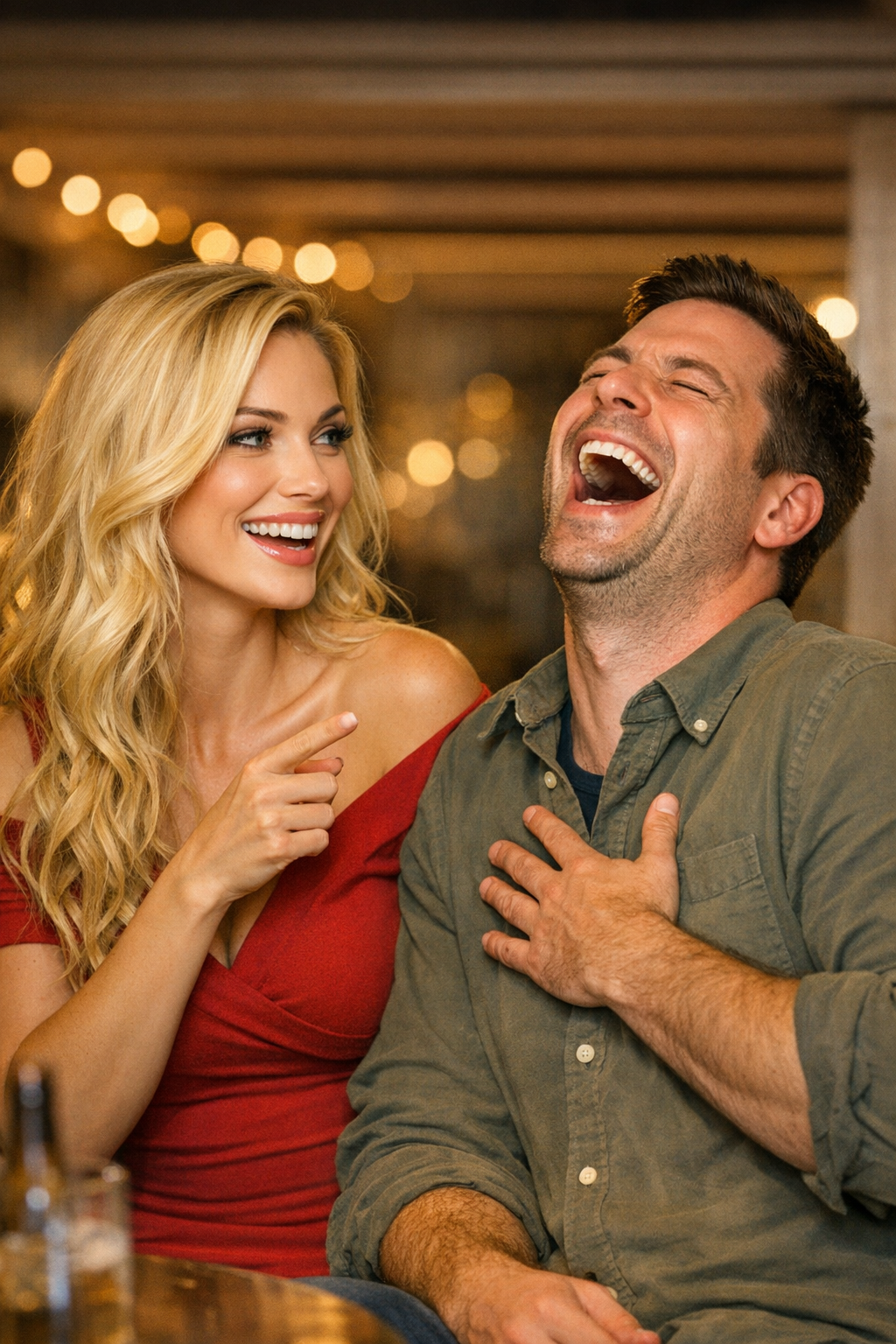
I found this out when an extremely attractive woman named Julie agreed to go out with me. On this date, she informed me that I was “not ugly.” The idea that she and I were operating from opposite poles of the beauty spectrum was obvious to anyone who saw me walking into a restaurant with her. “What is HE doing with HER?” was such an obvious question on the faces of the other patrons in the restaurant that if one of them gave voice to their look, I wouldn’t have been too surprised.

I wasn’t sure whether I should feel more insulted or complimented by those looks, but I really enjoyed playing the “HE” role for the first time in my life. I wanted to be seen with Julie in public more than once, and then I wanted to do some awful things to her in private. After she allowed both without a fight, I let her make condescending assessments of my physical appearance without a fight.

And I don’t think I would’ve been able to do any of that if I didn’t laugh at just about every joke she told. Based on my very brief dating experiences with Julie, my first piece of advice to my not-ugly-guy contingent is if you want to date excessively beautiful women, be funny. If you’re not funny AND you’re not ugly, however, you won’t have a shot in hell dating a woman as beautiful as Julie, and I don’t care what those loser-dates-the-lovely-lady, 90s movies taught us about hope. There is no hope, because the excessively beautiful just have far too many options. They won’t even look in our general vicinity, because they don’t want to get us started.

I wouldn’t have had a shot in hell at dating Julie either if I hadn’t accidentally discovered an end around, loophole, or whatever you want to call it in the not-ugly-and-the-beautiful natural laws of dating: Beautiful women love it when men find them funny.

I know what you’re thinking right here, you’re thinking I faked it to try to seduce her. I had no master plan, and I have no talent for deception, and you can ask anyone who has ever played poker, chess, or any game with me that requires some form of deception. I cannot bluff. I learned at a very young age what a horrible liar I was, and how much I hated getting caught in a lie. I felt so bad about lying that I made the decision that I wouldn’t go through what I assume good liars have to go through to get better at it. Long story short, my laughter was not fake or deceptive. I genuinely considered her funny, but I must admit if a guy, or a not ugly woman, told the exact same jokes Julie did, I would’ve been much more critical. I was so attracted to Julie’s physical appearance that I found her jokes funny. Was I giddy? I think I was as giddy as a schoolgirl who has such a huge crush on a cute boy that she giggles at everything he says. It’s an embarrassing admission, but it worked. 

It worked, because Julie, like everyone else in the world, loves it when someone considers them funny. The one caveat I would tell any man who tries this is that you will have to avoid the temptation of telling your own jokes, and that’s tougher than you think. When the jokes start flying, we get caught up in the moment. We want to add a nugget here and there to the tail end of their joke, or we might be the type who just wants to keep the jokes going, so we add our little bits. Don’t! They don’t like that. They only want us to laugh at their jokes. My little, tiny attempts to add to the levity in room revealed to her that not only was I not ugly, but I was not funny too, which led her to decide that I was not dating material.  

It’s no secret that we all love it when someone considers us funny, but if you’re not ugly, and you have regular interactions with someone who is so far out of your league that you don’t have a chance in hell of being seen in public with her, try laughing as hard as you can at her jokes. It might not work, depending on how far down the not ugly scale you are, but if you’re scraping the bottom of the barrel, what do you have to lose?  

The Not Ugly Limelight

I had a moment in my not-ugly life when I thought I might be attractive. It was a strange, almost inexplicable time that happened when I was barely a teenager, in the seventh grade. Three eighth grade girls and a couple of seventh grade girls expressed interest at the same time. This all too brief window in time made no sense to me, until I later learned that planets transit through zodiac signs to create aspects that affect an individual’s natal chart to trigger, amplify, or challenge energies. When I heard this, I rejected the notion outright, until I remembered this moment in my life. These weren’t the typical girls either, they were the most popular, best looking girls in the two grades. I don’t understand how the movements of celestial bodies could affect what we think, how we act, or how we verify it, but I’ve found no satisfactory explanation this. My guess is that my otherwise excessively pale face probably had some color to it for that brief moment in time, and that combined with the fact that someone convinced me that the center-part of my hair was no longer working for me. Not only did I start parting on the side, but I decided to start feathering my hair. I still don’t know if it was Uranus in retrograde, or my side part, but I do know I didn’t sell my should to the devil to experience what only the beautiful know for an all too brief moment of my life, but having this many females attracted to me at the same time never happened before all that and it hasn’t happened since. 

That’s right, my idea of what it must feel like to be a sex symbol peaked at age thirteen. When I received hints of their attraction, I decided that I was not going to get excited just because some girl just happened to look in my general direction, then at me, then lock eyes with mine, and smile. I simply pretended that it wasn’t happening, because I wasn’t going to allow my overactive imagination to begin interpreting what I thought I was seeing. I also didn’t want my aspirations to meet the tenets of the “The Bigger they are the Harder they fall” analogy. It took more than a couple of instances for me to realize these looks weren’t coincidences, this wasn’t a dream, and I wasn’t imagining it. I was shocked, stunned, overwhelmed, and a little terrified. I didn’t know what was happening, I didn’t know how to act, or if I should do something to end it before they found out I wasn’t who they thought I was. I wanted it to last, of course, but I had no idea how I could make this intoxicating idea that girls, real, live girls were actually interested in me, last. It was the closest I ever came to knowing what a Beatle, Elvis, and Marlon Brando must go through when multiple women are attracted to them, and I did not handle it well.  

I didn’t have to stress about it too long, however, as it ended almost as quickly as it began. Before I could consult with someone, or something, like a TV show, or an astrology reading, most of it was over. I don’t know if the tan faded, the hair wasn’t quite right, or the planets transited across other zodiac signs, but my options were limited to one girl: Rhonda.  

Now, when I say I was only left with Rhonda that might sound like I settled, but Rhonda might have been the best looking girl of the bunch. She was so beautiful that I remember having trouble getting to sleep when I thought of her. I couldn’t believe a beautiful girl found me physically attractive. It eventually became known, through intermediaries, that she wanted my phone number! Holy Larry! I thought this would prove to be an epoch in my timeline, a B.C./A.D. life-altering moment. It might have had a lot to do with my age I was at the time, how impressionable we all are at that age, or a reflection on how boring my life has been since, but the time I spent waiting for that phone call were some of the scariest, most exciting moments of my life.

The phone call obviously went well, as Rhonda and I shared approximately three more phone calls. I never thought this would last forever, but when she passed final judgement on me with a, “You’re boring!” ruling, the click on the other end of the phone reminded me of sound of a gavel pounding. It hurt like the dickens. It taught me that what a woman says about you stings far worse than anything a fella can do to you. The more I thought about it, though, the more I realized that I knew nothing about her, and she knew nothing about me. We absolutely had nothing in common, and therefore nothing to talk about. I should’ve been more interesting, but I was a thirteen-year-old, and my idea interesting subjects involved the NFL, the music of KISS, and Evel Knievel. I wasn’t well versed in topics that females find interesting, and the wife might say that I’m still not great at it. 

In the world of beautiful women, I learned that I was not ugly, not funny, and not very interesting. I was not what they expected, and the one step forward two steps back taught me my station in life, until I met Joel. Joel was a not ugly, not funny, and not very interesting compatriot who moved effortlessly from one table to the other in a singles bar. The women at the first table politely informed him that he was not welcome at their table, and the next one purposefully continued the conversation they were having before he interrupted it. I don’t know what was said at a third table, but when he left the women were laughing, and he was a darker shade of red. Joel came back to us, the fellas, his home base after each rejection, and he chatted with us until he spotted another table of women he found interesting. “How do you do that?” I asked him. “How do you just move to another table after being rejected like that?” Joel responded, but I can’t remember what he said. If he said something profound to sum up a philosophy that motivated him, I would’ve remembered it, but far more important to me was what he did as opposed to what motivated him to do it. My takeaway was, there will be moments in our life when someone will reject us for failing to be who they expect us to be, but we should use it to become who we want to be. How do you use being not ugly, not funny, and not very interesting? That’s up to you to figure out and find out. 

Looking for Emotions in All the Wrong Places


“Looking for love in all the wrong places can be dramatic, exciting, and fun,” nobody said. Nobody says this, but a number of us have a number of ten minutes to midnight relationships, and while some consider come of them exciting and fun, they know they aren’t built to last. The music stops at midnight, as we all know, and the curtain closes on our carefully crafted production. We take our costumes and makeup off and prepare them for the big reveal. 

The fairy tale romance is out there, and we know it. We’ve read about it, we’ve seen it in the movies, on TV, and we’ve heard about in rock and roll songs. We’ve heard about the turmoil and tumult that occurs in some relationships … in country music songs, but who wants to live like that? We shouldn’t have to settle. We might be embarrassed to admit that lust just doesn’t do it for us anymore, and we’re done trying to play a role in Gone with the Wind. We lick our wounds, we help them lick theirs, and we set about building our Frankenstein’s monster. We want someone funny, but not mean; somewhat skinny but not lean; dramatic but not traumatic; and nice but not sappy. We search far and wide, until we find that person who wants to get to know us while quietly watching reruns of the Andy Griffith Show and Three’s Company with us, eating a turkey sandwich and a bag of Lay’s original brand of potato chips.

When those after-the-show conversations casually morph into mundane conversation, we realize that some date-worthy people are normal, and they don’t mind listening to what we have to say. They also appear to be doing so with genuine interest. Our friends might not want to hear about the nights we spend with them, discussing the unheralded comedic genius Don Knotts, and they might even remind us how exciting and sexy our exes were.

We enjoyed those relationships for what they were, but they always find a way to transfer their toxic, emotional baggage to us. They affect and infect everyone in their wake, until the dating pool becomes an emotional, as opposed to physical, manifestation of the Cantina Bar scene in Star Wars. In our search for the perfect mate, we uncovered a precious commodity we never considered before normalcy. We never put the normal bullet point in our search engine, because we spent so much time condemning the normal. “Who wants to be normal? Normal is boring, and my parents were normal, and I’m anything and everything but,” we said various strains of this joke so often that we began to believe it. After all of the whirlwind romances leave us in an undefined state, somewhere near unstable, we begin to prize normal people. We seek someone who can yin our yang that might lead to a stable foundation that we can use to build something year by year, day by day, and hour to hour. We realize that the best romance is a “Little bit country and a little bit rock and roll.”

***

Elijah Wood and Tobie McGuire are two different people. I knew this on some level, but when I searched for a movie I just finished, to recommend it to a friend, I searched for Tobie McGuire. It turned out Elijah Wood read the screenwriter’s lines for the character of that movie. I used to know my cultural touchstones so well. Am I slipping? Who cares? We do. Knowing cultural references is important to us, and in many ways we think it defines our intelligence. As I’ve written elsewhere, in Abraham Lincoln’s day, it was vital to a person’s existence that they know The Bible and Shakespeare so well that you could drop and spot all references; in the 1990’s, it was The Simpsons and Seinfeld; and now with devices and streaming, the cultural touchstones are all over the map. There are still some cultural references everyone must know, however, and if a foreigner wants to assimilate into the American culture, they would do well to learn some of our cultural references. I slipped in one of mine, and I told a friend about this. She said, “That’s great, but I don’t know who either of those people are.” As someone who knows cultural references but doesn’t care too much about them, this placed me at a fork in the road. I used to care a great deal, and I once met a person who was as knowledgeable as I was in cultural references. She even topped me in several areas, a novelty I enjoyed. I had a crush on her, based almost solely on this area of her expertise. Our relationship didn’t last long however as she personified, for me, the idea that when selecting a mate in life, cultural knowledge might be on the tail end of the top 100 most important pieces of the pie in my decision making process.

***

“I’M MAD!” I yelled.

“No one cares!” my dad yelled back. Among the many things my dad taught me, one of the primary ones that stuck is no one cares when we’re mad. No one cares when we’re happy, no one cares when we’re sad, and no one cares when we’re mad. “If you choose to sit in the corner with a mad face on, that’s fine, but remember that’s your choice,” he said.

It was all quite frustrating at the time, but I now think my dad was probably, accidentally or incidentally, onto something. I now add to my dad’s emotionally callous response, “While you’re over there, in the corner, remember that it’s up to you to teach the world how they can help you avoid such messy displays of emotion. If you’re so mad that you’re now ready to tip the apple cart, ask yourself why you didn’t do, or say, something sooner. If you’re raging mad now, chances are you’re probably mad at yourself for your inability to do, or say, something sooner, when this was nothing more than a simple disagreement. We were all rational back then, and we probably would’ve listened to your solutions. Shoot that stuff at the source, and you might not ever have to be so mad again. If you’re mad at something someone said, or did, it’s your job to tell them about it.”

“But, they won’t listen to me,” the collective ‘we’ respond.

“Yeah, you’re probably going to have to do it a lot, and you might have to do it so often that it could lead to some form of confrontation or some sort of altercation, but if you don’t, you’re going to end up like Michael.”

Some twenty years prior to the day I met Michael, bullies were laying into him. The bullies were so relentless that whatever they did to Michael affected him twenty years later, when he told his story to a group of people who never met him before. These bullies picked on Michael so often, in his high school years, that he sought the assistance from an authority figure. That authority figure offered some advice that few authority figures would today. “Pick out the toughest one of the bunch and punch him in the mouth as hard as you can,” the priest, in charge of discipline at the high school we went to in different years, said. “He’s going to punch you back, and you’ll probably get beat up, but they will all leave you alone from that point on.”

“What did you do?” I asked after a pregnant pause.

“I didn’t do anything,” Michael said. “I couldn’t believe that a priest was telling me to punch someone.”

That was the end of Michael’s story as far as Michael was concerned. For those of us who never met Michael before, it was only the beginning of our understanding of him. If Michael found a forceful way to rebuke those bullies, his life from that day forward might be different. If Michael reached a point of desperation that required him to punch the biggest bully of the bunch, and he did it, he was probably a different man from the one we met that day. As the priest said, the big bully would’ve punched him back, and it would’ve hurt. Worst-case scenario, Michael ends up in a hospital, but most bullies simply punch back one time and leave their victim on the floor. Worst-case scenario, Michael ends up in the hospital, and he has to get his jaw wired shut, but Michael walks out of that emergency room a man who believes he knows how to handle his own situations. He doesn’t have to rely on the relative ineptitude of authority figures. He can handle himself, and he’s his own man, as opposed to the man we knew some twenty years who stepped away from his fork in the road.

As the years rolled along, in our working relationship, we learned that Michael was a seething ball of hatred. He hated certain people, until they came around. He said the meanest, most awful things about them, but when they stepped near him, he didn’t know how to express himself. Most of us have issues with confrontation, but most of us find a healthy, non-confrontational way of voicing our concerns. Michael didn’t even have that, and when I witnessed it firsthand, I wondered how different he might be if he followed that priest’s advice. It’s possible that Michael’s meek nature was a result of so many instances that one such instance wouldn’t make a dent in his approach, but it might have started the ball rolling.

It’s our job in life to teach others how to treat us. We might have to do it so often that they mock us for repeating ourselves, but we can add, “If you knew how I wanted to be treated, and you did it anyway, why do you continue to do it? What did you hope to gain?” We might have to repeat ourselves with such force that it results in what everyone fears most a punch in the mouth, but what’s the alternative? Where our we now? We’re so mad now that they’re under our skin. If people treat us poorly, we should recognize that as our inability to instruct them properly. Telling everyone that we’re mad, or giving them the silent treatment, is a complete waste of everyone’s time, including ours.” 

We didn’t enter into this argument with Michael. We simply felt sorry for him, but what if we had? We can imagine that Michael would’ve been able to counterpoint our every point. We would’ve argued, and he had twenty years of justifications for his actions. At what point in an argument, do we realize we’re doing more harm than good? At what point do we reach a zero point? We argue because we want everyone to know how smart we are. We argue because we want to persuade others to our point of view. We also argue to save our friends from themselves. At what point, do we realize the other party disagrees with us so much that no matter what we say, we’re never going to persuade them to our point of view? At what point do we realize there’s no point in continuing? Even when they’re demonstrably wrong, it makes no sense to continue the argument, as we can see that they’re not going to change their mind. We can also see that we’re insulting them at some point, and we might be damaging whatever relationship we have with them. As much as it pains us, we realize that some of the times it’s just better, less frustrating, and less maddening, to walk away.

When a Kiss is Just a Kiss


“Why do people kiss?” my nephew asked his dad when he was younger.

My brother called his wife into the room. “I think this question is more in your level of expertise.”

“Because that’s their way of saying I love you,” his mother answered.

“Why don’t they just say it then?” he asked.  “Why do they have to kiss?”

Questions like these have been asked by curious adolescents of giggling parents for as long as children and parents have been interacting. The reason that we parents might experience some hesitation when trying to answer questions like these is that it’s been so long since we didn’t know the answer that we don’t know how to answer the question. We’ve also taken things like kissing for granted for so long, and that it’s been such a staple in the process for so long, that we stepped back to ask “Why?” for a long time.

Puddy and Elaine

Most parents probably dismiss the peck as the source of their child’s inquiry, and focus their search for an answer on the saliva sharing smooch. Most of us probably assume that our child has already accepted the “Hello” and “Goodbye” peck as a fundamental part of the process of greeting and parting with our loved ones, and that the nature of the child’s curiosity regards why a man would want to trade saliva with a woman, in a city park, to express love, and why the two of them would enjoy that elongated transfer of fluids so much that they would want to do it more often?

“One hypothesis,” posed by Noam Shpancer, of Psychology Today, “is that (the sloppy smooch) might be a mechanism for gathering information about a potential partner. A kiss brings you in close –close enough to smell and taste [the] chemicals that carry immunological information. Our saliva carries hormonal messages: Close contact with a person’s breath, lips, and teeth informs us about his or her health and hygiene– and thus potential as a mate. Research also suggests a range of other functions, such as expressing and reinforcing feelings of trust and intimacy and facilitating sexual intercourse. The meaning of a kiss depends on who’s doing the kissing.”

My sister-in-law started out saying, “A kiss is a way two people express love.” 

“Why don’t they just say it then?” my nephew repeated. The two of them went back and forth for a bit, as his mother offered what he considered subpar answers, and he pressed her further. She would later confess that when he hit her with this question, it was so out-of-the-blue that she needed some time to think. 

“A woman learns a lot from a kiss,” she said. “A quality kiss shows a woman that you’re paying attention and that your affection for her is real. If it’s not she’ll know. Some of the times a kiss is just a kiss, but some of the times it means something, and a woman will know the difference.”

My nephew was not of the age to understand the term “end game”, but I’m guessing that that was the crux of his follow up question, “Why don’t they just say it then? Why do they have to kiss?” Why doesn’t a guy just walk up to the woman in the park and say, “I love you,” and walk away when he’s determined that she knows he’s being genuine?

I’m sure that his mother would then say something along the lines of, “Because saying ‘I love you’ can be easily faked, and a girl needs to know that you love her, and physically showing her, with a meaningful kiss, proves it to her. A woman can feel your intentions.” This basically goes to the chemistry, and the Chemistry that Shpancer described, in a woman knowing and knowing in her conscious and subconscious determinations, but that would’ve been way over my nephew’s head, and it would’ve only led to more questions about the abstracts of need, emotion, and fulfillment that he was too young to understand.

My nephew is male, of course, and reading the Psychology Today findings in the Evolutionary Psychology piece, he might never understand when a kiss is just a kiss on the level that those of the female gender do. For to a male, a kiss is rarely as important as it is to a female. If he thinks he’s going to provide an answer, he will pursue it. He will want to kiss a girl his age, and he will be confused when it’s over and it doesn’t achieve clarity for her, but he will continue to kiss girls, because he knows it means something to them. When he has ulterior motives, he might try to add bits of information to a kiss, but if his recipient has as much omniscience as his mom and Noam Shpancer theorize, the recipient will know when such additions are false. When he genuinely likes a girl, and those additional ingredients he adds are more organic, he might wonder what the difference was. My advice, if my nephew ever asks me for advice, is do not think, just do. As Olivia Newton-John sang in Grease, “Feel your way.”

In their findings, the Evolutionary Psychology poll states that 86% of women polled would not have sex with someone without kissing them first; while only 47% of males say they would not. Their takeaway was that:

“For women, the smell and taste of their kissing partner weighs heavily in their decision to pursue closer contact. Men routinely expect that kissing will lead to intercourse and tend to characterize “a good kiss” as one leading to sex.”

The next poll probably gets to the heart of my nephew’s follow up question better, as it asks the genders how important kissing is. In a 2013 poll listed in the Archives of Sexual Behavior, there is the suggestion that kissing may never be as important to my nephew as the girls he’s kissing, as men rank the importance of kissing as a 3.8, on a scale of one to five, while women rank it as a 4.2. Their takeaway was that:

“Women rank kissing as more important in all kinds of romantic relationships than men do; men also tend to consider it less important as relationships go on.”

***

The perfect illustration of the minutiae involved in a kiss comes from (where else?) the television sitcom Seinfeld. In an episode entitled The Face Painter, the character David Puddy informs the character Elaine Benes, that he will no longer “Support the team” by painting his face before the two of them attend a hockey match, because Elaine it embarrasses her when he does it. She is visibly touched by the idea that Puddy would alter his life in such a manner just for her, and to celebrate this new understanding in their relationship Puddy says:

“Ah, c’mere,” as he nears her for a kiss. “All right,” he says when that celebratory kiss is concluded, and he’s up and moving towards the door, “I gotta go home and get changed before the game. I’ll be back, we’ll make out.”

This scene is brilliant on so many comedic levels, not the least of which is the depiction of the value each gender places on kissing. Puddy acknowledges that some sort of romantic punctuation is needed for the agreement they’ve reached, and he basically says, “All right. Here!” to initiate that kiss. The comedic value of the situation occurs when this romantic punctuation concludes, and Puddy simply says “All right” as if to say ‘now that that’s over, I need to get some other things done.’ The very human element of “Enjoying that transfer of fluids so much that he wants to do more often” is then dispelled by Puddy saying once he’s done doing those other things (changing clothes), they can start doing something else (making out). He thereby places the value of making a seemingly transformative change of his life (no more face painting) on a level with the act of changing his clothes, and the excessive kissing involved in making out. This is all punctuated with Puddy unceremoniously suggesting that he’ll do what she wants when he’s done, but that he’s only doing it for her.

The subtext of this exchange surprises the once visibly touched Elaine for she thought she had a read on the situation. “You’d do that for me?” she asked when Puddy announced that he would no longer be painting his face. She believed they achieved a new understanding in their relationship, and she was so touched that he would make such a transformation that before he announced his plans after the celebratory kiss, she was breathlessly holding her hand to her heart. She also appeared on the verge of tears believing that her otherwise unsentimental boyfriend would be making such a life-altering sacrifice for her by sealing it with a kiss. She appeared to believe that this sacrifice, and that kiss, suggested a brighter future, and a better understanding, between the two of them as a couple. When Puddy stands and says what he says, it dispels all of the conclusions Elaine derived from the situation, and the idea that a “woman always knows”. And her only takeaway, as the scene closes, could be that Puddy, like most stereotypical jarheads, will go through the motions to please a woman, but it actually means little-to-nothing to them.

Most boys spend their adolescence believing that their mother knows all, until they find out she doesn’t, but they continue to do the things necessary to please her, and fortify this shared illusion, until most boys become better men for it. Some boys put their heart into it, and live their lives, and kiss their girlfriends with the belief that their mothers know all, and how they treat their mother will be an indicator for how they will go on to treat all women. Others, like the fictional character Puddy, go through the motions to make the women in their lives happy, but to them a kiss is much lower than a 3.8 on a scale of one to five.

After telling me this story, my sister-in-law asked me if I wanted to take a crack at answering my nephew’s questions, and I informed her that it’s probably better that I don’t. It’s probably better that he run the optimistic and loving road her answers put him on. He’ll likely become a better man by trying to prove to all the women in his life that he can be meaningful and moving when he wants to be, and when that time comes for him to plant that profoundly spiritual kiss on that one, special woman, he’ll do it with the belief that he can make her believe it too. And, he’ll hopefully get all that done before he falls prey to the cynical notion that some of the times a kiss is just a kiss to get women to shut up about wanting to kiss all the time.