Enjoying Other People’s Pain


Tedious. The guy is tedious. He doesn’t even know it. He thinks he’s hilarious. He thinks this is his big moment. He probably thinks this moment on stage is the big break he’s been waiting for his whole life. Shouldn’t we always think that? Yes, but he thinks this is a stepping stone to a bigger, better life. Someone probably told him he was funny. Was it his Aunt Clara, or his dad? Who told this guy he was so funny that he should step on a stage and try to make a career out of it? I’m not funny, so I’m probably not the best critic, but I know what I think is funny and this ain’t it. I know the plight of the unfunny, but this guy? The idea that this guy has a bright, gleaming smile on his face makes it obvious that he thinks this is his moment in the Sun. He thinks he’s doing it. He thinks this might be the best day of his life. “Except for the birth of my children,” he might add, “and the day I bought Herschel the Turtle at a pet store, and the day I met my wife.” He’d probably qualify that best-day-of-my-life assessment, so no one calls him out on it, but he’d probably say it was top-5 … if someone stopped him right there in the first quarter of his standup routine.   
How many people can do this? I wonder, while trying to drum up some respect for this guy. What percentage of the population can stand up on a stage and try to make complete strangers laugh? I respect anyone who can do what I never could. He told us he traveled twelve hours to be here tonight. He traveled half-a-day to try to make a roomful of strangers laugh. That’s a level of commitment that most people don’t have. It’s one thing to try to make a table of four laugh, but a comedy club requires its patrons to pay a two-drink minimum to enter. How many people could stand up to try to make a roomful of demanding, paying customers laugh? I mentally applaud this guy for doing what he’s doing, but I can’t get past the fact that he’s just not funny.  

The audience is receptive at first. At first, they’re laughing at everything he says. Why are they laughing? My bet is they’re aching for comedy. It’s why they’re here. Most of them probably bought their tickets weeks in advance, and they looked forward to it all week. They convinced their girlfriend, wife, brother, or friend that this would be an excellent idea for a Friday night. They bought the tickets for the headliner, but they’re more than willing to give this guy the benefit of the doubt, if he’s halfway decent. What if he did something edgy? What if his act involved nothing more than eating a bowl of Count Chokula? What if he performed a dramatic reading of Dr. Seuss’ ABC book or The Great Gatsby? Would they still be laughing? To us, he has a certain position of authority on humor, because he’s up there, and we’re not. We assume he’s played a number of cities before ours. We assume that he’s up there, because other people more knowledgeable than us put him up there, and he’s been thoroughly vetted. He’s doing something none of us could do sober, so we defer to his experience. Is that why they’re laughing, because I find this guy typical and tedious. 

I was so immersed in these thoughts that I missed the audience turn. The laughter went from a throng to sparse. What are you laughing at? I thought to those few still laughing, this guy’s not funny. While I searched for the laughers, I failed to notice that they were some of the few who were still laughing, until they stopped too.  

The standup comedian was baking under an uncomfortably bright spotlight when that silence took hold. The silence was deafening and a little claustrophobic. Prior to the turn, he informed us that he traveled half a day for the chance to make us laugh, and he added some typical, tedious notes to that, and everyone laughed. That was his attempt to build familiarity with the audience, and to infect them with the laughing bug so they might follow him into the unfamiliar. They didn’t. 

In the now deafening silence, I thought about that twelve-hour drive, and how it must’ve been filled with such excitement. I figured he must have quickly clicked his cruise control in, because he knew his excitement would cause him to violate speed limits. He probably thought his appearance in our small city would kickstart his dream of being a standup comedian. I wonder if that trip involved any concerns about about how quickly the best day in your life can turn into your worst. Twelve hours is a long time to spend in a car, alone, with nothing but your thoughts, your excitement and your worst fears.

He resembles Weird Al without the looks. I see myself in this man. I see his observations. I know where they’re headed, but they don’t quite get there. There’s something wrong with his delivery, and his material. Members of the audience are now cringing at one another. They’re as uncomfortable as he is, I think. I chuckle. He drops another tedious joke, and I laugh harder. His material hasn’t changed, but his delivery has. He’s in pain now, and I’m close to guffawing. 

He had a few self-deprecating jokes that hit home in the beginning. He opened with a few jokes about being unattractive and overweight. He joked about how grateful he was that a woman decided to become the wife of an overweight, unattractive man. They laughed. Little by little, joke by joke, silence began to rear its ugly head, until it became obvious the poor man was baking under the spotlight. I was one of the few not laughing in the beginning. Now I’m the only one who is. Various members of the audience began twisting around in their seats to see who is laughing.  

I laughed because I saw him sweating. I laughed because I saw him trying so hard that he was trying too hard. I laughed because he was drowning, and he was not doing some kind of meta routine on failure. I laughed, because I realized I knew we were watching a man’s dreams come crashing down around him. I laughed because I knew I was witnessing one of the best days of his life turn into his worst nightmare. It was fascinating to watch. It was captivating.

“What’s the opposite of empathy and sympathy?” I asked a friend, in a discussion involving this peculiar morbid curiosity we have for enjoying other people’s pain. When he didn’t answer straight away, I added, “Sociopathic, psychopathic? Is it narcissism? Whatever it is, I have it.”    

“It’s evil!” he said. “We’re not evil, but we have a little spot of evil in our hearts. You know how some people say they have a soft spot in their hearts for something about a person, place, or thing? Yeah, we have a hard spot in our hearts.”

That was such an insightful comment that I couldn’t help but think he put a lot of thought into it, but was it true? Kind-hearted, sympathetic and empathetic men do not enjoy watching another man squirm in pain. I don’t rubberneck on the interstate, hoping to see some guy screaming on a stretcher, and I don’t enjoy seeing other people cry, but I love watching the worst part of an otherwise healthy, normal man’s worst day. What’s wrong with me? Have I been conditioned by the comedians who almost appear to enjoy bombing? Andy Kaufman, David Letterman, and Norm MacDonald turned bombing into an art form. They almost appeared to get off on it. MacDonald said he didn’t care if an audience laughed or not, as long as it was a good joke. That was his charm. Chris Elliott personalized the Kaufman/Letterman element and created a career out of it, based on the idea that no one would purposely subject themselves to the level of self-deprecation and debasement he did that would result in ridicule and embarrassment. Did they plant seeds in my brain that anything embarrassing, uncomfortable, or cringeworthy is some form of lowbrow entertainment that is so low that it’s considered high art? I didn’t get that, until I did. Once it clicked that it’s schtick, it stuck. Once I got it, I couldn’t wait to proclaim to the world that I got it. I understood it, until I understood it to the point that I now consider it hilarious to watch another man squirm under the bright spotlight of a small city’s comedy club. 

It’s not schtick for this man however. He worked hard on this material. We can feel it in his transitions that this isn’t some form of meta material with highbrow commentary on the plight of man. We can hear him nix some material, lose his place, and worry that he frontloaded all of his best material. We can hear him worry about his performance while he’s talking. He’s lost faith in his material, in himself, and his ability to turn this around. I laugh harder. I have the giggles. I can’t stop. People are staring. The other comedians in the comedy club are giving me looks. I compose myself, until I analyze the comedian’s face deeper. His pain is so obvious that I imagine this is what it might look like if I could see the expression of someone who just jumped off a building. I have the giggles again, but I’m controlling it better this time. 

Mercifully, the comedian’s act ends. The crowd applauds politely, and the comedian surprises me by mouthing, “Thank you!” to me. I didn’t know it at the time, but my friends later tell me that he began directing his jokes at me toward the tail end of his act. I saw him looking at me, but I didn’t think he was looking at me. They said he was. He, presumably, thought I was the only audience member who got it. I felt bad, because I wasn’t laughing with him. I was laughing at him.  

One excuse I could use to explain my behavior is that I find the unfunny hilarious. Perhaps I relate to this comedian, because I’ve been told that I have a decent pitch, and I know my beats, but my punchlines are so confusing that they’re not funny. Perhaps my laughter had something to do with the idea that I don’t enjoy traditional humor. I’ve watched too many comedies, sitcoms, and radio shows to appreciate what we call a traditional humor.   

It’s Letterman’s fault. He started it all for me. Letterman turned squirming into an art form. Letterman left us wondering how we could help him, and he answered by saying there’s no help for me. It made us so uncomfortable it was almost painful and hilarious to watch. It’s the joy of witnessing other people’s pain (OPP), and it’s David Letterman’s fault. I’d love to say that I believe that. I’d love to say that watching him on NBC for all those years had such a profound effect on me that I’m now conditioned to find OPP hilarious. How many years did he cringe with us in uncomfortable pain? I’d love to say it’s all his fault, but my enjoyment of OPP predates him.

***

In grade school, I just happened to have the perfect angle to catch Andy Parizek’s impact face, when he walked into a light pole. Some deep, dark part of me found his expression of pain so precious that I watched it over and over on an internal loop I developed in my brain. I wished I had some ability to draw, so I could create some product to memorialize this moment. Andy Parizek wore glasses, and the impact was so perfect that it broke his glasses in a clean break right down the middle. The pain was followed by a brief period of silence in which the good people around him tried not to laugh and further his pain. When those good people then moved in to comfort him, I tried to run away to a dark corner of the playground to laugh, but I didn’t quite make it. 

“How come when we get hurt, it’s so funny to you,” Mike Amick said, “but when you get hurt, we’re supposed to take it serious?” 

Is it evil to enjoy watching other people get hurt? Do we have a hard spot on our hearts for certain moments? We’re not evil, but is there something wrong with us if we enjoy it when another person cries during an argument? Is there a hard spot on the heart of someone who enjoys watching another’s dreams come crashing down around them? The fact that a grade school child’s assessment stays with me to this day should suggest that I’m still struggling with it.

When we discuss such things, some of us exaggerate the levels of pain involved. The incidents we’re talking about here are skinned knees, the guy who walked into a pole and broke his glasses in half, and a comedian who wasn’t able to make strangers laugh. Most of us have never seen anyone get truly hurt, and if we did, we probably wouldn’t laugh. Yet, it is a little deranged and morbid to enjoy watching another experience minor pain, regardless if that victim eventually finds a way to laugh about it. 

I’m a grown man now who manages to display kindness in the face of tragedy. When someone dies, I join the good people who express compassion, and sympathy. If I ever saw someone truly get hurt, I don’t think I would find their excruciating pain enjoyable. I know all kinds of physical and emotional pain intimately now, and I empathize when anyone endures minor physical pain, but after I tend to their wounds and make sure their okay, I still rush to that dark corner of the room to laugh my tail off.

Conducting corporate meetings is not in the same league with standing on stage before paying customers, but they gave me a taste of what this comedian was going through. When you’re conducting a board meeting, your material sucks, but it’s important that the employees know the material. It doesn’t matter that the employees know that they’ll be caught with their pants down when the situation in which this material arises, they’re so bored they can’t take it anymore. I’ve been on both sides of corporate board meetings, and I know one in one hundred are in some way interesting. In the hundreds of board meetings I conducted, I thought I had an interesting one once. It was a special subject I knew inside and out, I got a great night sleep the night before, and I think I ate something healthy. I was on, and I knew it. I dropped two or three jokes that I thought were pertinent, and I looked out in the audience to gauge their reaction. Two people were asleep, and the rest of the eyes in the room were glossed over. I had a small taste for what this comedian was going through, but that didn’t make it any less funny to watch him squirm and implode.

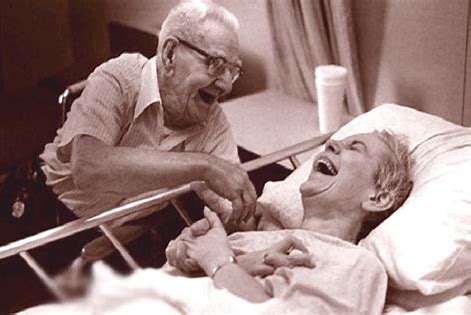
Anyone who laughs at other people’s pain knows they’re going to get theirs, eventually. We’ve all experienced some levels of karma, but we know that ain’t it. There’s more to come. We know it’s going to get us, and it’s going to hurt. We know there will come a day when we’re old and decrepit, struggling to breathe one last breath, and someone will find that struggle hilarious. We’ll probably yell something like, “What are you laughing at? I’m dying here!” in the heat of the moment. When our emotional hysteria subsides, and we don’t have the strength to fight death anymore, we’ll either acknowledge that we deserve it after laughing at so many others during the worst days of their life, or we’ll find humor in it too.  

The Voluntary Visit to the Dentist


“As nice as you are, I’ve come to realize that you are not my friend,” I informed Ms. Mary, my dental hygienist, after she provided a deep cleaning procedure that involved the sights and sounds of my worst nightmares.

Ms. Mary is an extremely pleasant woman. Some might even go so far to say that with her disposition, she’s the perfect hire for such a position, and she has a voice that would sound perfect for audiobook versions of children’s books. She may have missed her calling, we think as we listen to her. She also has an unusually melodic laugh that makes us smile regardless how much trepidation and fear we feel sitting in her chair.

In a place many of us consider one of the scariest places on Earth, Ms. Mary’s bedside manner (or in this case chair side) puts us completely at ease. She is, indeed, the perfect hire. At some point, however, and we both know that this moment is inevitable, Ms. Mary will twist to the left to get down to business, and her business is not kind, sweet, or endearing. Her business involves something called a Sickle probe, a Scaler, and the most feared dental tools of all, the drill, a dental air drill to be precise. She doesn’t cackle when she picks it up, and no one cues up harrowing music to inform us that the setting is changing. She just quietly turns to gather her tools, while we’re answering one of her polite, sweet questions about our lives, and she returns to start the process

Some of Ms. Mary’s tools make the most awful sounds, and some of the others chip away at the plaque and other buildup her patients have so recklessly acquired over the years. They’re all painful. At some point in the process, we inform Ms. Mary that we obviously don’t have enough painkiller, and at another point in the process we know there never will be enough. Ms. Mary appears to do her best to accommodate us, but we know, somewhere deep in our heart, Ms. Mary is an awful person who enjoys this. 

When I tried to assure Ms. Mary that I was just joking when I said ‘you are not my friend,’ she said, “Oh, don’t worry about that. I love my job.” That convinced me that she knew I was joking, but it also led me to wonder if she might be something of a psychopath. She loves doing this to me? She loves doing this to kind, well-meaning people like me so much that she’s been doing it for over ten years? Ms. Mary has such a beautiful portrait of her family up in the corner of her cubicle, and as I said earlier she is so pleasant and seemingly well-centered, and happy that I’m sure I’ll feel different about her tomorrow, so I have to write this today.

I know this is Ms. Mary’s job, and I know someone has to do it, and I know that neglectful clients are almost required to find someone to do this, but I can’t help but suspect that if Ms. Mary enjoys doing such awful things to otherwise pleasant individuals like me, who never do anything to harm anyone, she might have some psychopathic tendencies. If as Diffen.com says, “[Psychopaths] can pretend to be charming and loving, so those around them can’t always detect their lack of empathy,” I suspect Ms. Mary might have some tendencies that remind us of psychopaths. Before we dismiss this idea entirely, I think we should look up the job history of some of our country’s worst psychopathic serial killers to see if we can find some corollaries. My bet is we find one who says:

“I was a dental hygienist for a couple years, and I found it absolutely thrilling, but I realized I needed to inflict more pain after a while. There was a reason that I was attracted to the profession in the first place though.”

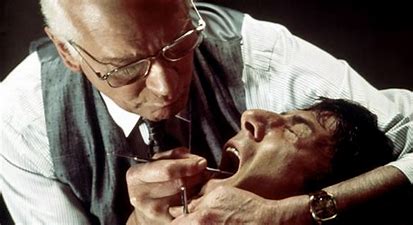
No one portrayed the sadistic tendencies of a dentist better than Laurence Olivier in the movie Marathon Man. There was one relatively horrific scene, in this otherwise boring movie, in which Olivier threatens to pull a healthy tooth from his patient without painkillers, unless the patient gives him the information he needs. The reason I consider the horror in this scene relative is that when I’m nowhere near a dentist’s chair, I don’t understand why anyone would consider having a healthy tooth pulled without painkillers so frightening that they would give up state secrets. When Ms. Mary and the dentist liberated me from their office, after about an hour of a level of torture all clients know, however, I recall that movie scene with a shudder.

The scene we’re starring in involves us lying supine, mouth open, and vulnerable to whatever they have planned. In the moment, I know I would’ve talked if Laurence Olivier prodded some sensitive nerves, telling me, “You need to take better care of your teeth.” If he hit those sensitive nerves with the high-pitched sounds of his drill, and I had no painkillers, I suspect I might give up every state secret I know.

Some talk about the high-pitched sounds of a drill with abject horror. This conversation is so common and the need to address the fear is so prevalent that most dentist office’s now provide their clients headphones to drown that sound out. Clients and prospective clients also talk about how much they hate the pain involved, so they take all of the painkillers the dentist has to offer, plus the nitrous oxide. Some potential clients seek dentists who have all of painkillers the state will allow, including putting them to sleep.

Prior to this particular dentist office visit, I informed everyone I knew that I turned down all but the basic painkiller, because I wanted the dentists and their assistants to hurry up and finish whatever procedures they proscribe for the horrors going on in my mouth. A younger, braver me opted to endure the pain to expedite the process. I did not want to wait for the nitrous to take hold. I just wanted them to start, so they could end sooner. Something changed over the years. I don’t know if I psyched myself into a frenzy or what, but when they started drilling, I raised a hand and asked for more painkiller and more time for the nitrous to take hold. I took all the painkillers they had at their disposal this time and the headphones.

***

I’ve heard about the Stockholm syndrome in which the captive begins to develop unusual feelings of trust and affection for their captors. Some of the captives, used in various case examples, develop an emotional attachment to the captors who torture them, and they do so because they become reliant on their captors for survival. At some point in the torture, they slip from being a hostile captive to a cooperative one, and finally to one who unwittingly begins to side with their captors’ cause. Everyone develops coping mechanisms for stressful moments, and while we understand that sitting in a dentists’ chair is not in the same league with all of the various forms of torture known to man, it does give those of us who know nothing of real torture some insight into what we might do when our captors know the right nerves to hit to get us to talk. 

My coping mechanism for dealing with this relatively, low-level stress was writing the article you’re reading right now. I wrote most of this article, in my mind, while Ms. Mary chipped away at my plaque, and I completed it when the dentist finished me off. When Ms. Mary tapped a sensitive nerve, I laughed. I did not laugh because I’m impervious to pain. I laughed because I thought of a great line I wanted to add right here … but I forgot it. Did I forget it, because our mind sweeps out negative memories to keep us happy? Some students of the mind suggest that the mind distills bad memories from our thoughts to keep us happy, in a manner similar to the liver distilling unhealthy products from our body to keep us healthy. I thought not, because the session wasn’t that horrific. I blame it on the drugs Ms. Mary induced. Whatever the case was, I remembered thinking that it was such a great line that I should hurry up and write it down before I forgot it, as I knew that it would get lost in the ether, or to the ether, and I probably should hurry up and write it down. I didn’t write it down, or even say it to Ms. Mary to make it more memorable, because as much as I live for great sentences, I didn’t want to prolong the process for even a minute more.    

I experienced a small window into how I might fare under torture when Ms. Mary drilled into a nerve that was not sufficiently dulled with painkillers. She responded in the manner I hoped she would, but I couldn’t help but think of what I might do if my captors not only didn’t stop when they hit that nerve, but they continued to explore the extent of my pain to get me to do whatever they wanted. We all love to think that we’re the heroic captive type who would never talk, but receiving a drill to a tender, exposed nerve reminds us why we revere those who endured what we cannot even imagine. I thought about how much I might hate the people doing this to me while they were at it, and I thought about how glorious it would be for me when they decided to stop. 

When the dentist finally decided I had enough, I appreciated his mercy so much that I felt grateful. It’s over, I survived, and I appreciated his contributions to my survival. The Stockholm syndrome suggests that the captive might appreciate their captors’ mercy for stopping. Those who study this effect say it doesn’t always happen to captives, but it has obviously happened so often that we’ve developed a term for it. For those who want to understand how this anomaly might happen, try going ten years between dentist visits. When the scraping, grinding, and drilling finding ends, it feels like they’re acting in a merciful, kind, and sympathetic manner, and the euphoria you feel might lead you to inexplicable feelings of affection that you don’t have for people who have never drilled anything into your face for a couple hours.

***

The thing about going to the dentist is it’s voluntary. We don’t have to go. If we want to keep our teeth, and keep them in such good shape that they might last for most of our lives, we must visit the dentist biannually. Some even suggest that a deterioration of our oral hygiene can lead to a decline in our overall health, but  it’s still voluntary. When we don’t visit the dentist’s office regularly, no one will think less of us, because no one will ever know. They might see the degradation of our teeth over time, but few will suspect that it has anything to do with the fact that we haven’t visited a dentist’s office in a while. They just cringe when we smile, and they think less of us, but they likely won’t make the connection. 

My dad had a miracle cure for bad teeth, milk. He thought the calcium in milk helped preserved his teeth so well that he didn’t have to brush, and he would never have to go to a dentist’s office, and he didn’t for most of his life. He thought milk, and the calcium therein, were the miracle cures to maintaining oral health to the point of having his natural teeth into old age. A high school friend of mine never brushed his teeth either, and he never visited the dentist’s office. His miracle cure was Listerine. Both men found the error of their ways during “the most painful experience I’ve ever had” when they eventually found their teeth so painful that a visit to the dentist proved to be the lesser of two evils. 

If they hadn’t volunteered this information, we would’ve never known, because no one lauds a person for responsibly visiting a dentist biannually, and no one talks about a person who doesn’t. “There goes Stewart, he hasn’t visited a dentist’s office in ten years.” I’ve never heard anyone say this, or anything else, about a person regarding the regularity of their dentist visits. There’s no peer pressure, parental pressure, or any other form of pressure, other than internal, to routinely address what could be a problem if we don’t.

“It’s voluntary? You mean I don’t have to subject myself to pain if I don’t want to do so? I have to be self-motivated to subject myself to the pain involved? Even those who regularly visit the dentist responsibly experience some pain in every visit? Who, in their right mind, would do this on a biannual basis?”

“The longer you wait the more painful it will be,” they caution.

“So, the only motivation to endure regular, painful visits, is to stave off the prospect of more pain?”

Most of the rewards for enduring everything Ms. Mary has at her disposal on a biannual basis, to maintain a healthy mouth, are long-term. If we maintain that biannual schedule, it’s possible that we might never experience a toothache, if we proactively follow their prescriptions for greater oral health on a daily basis. Yet, if we never have a toothache, how much do we appreciate it? If there are so few tangible, short-term rewards, what are the long term ones? Well, if we’re lucky enough to live into the 70s, 80s, and beyond, we might be able to luxuriate in the idea that we’re one of the few in the retirement community who still has most, if not all, of our natural teeth, but we’ll have to wait decades to lord that over our peers. When we finally arrive at that glorious day, how will they react? What will be our lifelong reward for having the various dentists and their Ms Marys drilling into our face for an hour, two times a year, for decades? If we’re lucky enough to live that long, we might one day receive nothing more than an unceremonious shrug from that guy who is now forced to wear dentures.

Sprinting & Age


Yesterday, I realized we’re all sprinting to old age. Today, I realized that those lucky enough to make it to old age should probably refrain from sprinting. The aging process is a relative progression, as we’ve all met young sixty-year-olds and old forty-year-olds, but no matter how old we are, we occasionally receive reminders that we’re aging. The aging process rarely hits us in an “Oh, my God I’m (fill in the age here)!” one day in the mirror. Aging is often more of a gradual process that hits us in tiny, little, and seemingly insignificant hits, every day.

We fell on a Tuesday doing something we’ve done our whole lives. We tripped trying to skip a stair on a Wednesday, and we’ve skipped a stair since our legs grew long enough to do so. (Mental note, skipping stairs may no longer be in our repertoire.) On Thursday, we caught ourselves making old man sounds when we sat, but we can’t even remember when we started doing that. We admired a beautiful person on Friday, and someone informed us that we’re probably too old to continue doing that. “It’s just odd,” they said, “considering the age gap.” Someone considered it inappropriate on Saturday, and on Sunday someone found it “Absolutely disgusting” that we should admire the beauty of a 20-year-old. “Because you’re old enough to be her grandpa!” they say. The progression didn’t occur that quickly, within one week, but on some days it seems like it does.  

We all know we’re aging on a physical, superficial level, but mentally we’re not so far removed from that energetic, wildly enthusiastic 20-year-old who was afraid to talk to girls. When they add, “And you should know better than to stare at a 20-year-old woman,” we realize how far removed we now are. We do “know better” on one level, we know how old we are, but their scorn is a painful reminder of how much we’ve aged. We do the calculations in our head, and we realize they’re right. We are, in fact, that old now. The realizations that we’re that old now are not about any of one of the matters listed here. It’s about all of them. It’s about that big old snowball that’s been accumulating over the years without notice.

***

“You know you’re old when you fall and no one laughs,” a comedian once said. You know you’re old when they surround you after a fall, and they’re not there to point and laugh. They’re there, because they’re concerned. You know you’re old when their raised eyebrows suggest that you might want to refrain from such activities in the future. You know you’re old when no one laughs about it later, even behind your back. People didn’t laugh when we fell when we were very young, and somewhere along the way, it turned full circle. People aren’t laughing anymore. They’re concerned. It’s humiliating. The science of their silence involves a calculation of our age and the impact of your fall. It’s no longer funny. It’s so disturbing to some of them that they consider it alarming.

“What happened?”

“He was sprinting.”

“Ok, well, he probably shouldn’t be sprinting at his age,” they instruct one another.

You know you’re old when you’ve become the subject of group concern, and the group addresses the subject of their concern in the third person, as if to suggest that they’ll take care of this whole matter going forward, because it’s obvious that we can’t anymore. They addressed us in the third person when we were young, implying that an authority figure should’ve seen to it that that didn’t happen. Everything in between involved laughter, directed at us in the first person, because they knew we were old enough to know better but young enough to sustain the damage of our stupidity. We might feel some warmth when we realize how much these people care about us, but that fades when we realize their resolutions mirror those family members make when our loved ones reached a point when they were no longer capable of caring for themselves. They have no problem telling us when we’re too old to oggle, but no one instructs that we’ve reach a point where it’s considered ill advised to sprint until it should be obvious to everyone involved.

***

A game of ‘keep away’ developed organically. My nephew was in the middle, laughing as hard as the two adults were on opposite sides of him. He was laughing so hard, and apparently having so much fun, that another kid joined into help him defeat us. Another kid joined in a couple of throws later, then three, then four, then so much more. The game wasn’t young versus old, but it evolved into it. It started out friendly, but it evolved into a competitive definition of whatever remained of our athletic ability.

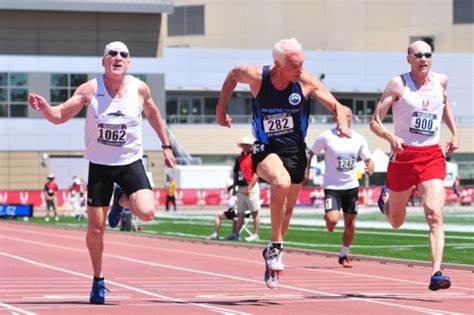
I started out tossing the ball from a stationary position. I was laughing and failing on purpose, giving the kids a chance, until one of them said a little something that I considered a provocative definition of my declining athletic ability. When it came time to catch the ball, I followed the same pattern. I went from light-hearted attempts to get open to employing quick, ankle spraining jukes. When I realized I couldn’t shake the nephew I once held as an infant, the quick movements evolved into some running. I ran every single day at one point in my life, so it was not a concern to me. I don’t know if I started losing, or if I sensed that the others were further questioning my ability, but I began sprinting to open spots to capitalize on the holes in their coverage. It dawned on me, while doing it that I haven’t done this in years. No one gave this a second thought for most of my life. Some people run, some people sprint. I didn’t see the spectators watching, but I could feel it. I even saw a couple stand with some concern. Did they see the game for what it was, or were they wondering if they should begin sprinting too? Did they stand to source the emergency that sparked my progression? I looked over to verify that they were watching me, but in that casual glance, I almost tumbled. I couldn’t look back at them. I had to be mindful of my feet. (Mental Note II, running now requires more focus.) Running was not my greatest concern. Stopping was. I had a myriad of little feet under mine, and I had to focus to avoid them.

I know I’m not as athletically inclined as I once was, but who is? I am smarter now. I know how to use my faculties much better than I did when I was younger. In the midst of these throws, my competitive juices got the best of me. I overdid it. I knew my best presentation could be found sitting on the lawn furniture with the other old people, talking about what old people talk about with lemonade in hand on a sunny day, but I didn’t decide to play this game. An impromptu game broke out and evolved into a character-defining match of my ability against theirs. I could not just quit. “Why did you quit?” I imagined one of them asking me. “Because I’m old and I can’t handle the physical requirements of such a game anymore.” Yeah, that’s not in my nature.

The nephew I once held as an infant was shutting me down in coverage at one point. I encouraged it verbally, but I also wanted to discourage it physically. I wanted to prove so dominant that he left our little game a little demoralized. To do so, I employed some of the know-how I picked up along the way, using the bag of tricks I developed in the decades I spent playing intramural football. Michael Jordan developed a fade away when his skills started to decline. I developed a few moves of my own over the years. “Youth is wasted on the young,” Winston Churchill said. What if I had this wide array of jukes when I was younger, I asked myself, would I have been better? I sprinted to the right, juked, and went further right. In doing so, my fellow old man led me well with a pass. My ability to stop on a dime and juke surprised my nephew. He went left to cover the traditional juke, and he did so right under me. To avoid taking him out, I had to adjust. (Mental note III, my ability to adjust on the fly has receded.) I tripped over his feet. (Mental Note IV: Studies show that the chances of tripping increase exponentially when we sprint.) Been there, done that. (Mental note V, watch out for ground, it hurts, but not near as much as a parked car.) I didn’t have much choice, in the stumbling and bumbling that followed. I decided to take on the car. (Mental note VI, the pain experienced from stationary objects increases when approached at top speed, and we should all try to avoid parked cars as often as possible. They can be unforgiving.) Hitting the car, and then the equally unforgiving concrete was humiliating, and I thought the people surrounding me with looks of concern was the peak of my humiliation, until my nephew called me up later that night to apologize for getting me so worked that I almost ended up impaled on a car.