Trope-a-Lanche: The Serial Killer Movie


How do we know when we’ve watched too many movies? Do you know who dun it, before they dun tol’ you? Have you spotted tropes (recognizable storytelling patterns, familiar devices, themes, character types, or plot moves that audiences instantly understand because they’ve seen it many times before) in movies so often that you now scream “trope-a-lanche!” when the tropes begin to avalanche. Have you disabled the suspension of disbelief for others, because you dissected the filmmakers intent behind plot devices, characterizations, etc, and you accidentally ruined the movie for them. If you’ve done any of the above, you’ve probably watched too many movies.

I initially mistook the ability to track patterns and tropes for intelligence, until I learned that even the sharpest cinematic observation is in service of absolutely nothing. It was a mark I thought should’ve informed my audience that I was so observant, but all it really did was tell them that I’ve watched too many movies. In some social situations, it pays off to watch a ton of movies. When someone asks you if you’ve seen some obscure movie, and you say yes, it can lead to some conversations. “What was your favorite part?” “What did you think of the actor, the twist, or that one scene.” That gratification is fleeting and rare. I used to be quite proud of the totality of the library of movies I’ve watched, and I used to be quite competitive in that regard. If you try to compete with me over most movies watched now, I’m probably going to let you have that crown, because I consider it an odd brag to say I’ve wasted a bigger chunk of my life watching movies than you have. 

A friend successfully bested me once saying: “I’ll bet I’ve watched more movies than you.”  

“Okay,” I said. “I don’t know why you’d brag about that, but I’m going to guess you haven’t.” 

“Do you watch porn?” he asked. 

“No.” 

“I win.” 
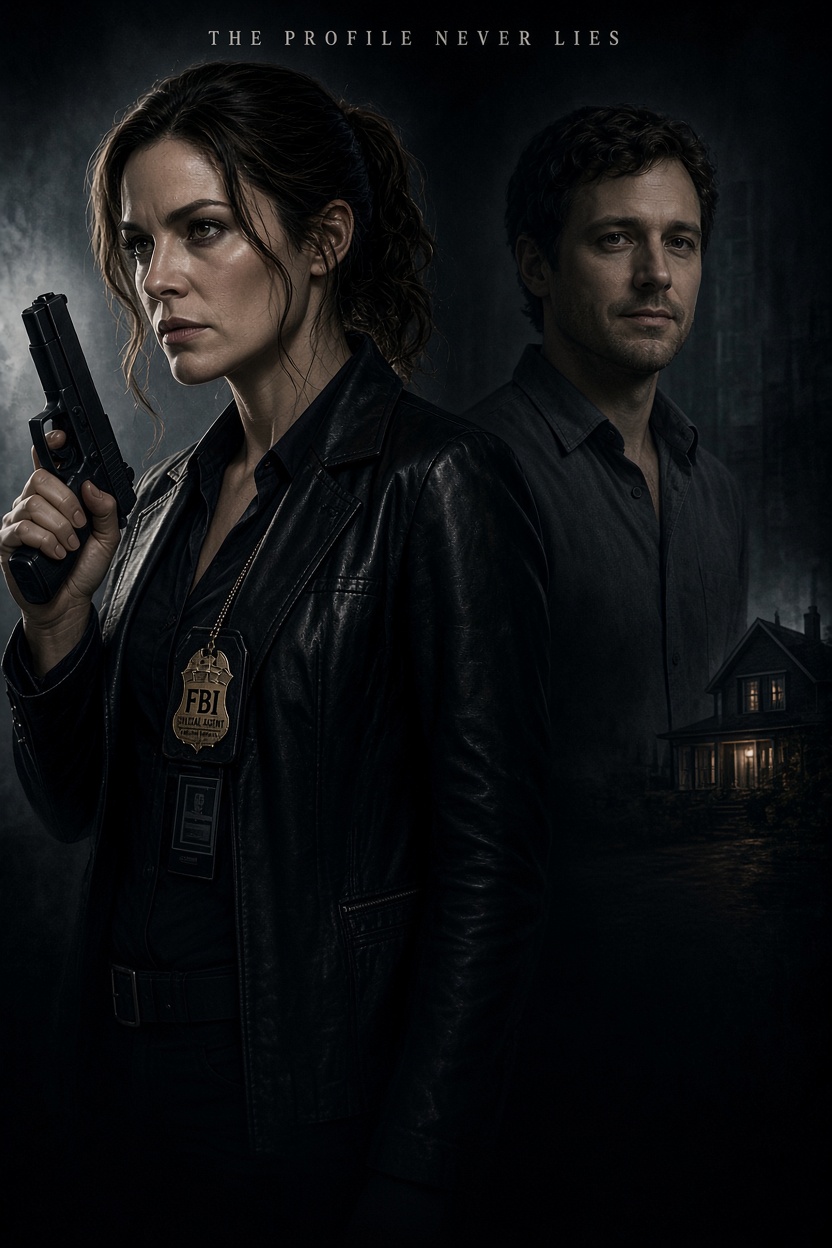
I try to apply the “Everything in moderation” recommendation to every thing in life, and I’ve found some success when it comes to nutrition, but I haven’t found near as much success with popcorn consumption or watching football and movies. The problem with watching too many movies, and obsessing over a subgenre like serial killer movies, is that at some point we’ll reach a tipping point where we’ll be able to characterize every character before they’re fully characterized, know the feng shui of the serial killer’s living room, the state of the abandoned warehouse where they’ll finally locate him, and pretty much how the final showdown will play out. Again, we don’t say this as a brag, as one of the consequences of watching too many movies is that we’ve damaged the joys of suspense and discovery.

The Serial Killer/Profiler Movie 

Unless you’re counting Sherlock Holmes as a profiler, as opposed to a consulting detective, the first cinematic profiler was a character named Will Graham in Michael Mann’s Manhunter (1986), based on Thomas Harris’ Red Dragon. This wasn’t the first serial killer movie ever made, but it was the first one I saw. It was also the first movie to use the art of psychological profiling to catch a serial killer, as pioneered for the FBI by Mindhunter author and Silence of the Lambs consultant John Douglas and author of Whoever Fights Monsters, Robert Ressler. I loved Douglas’ Mindhunter so much that if there was a stock or ETF (Exchange Traded Fund) in 1995 that focused on serial killer vs. profiler movies and books, I probably would’ve bought a couple shares. I’d probably would be a rich man now too, because I now get a new profiler-chasing-serial killer movie listed on my streaming services so often that I won’t watch them anymore, because I know the template they use, the one laid out by Manhunter, Silence of the Lambs, and Mindhunter, so well that I know it too well.

“I need to get inside the head of the killer,” our archetypal Special Agent of the Behavioral Analysis Unit Rhonda Gunderson says. This rhetoric is one of the numerous tropes of the typical serial killer movie, and the process inherent in doing so will come at great personal and/or professional expense. When our archetypal profiler, Special Agent of the Behavioral Unit Rhonda Gunderson, finds the killer’s Rosetta Stone, she uses it to correctly point out who the killer’s next victim will be. Her fellow Law Enforcement Officials (LEOs) won’t believe Gunderson, until her premonitions turn out to be correct so often that they can no longer question her mindmeld.  

1) The serial killer, with a media-style nickname or moniker, is unusually brilliant, erudite, articulate, cultured, charming, and attractive. (The idea that an unattractive piece of trash who didn’t graduate from high school might impulsively slaughter a bunch of people just isn’t as interesting to us anymore.) We want the horror conducted by our serial killer familiar, so filmmakers make them as clean, neat, and organized as we are. We also love the idea that the serial killer could be that quiet neighbor who seemed so nice and neighborly.  
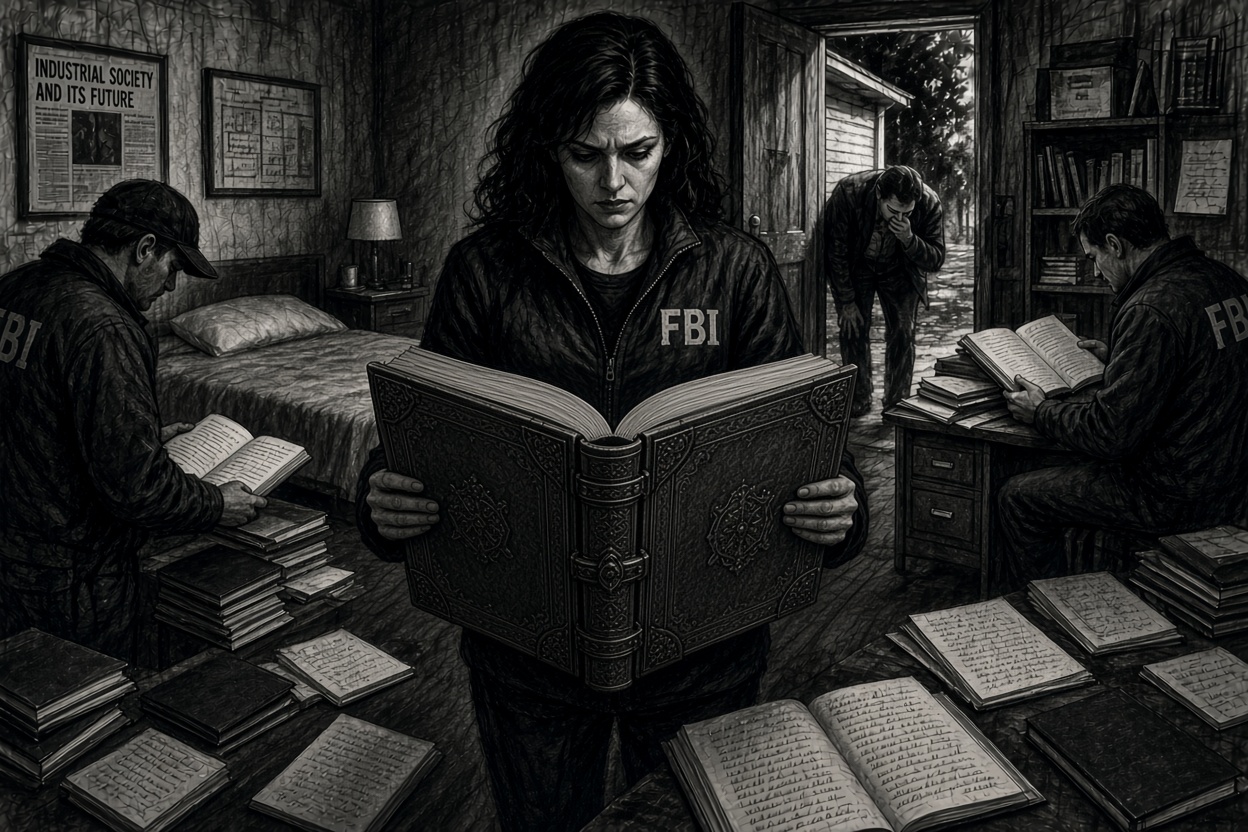
2) The killer will develop an intricate pattern, theme, or a highly sophisticated puzzle that calls upon the investigators to know their arcane and erudite literary or religious references well enough to compete with his unusually brilliant mind. The investigators must decode his message, puzzle, or worldview to prevent another killing, and one of the LEOs, usually our profiler, will have intimate knowledge of the arcane and erudite reference. At some point, in this period of discovery, one of the LEOs will characterize this as, “A race against time.” 

3) The killer will introduce a philosophical concept regarding the blurring of lines that detail a hypocrisy in society, that Special Agent Gunderson has a flaw he characterizes as similar to the killer’s, or the killer will pound home a vulnerability that speaks to society’s moral relativism. “Well, he’s right about that,” someone in the audience will say.   

4) The cat-and-mouse structure will involve a psychological duel as opposed to a physical one. At some point, Special Agent Gunderson will state that she is maddeningly close to “getting inside the head” of the killer, but she will not be able to tap into that level of evil. She will need to find another unusually brilliant genius serial killer who is still bloodthirsty but incarcerated, to give her insight into the mind of the active killer.  

The Final Showdown

A) When they finally track the killer down, he won’t be home, but Gunderson and the LEOs around her will enter his home. The serial killer’s home will be a meticulously curated horror show of his warped, damaged, and “unusually brilliant” psyche.

B) The lighting inside the home will contain insufficient natural light, and it will be so dark that it will require one of the LEOs to flip a light bulb on, but no one will. They will use flashlights to scour the walls completely covered in newspaper clippings of the murders, Polaroids or stolen photos of the victims (alive and dead). The killer will then label each picture with a sharpie to allow the LEOs to know which body part belongs to which victim.  
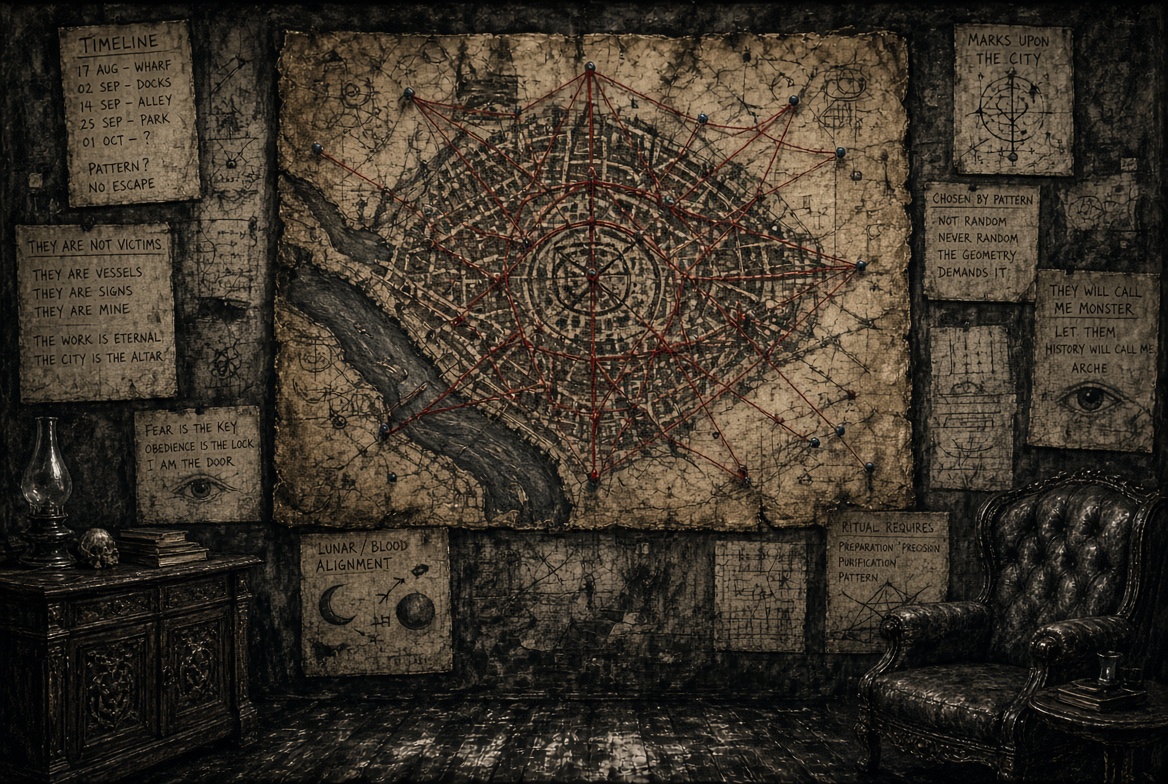
C) To further incriminate himself, the killer will provide an enlarged, elaborate map of the city with multicolored pins and red yarn connecting crime scenes, timelines, and obsessive diagrams. (There was one serial killer movie that used yellow yarn as opposed to red. I was like “What the heck? How does yellow illustrate an obsessive need for blood?” My guess is either the filmmakers couldn’t find red yarn, or they didn’t think anyone would notice.) The configuration of the red yarn hooked around the multicolored pins will form a pentagram, or some image the audience will associate with evil. 

D) The killer will have a trophy collection on the dresser filled with personal souvenirs—locks of hair, jewelry, driver’s licenses, underwear, lipstick, or they will have extreme keepsakes in jars in a freezer that contain fingers, teeth, or body parts carefully preserved.

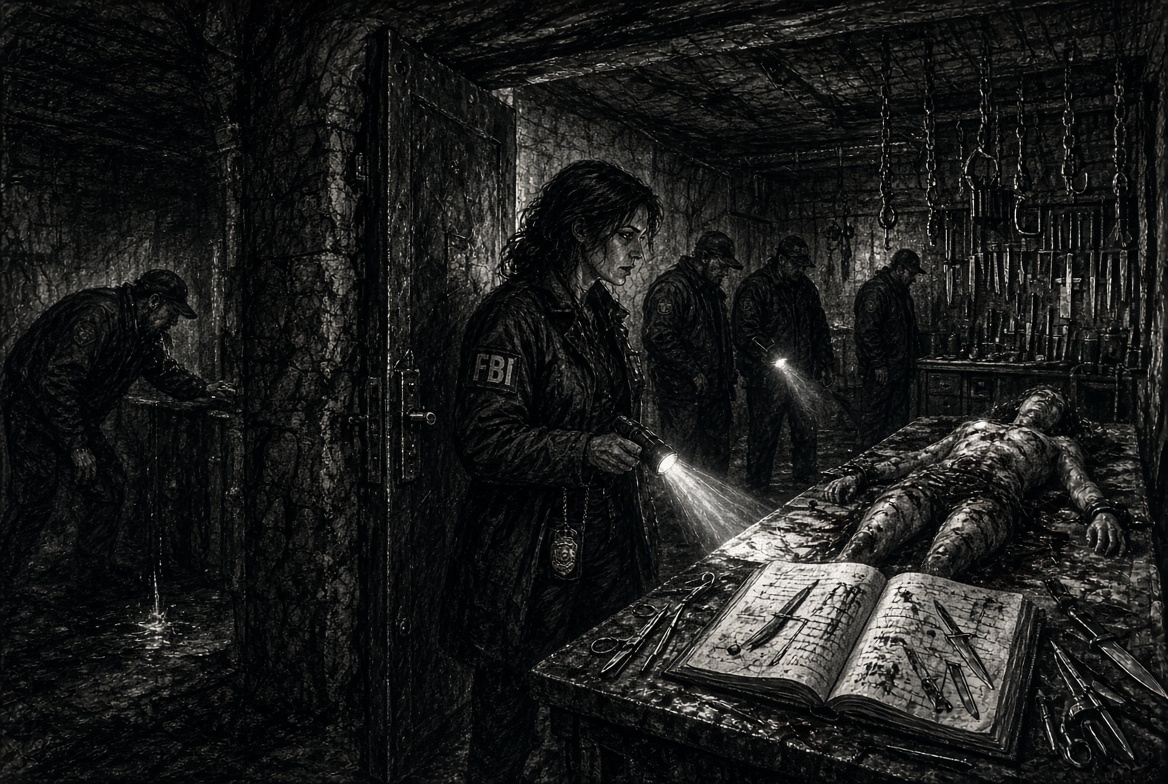
E) When the LEOs and Gunderson leave the serial killer’s living room, they will find a torture cellar or hidden room that real estate agents sell as a “must have” for all prospective serial killers. (How many of us have multi-room, cavernous areas carved out of our basement?) Inside his torture room, the law enforcement officials find various restraints in their workshop, knives, surgical tools, “how-to” books regarding surgery, a bloodstained table and a captive/victim who is barely clinging to life. 
F) In his bedroom, Gunderson and the LEOs find an incredibly incriminating journal with stacks of handwritten notebooks or a single massive ledger filled with detailed accounts of the crimes, philosophical justifications based on literary or religious references, lists of future targets, or pure delusional stream-of-consciousness, Unabomber-style writings. As busy as this room will appear to the naked eye, it be unusually clean, and extraordinary in its tidy, organized manner. One movie even went so far to suggest that its serial killer went to the trouble of developing an almost aseptic quality of sterility. “Why would an impulsive killer worry that much about spreading germs?” we ask. Depending on the over-the-top quality of the production, the serial killer might adorn his room with mannequins posed in victims’ clothes, taxidermy, religious icons mixed with occult symbols, or a bedroom that looks like a shrine. The answer to our previous question will arrive here, as Gunderson suggests that the tidy, organized manner of this man’s rooms illustrate a love/hate relationship the killer has with his domineering mother.

G) The LEOs will also note a chemical smell, usually bleach or formaldehyde mixed with the smell of human decay. To illustrate the smell those of us in the audience cannot smell, one of the LEOs will leave the house to vomit.  

H) Finally, one of the LEOs will say, “You’ll want to see this” to Special Agent Gunderson. The LEOs will all be standing around a board, and they will make room for Special Agent Gunderson. On this board, she will see amateurish photos taken from an amateurish camera. These pictures will be purposefully amateurish with odd angles. After she methodically walks past them, she will finger the last one and whisper, “He’s been watching us all along.”  

As noted, the house will empty, save for a victim clinging to life. The killer will either be on the run, hunting his next victim, or about to return at the worst possible moment, but the house overflowing with proof that the profile the incredibly brilliant and talented Special Agent Gunderson created was right all along. 
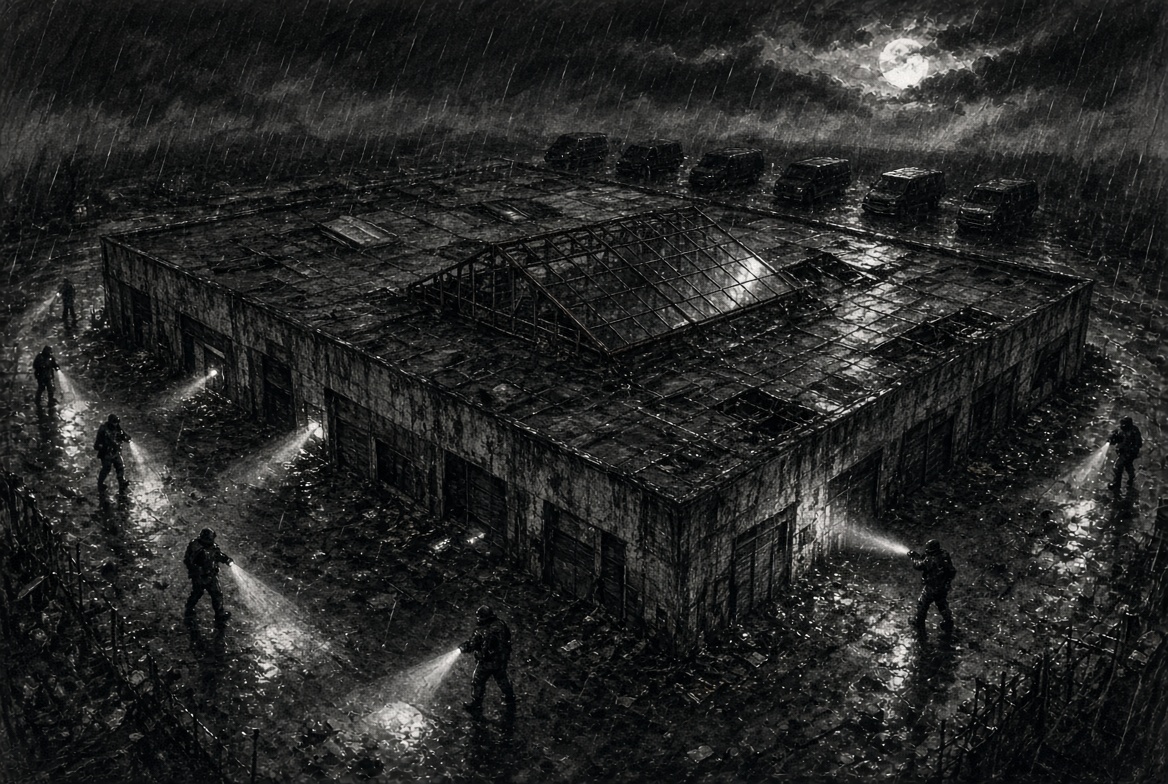
I) An eye-witness account suggests that the serial killer is in an abandoned warehouse. When Gunderson and the LEOs approach, it’s dark out, and there is heavy rain that soaks everything but actors’ hair. When Gunderson and the members of the LEO team she trusts approach the warehouse, black SUVs and SWAT vans roll up quietly. Guns are drawn. Flashlights cut through the darkness. Someone whispers over the radio: “We’ve confirmed his presence. He’s in there. Proceed with extreme caution. We’re on high alert for the possibility of booby traps.” Gunderson will shut off her radio, and she’ll encourage her team to go to radio silence, as they approach the entrance of the warehouse.

The warehouse is entirely empty when they enter, and the natural light shining from the abandoned warehouse roof is broken by the shadows of beams and the occasional bird flying from beam to beam. To break up the spooky silence, a bird will fly too close to Gunderson to provide a jump scare as she walks through the warehouse with her gun poised. At some point in her walk through the warehouse, Special Agent Gunderson becomes separated from her team, as the LEOs begin clearing the various rooms in the warehouse. She will enter the most incriminating room that has evidence in the form of more wall clippings, trophies, and that same lingering chemical smell. She will put the back of her hand to her nose and scrunch her face to illustrate for us how bad this smell is.  
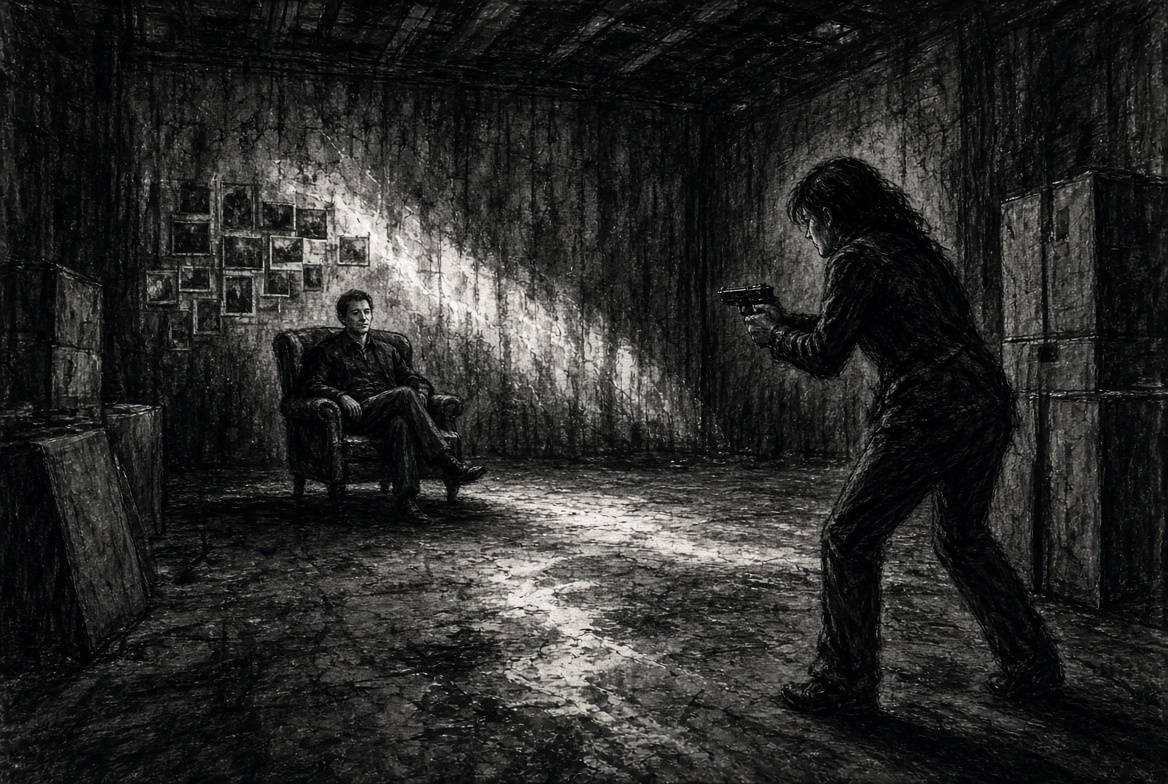
J) The killer appears in the dark corner of this room. He is sitting in a walnut brown Baxton studio Billie side chair. He is not surprised when Gunderson enters. He’s been waiting for her. (I would love to see a scene where one of the LEOs locates him first, and he says, “What, wait a second, who are you? Go get Special Agent Gunderson, and tell her to be taken aback by my calm yet authoritative stance.”) The media monikered serial killer is in a dark room, lit only by limited natural light and occasional flashes of lightning. (In some movies, his face remains in shadow for another beat.) He congratulates Gunderson for displaying her incredible and unprecedented talent and intelligence by finding him, and he further compliments her by saying that only she could understand him well enough to develop the profile she did. He also states that as incredibly brilliant and intelligent and talented as she is, Special Agent Gunderson couldn’t have arrived at such knowledge of him if she didn’t have intimate or familiar knowledge. “No one else can understand us,” he says, explaining how elements of her past leads her to understand his methodology better.

“I’m nothing like you,” the incredibly brilliant and incredibly talented Special Agent Gunderson says. 

“We’re more alike than you know,” he says with a smile. 

K) The media monikered serial killer will then drop a lengthy exposition regarding his methodology, and once that’s complete, we will hear the sounds of boots stomping on the stairs and radios crackling as the LEOs join Gunderson in the abandoned warehouse room. “Hands where I can see them!” they will shout with weapons drawn behind her. The lighting will become more dramatic, as all of the flashlights light the room (or the lightning flashes become more frequent), as the serial killer and Gunderson begin exchanging words (Sometimes they shout, sometimes they whisper. This is one of the few points in the typical serial killer movie where the filmmaker has some discretion.) When Special Agent Gunderson finally reaches her “nothing to lose here” point, she will seek to take action, but the serial killer will stop her in her tracks by revealing the final victim (Either the initial victim that caught Gunderson’s attention, her daughter, or some young girl to whom she’s developed some form of affection) to raise the stakes.  
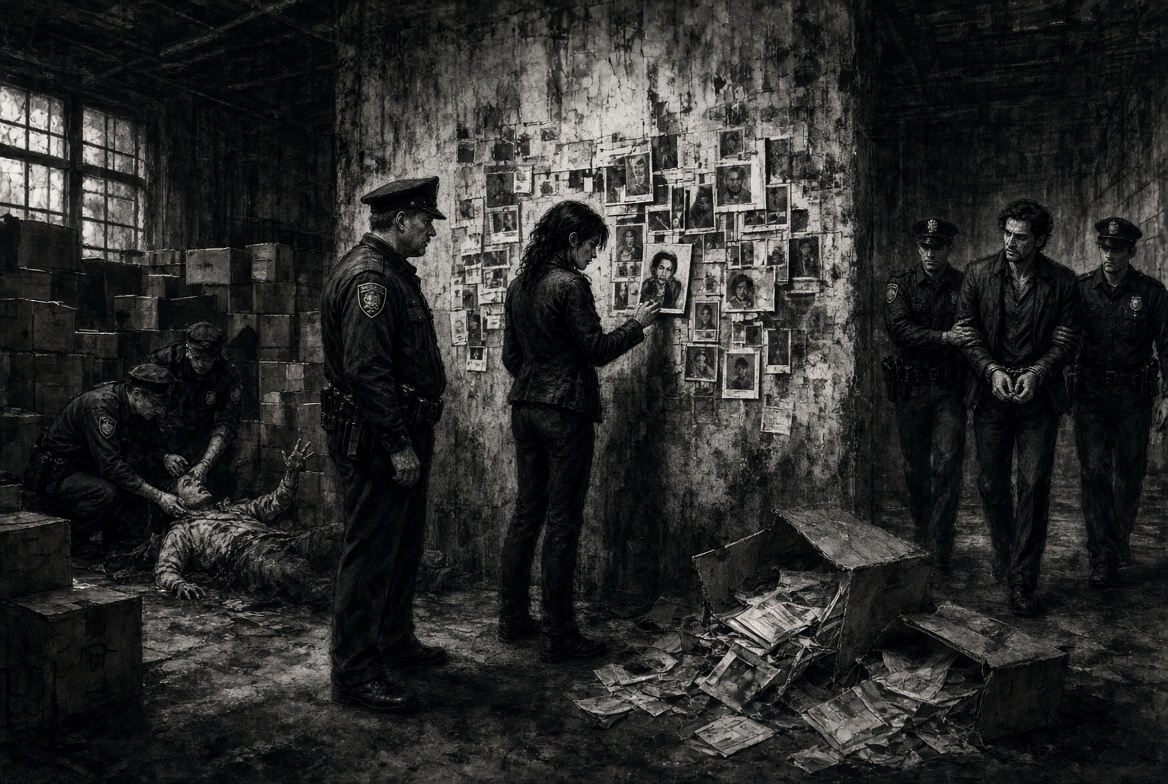
L) A struggle breaks out: a brief, brutal fight in a confined space, knives flashing, a gun sliding across the floor, and Gunderson will begin look around the abandoned warehouse to use something in the warehouse against him. When she finds something elaborate that triggers an elaborate something else that won’t harm the female victim, the killer becomes separated from the victim, and the serial killer is tackled, slammed against a wall or the floor, and cuffed by one of the LEOs. He will smirk an evil little smirk while they’re apprehending him, and he’ll whisper one final line to Gunderson while being taken away, something like, “Society will never truly understand us.” 

M) The scene ends with the killer being led away in the rain under harsh floodlights. Gunderson will remain in the room of the abandoned warehouse for a beat, staring at the wall of evidence or the trophies, looking hollowed-out rather than triumphant. Rainwater drips from the ceiling, and one of the LEOs will congratulate her on doing what he considered impossible. “You are an incredibly brilliant, intelligent, and talented woman,” one of her subtly yet unmistakably misogynist detractors will say. “And I can’t believe you did it, but you did. It’s over, it’s finally over.”

“I wish I could believe that,” Special Agent Gunderson whispers, glaring at something poignant in the serial killer’s display. “I wish I could believe that,” she says fingering it. The camera zeroes in on that poignant artifact that foreshadows the future horror this episode could portend, which everyone who watches too many movies knows is the sequel(s).

Long before I learned about “movie tropes”, my friends and I talked about movie tropes all the time without using a term we had never heard before. We watched so many movies that we could spot the tropes before the movies delivered them. We never turned it into a drinking game. If we had, our brains would be more damaged than they already are, because each genre, and subgenre has an algorithm that one movie maker created to set a precedent. Once that precedent was set, the filmmakers, the studio execs, the investors, and all of the players involved demanded that the creatives involved in the movie follow the same blueprint that the precedent setter set to prevent confusion for the audience. 

Based on the ubiquity of current profiler-chases-serial killer movies, we can guess that they make a lot of money now, but they also cost a lot of money to make. There are low-budget, independent movies of course, but most movies cost a lot to make. Those movies require big budgets, and big budgets require approval from the hierarchy or the greenlight authority to get through the chain of gatekeepers that wield different kinds of power. The director and screenwriter have to answer to all of them if they want to make it to the next stage, and from what I hear these gatekeepers are very generous with notes on how the directors and screenwriters can make their project less confusing for the audience. Filmmakers have been subjected to this process long before I was born, and it will continue to work this way long after I’m gone. Some screenwriters and directors refuse to concede to these notes, and we call them two things: auteurs and unemployed screenwriters and directors. The auteur is an artist whose personal creative vision is strong and distinctive that he might be able to tell the gatekeepers what they can do with their notes. Most auteurs are not welcome in most genre movies, because genre film fans grow accustomed to certain rhythms, rhetoric, and patterns, or what we now call tropes. When one of the auteurs is so talented and brilliant that they find a way to make a decently budgeted movie without conceding to “the notes” those I know and love say, “I just found it confusing. I don’t know why, but it confused me, and I didn’t like it.” Those of us who watched too many movies strive to find movies from auteurs who break the system by refusing to kowtow to notes from production studios and investors. Yet, we know that most movies are so expensive to make that the artistic vision screenwriters and directors prize often gets so diluted by those who know far more than I do about how to appeal to audiences and make a lot of money in the process, but it does tend to make movies very similar to those of us who watch too many of them.  

Mindhunter


“The stories and legends that have filtered down about witches and werewolves and vampires may have been a way of explaining outrages so hideous that no one in the small and close-knit towns of Europe and early America could comprehend the perversities we now take for granted. [These] Monsters had to be supernatural creatures. They couldn’t be just like us.” John Douglas and Mark Olshaker wrote in an excellent memoir titled Mindhunter to explain that serial killers are not a recent phenomenon.

What’s more scary the idea that monsters are real, or the idea that your quiet, unassuming neighbor could commit monstrous acts? Before we giggle at our predecessors for believing werewolves and vampires walked among them, we need to keep a number of things in mind. They were afraid, and they sought to find answers that might comfort them. We’re still afraid, but our fear is driven by the fact that we know that those who commit such monstrous acts are ordinary people who aren’t that much different. We might have better theories and educated guesses, thanks in part to the interviews conducted by John Douglas and Robert K. Ressler and many others, but we still don’t know enough to stop current and future monstrous acts. When we’re afraid, we want answers, and future generations might giggle at us for our “more modern, informed answers”. The answers we have, thanks to advancements in the fields of law enforcement, science, and technology inform us that we’re not surrounded by vampires, werewolves, or any kind of literal monsters, but ordinary people who are in some ways triggered to commit monstrous acts. The question is, do these answers provide us comfort, or do they make us more afraid?

Our predecessors obviously considered the latter more horrific, and they developed the idea of monsters to help create some distance between themselves and those who would commit such acts.

We could very easily say that our predecessors were less informed on such matters, but that is almost solely based on the idea that they didn’t have the science and technology we have to help them explain matters. (Anyone who thinks it’s a stone cold fact that we’re smarter now, on average, need only take an 19th century 8th grade examination to compare.) I don’t think they were less intelligent, or that most of them truly believed that men all over the world were turning into wolves and vampires. I think they wanted an explanation that might help them avoid discussions on the subject of whether the quiet, unassuming man they met in the apothecary was capable of such monstrosities.

Those of us who watch the NFL often enough begin to think we know what we’re talking about when we question our favorite team’s general manager (GM) moves. If I were a GM, I would open my press conference with eleven words, “You know nothing. Please keep that in mind throughout our Q&A.” If I led an investigation on a psychopath committing serial crimes, I would issue the same intro. Most of us know nothing about law enforcement. Most of us know nothing about the long, laborious task of collecting evidence, and the mind-numbing task of studying case files. We might think we do, because we’ve logged thousands of hours watching movies and TV shows on the subject, but we know nothing.

If we were to devote our lives to learning more, by way of TV shows, movies, and the books in the true crime section of our favorite book store, we might one day reach a point where we know next to nothing. If, that is, are engagement is studious. I knew nothing when I first picked up the book Mindhunter decades ago, and I probably know next to nothing today. I knew nothing when I proceeded to buy all the books written by Douglas and Olshaker, and all of the other books that line the true crime section of the book store, and I know next to nothing now. I do know that Mindhunter was the best of these books, and I couldn’t believe it took over two decades for someone to make a movie, or a TV show on Doulgas’ excellent memoir.

Those who have yet to watch an episode of season one of the Netflix series, based on the book, should know that the consensus is that it starts out slow and confusing. To some, each episode of the series is slow and laborious, because it does not involve FBI agents knocking down doors, taking over investigations, or engaging in gun fights. Mindhunter is not the typical profiling show of FBI agents trying to catch a serial killer before he acts again. It is the story about two FBI agents who used the information gathered during interviews with psychopaths to understand such people better for the purpose of helping law enforcement identify them sooner, apprehend them later, and then convict them. Uber fans of the book, who never understood why no one made a movie about this chapter in John Douglas’ life, and this chapter in criminal justice, realized that sometimes even fantastic books don’t play very well in visual mediums. The Mindhunter series on Netflix is largely cerebral, and if you have no interest in this subject, the pace can appear plodding in parts.

Those of us who loved the book and wanted viewers to see the genius of the book for themselves cringed through the slow start, because we know that a slow start can be the death knell for any series on a streaming device. The reason for the slow start is that a series such as this needs to establish the modus operandi (M.O.) behind the FBI agents interviewing criminal minds to understand the criminal mind better, the series also has to establish the characters involved to spark interest, and the series creators needed to add the requisite (albeit fictional) romance. The characterization and the modus operandi of the FBI agents is necessary for any show, of course, but if I were the head writer of the series, I would’ve opened with the Ed Kemper interviews and dropped the backdrop information in accordingly. I might have also attempted to integrate the M.O. into the first episode, but I would have done so after the initial Kemper interview. My cringe was not because the series was done poorly, but as a member of the short attention span generation, I cringe when a series start out at a snail’s pace, because I can hear the millions of viewers who didn’t read the book, flipping to the thousands of other options available at their fingertips. Those who are patient enough to work through the largely fictionalized characterizations, will learn of a fascinating retelling of a 1995 memoir, by the same name, written by John Douglas and Mark Olshaker.

Although Mindhunter, the book, would influence some award winning movies and TV shows, the more faithful-to-the-book Netflix series, contains little to no action scenes. The book, and the series, are more about the groundbreaking work two FBI agents did to change the procedures law enforcement officials use to investigate violent crime. This story is more about the cerebral tactics these two agents advanced to a level unseen in the FBI prior to their arrival. Previous work done in the FBI influenced their work, as did the work of local level law enforcement officials, and the occasions when law enforcement officials brought in a psychiatrist to assist them with a case. In the book Mindhunter, John Douglas also noted that his work derived some influence from literature, specifically, Sir Arthur Conan Doyle’s Sherlock Holmes, Edgar Allen Poe’s The Murders in the Rue Morgue, and a British novelist named Wilkie Collins.

The work Douglas and Robert Ressler did inspired the creation of numerous gun-toting FBI-chasing serial killer Hollywood movies, including Manhunter, The Silence of the Lambs, The X-Files and hundreds of other movies and TV shows, but John Douglas says he didn’t care for any of those portrayals.

“They don’t put across accurate portrayals, and [that] aggravates me,” he said. “I can’t look at those movies.” As for the Netflix series, Douglas says, “They’re going by the book and I am very pleased.” Watching the series, he said, “is like reliving my life all over again.”

We can guess that Douglas didn’t care for the Hollywood attempts to tell his story because they felt the need to Hollywood his story up, and I join him in this general sentiment. I loathe movies that do whatever they can to add action scenes, and a romantic angle, to involve the audience in the lives of their characters.

After watching the Netflix series, however, I now understand why various producers, directors, and all the players involved in making the Hollywood versions of his tale, felt the need to Hollywood it up in their versions of the story. If they maintained a stance that their versions would adhere to the book more faithfully, they probably wouldn’t receive funding for it. Their rejections would probably state that no one wants to watch FBI agents doing behind the scenes work.

John Douglas characterized his twenty-four year career in the FBI, as putting himself in the mind of the hunter. To do so, Douglas developed a process of interviewing and studying psychopaths for the purpose of understanding their methodological approach to choosing victims, securing their removal from the public space, and covering their trail.

On the latter, Douglas wrote, “No matter how much a criminal thinks he knows, the more he does to evade detection, or throw us off the track, the more behavioral clues he’s going to give us to work with.”

When asked how John Douglas would describe his role in these investigations, he said, “If you’re a cop and I work with you on a case, I help to develop a more proactive technique.”

Douglas also tried to clarify the role the Investigative Support Unit (which is part of the FBI’s national Center for the Analysis of Violent Crime at Quantico) played in investigations:

“We do not catch criminals. What we try to do is assist local police in focusing their investigations, then suggest some proactive techniques that might help draw a criminal out.” Douglas then writes, “We (also) try to formulate a strategy to help the prosecutor bring out the defendant’s true personality during the trial.”

My analysis of John Douglas, the work he did after the interviews in the field of profiling, and what I once considered the most brilliant books I’ve ever read on the subject, might sound like a love affair gone awry from this point forward. Like an impulsive, physical attraction to another person, I was gaga over this book, and my initial impulses resulted in me failing to view this book objectively.

Before I get into that, however, there is one chapter that no one will ever be able to make me see the light on: Everybody has a Rock. In this chapter, Douglas writes that he attained a confession from an alleged perpetrator by placing an ordinary rock in the corner of the room. It was not the rock that various law enforcement officials believed the alleged perpetrator used to inflict blunt force trauma to the head of Mary Frances Stoner. It was just a rock that Douglas found that he considered roughly the same size and shape as the one law enforcement believed a perpetrator used in Ms. Stoner’s murder, and he placed it in the corner of the interrogation room before the interview. Douglas used numerous behavioral techniques in that interview with the alleged suspect to inform him that he knew the suspect as well, if not better, than anyone who interrogated him previously. Throughout the interview, the suspect kept glancing over at the rock waiting for Douglas to broach the topic of the rock. John Douglas never did. He used it as a triggering stressor, combined with the detailed information he had on the suspect, to make him sweat. Long paragraph short, the man confessed, and Douglas concluded this by writing:

“If the triggering stressor is a legitimate, valid concern, it will have a good chance of working. [The rock] could be mine. Yours would be something else and we’d have to try to figure out in advance what that would be. But there would be something. Because everybody has a rock.”

We all have a vulnerability, in other words, a susceptibility of sorts in the case against us, and it’s law enforcement’s job, and the prosecutor’s job to find it. It’s not a ground-breaking idea, of course, but when it works, it can sound so perfect, as in this case, that it sounds like a magician revealing that he’s had a rabbit in his hat the whole time.

Most also credit John Douglas as a pioneer for a controversial art form called profiling. When I first read Mindhunter, I was an unquestioning fan. I considered John E. Douglas a flat out genius, and I thought he personified the idea that every problem is one genius away from a solution. In the decades since, I’ve read numerous naysayers state that many of the profiles Douglas and other profilers have created for unknown subjects (UNSUBs), are equivalent to Forer Effect.* I was a little shocked by the pushback for I considered profiling an art form, if not a scientific approach to help law enforcement locate and determine which type of criminal was most probable. I considered profiling on the verge of hard science. I was also shocked to learn that many law enforcement officials groan when profilers enter into an investigation, because they don’t believe profilers can help them in investigations any more than they believe psychics can.

One of my naysayer friends asked me the pointed question if I thought psychics could help law enforcement locate and determine suspects. “Of course not,” I said, “but that’s not what John Douglas does.” After a back and forth that involved the details we both knew from the book, the naysayer encouraged me to re-read page 151 of his Mindhunter book.

Page 151 of Mindhunter contains John Douglas’s description of profiling, a description I now consider tantamount to a confession:

“What I try to do with a case is take in all the evidence I have to work with –the case reports, the crime-scene photos, and descriptions, the victim statements or autopsy protocols– and then put myself mentally and emotionally in the head of the offender. I try to think as he does.” So far so good, this was the summary I provided my naysayer friend. The next part is what I presumably skimmed over in my first reading. “Exactly how this happens, I’m not sure, any more than novelists such as Thomas Harris who’ve consulted me over the years can say exactly how their characters come to life. If there is a psychic component to this, I won’t run away from it, though I regard it more in the realm of creative thinking.” {Emphasis mine.}

The next paragraph in the book details Douglas’s praise of psychics, “I’ve seen it work,” he says. Douglas does admit, however, that hundreds of psychics were brought in to help law enforcement officials solve the Atlanta child murders, and they weren’t even close in their descriptions of killers and methods.

Other naysayers who argue that the effectiveness of criminal profiling John Douglas is suspect, ask how many of his profiles were wrong? One suspects, if other naysayers are correct, and what Douglas does is equivalent to what psychics do, that he is wrong more often than he is right, but that he might say that that’s the nature of profiling. Mindhunter is John Douglas’ book, and he can include the data to support his argument, but if Douglas and others’ profiles had a praiseworthy track record, I think he would’ve proudly listed those statistics. He probably still would’ve added that profiling is an art form, and not a science, but he could’ve added something along the lines of “Our figures show that qualified profilers have been proven correct ‘X’% of the time since we developed the technique for law enforcement.”

It’s been a long time since I read the book word for word, but I can’t remember the chapter listing the success rates, and there is no statistics of listing in the index. In the end, this is a memoir of John Douglas’ life as an FBI agent, and the many successes he’s had. As I wrote, he doesn’t have to list anything he doesn’t want to list, but for those of us who want to believe in him and his techniques, these facts would’ve given us ammunition against his naysayers. Having said all that Mindhunter is a great read, and he never claims he found a scientific approach to crime solving.

As has been reported, season two of this Netflix series will focus on profiling and the Atlanta child murders, but those who might fall prey to the belief that profiling is a hard science that will result in some sort of exactitude must keep all of this in mind.

They should also keep two key facts in mind when watching the focus on the Atlanta child murders. The state was able to convict suspect Wayne Williams of killing two grown men, but they were never able to convict him of a killing a single child. As Biography.com states, “Once the trial (of the case of those two grown men) was over, law-enforcement officials declared their belief that evidence suggested that Williams was most likely linked to another 20 of the 29 deaths the task force had been investigating. DNA sequencing from hairs found on different victims revealed a match to Williams’s own hair, to 98 percent certainty. But that 2 percent doubt was enough to prevent further convictions.” (One has to imagine that the various levels of law enforcement were disgusted with the prosecuting attorney’s office for their unwillingness to pursue these charges to preserve their success record.) 

I noticed that the first season of Netflix’s Mindhunter paid little attention to the art of profiling. I cannot remember if the series used the term, unless they said something like, “we could use this information to build a profile on him”. As far as I remember, the first season didn’t use the term at all. Perhaps, that was because Douglas didn’t coin the term in the time period season one covers, or it may be that the series producers wanted to stay away from the controversial term. (If they used it, I expect fans will help me correct the record.) Regardless, I read that they will put more focus on profiling in season two.

The almost painful confession I must make in regards John Douglas, and his insight into criminal profiling, is that I believed it 100%. Even though Douglas confessed in his book that profiling was more art than science, I considered the art of profiling based on science, behavioral science, and I considered John Douglas an indisputable genius. Even though he said, if someone were to accuse him of using psychic components, “I won’t run away from it.” He then added, “I’ve seen it work.” Any rational mind would respond, “Okay, fair enough, but how often do psychics provide unequivocal assistance to law enforcement work? How often does their information lead to a suspect who is later convicted?” I’m sure there are some who might cite anecdotal evidence with a case for me that pinpoints a case in the history of law enforcement where a psychic helped solve a case, but my rational mind takes me back to that question, “If this particular psychic has a gift, and they were able to help law enforcement solve a case, how often have they been wrong throughout their career?” If there were more documented stats on the powers of even one psychic, perhaps juries and the overall court system would accept and acknowledge evidence that was obtained with a psychics insights in the courtroom. At this point in history that has not happened.

In my excitement, I failed to read his book with enough skepticism. I do this, because I enjoy falling in love. I’m a relatively intelligent person who appreciates how math and hard science can help explain most of the inner workings of the universe, but I will not apologize for the emotional, almost romantic attachments I have to ideas before the facts roll out. I continue to believe, for example, that for every problem that plagues man we are one genius away from finding a solution, but I am now more skeptical of the former FBI agent’s influential approach, techniques and procedures than I was when I first read his book. Although I was wrong, painfully wrong, I believe a book such as this one highlights the discussion of belief. When I learned that many in law enforcement do not value criminal profiling as much I thought they should, and I reread Mindhunter in a more skeptical mind frame, I was swayed that it wasn’t the hard science I assumed on initial reading. I’ll take the arrows when they come my way, but I won’t give up the optimistic beliefs that have served me well over the years.

——————————-

*The Forer Effect is the observation that individuals will give high accuracy ratings to descriptions tailored to their personality, but is in fact vague and general enough to be assigned to a wide range of people. This effect can provide a partial explanation for the widespread acceptance of some beliefs and practices, such as astrology, fortune telling, graphology, and some types of personality tests.

Rilalities III: Thoughts


Posted by Muyiwa Okeola

A Thought: Anti-religious people go nuts when the religious Creationists point out that there are gaps in Charles Darwin’s attempt to explain creation. “How could there not be gaps in his Theory of Evolution?” they ask. “Darwin was dealing with mid-19th century science.” They also caution that we shouldn’t insert God, or mystical miracles, into every gap we currently have in our current explanations, based on our current levels of science. The import of this message is that we have already filled many of Darwin’s gaps with our current levels of science, and we will fill even more as science advances in the future. Yet, some of these people, who place such prominence on science, are perfectly willing to fill the gaps of our current levels of science on global warming with the explanation that man did it.

On that note, how many future generations, with their progressed levels of scientific knowledge, are going to be laughing at global warmers in the manner we currently laugh at bloodletters and flat earthers? There were even some people, see Aristotle, who believed that a slab of beef spawned maggots. Scientists warn, based on these precedents, that we shouldn’t leap to conclusions, or fill the gaps of our current scientific knowledge, with explanations that support our personal agendas, but some of them claim that all the science is in on … everything, and there’s no need for more debate on the subject, no matter how we arrive at truths through the scientific method.

B Thought: We all learn lessons in life, no matter how old we are, and no matter how many times we have already learned those lessons.

C Thought: Debate matters of substance with enough people, and you’re bound to come across extremes. Those of us who discuss matters with representatives of the extreme faction of the other side, find it enjoyable to nuke their ideas out of the park with facts. If you seek such discussions often enough, however, you’re bound to run across the extreme faction from your side. Some of these people, unfortunately, go so far out of the parameters that you may initially think that the other side may be right about their characterizations of your side. They’re not. The person in front of you is simply a characterization of the extreme faction of your side that diverts themselves away from the important matters of the day with trivial matters. I don’t know if these people strive for the trivial, because they’re not able to compete in the knowledge of important matters, or they find the trivial more entertaining, but they are inordinately intrigued by the trivial, and they exist on both sides of the aisle

D Thought: Most artists have one masterpiece in them. Everything they do after that is, in ways large and small, derivative of that one master. Those of us who get excited when we experience a masterpiece, should understand how difficult they are to create. Most of us characterize the masterpiece as brilliant, and we think the next piece should be just as brilliant, and if it isn’t, “it sucks!” An overwhelming majority of us don’t know what it takes to create a masterpiece, much less something of an artistic nature, but we enjoy giving our uninformed opinions for the mileage they gain us.

E Thought: Some watched the movie version of Fight Club and fell in love with the romanticized notion of blowing up banks to finally achieve economic justice in this unfair system. The import of this dream is that those who are burdened by debt, would be no more, and we could reset the system to finally give the poor the chance they never had to be rich. In this dream, those who inherit money, would have to start over from scratch. Those who gain money by being lucky, or being in the right place at the right time, would have to do it again. Those who accumulate money by ill-gotten means, would have to start over from scratch, and those who haven’t been afforded a chance to succeed in our unfair system, would be able to have another crack at the system.

Let’s put aside the ridiculous notion that blowing up a couple branches, or a couple banks, that house a couple computers, can accomplish anything. Let’s say, for the purpose of this argument, that some Electromagnetic Pulse (EMP) bomb were able to comprehensively wipe out all data, and all Americans were afforded a restart. How depressing would it be, to these dreamers, to realize that people are, in fact, different? How depressing would it be to them that some people are more talented, more industrious, more ambitious, more creative, and more willing to risk it all for more? How depressing would it be for these people to finally achieve hope and change, only to realize that everything would eventually cycle back? How depressing would it be when all the same millionaires are the same millionaires and billionaires ten years after the EMP bomb occurred? It’s not only possible, it’s likely. Most of those who accumulate the millions and billions they do, do not do so by birthright. Most of them knew how the system worked so well that they could manipulate it again, if called upon to do so, and they might enjoy the challenge. In this post-EMP world, these people would know how to raise capital better than we would, they would know how to form coalitions better than us, and they would be far more willing than the rest of us to risk it all on some idea that they just thought up. We, theoretical dreamers, would be living in John Lennon’s Imagine world, while they would be re-invigorated to prove themselves all over again. This event would prove to be only be more depressing to those dreamers to eventually realize that they couldn’t do it yet again.

F Thought: One of the primary arguments against the stop, question, and frisk law, used by the police in New York City, is that it violates the Fourth Amendment, and it allows for some degree of profiling. Most of those that argue against this law do not want it finessed. They want it ended. An interesting aspect of the law, that I hadn’t considered before, is that some leaders have been screaming for generations that government do something about the crime that occurs in specific neighborhoods. They’ve said, for generations, that government leaders ignore the crises that occur in some crime-ridden neighborhoods, and they’ve said that the police virtually ignore those neighborhoods. Yet, when a government, and its police force, do attempt to do something, and that something is the stop, question, and frisk law, the leaders claim that it unfairly targets some in some specific neighborhoods where crime is the highest. The answer, of course, is that those leaders, screaming the loudest about the fact that the government wouldn’t do anything to solve crime, and that most police forces won’t even go into those neighborhoods, never wanted solutions. They just enjoy the fruits of the labor involved in screaming.

G Thought: Why do serial killers in movies, and on TV shows, turn the TV off when a news report of their spree makes it to air? I understand that the screenwriter is trying to establish the fact that the killer is not doing what he’s doing for fame. “This particular killer has a more gruesome motive,” the action of turning the TV off attempts to suggest. “His malady is so much deeper than all that. This particular killer is not your typical, garden variety serial killer.” In one particular show, Netflix’s The Fall, the serial killer plays with his child while the TV broadcasts a press conference with those in charge of the investigation detailing their findings, and he appears to be only symbolically interested in the broadcast. When it’s announced, by the serial killer’s wife, that dinner is ready, he shuts the TV off, mid-press conference, and takes the daughter to the dinner table. It’s cool that he doesn’t care, and it does characterize him as something different than what we expect, but shouldn’t that killer want to know how the law’s investigation is proceeding, so he can, at least, adjust his spree accordingly?

H Thought: Anyone who argues against the idea that most Americans are ignorant when it comes to the subject of Economics, needs to watch an episode of TruTV’s Hardcore Pawn. Pick any episode, and you’ll see a customer walk in with something of relative value, and you’ll hear them assign it value. “I want $100 for this ticket to (a concert by the band) Journey!” said one particular customer, on one particular episode. When she was asked how she arrived at that dollar figure, she couldn’t do it. When she was informed that she wouldn’t be getting $100, she was outraged. “I want $100!” 

These customers don’t care that they’ve just entered a pawn shop –that is not going to give them face value, much less fair market value, for their product– they just want their $100, and they usually “don’t care” because they don’t know. They know nothing about economics, bartering, or the fact that a pawn shop is in the business of making as much profit off their products as possible. They don’t even know enough to know anything about the bartering process involved in the pawn shop world, they just want their $100. I don’t want anyone to think that I approve of what they do on the show, or in their shop, for I think they shortchange most of their sellers, but if I were to enter this, or any pawn shop, I would walk in knowing that I probably wouldn’t receive the value that I assigned to this product. My goal would be to get something more than I fear I would get. And perhaps this fear, and this knowledge of how the pawn world works, would lead me to getting far less. Regardless, I can assure you that I wouldn’t be one of these crying and screaming idiots that ends up getting tossed out on their ear, on a nationally broadcast television show, or if I were, I wouldn’t be signing the release that allowed them to air it. It would officially be the most embarrassing moment of my life. To these people, apparently, it’s just another manic Monday.