A Review of the Netflix Series: Home Game


Most of us love sports, yet we never bother to ask why. The wide variety of answers for why we love sports might never be apparent to us, until we meet someone who doesn’t. We might not be able to learn why we love sports by watching the Netflix series Home Game, and it won’t curb our appetite for specific sports, but it will show the uncomplicated love some people have for their sport, and it might remind us why we love ours.

Home Game’s documentary about Florence, Italy’s sport of Calico Storico will not satisfy anyone who misses American football or rugby. The documentary about the Kyrgystan sport of Kok Boru will not satisfy anyone who misses basketball or polo, and a horseracing fanatic is probably not going to experience satisfaction watching riders pushing water buffalo through a flooded rice field, in Bali’s sport Makepung Lampit. What we will see are the staples of sport. We’ll see the passion, determination, and the temerity it takes to conquer an opponent. We also see an element of sports that we don’t talk about enough, the arduous, sometimes excruciating training it can take to become a champion. Our initial response might be to view some of the games depicted in these episodes as silly, particularly the Makepung Lampit sport that involves throwing a dead goat in a large, cement vase, but from that vantage point, all sports seem silly. In many first world countries, ten guys try to force a ball through a hoop in basketball. In the third world country of Kyrgyzstan, four guys try to force a dead goat into a large, cement vase. What’s the difference? Would the Kyrgyz or the Balinese people view the idea that first world sports involve crossing lines and putting balls and pucks in goals of various sizes silly too? What would they think of the sport that involves an athlete putting a ball in a can from a great distance, in as few attempts as possible? The point is that we can view all sports as silly on a micro level, but on a macro level they but a vehicle for displaying discipline, temerity, athletic prowess.

We can be sure the documentarians of Home Game did not choose the relatively obscure sports they did to help those sports achieve more popularity, and I doubt the sports will gain a greater following. It’s more likely that they chose the most obscure sports they did to examine the psychology of sports through an alternative lens. When we hear/read interviews of our favorite top tier athletes, they often use boilerplate language that becomes so common we don’t remember much of what they said five minutes after the interview is complete. It might have something to do with the fact that almost all of these episodes deal with sports in different countries, but they appear to give fresh insight into the art of competition, and the desire to win. English is not the native tongue of most of the competitors in the interviews, but we realize that the desire, the will, and the temerity it takes to win and eventually become a champion are a universal language. Most of the episodes require subtitles, and while that might turn some viewers off, it’s equivalent to watching sports with the volume off.

In one episode, we meet a champion named Guyga. Guyga is the champion of West Kinashasa, in the Democratic Republic of Congo’s version of WWF that they call Catch Fetiche. We see kids and teenagers triumphantly run alongside Guyga. We see him train, we hear him talk about his training, and we witness his drive to be the best. After meeting Guyga, the documentarians introduce us to other Catch Fetiche wrestlers, and they engage in similar rhetoric. It’s similar, but for reasons we can’t put our finger on, it’s different. There was something there, and we missed it, so we rewind back to the introduction of Guyga. We see the difference in his walk, this time, and we know we’ve seen that stride before. It’s Mike Tyson entering the ring in the late 80’s, it’s Tiger Woods and Michael Jordan in the 90’s. It’s a champion at his peak. It’s in his shoulders when he walks, and in his stride. When we see Guyga’s face again, we see, without knowing anything else about the sport of Catch Fetiche that Guyga is its champion. In a later shot, Guyga flexes before the camera, and his musculature is impressive, but his face is what we find captivating. He doesn’t appear as thrilled to be on camera as the rest of us are, but he doesn’t shy away from it either. His far off stare suggests he’s seen battle many times before, and he wins far more often than he loses. The Congolese who run with him make a big fuss about him, and again, he doesn’t appear to need their adulation, but he doesn’t shy away from it either. He’s accustomed to it. He’s accustomed to glory. His stride, and his demeanor, reminds us of the quarterback of our state champion high school football team, the Heisman Trophy winner in college, and the MVP in the NFL. We recognize that for all the tangibles we attain from athletic pursuit, an intangible quality reveals itself in the walk and the face of a champion.

If Guyga decided to retire from the Congolese, voodoo version of the WWF, Catch Fetiche, and he moved to America, and worked in a cubicle next to ours, we’d know there was something different about him. “What’s up with you?” we’d say. “You’re the new guy, yet you walk around the office like a rooster in a henhouse.”

“I used to be a champion in the Democratic Republic of Congo,” he’d say. “Have you ever heard of Catch Fetiche? No one around here has, I used to be the champion of it.”

“I knew it,” we’d say. “I knew there was something different about you.”

In the roller derby episode from Austin, Texas, we see some subtle contrasts between Guyga and the Mad Maxican. After witnessing the glory of an individual champion who has it dripping from every pore, we listen to the roller derby team members speak, and we play a game called spot the champion. We might know more about roller derby than we do Catch Fetiche, but we still know very little. After witnessing Guyga, we think we can spot the look of a champion from a mile away. We think we see it on the face of a key player, who calls herself Ninja Please. The meeker Mad Maxican doesn’t quite have the confident/arrogant demeanor about her that Ninja Please did. Yet, when they take the floor, the Mad Maxican thoroughly outperforms Ninja Please. Why were so wrong about the Mad Maxican? Does it have something to do with the elevated expectations we have when someone says all the right things, as the Ninja Please character did? Does it have something to do with the idea that women, in general, are more humble, and harder to read in this sense, or does it have something to do with the difference between a team player and one who achieves individual glory? Is there an unsung player on the Mad Maxican’s team, who makes her success possible? Is this unsung hero equivalent to an all-star guard on the line of an NFL team, without whom the stars on the team couldn’t achieve half the success they do? We don’t know, because the documentarians don’t delve into those particulars. Perhaps, the Mad Maxican has a quiet confidence about her that doesn’t shine through in interviews. Whatever the case is, we see the contrast of individual successes can have on a person like Guyga and the team success the Mad Maxican enjoys.  

In an episode that covers The Highland Games, in Scotland, the documentarians introduce us to a former champion training an individual who wants to become a future champion. We see the faded glory in that former champion’s face. The athletic achievements of his past instill in him an apparent lifelong confidence, but there’s something missing in his face. We see how much he misses the glory of being a champion. We see the “Youth is wasted on the young” Churchill quote personified in the man that suggests the former champion wishes he appreciated his moment in the sun more.

The episode that Netflix used to promote the series and the one that appears to be garnering most of the critical attention is the first episode in the series depicting a sport called Calico Storico (historical football in English). Calico Storico is the equivalent of rugby meets martial arts. There are linemen who fight on the front line, as in American football, and two ball carriers. The ball carriers attempt to drop a ball in a field-length net. Four teams fight to be champions of Florence, Italy. There’s no money involved, just the pride of the players. The prize for victory is a cow. They don’t slaughter the cow to triumphantly eat it. They simply just walk down the street with it, in a victory parade. Some criticize this episode as a bunch of meatheads plowing into each other, but that criticism misses the mark. Those critics don’t see the passion, the will, or the sheer determination these men put into achieving victory. They prefer to see the sport through a political lens. If the documentarians chose to focus on a woman attempting to enter into Calico Storico, these critics would enjoy the episode more, but there is very little politics in any of the documentaries of Home Game. The documentaries choose to place their focus on the simplicity of athletic competition and athletic achievement. As opposed to modern American football players, the athletes in Calico Storico love their ultra-violent sport so much that they want their children to play in it. One athlete chooses to live in a specific part of the country, so his kid would have a chance to play for the team he did. They suffer minor to severe injuries for their sport, but the prospect of such injuries doesn’t diminish their love of the game.  

The beauty of Home Game beauty is that it reminds us of the unadulterated love of sports. Their love of sports calls to mind the prima donnas of most sports who take their status as a top-tier athlete for granted. If some of their athletes depicted in these documentaries play their beloved sport for money, the documentarians do not mention it in the episodes. The conditions of the countries of most of these documentaries suggest that if the athletes make any money, it’s a relatively paltry sum and not the reason they play the game. The documentarians focus each episode on the beauty of sport without much distraction. Almost all of the sports depicted are unique to our experience, but they detail in the faces of fans and athletes alike, that the language of sports is universal.

Dissected properly, just about every episode of Home Game teaches us a different element of sports that we might not have considered before. They provide us an outsider-looking-in perspective of what it means for the athletes to compete, what it takes to win, and what it means, to them, to become a champion. We see the captivated fans in the stands celebrating goals of a game hundreds to thousands years old. As we watch their game, we see the thrill of their favorite team scoring a goal, the disappointment of seeing their team scored on, the thrills they experience after victory and the agony of defeat. We see ourselves, from their perspective, we remember vicariously enjoying and celebrating the athletic accomplishments of others, and we realize how much we miss it. We appreciate their love of sport from a distance, and it touches us in a very familiar place at the same time.

The Other Side of Talent


“He has a talent,” one person said of another. “I don’t know what it is,” she furthered, “but he has a real knack for taking photos.” The subject of that compliment beamed in the aftermath. The compliment was vague, but she used the ‘T’ word, and very few can avoid the gush that follows having a ‘T’ word thrown at them.

It was a nice photo (not the one pictured here), but the ‘T’ word? The compliment suggested that this photo was but one of a long line of photos that you had to see to believe, but it was still just a photo.

Most of us reserve our use of the ‘T’ word for athletic and artistic accomplishments, but we know that many use it in broad terms. We know, for example, that an engineer can display a wide array of talents for his craft that others may not have, but we often say that that person is good at what he does, a master craftsman, or expertly skilled, but the use of the word talent is not often used in conjunction with most skills.

Some could say that a grown man’s ability to outdo his young peers in a game of hopscotch is a display of talent, but most fellow adults watching this man hop from square to square would suggest that he should consider finding a more constructive use of his abilities, if he wants others to consider him a talent.

Merriam-Webster defines talent as “a special ability that allows someone to do something well.”

Philosopher Ayn Rand steadfastly refused to recognize photography as art, but she did concede that it requires a skill, a technical skill, as opposed to a creative one.

We all know that definitions, such as these, can be broad, but most of us have personal definitions that fall on stricter lines. If the definition of talent is as broad as Merriam-Webster described, and photography requires some technical skill, then we should concede that taking a quality photograph does require some talent. One could also say that a talented photographer uses discretion and selectivity when he selects his shot, but could this ability to capture a moment be nothing more than a right place, right time decision? Some of them don’t even display that. They take ten to twenty photos and display the perfect one.

If one takes a hundred different photographs, and only one of them is of an exceptional quality, is that a display of the photographer’s skill? Yes it is, in a broad sense of the term. If that’s the case, we could say that if a man takes a hundred free throws and only makes one, he has a talent for shooting free throws, if that one free throw is so perfect that it barely touches the net.

If a photographer purchases a top of the line camera, and he uses the best photo-enhancing software available to produce evidence of his prowess, and he lays that photo down on a table next to the photo of another taken with a disposable Walmart camera, and no enhancements are permitted, does his superior photo reveal God-given talent on his part, or does it contribute to the lie that a skilled, talented photographer is artistically talented?

The Truly Talented

We’ve all witnessed the effect truly talented people can have on a room, and this effect often makes us a little sick. “He’s just a human being for God’s sakes!” is one of the snarky, coping mechanisms we’ve developed for dealing with “the gush” to adore the talented.

The adoration of talent varies with the skill required to accomplish the feat, of course, but if you’ve ever met a truly gifted people, you know that most of them are not interested in being better today than they were yesterday. Most of them enjoy the potential they have to be better more than they do the work involved in becoming better. “We’re talking about practice!”

Those that become obsessed with being better, and enjoy the benefits the rigors of practice can produce, often end up having their names etched into something by the time they’re finished. These few don’t necessarily bathe in adulation, they focus on one on one battles. When they get beat, and everyone gets beat, they do things that the overwhelming majority of us avoid to get better. For the overwhelming majority, sports, artistic endeavors, and all the venues that require talent involve moments. The talented enjoy those moments for what they are, when they happen, but the people who will have their names etched into something take it home with them. For these people, their talent is but a starting point and a gift that they end up honing to perfection, but even for these people talent can be a curse and a burden, and it can lead to acceptance, love, worship, and being scrutinized, ostracized, hated, and ridiculed. The idea of their talent, i.e. their potential, can also haunt them when they encounter its limitations.

An edition of 30 for 30 called Of Miracles and Men portrayed the other side of talent. It depicted the other side of the Miracle on Ice story that we all know of a ragtag group of American amateurs defeating the most talented Russian hockey team ever assembled. Some would argue that this Russian team might have been the greatest assemblage of hockey players ever to tie skates on their feet. This team had already won four Olympic gold medals in hockey, by the time they took to the ice against this American team, and some of them would go onto win a fifth after the 1980 defeat. To hear this group of talented men speak of their careers, the 1980 loss to a group of American amateurs, in a medal round, sits in their system like a kidney stone that will never pass. This Russian team beat an assemblage of Canada’s best that included probably the greatest hockey player that ever lived Wayne Gretzky. They also beat the 1980 American team in a match that preceded the 1980 medal round upset, and those two matches were not even close. This team was so dominant that they could not be beat, until they were.

Some would think that such an historic upset might serve to highlight the Russian team’s greatness, if one could say that one defeat in the midst of a record of total annihilation is a blip in the overall dominance this team displayed over the hockey world for two decades. Listening to these men speak, however, the listener gets a taste for the other side of talent when the only story anyone wants to hear from them involves the one time they didn’t succeed, and how that has haunted them since.

The point one could take from this 30 for 30 episode is that these men spent an excruciating amount of hours of their young lives in cold, dank gyms honing their God-given gifts, trying to improve on the smallest details of the game, only to fall to a bunch of ragtag Americans that may not have spent one-fifths the amount of time honing their gifts. Even with five gold medals (including the 1984 Olympics), the only thing we want to talk to them about is that one match they failed to win thirty-five years ago.

If you’re acknowledged as the most talented person anyone you know has ever met, and the only thing anyone wants to discuss is the one time you failed, why would you want to raise their expectations? Why would you want to endure the marathon practice sessions that focused on the minutiae your coach informed was going to be vital when you encountered the wall of your God-given abilities? Why would you want to invest more of your life becoming better at something other people hate you for being so good at? We’re talking about desire here.

We’re talking about the desire to be better today, than you were yesterday. “We’re talking about practice!” We’re talking about preparing for that day, that every talented person experiences, when they meet their personal wall.

The wall, for those that have never read about it, involves going up against other people that were the most talented people anyone they know had ever met. It involves seeing what the gifted person is made of when they encounter the another person loaded with so much talent that talent is afterthought.

To read the former NFL quarterback Kurt Warner’s examination of the natural talents that fail to succeed on the NFL level, it’s about having a coach, or mentor, early on that recognizes the person’s talent level, and challenges them in a brutal, heartless manner, to reach within themselves to find various other methods of succeeding beyond the talent level they’ve always known. This heartless mentor also helps the talented person in question determine if they have the desire to succeed on a level they may not have even considered to that point.

The Less Than Talented

“My talent has always been, and will always be, and it should be written with a capital ‘P’!” –Your Potential once said.

What if your talent has never taken you the places you thought it would, but you’ve always known you had the potential you had to succeed. What if your talent lays somewhere between being as talented as anyone that you’ve ever met, and perhaps more, but that untapped potential to be more has always remained at a frustrating distance?

We spoke of ‘the wall’ that every recognized talent experiences, but there is another wall that can be more formidable: the wall of self-imposed expectations. The talented might encounter this wall in moments considered inconsequential to other participants, and observers, but to the person that has lived with the idea that they’ve always had the potential to succeed it is but another example of their ineptitude. Most of them do not know that this is the source of their frustration, or if they do, they won’t acknowledge it.

As the Kurt Warner story informs us, the primary difference between those who will succeed and those that won’t occurs soon after they experience adversity. Moments of adversity can be large and small, but they all reveal who we are, and who we are going to be.

A young Kurt Warner may have dealt with moments of adversity throughout his largely undocumented young life, but we can guess that none of them would compare to the adversity that the adult Kurt Warner would experience in his adult life. The most talented person in his area received so few scholarship offers that he ended up playing quarterback for the University of Northern Iowa. The NFL draft did not draft him, following that college career, and the only team that gave him a try-out, cut him before the season even started. He ended up stocking shelves for a supermarket chain. He then played quarterback in the Arena Football League, and he had a stint in NFL Europe before an injury to a starter allowed him to start for a NFL team and lead them to a Super Bowl victory. He was MVP of that Super Bowl and MVP for the season. That Super Bowl team cut him a couple seasons later, and he went onto play for another NFL team for a couple of unproductive seasons, and he ended up with a team that he, again, guided to the Super Bowl. After Kurt Warner’s career concluded, he was considered to be the best undrafted free agent to ever play the game.

Kurt Warner’s story is one of not living up to his self-imposed expectations. It’s a story of what he did after failing to succeed on many levels. (After leading the St. Louis Rams to a Super Bowl victory, then a Super Bowl loss, he ended up on a New York Giants team that gave up on him in favor of future Hall of Fame starter Eli Manning. Warner then led the Arizona Cardinals to the Super Bowl.) It’s a story that should be held out as an example to talented people, but for most of those that are more talented than anyone they’ve ever met, talent and work have always been a zero-sum game: The more talent one has, the less work they think they have to do.

Warner states that most coaches and mentors coach to the talent, and they let the talent do what they do well in a manner that the coach hopes will reflect the coach’s ability to harness talent. They coach for the next game. They coach to keep the talent happy.

If we’re talking about practice, however, one of a coach’s duties should be to put talented people in uncomfortable positions to reveal to them what they must do when talent alone may not be enough get them out of moments of adversity.

It also allows those talented people –that have always used their talent as a picket sign to avoid the rigors of practice– to learn how to finesse the minutiae of their abilities and hone their desire.

As anyone who has displayed an ability to do anything knows, there is always a ceiling, and when one hits their head on that ceiling it can be humbling and humiliating. Some of the times, it’s more rewarding to hide in a cloud of potential. Those of us considered lesser-thans don’t understand what it must feel like to have so many consider us a true talent, and we never will, and that can provide the talented a comfortable space between the reality of their talent and the potential we believe they might have.

If you’ve ever witnessed a display of YouTube-worthy temper tantrum in a bowling alley, on a miniature golf course, or at a softball field, and you’ve wondered why a person would attempt to gouge their own eye out after missing a two-foot putt, I can tell you –as a former wild temper tantrum thrower– that there’s something more to it than the idea that the ball doesn’t always go where we want it to go. We thought we spotted something at a very young age, we thought we were going to be a somebody, a contender, and the obnoxious five-pin that will not fall no matter what we do is not just a configuration of rock maple wood to us, it is the eye of fate staring at us, mocking us for not being able to fulfill the potential we thought we saw.

These eye-catching temper tantrums are borne of an inability to deal with even the most inconsequential moments of adversity, because we never had a heartless mentor who cared enough not to care that we were tired, that our feelings were hurt by something they said, or that we wanted to quit the game because “it’s just not fun anymore”. One could read this post, and think it’s all about sports, until they witness a guy who has no capacity for dealing with the obnoxious five-pins of life, and in the moment that captures his frustration in life for all to see, he does something to the ball return that causes parents to shield their kids’ eyes. For an overwhelming majority of those who would have their names etched into something by the time their career is over, their mentors would spend countless hours teaching them how to deal with such adversity, how to overcome walls –self-imposed and otherwise– and how to become successful people, and yes, talented photographers, I guess.

The Psychology of the Super Sports Fan


Sports are an institution in America today. If you are a male, you are almost required to be a sports fan. I’ve seen numerous males try to escape this fact of life in America, but I’ve seen very few pull it off successfully. Those who are able to escape this super sport fan requirement deserve a hat-tip, in some ways, because they don’t have to endure the pain and sorrow watching sports can inflict on a person. It’s too late for me. I’ve had too many teams disappoint me to ever enjoy watching sports in the manner we all should. Super sports fans hate sports as much as we love it, but we’ve found no cure for this ailment other than more sports and other disappointments that help us forget the past ones.

In 2012, The Atlanta Falcons won their first playoff game in four years of unsuccessful attempts. As a fanatic Falcons fan, I’m prepared for the discussions that will follow. I know that the discussions will involve attacks that I’ll deem personal, as a result of my life-long affiliation with this team. If they lose in the next three weeks, I will be guilty by association. If they win, I will be permitted a temporary amount of basking, but I will soon have to reconfigure my psychology in preparation for the next game, and the next season. A super fan’s job is never over.

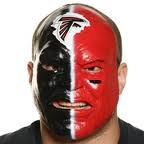
Falcon fan face painterImmersing one’s self in the world of sports’ super fandom can be stressful, for a super fan is required to remain perpetually unsatisfied with their team’s progress, regardless how well they do. A super fan is never happy. A casual sports fan can enjoy a good tussle between two opponents, measuring one another’s physical abilities, but a super fan doesn’t enjoy a good game that involves their team, unless their team blows the other team out. Close games are stressful, as they suggest an obvious deficiency in their team that must be rectified before the next game. Unadulterated blowouts confirm superiority.

A coach says they’re not satisfied with their team’s accomplishments, and the teams’ players echo this sentiment. The two factions echo this sentiment so many times that super fans have now incorporated it into their “we” lexicon. I can understand a player, or a coach, issuing such statements, for they are always on trial, they are always pushing themselves to be better today than they were yesterday. It’s the very essence of sports for the participants to remain unsatisfied. Why does this mentality also have to exist for those of us who are watching them on TV? A super sports fan doesn’t question why they have this mentality, they just have it.

Most normal people regard watching sports as a frivolity, a conversation piece to engage in with friends and family. To them, sporting events provide a simple event, or an excuse, to get together with friends and family. For these people, sports is little more than background noise that cover the lulls that may occur at get-togethers. They may keep up on some sport’s headlines, but they often do so to engage in superficial, meaningless conversations. They also use what little knowledge they have to needle the obnoxious diehards on their team’s loss.

There’s nothing wrong with this needling on the surface. Needling is what super sports fans do to one another, but in the world of super sports fans everyone has something on the line. When you mock a super sports fan’s team, you had better be ready to take as well as you give for a super sports fan will always come back ten times as hard. It’s as much a part of the super sports fan culture as watching the sport itself. For the non-sports fan, for whom sports is but a casual conversation piece, needling a super sports fan is revenge for all the years that super sports fans have ridiculed them for being non-sports fans, or if they haven’t been ridiculed, they have at least been ostracized from the all of the conversations that revolve around sports, and they’ve built up some resentment for sports fans that comes out in these needling sessions. It also gives them great joy, when the conversation turns back on them, and the super fan says, “Who’s your favorite team?” that they don’t have one. The fact that they don’t have one gives them an immunity card against reprisals. It’s what they’ve dreamed of dating back to their pre-pubescent days when their peers ridiculed them for preferring Star Wars and Lego to sports.

In the world of the super fan, it is seen as a testament to their character that they remain unsatisfied with their team’s performance? Even a fan of a traditional doormat, such as the Atlanta Falcons, is informed that the best record in the regular season should mean nothing to them, and their first playoff victory in almost a decade should mean nothing to them. You want that ring. If we’re in any way happy with the progress they’ve made, we’re satisfied, and being satisfied equates to being weak, and soft, and everyone around us knows this, and they won’t have much time for us if we don’t demand perfection of our team.

I once heard that the reason the Chicago Cubs are perennial losers is that their fan base will turn out regardless how they perform. I’ve heard it said that they’re more concerned with beer than baseball, and that they enjoy the confines of Wrigley Field more than they do a winner. There is a certain amount of truth in this when one considers the actual attendance figures in Wrigley Field, of course, but are they saying that a Cubs’ General Manager is apt to forego a prized free agent signing, because he knows that the fans will show up anyway? Is a manager going to inform the organization that he is not going to call up a star prospect, because he knows that the fans will show up regardless if the team is better or not? Their job is on the line every year. Get in the playoffs or get out is the motto in most of professional sports, and I dare say this is no different in Chicago regardless of their team’s ‘lovable loser’ tradition.

The radio show host who said this about the Cubs was making a general point that there isn’t the sense of urgency in the Cubs organization that there is in the Yankee organization. Yankee fans are adamant that their team win the World Series every year, and they’re quite vocal with their displeasure when the organization puts anything less than a championship team on the field. I can’t say that this is without merit, but should this same requirement be made of the fan sitting in a bar discussing sports with a fellow super fan? Why is it elemental to the respect of his peers that the super fan maintain an unsatisfied persona to maintain the respect of his super fan friends?

Super fans who have listened to sports talk radio for far too long, have had it pounded into our head that there’s no glory in meaningless victories … if you don’t have that ring. If you were a Buffalo Bills fan, in the 90’s, and you were happy with an appearance in the Super Bowl for four straight years, you were soft, because those teams lost all of those Super Bowls. The super fan of the Bills would’ve preferred that the Bills failed to make it to the playoffs in the face of all that losing. That was embarrassing. The Bills proved to be historic choke artists. Nothing more. It didn’t matter to the superfan that they were able to do something unprecedented when they made it to the Super Bowl again, after three consecutive losses. They lost the fourth one too! Bunch of choke artists is what they were.

Did it matter to anyone that the Atlanta Braves made it to the playoffs fourteen consecutive years in a span that stretched from the 90s to the 00s? It didn’t to the super fan. They grew tired of all that losing. Did it matter to the super fan that they made the NLCS nine out of ten years? It did not. Did it matter that they made it to the World Series in five of those years? If you’re a loser it did. They won one World Series throughout this stretch, and the super fan remained unsatisfied throughout.

“No one remembers the team that lost in the championship.” “One team wins, and the other team chokes.” These are some of the most common tropes of the language of the super fan that you’ll have to adopt, if you ever hope to garner the type of respect necessary to sit with super fans in bars discussing sports.

If our team loses, but we’re satisfied just to be there, that says something about our character. In these conversations, we are our team, and our team is us. If such conversations make us uncomfortable, the best way for us to retain our identity will be to distance ourselves from our team by informing our friends that we disagreed with a move or a decision that they made, but often times this is not enough to leave us unscathed. Regardless what we say, we cannot avoid having them consider us a choke artist based on the fact that our team “choked” in the championship. We could switch teams, of course, but that is what super fans call a fair weather fan, and a fair weather fan is the lowest form of life in the world of super fandom, save for the needling non-fan. Our best bet is to just sit there and take it. Our friends will enjoy that a lot less than our struggle to stick up for our team.

Even if our team wins it all, we super fans will have no glory. We’re never satisfied, and winning it all for one year, just means that our concentration flips to next year. We don’t just want a championship, back-to-back championships, a three-peat, and then a dynasty. The definition of a dynasty is also perpetually beyond reach, as it is often relative to the individual and often only assigned in the death of the dynasty. By that point, however, we can only reminisce about what once-was, which is a horrible feeling for the superfan.  

The true fan is the superfan, always seeking definition of their character through constant calls for perfection. Even if their team wins a championship, they didn’t win by much. Our team should’ve slaughtered that bunch-a-losers. There is always room for improvement, and we’ll scour the draft pool and the free agent list, to find that perfect component for next year’s run. If our team doesn’t do what we think they should do, we gain some distance by proclaiming that the team doesn’t know what they’re doing. We know this because we’re super fans, but most of us have never played the game, or had to deal with team play, salary caps, or prima donnas who generate excellent stats with no regard for the team.

The one thing that every fan, and every super fan, should be required to recite before every game is “You’re just a fan”. I don’t care if you wear your hat inside out and backwards, or you sit on half a cheek for a week, and you don’t speak of your team’s progress for fear of jinxing them, you’re just a fan. I don’t care if you have seven different jerseys for the seven days of the week, that you paint your face, or brave the cold and go shirtless. You’re just a fan. You’re no more instrumental in the way they play the game than the guy at the end of the bar who doesn’t care for sports. So, does this line of thought make it any easier to be a super fan? It does not, because as a super fan, we know that our reputation is on the line every time our team takes the field, court, diamond, or rink. We know that our friends are just dying to call our team (i.e. you) a loser, a choke-artist, and that can make it super stressful to be a super fan.

Are You Competitive?

“I’m sorry I’m just sooo competitive,” Mark said after yelling in anger because our favorite team lost a game on the television set (TV). As men, we’re biologically predisposed to respect competitive men, but Mark was so competitive that he couldn’t control his anger over images on a TV screen. Is that odd? I never thought of it as odd, my whole life, until Mark did it. ‘Who cares if you’re competitive while watching a game on TV?’ I thought in Mark’s general direction. Don’t get me wrong, I’ve said it, and I’ve heard maybe a hundred people say it before Mark, but for some reason it struck me as so odd when he said it. I don’t know if it was how Mark said it, the environment around us, or our respective ages, but this moment opened my mind’s eye to the foolish nonsense I believed about my sense of competitiveness when it came to watching images on the screen wear my favorite laundry.  

I’ve recently discovered that it doesn’t matter how competitive I am watching while my favorite teams play sports on TV. I used to think it was a testament to my character that I refuse to accept second place from my teams. “It says a lot about you that you’re willing to accept just being in the championship game,” those who watch sports say. “You should want to win that championship game.”  

You do understand that I’m not playing in that championship game,” I told one friend to try to calm myself. It worked, and I use this line now when someone confronts me about my team losing a game. Of course I want my team to win that championship game, I want my team to win every single game, but what do I do if they don’t? What do I do if they do? It turns out, I’m not playing in that game, and it doesn’t matter what I do, it doesn’t matter what I think, and my emotional investment in my team will not affect how they play. If my team is in a championship game, it’s the team I chose to support that is. What that in mind, we need to mentally rewrite what those who watch sports say, “It says a lot about you that you’re willing to accept that your favorite team is in the championship game,” those who watch sports say. “You should want your favorite team to win that championship game.” 

We all know and love the “WE” jokes. A guy watches too much sports for too long, and he accidentally, incidentally becomes a part of that team. “WE” can’t help it. “WE” love them so much that when we watch them on the screen “WE” know when we need to run the ball more often, “WE” know when we need to put the ball in the paint more, and “WE” know what everyone else knows … we really need a hit here.” We want our favorite team to win so badly that we scream out hundreds of miles away from the players, in a bar of unsuspecting customers after “WE” make a horrible mistake, and we apologize after our embarrassing display, “I’m sorry, I am just so competitive.” Does it really matter how competitive we are while watching sports on TV? Does it really matter to anyone that we’re not able to accept second place, a “good” season, a “good” game, or anything less than absolute domination of the opponent in a championship game.  

One key component to the fanaticism of the typical fan is the underlying psychology of said fan. I can only use my own embarrassing rage as an anecdotal example. When I was most unsatisfied with my life, I was a raging fan. To my embarrassment, I would have anxiety issues watching another slow progression of my team losing a game. I was miserable to be around. I scared my dog, and my wife no longer enjoyed watching sports with me. Now that I’m more satisfied with the general direction of my life, I’m finally starting to see how foolish it was that I got SO UPSET!!! over some team losing a game on a television program. I love sports, always have, always will, but I don’t know if I really enjoyed watching sports.  

I hear what my new friends like Mark say, but I hear it from a newfound perspective, and I cannot believe how foolish I used to be. When one of my teams just barely lost the championship on a last second field goal, I left the party and drove home, “Because I didn’t want to sit there and talk about how close we were to finally winning our first championship in my lifetime.” I didn’t want to talk about the loss, but we probably would’ve spent three minutes talking about it and move on. The thing about my childish temper tantrum was that it was caused by a television program not turning out the way I wanted.  

Throughout my life, I’ve thrown remote controls across the room, and I got mad at a fella who said, “Well, it was a good game.” I didn’t want a good game, I told him, I wanted my team to win. Then, after one of my teams finally FINALLY won a championship, I remained purposefully and stubbornly unsatisfied, because I wanted to focus on next year. I thought about the natural attrition of losing some talent, and how we were going to replace them, and if we had a chance at a repeat. When we repeated, I wanted a three-peat, and I was miserable when that didn’t happen. Being a super sports fan should be fun and enjoyable, but it’s not, and if you take it as far as I did, it can actually make you a little miserable.   

I’ve recently discovered that it doesn’t matter how competitive I am while watching my favorite teams engage in sporting activities on the television set. It doesn’t will them to win, it doesn’t exert some force on them to do better when I steadfastly refuse to accept a mere winning season, a post-season appearance, or second place from my teams. “It says a lot about you if you’re willing to accept being in the championship game,” we super-sports fans say to establish our bona fides in our group. “WE” want to win that championship game every…singletime!”  

Of course I want my team to win that game, I want my team to win every single game, but what do I do if they don’t? What do I do if they do? It turns out, I’m not playing in that game, and it doesn’t matter what I do, it doesn’t matter what I think, and my emotional investment in my team will not affect how they play in any way. If my team is in a championship game, it’s the team I choose to support that is in a championship game. I’m not playing in this game, and their performance is not a reflection on my character, and if we they make a mistake, it is not a statement on our my ability in any way, and the outcome of this game should have no bearing on my emotional stability. What that in mind, we need to mentally rewrite what those who watch sports say, “It says a lot about you that you’re willing to accept that your favorite team is in the championship game. You should want your favorite team to win that championship game.” I know this sounds odd, but some sports fans need to learn to detach themselves from the “WE” mind meld that leads them to say, “I’m sorry, I am just so competitive,” when watching a game on TV. 

One key component to the fanaticism of the typical fan is the underlying psychology of said fan. I can only use myself as an anecdotal example. When I was most unsatisfied with my life, I was a raging fan. To my embarrassment, I would have anxiety issues watching another slow progression of my team losing a game. I was miserable to be around. I scared my dog, and my wife lost her love of watching sports with me. Now that I’m more satisfied with the direction of my life, I’m finally starting to see how foolish it was that I got SO UPSET!!! over my team losing a game on a television program. I love sports, always have, always will, but I don’t know if I ever really enjoyed watching sports.  

I hear my friends now from my newfound perspective, and I realize how foolish I was. When one of my teams just barely lost the championship on a last second field goal, I left the party and drove home, “Because I didn’t want to sit there and talk about how close we were.” I threw my remote control across the room after we choked another game away, and I got mad at a fella who said, “Well, it was a good game.” I didn’t want a good game, I told him, I wanted my team to win. Then, after one of my teams finally FINALLY won a championship, I remained purposefully and stubbornly unsatisfied, because I wanted to focus on next year. I thought about the natural attrition of losing some talent, and how we were going to replace them, and if we had a chance at a repeat. When we repeated, I wanted a three-peat, and I was miserable when that didn’t happen. Being a super sports fan should be fun and enjoyable, but it’s not, and if you take it as far as I did, it can actually make you a little miserable.