The True Thief’s Mentality


“Why do you watch such awful shows about such awful people?” our mother asks us. “Even the comedies you love are about awful people doing awful things to one another.”

“It’s complicated.” We say that because that’s what the critics call the complicated characters of Pulp FictionThe Sopranos, and Breaking Bad. They call them complicated characters, because they’re good guys, family men in some cases, who just happen to do bad things. It might be complicated for them, but it’s pretty simple for us. We love criminality, violence, and a general stench of awfulness in our entertainment vehicles.

“If it doesn’t have some violence, or the threat thereof, we’re kind of bored,” a friend of mine said to wrap it all up for me. Is that so complicated it’s simple or so simple it’s complicated. We let those who concern themselves with such matters resolve those heady concepts, we just know we love reading watching, listening, and playing games that are violent in nature.

The funny thing is an overwhelming majority of us haven’t even considered using violence to solve our problems since our kindergarten teacher scolded us for doing so. We also pick up on their bizarre, cringey, and hilarious justifications, “He had to do it ma’, that guy just ate some of his peanut butter without asking. It’s about respect.” Yet, we only apply it to fictional characters in fictional settings.  

“I only take from the rich,” is another justification the modern thief uses, in modern movies, to establish their nobility. ‘Fair enough,’ viewers at home might say if we accidentally view their actions in an objective manner, ‘but who are the rich?’ Gilligan’s Island prototypes dance in our heads when we think of “the rich”, but the rich guy demographic is actually a pretty broad category. It can include “evil” hedge fund managers who short-sell a company into oblivion and devastate its employees, but it can also include the little old lady who scrimped and saved her whole life, so she didn’t have to work when she became frail and feeble. We don’t want to think about the latter, because they don’t fit the Robin Hood myth that thieves only steal from the obnoxiously rich to level the unfair playing field by giving it to the poor, and overcomplicating such simple matters does ruin movies. 
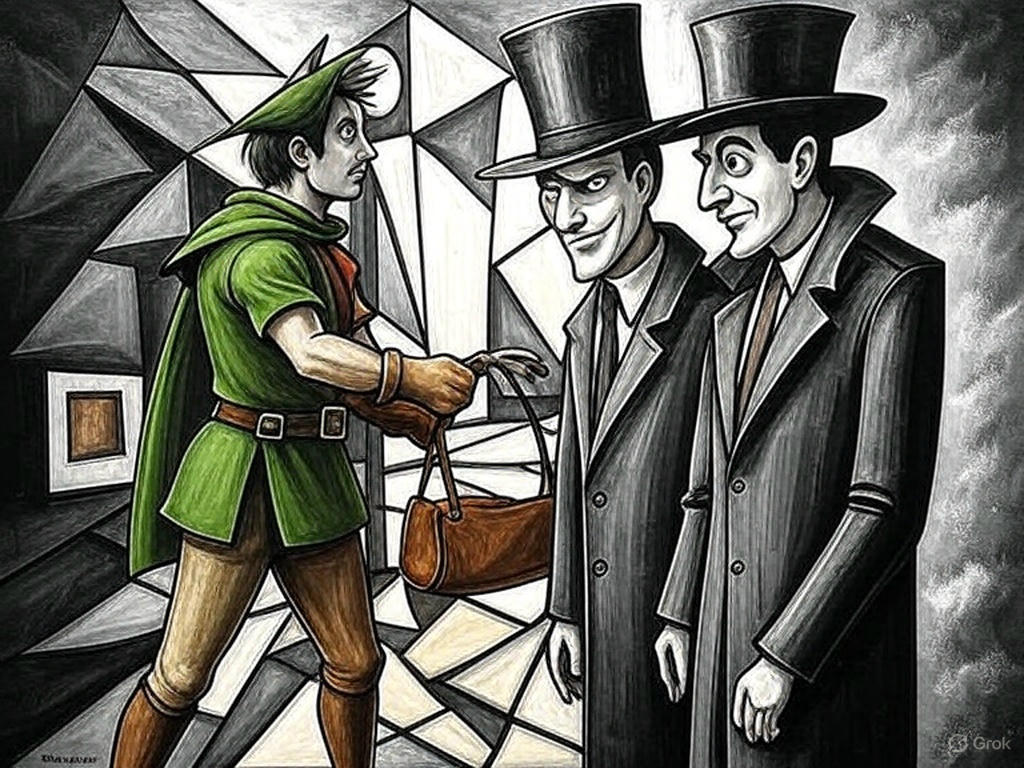
The thing with the Robin Hood myth that permeates so many of our favorite stories about thieves is that our more modern interpretations have twisted the original tales. We can’t call these modern portrayals wrong, because there’s no definitive evidence to suggest that an actual Robin Hood ever existed. Yet, the current interpretations are very different from the original English ballads and poems about this fictional character. They referred to a Robin Hood who stole from corrupt government officials who overtaxed and overregulated their constituents. These pre-Victorian-era English ballads and poems of Robin Hood detail how the Sheriff of Nottingham and the abusive local authorities overtaxed and over regulated their constituents to empower the government and line the government officials’ pockets. Why did this fictional hero prove so popular? Were the governments of this era too powerful? Were the people of Robin Hood’s era so overtaxed and over regulated that they were so reliant on government that they needed a hero to take that money and power back? 

These government officials became “the rich” by stripping their constituents of financial freedom through confiscatory taxes and burdensome regulations, and Robin Hood stole in back. For whatever reason, the Victorian-era fiction writers began leaving out the idea that the rich were government officials, and their bad guys were those individuals who amassed their own wealth. We don’t know why the Victorian-era writers rewrote the tale to leave out government officials, so we can only speculate that it either fit their worldview to do so, or they feared reprisals from their own government officials.

The altruistic, Robin Hood-style thief who steals from the rich and gives to the poor is such a romantic figure that we forget that some thieves steal stuff just because they want other people’s stuff. We think it says something about us that we assign noble goals to thievery. “They are only doing it to feed their children.” Some are, of course, but how many steal for the Thrill of it All? How many steal, because “He has so much that he won’t even miss it.” How many thieves “only steal from bad guys”? How many steal, because they think they deserve to have nice things? It is complicated in some cases, but in others, it’s actually quite simple.

No writer is going to write a story about a thief who just wants to steal things though. That would deprive their story of romantic and/or empathetic attachments. We want our fictional thieves, mass murderers, and other assorted criminals to be noble when they inflict pain on other people. Yet, we don’t need to read Dostoyevsky to understand that no thief considers themselves the bad guy in their autobiographical tale. All we need to do is listen to them. AsSocrates once said, “No one knowingly commits an evil action. Evil is turned into good in the mind.” They just have a want, and a want can easily be twisted into a need for those who want/need the justification. 

In the modern landscape, writers climb all over one another to depict the “gritty reality that no one wants to hear.” Yet, when they have their complicated characters say, “I only take from the rich,” they only have their characters steal from hedge fund managers who have yachts and second and third homes. I’ve never stolen from a hedge fund manager, but I have to imagine it’s not only very difficult, it’s fraught with peril. I have to imagine that most hedge fund managers have the best and most updated security systems set up in their homes and to guard their internet activity, and they also have a team of lawyers on retainer who are always on the lookout for cases to justify their existence. Thus, not only would it prove more difficult for the thief to steal from hedge fund managers, if they get caught, they know their prosecutors will be high-priced lawyers who know how to secure justice. 

Like the great white shark and the mountain lion, most thieves don’t act impulsively. They don’t want to get hurt, and they don’t want to get caught, so they profile their victims and stalk their prey, studying their practices and patterns for vulnerabilities. They want to know how easy it’s going to be to steal. If they’re able to steal something, they’d prefer victims who don’t have the money or the wherewithal to prosecute them. Thus, most real-life thieves aren’t as likely to pursue the noble cause of stealing from a hedge fund manager. They’d prefer to go after a little old lady’s life savings.   

No thief ever says anything along the lines of, “I’m actually a bad guy, and I have no qualms about saying that. I don’t care who I have to steal from, I’ll steal from my own mother if it means avoiding having to go to work. Say what you want about stealing, but it is so much easier than working for a living. People who work are such saps, especially when there are so many vulnerable people in the world who have so much stuff worth stealing. Hey, I know my soul is tainted, and it has been for most of my life. I’m just a bad person who enjoys hurting people financially. If I have to hurt them physically to get what I want, I will, but that’s not my go-to. And if there is an afterlife, I know I’m going to pay, probably for the rest of eternity, so I’m just going to enjoy this life while it lasts.” 

If no writer would have their beloved main character say such a thing, how about they have their thief drop all the typical “steals from the rich and gives to the poor” mythical justifications on us, and then steal from frail, little old ladies? To our complicated character, this would be true, technically, as the little, old lady in our production would be rich, and our thief would be poor. 
In our “gritty, real-life” production, the thief would get caught, and he would manipulate our thought patterns by complaining about the rough treatment he received from the arresting officers, the conditions of their jail cell, and how the judge took away their phone privileges. If a book captured that effectively and creatively established our otherwise sympathetic character saying a line like, “I only steal from frail, vulnerable old women because it’s easier and they don’t fight back. They just scream a lot about how I’m stealing their life’s savings and all that, and I find their tears delicious.” That book would not sell well, because it would be so confusing. 

I think it’s safe to say that we’re accustomed to our “bad guys” turning out to be the production’s most virtuous character when the smoke clears, and the generally agreed upon “good guy” being found out to be the complicated character in the end. We don’t want our favorite bad guys to hurt genuinely nice people just for the money. We also don’t want to learn a lot about the victims. We prefer they be largely faceless entities and corporations that have no people involved, or unattractive people who haven’t bothered to monitor their diets well. We prefer that the author avoid characterizing them, so we can enjoy the violent thefts without having to go through the guilt of watching the victims suffer. Or, if they’re going to characterize them, we prefer the victims be bad guys that no one but our very perceptive thief knows is a bad guy, because he’s done his research. We want those “good guys” who are actually bad to pay, because that’s the typical duality we’ve come to expect in our modern movies.

Some thieves experience remorse for their actions, some regret getting caught, but our psychopathic thief would prefer to steal from the lemonade stands that seven-year-olds set up, because that’s easy money. “I love money. I don’t care how I have to get it. I love money.” Our complicated character would characterize that seven-year-old, lemonade stand’s lead entrepreneur as a bad girl, because he considered her so aggressive that she was likely a bully. Then, on his death bed, our complicated thief would steal something from the dying patient with whom he was forced to share a hospital room. As our movie closes, his theft is discovered, and one of his nephews turns to the thief’s wife, hugs her, and says, “Well, he died doing what he loved.” Now that would be “a gritty taste of reality that would unnerve audiences about the reality of our world.” 

Whenever I sit through one of these modern portrayals of the nobility of the thief, the Robin Hood-style tales, I think about every thief I’ve encountered. They’re not prejudicial about choosing victims, as long as it’s easy, and they don’t give the proceeds from their theft to anyone, poor or otherwise, because, for all intents and purposes, they consider it theirs now. “I went to all the trouble of planning this, and I put my can on the line to get it. If they want theirs, they gotta go get it themelves!”  

I know my experiences with criminals, thieves, and fraudsters are anecdotal, but I worked in the fraud division of a huge company, and I spoke with hundreds of victims and alleged perpetrators on a daily basis. Those who created our website gave these thieves the opportunity to be an anonymous figure who could try to rip off other anonymous people in almost total anonymity. They weren’t ripping off a Helen Otterberg form Pocatello, Idaho, in their mind, they were ripping off a faceless, Hotter@internetcompany.com entity. They weren’t Steve Jurgensen from Loch Arbour, New Jersey, in their mind, they were Imhotep@othercompany.com. The anonymity, relieved the alleged perpetrators from the feelings of remorse or guilt they may have felt if they actually saw Helen. Well, I spoke to the Helens of the world, some of them were little old ladies who were a little careless with their information, and they didn’t the first thing about spotting fraud on the internet. The Steves didn’t hear the fear and sadness I heard on the other end of the line, and some of them may not have cared if they had. They believed they could use the anonymity inherent in the platform my bosses created to steal as much money as possible. 

Our fraud teams stopped an overwhelming amount of money from being withdrawn from our system into the fraudsters’ bank accounts, but we did not seek law enforcement’s assistance, unless the fraudster’s activity reached very specific levels. Thus, it was on the victim to seek further action, and in my experience few of them did. They considered it our job to stop the money, and it was, but once we completed our job, the matter was basically closed as far as most victims were concerned, and the victim and the alleged perpetrator learned something from the experience, and they both adjusted accordingly. As I wrote, these experiences are all anecdotal, but my experiences with friends who stole stuff, and my work in a fraud unit, gave me a better taste of the true thief’s mentality than most will ever have. 

Even with experiences that differ from what screenwriters portray on screen, I still love fictional violent crime dramas. I think The Godfather and II, Goodfellas, Pulp Fiction, Breaking Bad, Better Call Saul, and The Sopranos are some of the greatest productions of all time. I also love their cringey, complicated moral relativism, their attempts to achieve nobility, and the excuses these characters use to absolve themselves of wrecking so many lives with their actions. Yet, I absolve myself for ever flirting with the notion that their actions were justified by saying I don’t believe in the supernatural beings with supernatural powers, but if I know if I want to enjoy a movie about them, it’s incumbent upon me to suspend my disbelief for as long as it takes to enjoy the movie.  

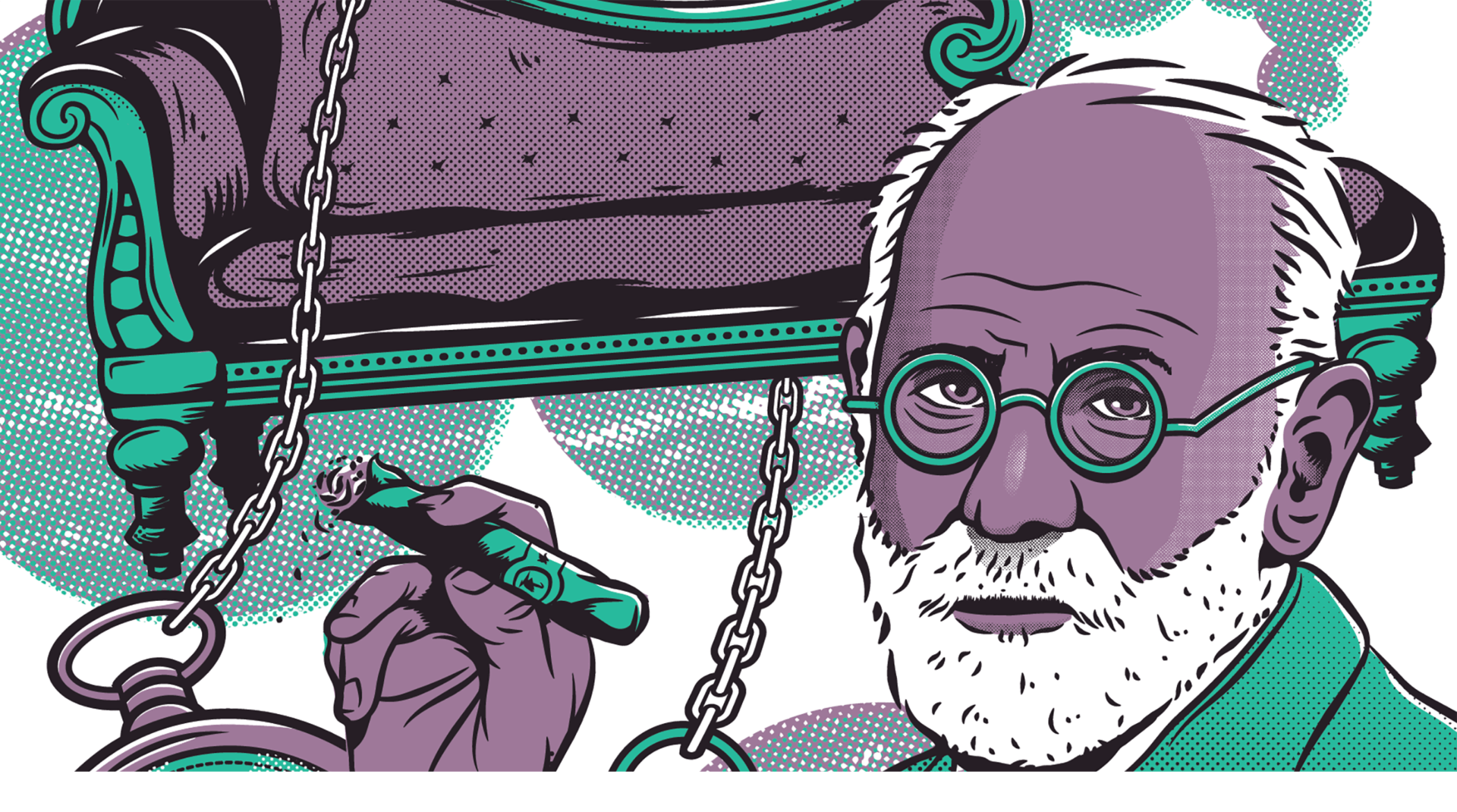
Don’t Go Chasing Eel Testicles: A Brief, Select History of Sigmund Freud


We envy those who knew, at a relatively young age, what they wanted to do for a living. We may have experienced some inspirations along the way, but we either lost interest quickly, or we never follow through. Whatever the case was, no one I know read medical journals, law reviews, or business periodicals in our formative years. We preferred reading the latest NFL preview guide, a teenage heartthrob magazine, or one of the many other periodicals that offer soft entertainment value. Most of us opted out of reading altogether and chose to play something that involved a ball. Life was all about fun for the kids in our block, but there were other, more serious kids, who we wouldn’t meet until we were older. They may not have known they would become neurosurgeons, but they were so interested in medicine that they devoted huge chunks of their young lives to learning everything their young minds could retain. “How is that even possible?” we ask. How are they able to achieve that level of focus when they were so young? Are we even the same species?

At an age when we’re so unfocused, some claim to have had tunnel vision. “I didn’t have that level of focus,” some said to correct the record, “not the level of focus to which you are alluding.” They might have diverged from the central focus, but they had more direction than anyone we knew, and that direction put them on the path of doing what they ended up doing, even if it wasn’t as specific as we might guess.

The questions regarding what we should do for a living has plagued so many for so long that comedian Paula Poundstone captured it with a well-placed joke, and I apologize, in advance, for the creative paraphrasing: “Didn’t you hate it when your relatives asked what you wanted to do for a living? Um, Grandpa I’m 5. I haven’t fully grasped the importance of brushing my teeth yet. Now that I’m forty, I’ve finally figured out why they asked that question,” Paula Poundstone added with a comedic pause. “They were looking for ideas.”

Pour through the annals of great men and women of history, and you’ll find that some of the greatest minds of science didn’t accomplish much of anything until late in life. Your research will also show that most of the figures who achieved success in life were just as dumb and carefree as children as the rest of us, until something clicked. Some failed more than once in their initial pursuits, until they discovered something something that flipped a switch.

Even those who know nothing about psychology, know the name Sigmund Freud. Those who know a little about Freud know his unique theories about the human mind and human development. Those who know anything about his psychosexual theory know we are all repressed sexual beings plagued with unconscious desires to have relations with some mythical Greek king’s mother. What we might not know, because we consider it ancillary to his greater works, is that some of his theories might have originated from Freud’s pursuit of the Holy Grail of nineteenth-century science, the elusive eel testicles.

Although some annals state that an Italian scientist named Carlo Mondini discovered eel testicles in 1777, other periodicals state that the search continued up to and beyond the search of an obscure 19-year-old Austrian’s in 1876.[1] Other research states that the heralded Aristotle conducted his own research on the eel, and his studies resulted in postulations that stated either that the beings came from the “guts of wet soil”, or that they were born “of nothing”.[2] One could guess that these answers resulted from great frustration, since Aristotle was so patient with his deductions in other areas. On the other hand, he also purported that maggots were born organically from a slab of meat. “Others, who conducted their own research, swore that eels were bred of mud, of bodies decaying in the water. One learned bishop informed the Royal Society that eels slithered from the thatched roofs of cottages; Izaak Walton, in The Compleat Angler, reckoned they sprang from the ‘action of sunlight on dewdrops’.”

Before laughing at these findings, we should consider the limited resources those researchers had at their disposal. As is oft said with young people, the young Freud did not know enough to know how futile the task would be when a nondescript Austrian zoological research station employed him. It was his first real job, he was 19, and it was 1876. He dissected approximately 400 eels, over a period of four weeks, “Amid stench and slime for long hours” the New York Times wrote to describe Freud’s working conditions. [3] His ambitious goal was to write a breakthrough research paper on an animal’s mating habits, one that had confounded science for centuries. Conceivably, a more seasoned scientist might have considered the task futile much earlier in the process, but an ambitious, young 19-year-old, looking to make a name for himself, was willing to spend long hours slicing and dicing eels, hoping to achieve an answer no one could disprove.

Unfortunate for the young Freud, but perhaps fortunate for the field of psychology, we now know that eels don’t have testicles until they need them. The products of Freud’s studies must not have needed them at the time he studied them, for Freud ended up writing that his total supply of eels were “of the fairer sex.” Some have said Freud correctly predicted where the testicles should be and that he argued that the eels he received were not mature eels. Freud’s experiments resulted in a failure to find the testicles, and he moved into other areas as a result. What kind of effect did this failure have on Freud, professionally and otherwise? 

In our teenage and young adult years, most of us had low-paying, manual labor jobs. We did these jobs to get paid when no one else would pay us. We bussed tables, took bags to hotel rooms, parked cars, and did whatever we had to to get paid. Our only goals in life were to do the job well enough to keep the boss off our back. We had no direction, and no one I know did what they did to end up in the annals of history. When we got fired or quit, we just moved onto the job that paid us more. We didn’t think about rewarding or fulfilling. We just knew we didn’t want to do that (whatever we did in the first job) anymore. 

Was Freud’s search for eel testicles the equivalent of an entry-level job for him, or did he believe in the vocation so much that his failure devastated him? Did he slice the first 100 or so eels open and throw them aside with the belief that they were immature? Was there nothing but female eels around him, as he wrote, or was he beginning to see what plagued the other scientists for centuries, including the brilliant Aristotle? There had to be a moment, in other words, when Sigmund Freud realized that they couldn’t all be female. He had to know, at some point, that he was missing the same something that everyone else missed. He must have spent some sleepless nights struggling to come up with a different tactic. He might have lost his appetite at various points, and he may have shut out the world in his obsession to achieve infamy in marine biology. He sliced and diced over 400 after all. If even some of this is true, even if it only occupied his mind for four weeks of his life, we can imagine that the futile search for eel testicles affected Sigmund Freud in some manner.

If Freud Never Existed, Would There Be a Need to Create Him

Every person approaches a topic of study from a subjective angle. It’s human nature. The topic we are least objective about, say some, is ourselves. Some say that we are the central focus of speculation when we theorize about humanity. All theories are autobiographical, in other words, and we pursue such questions in an attempt to understand ourselves better. Bearing that in mind, what was the subjective angle from which Sigmund Freud approached his most famous theory on psychosexual development in humans? Did he bring objectivity to his patients? Could he have been more objective, or did Freud have a blind spot that led him to chase eel testicles throughout his career in the manner Don Quixote chased windmills?

After his failure, Sigmund Freud would switch his focus to a field of science that would later become psychology. Soon thereafter, patients sought his consultation. We know now that Freud viewed most people’s problems through a sexual lens, but was that lens tinted by the set of testicles he couldn’t find a lifetime ago? Did his inability to locate the eel’s reproductive organs prove so prominent in his studies that he saw them everywhere he went, in the manner that a rare car owner begins to see his car everywhere, soon after driving that new car off the lot? Some say that if this is how Freud conducted his sessions, he did so in an unconscious manner, and others might say that this could have been the basis for his theory on unconscious actions. How different would Freud’s theories on sexual development have been if he found the Holy Grail of science at the time? How different would his life have been? If Freud found fame as a marine biologist with his findings, he may have remained a marine biologist.

How different would the field of psychology be today if Sigmund Freud remained a marine biologist? Alternatively, if he still made the switch to psychology after achieving fame in marine biology, for being the eel testicle spotter, would he have approached the study of the human development, and the human mind from a less subjective angle? Would his theory on psychosexual development have occurred to him at all? If it didn’t, is it such a fundamental truth that it would’ve occurred to someone else over time, even without Freud’s influence?

We can state, without fear of refutation, that Sigmund Freud’s psychosexual theory has sexualized our beliefs about human development, a theory others now consider disproved. How transcendental was that theory, and how much subjective interpretation was involved in it? How much of the subjective interpretation derived from his inability to find the eel testicle? Put another way, did Freud ever reach a point where he began overcompensating for that initial failure?

Whether it’s an interpretive extension, or a direct reading of Freud’s theory, modern scientific research theorizes that most men want some form of sexual experience with another man’s testicles. This theory, influenced by Freud’s theories, suggests that those who claim they don’t are lying in a latent manner, and the more a man says he doesn’t, the more repressed his homosexual desires are.

The Williams Institute at UCLA School of Law, a sexual orientation law think tank, released a study in April 2011 that stated that 3.6 percent of males in the U.S. population are either openly gay or bisexual.[4] If these findings are anywhere close to correct, this leaves 96.4 percent who are, according to Freud’s theory, closeted homosexuals in some manner. Neither Freud nor anyone else has been able to put even a rough estimate on the percentage of heterosexuals who harbor unconscious, erotic inclinations toward members of the same sex, but the very idea that the theory has achieved worldwide fame leads some to believe there is some truth to it. Analysis of some psychological studies on this subject provides the quotes, “It is possible … Certain figures show that it would indicate … All findings can and should be evaluated by further research.” We don’t know in other words, there’s no conclusive data and all findings and figures are vague. Some would suggest that the facts and figures are so ambiguous that Freud’s theories were nothing more than a provocative and relatively educated and subjective guess.[5]

Some label Sigmund Freud as history’s most debunked doctor, but his influence on the field of psychology and on the ways society at large views human development and sexuality is indisputable. The greater question, as it pertains specific to Freud’s psychosexual theory, is was Freud a closet homosexual, or was his angle on psychological research affected by his initial failure to find eel testicles? To put it more succinct, which being’s testicles was Freud more obsessed with finding during his lifetime?


[1]https://en.wikipedia.org/wiki/Eel_life_history

[2]http://www.theguardian.com/environment/2010/oct/27/the-decline-of-the-eel

[3]http://www.nytimes.com/2006/04/25/health/psychology/analyze-these.html

[4]https://en.wikipedia.org/wiki/Demographics_of_sexual_orientation

[5]http://www.pbs.org/wgbh/pages/frontline/shows/assault/roots/freud.html

The Thief’s Mentality


The best thief I ever knew accused me of stealing, lying, and cheating so often that I began to question my integrity. A woman I dated cheated on me so often that I’m still embarrassed that I wasn’t more aware of her infidelities. Her octopus ink involved her accusing me of cheating on her, and she did it so often that I forgot to pay attention to what she was doing to me. If their goals were to prevent me from analyzing them, they did an excellent job because I spent most of my time defending myself around them. Some might call what they did projection, others might call it deflection or obfuscation, but I believe the games these people played fall under a comprehensive, multi-tiered umbrella I call the thief’s mentality.

Kurt Lee introduced me to the confusing mind of a deceptive person. The art of deception was such a key component of his personality that he thought he was able to spot transgressions gestating in the minds of those around us. In the manner a professional saxophone player spots nuances in the play of another, Kurt Lee spotted the intricacies of manipulation around him, and he did so from the same angle of admiration. Yet, he put so much effort and focus into tuning into their frequencies that his instincts often led him astray.

Kurt taught me more about deception than any other person I’ve encountered, movie I’ve watched, or book I’ve read on the subject. He would serve as my prototype for those who would exhibit a wide array of similar traits, traits I would only later deem the characteristics of the thief’s mentality.

The most interesting aspect about him, a characteristic that might defy that which I will describe throughout this piece, was his charm. When it served him, Kurt Lee could be the nicest, most engaging, and infectious person you’ve ever met. He was also a funny guy, and genuinely funny types have a way of disarming us, unless we stick around long enough to learn more about the games they play.

Those who knew Kurt Lee, on a superficial level, envied him for the ways in which he openly defied authority figures without guilt. Those who actually spent as much time around Kurt Lee as I did, however, witnessed that for all the charisma a piece of work (POS) displays, they ultimately end up destroying themselves from the inside out.

One afternoon while on a city bus, Kurt decided to play with the crocheted ball on top of the stocking cap of the elderly woman who sat in front of him. My role in this spectacle may be one of the things I have to answer for on Judgment Day, because I found his appalling act hysterical.

I was young, we both were, but I was so fascinated by this that I now ask myself why? I was learning and learning takes all shapes. We learn Geometry, History, and what to do and what not to do from our peers. We also learn answers to the question of why a young male, in the prime of his life, shouldn’t play with ball atop an old woman’s stocking cap. We learn the difference between a Kurt Lee and ourselves, and the answers are fascinating. Is it all about morality, I asked myself, or does it have more to do with common decency? My mother taught me that when a young, healthy male sees an elderly woman sitting alone, he should smile at her and try to think up something kind to say to brighten her day. My mother taught me to hold the door for her, and she said that I should consider it a privilege to give up my seat to that woman on the city bus, if no other seats were available.

Not only did Kurt Lee ignore those conventions, he chose to pursue the opposite. He chose to violate the sense of security of one of most vulnerable member of our culture by playing with the ball atop her stocking cap. It was wrong on so many levels, of course, but it was also a fascinating exploration of human nature. How would this old woman react? How would a real POS counter her reaction? Why did he do it in the first place? Did he think he would get away with it? Did he even care? I would never know the answer to the latter questions, because I didn’t know Kurt on that level, but my fascination with the answers to the former led me to urge him on with laughter. That was wrong, too, of course, but I now believe my laughter was borne of curiosity. I wanted to learn more about the moral codes by which we all abide. I hoped to learn all that by watching another solidify my rationale, with no regard for the consequences of violating them. My thinking was not that complex, at the time, but I couldn’t wait to see how this episode would end, and I dare say that most of those who are more successful in abiding by the standards our mothers taught us would not have been able to look away either.

The vulnerable, elderly woman eventually turned on Kurt, and she did so with an angry expression. She allowed the first few flicks of the ball atop her stocking cap go, presumably taking a moment to muster up the courage to tell him off, and then she gave him that angry look. Kurt Lee appeared ready to concede to that initial, nonverbal admonition, until he saw me laughing. Egged on by me, he did it three more times before she reached a point of absolute frustration that led her to say something along the lines of, “Stop it, you young punk!”

To that, Kurt began thrusting his hips forward in his seat, while looking at me, whispering, “She just wants unusual carnal relations!” As a teenager trying to elicit more laughter from another teen, Kurt Lee did not use that term. He selected the most vulgar term he could to describe his extrapolation of her desires.

***

Had Kurt Lee decided to stick his middle finger up in the face of a healthier, younger adult, it would have been just as difficult to avoid watching. The fact that he chose such a sacred cow of our culture for his rebellion, however, made his actions over-the-top hilarious. In my young, unformed mind, this was a real life equivalent to David Letterman’s man-on-the-street segments, taken up ten notches on the bold-o-meter. I would later learn that Kurt’s motivations did not involve making profound statements about our societal conventions. He just did things. He was a doer, and doers just do what they do and leave all of the messy interpretations of what they do to others. I would later learn, by watching Kurt Lee, that he selected his victims based on their inability to fight back. In this vein, Kurt Lee was something of a coward, but I couldn’t know the full scope of Kurt Lee at the time. At the time, I found his actions so bold that I couldn’t look away, and I couldn’t stop laughing.

I encountered a wide variety of thieves in the decades that followed Kurt Lee, but they paled in comparison to his mentality, his philosophy, and what drove him to be so different from everyone I had ever met. To listen to him speak on the topic, however, there was nothing different about Kurt Lee. He believed he simply had the courage of his convictions. He ascribed to the more conventional line of thought that we were all afraid to be like him, but he added that the rest of us have had this part of our makeup denied to us by our parents and teachers for so long that we now believe we are different. The import of his message was that this was not about me, and it was not about him. It’s about human nature and the thief’s mentality.

“If you could get away with it, you’d do it too,” was his answer to questions we posed. “You mean to tell me you’ve never stolen anythingEver? All right then, let’s talk about reality.” Kurt Lee was a thief, and like most thieves, he did not defend his position from the position of being a thief. He would substitute an exaggeration of your moral qualms regarding thievery, claiming that any person who has stolen even once is in no position to judge someone who steals on a regular basis.

In short bursts, and on topic, Kurt Lee could lower the most skilled debater to the ground. We called him a master debater, with the innuendo intended, because it was almost impossible to pin him down on specifics. It was a joy to watch. Prolonged exposure, however, opened up all these windows into his soul.

When we asked him how a guy from the sticks could afford the latest, top-of-the-line zipper pants, a pair of sunglasses that would put an employed fella back two weeks’ pay, and an original, signed copy of the Rolling Stones, Some Girls. He would tell us, but even his most ardent defender had a hard time believing Santa Claus would be that generous to even the nicest kids on his list.

Kurt Lee stole so often by the time I came to know him, the act of shoplifting lost much of its thrill. He decided to challenge himself in a manner top athletes, and top news anchors do, by hiring third-party analysts to scrutinize the minutiae of their performance. He asked me to watch him steal baseball cards from a baseball card shop owner that we agreed needed to learn a lesson, because the man refused to buy our cards 99 percent of the time. On those rare occasions when he agreed to buy them, his offers were so low they were almost insulting.

I posed a theory about our transactions with this shop owner. I theorized that the intent behind his frequent refusals to buy our cards was to establish his bona fides as a resident expert of value. That way, when he informed us that any of our cards were of value, we were ready to jump at the chance, no matter what amount he offered. “By doing so,” I concluded, “he actually makes us feel more valuable, because we think we finally have something worthy of one of his offers.”

“You’re right,” Kurt Lee said. “Let’s get him.”

I felt validated for coming up with a theory that Kurt Lee accepted, but in hindsight, I think Kurt Lee would’ve used anything I said to motivate me to conspire against the owner.

“One thing,” Kurt Lee said before we entered. “I don’t know if this needs to be said, but I’m going to say it anyway. Don’t watch me, don’t talk to me, and be careful about how often you look at me. Don’t try to avoid looking at me either.” When I laughed at that, a laugh that expressed some confusion, he added, “Just don’t do anything stupid or too obvious.”

I had reservations, of course, but I considered this an invitation into a world I never knew, and Kurt Lee’s provisos might have been necessary, because I was not only excited by Kurt’s invitation, I was just as nervous and scared. I was what a number of senior citizens called a good kid, and up until the moment I met Kurt Lee, I led a very sheltered existence. Before entering the baseball call shop, I considered the idea that my foreknowledge of this crime could implicate me as an accessory, but I couldn’t shake the asexual intimacy Kurt Lee was sharing with me, with this invitation into his world.

Standing near the door stop, Kurt Lee opened his pockets, in the manner a magician might, and he asked me to confirm that he had no cards in his pockets. I considered that an unusual act of bravado, but I didn’t stop to think about what it implied in the moment.

Throughout the course of our hour spent in the shop, I didn’t witness Kurt Lee steal one thing, and I mocked him for it. “What happened? I thought you were going to steal something,” I said as we stood outside the store. “I’m beginning to think you’re chicken.”

He allowed me to mock him without saying a word. When I finished, he opened his jacket to show me his inner pockets. What I saw knocked me back a couple steps. I actually took a step back when I witnessed the number of baseball cards that lined his inner pockets. I would’ve been impressed if he displayed one card, and three or four would’ve shocked me, but the sheer number of cards he stole without me noticing one act of thievery, led me to believe that Kurt Lee wasted his abilities on the petty act of shoplifting. I considered telling him to try his hand at being a magician for I thought what I just witnessed the skills of a maestro of deception. I was so shocked I couldn’t think of anything to say. If I could’ve managed words, I would’ve said something nerdy about how I thought Kurt should find a way to employ this skill in a marketable way. 

Soon after recovering from that shock, I began to wonder how one acquires such a deft hand. As with any acquired skill, there is some level of trial and error involved, and nestled within that lies the need to find a utility that permits the thief to proceed uninhibited by shame. A skilled performer in the arts or athletics delights in displaying their ability to the world, in other words, but a thief has to operate in the shadows, and they acquire their skill with a modicum of shame attached. Success as a thief, it would seem to those of us on the outside looking in, requires the potential thief to either defeat that sense of shame or find a way to manage it.

Shame, some argue, like other unpleasant emotions, becomes more manageable with greater familiarity. When a father introduces shame to his child, in the brutal assessments he makes regarding the value of his kid, the child becomes intimately familiar with shame before they are old enough to combat it. When such brutal assessments are then echoed by a mother’s concern that their child can’t do anything right, the combined effort can have a profound effect on a child. When those parents then console the child with a suggestion that while the child may be a bad seed, but they’re no worse than anyone else is, something gestates in the child. The moral relativism spawned from these interactions suggests that the search for the definitions of right and wrong is over, and the sooner the child accepts that, the more honest they will become. Seeing their mother scold a teacher for punishing their child for a transgression only clarifies this confusion a little more. In that relativist scolding, the child hears their mother inform the teacher that their child can do no wrong, and they see her unconditional support firsthand. Over time, the child must acknowledge that their parents will not always be there, so they will need to develop internal defense mechanisms in line with what they’re learned. The child also learns to accept these realities for what they are, for the Lee family has never had the courage necessary to commit suicide.

I hated discounting the level of individual ingenuity on Kurt Lee’s part, but he was simply too good at the various forms of deception for it to have been something he arrived at on his own. Attempting to source it might be a fool’s errand, but I wondered if I were able to sort through Kurt’s genealogical tree, if I might find sedimentary layers of grievance, envy, frustration, and desperation that worked their way down to him. To those who consider seeking evidence of foundational layers a bit of a stretch, I ask how much of our lives do we spend rebelling against, and acquiescing to parental influence, and how many of us can say we are entirely free from it?

Poker players tell me that everyone has what they call a tell, which is a twitch, a habit, or a characteristic that we cannot hide when we’re attempting to deceive. “It’s your job to find it during the game,” they say. I don’t doubt what they say. I’m sure we all have tells, and I probably have a ton of them, because I get nervous when I’m being deceitful. When I stole, I felt guilty, ashamed, and I had anxiety issues. What if I kept doing it? What if I had decades of experience? Would I get better at it, and would I find a mechanism to drain the shame of it all? Some in the field of neurology even suggest that research shows that our brains change when we lie more often. Does someone with a thief’s mentality hone the ability to manage emotions most of us normally experience with theft, lying, and cheating so well that it would take a maestro of deception to spot them in the poker game?  

I was so obsessed with this, at one point, that I accidentally stepped over the line between being curious and badgering, something Kurt Lee made apparent in his volatile reaction:

“You think you’re better than me?” Kurt Lee asked, employing the universal get-out-of-judgment free card of moral relativism. This time-honored redirect relies on the lessons taught to us by our mothers, that we are no better than anyone else is, but Kurt’s rant began to spiral out of control when he tried to pivot to what he believed its logical extension.

If no one is better than anyone else is and everyone resides on the cusp of whatever Kurt Lee was, the logical extension required the inclusion of an individual that many perceived to be so harmless it was almost laughable to suggest otherwise. The individual, in this case, was a kid named Pete Pestroni. If Kurt Lee’s arguments were going to hold water, the idea that Pete Pestroni was a wolf in sheep’s clothing would have to become an agreed upon fact. I’m still not sure why Kurt Lee went down the Pete Pestroni road so often, but I suspect it had something to do with the idea that if Pete was immune, in one form or another, everyone else had to be too. In Kurt’s estimation, Pete was just too weak, or too scared, to let his inner-wolf run wild. We would laugh at the implausibility of Pete Pestroni having a Kurt Lee trapped inside, a thief dying to come out, but our intention was to laugh with Kurt Lee. He wouldn’t even smile, however, because some part of him believed that if everyone was a thief, then no one was, at least to the point of separating the thief out for comparative analysis. This was a sacred chapter in Kurt Lee’s personal bible, and an ingredient of the thief’s mentality that took me decades to grasp completely.

The thief’s mentality is a mindset that involves a redirect of exposing an uncomfortable truth, or a hypocrisy, in others, so that the thief might escape a level of scrutiny that could lead to an uncomfortable level of introspection. An individual with a thief’s mentality may steal, but that person is just as apt to lie and cheat. The thief’s mentality begins as a coping mechanism for dealing with the character flaws that drive them to do what they do, but it progresses from those harmless, white lies to a form of deception that requires a generational foundation. 

The thief’s mentality requires deflection, by way of subterfuge, as a means to explain the carrier’s inability to trust beyond the point that they should be trusted, but some thieves’ outward distrust of others reaches a point of exaggeration that says far more about them than those they accuse. Their cynicism is their objectivity, and others’ faith in humanity is a subjective viewpoint, one that we must bear. We live in a dog-eat-dog, screw-or-be-screwed world in which those who trust anyone outside their own homes are naïve to the point of hopelessness. If the listener is to have any hope of surviving in such a world, it is incumbent upon them to see passed the façades and through the veneer, others present to the truth.

The truth, in Kurt Lee’s worldview, held that TV anchors with fourteen-inch parts, and perfect teeth, ended their days by going home to beat their wives. He didn’t believe that a person could attain wealth by honest means. He insisted that because some states convicted some Catholic priests as pedophiles that meant all Catholic priests were, and he had a particular fascination with infidelity in the White House. “You think JFK and Clinton are different? They’re just the ones that got caught is all.” There was also his contention that little old ladies who complained about having someone toy with the balls on the stocking caps just want to have unusual carnal relations. As with most tenets of a person’s worldview, there was some grain of truth in Kurt Lee’s, but he often had to put forth a great deal of effort to support it.

In most such discussions, Kurt Lee’s audience was immune. “I’m not talking about you,” he would say to his audience, so they might view the subject matter from a shared perspective. If we began to view ourselves as an ally, we might join him in convincing our world that he’s not that bad, or the world is as bad as he is. Yet, our agreed upon immunity from his charges begins to fracture in the course of the thief’s logical extensions. When that happens, the thief turns their accusations on us. We might consider ourselves all virtuous and moral, but the thief knows everything there is to know about hidden agendas. They maintain a perpetual state of readiness for that day when we break free of the constraints of morality and loyalty to expose our evil, naked underbelly to the world. The thief has us all figured out, because they know those lies we tell. It’s the thief’s mentality.

Thieves may even believe their exaggerated or false accusations, regardless of all we’ve done to establish ourselves as good, honest people. The validity of their accusation, however, pales in comparison to their need to keep us, the subjects of their accusations, in a perpetual state of trustworthiness. Kurt Lee, and my adventurous ex-girlfriend, made their accusations to keep me in check in a manner they knew I should’ve kept them in check. The import of that line provides us a key to understanding why an individual with a thief’s mentality would make such a charge against us, and the Pete Pestronis of the world who are so honest it’s laughable to suggest otherwise. Some might call such accusations psychological projection, the inclination one has to either deny or defend their qualities by exaggerating comparative examples in everyone else. Others might say that it’s some sort of deflection or obfuscation on the part of the thief, but I believe it all falls under a comprehensive, multi-tiered umbrella that I call the thief’s mentality. Still others might suggest that Kurt Lee’s accusations were born of theories he had about me, the people around him, and humanity in general. If that is the case, his theories were autobiographical.

Whether it was as complex as all that on an unconscious level, or some simple measures Kurt Lee developed over the years to prevent people from calling him a POS, I witnessed some try to turn the table him on the accusations by telling Kurt Lee that other people trust them. “What are you talking about?” they’d ask when Kurt would start in on one of his You’re no better than me’ rants. “My guess is when you come over for family reunions, your aunts and uncles hide their wallets and purses. They don’t do that to me, because I don’t steal, cheat and lie.”

Kurt Lee’s response to this was so clever that I thought it beyond his years. Again, I hate to discount individual ingenuity, but it just seemed too clever for Kurt to deliver as quickly as he did when he said:

“So, if someone trusts you think that means that you’re trustworthy?” Kurt Lee responded. He said the word trustworthy, as if it was an accusation, but that wasn’t the brilliant part of his response. As brilliance often does, his arrived in a section of the argument where the participants will say whatever they can to win, regardless what those words reveal. Kurt Lee suggested, in different words, that those who consider themselves a beacon of trustworthiness are suffering from a psychosis of another stripe. The reason I considered this response so perfect, as it pertained to this specific argument, was that it put the onus of being trustworthy on the person who challenged Kurt Lee’s trustworthiness. It also put further questions regarding Kurt Lee’s character –or what his inability to trust the people in his life said about him– on the back burner, until the questioner could determine whether the level of his own trustworthiness was a delusion that group thought led him to believe.

Crafting the Frame

With all that Kurt Lee taught me about this fascinating mentality, always fresh in mind, I’ve had a number of otherwise trustworthy friends ask me how to deal with the thief in their life. They failed to understand why their loved one couldn’t trust them in even the most benign arenas of life.

It stressed one of my friends out, “I don’t know what I did to damage his trust, but no one’s ever accused me of half of the things he does.” She said that she considered herself a trustworthy person, and she always had, but  she was insecure about it, as we all are. “How do I win him back? How do I regain his trust?” she asked.

“It’s not about you,” I told her. “It’s the thief’s mentality.” I didn’t enjoy saying this to her, because I was basically telling her that she was trapped in a relationship with the afflicted. I explained the mindset of the thief, as I learned it from my personal experiences with Kurt Lee, and she later told me that it helped.

“It helped in a weird way,” she said. “I finally had a name for what he did. Every time he accused me of cheating on him, or wanting to cheat on him, I’d think, it’s the thief’s mentality. It didn’t stop the accusations or the insecurity I felt afterwards, but it helped in a weird way to know that someone else went through all this. It sort of helped me frame him in a way I never considered before.” 

When I told her that she wasn’t trapped in the relationship, she said, “Oh, I know. I could dump him like yesterday’s trash,” but she never did. She ended up marrying the guy. So, whatever short-term relief she experienced with this idea that her loved one was never going to trust her anymore than he trusted himself dispelled it.

The damage thieves, like my friend’s lover and Kurt Lee, incur is irreparable. They likely do not enjoy the lives they’ve created for themselves, and the idea that they can’t even trust the one person in their lives that they could, or should, but their accusations do allow them to spread their misery around a little. It lightens their load to transfer some of their toxins to others. It also gives them a little lift to know that we are a little less trusting than we were before we met them. They must find some relief in the belief that they are not such an aberration, but this relief is temporary, as the toxins that have made them what they are as endemic to the biological chemistry as white and red blood cells. Nevertheless, it must please them to know that after our interactions with them, we now view humanity in the same cynical, all-hope-is-lost manner they do.

If it’s true that a mere two percent are self-aware and reflective, then the lack of self-awareness, at least as it pertains to what we are, and what we are to become, is as endemic to the thief’s mentality as it is in every other walk of life. Like the rest of us, thieves do not believe they live on an exaggerated pole of morality. Rather, they believe they reside in the middle, alongside the rest of us, somewhere just north of the good side of the fuzzy dividing line. They also know that we’re all tempted to do that one thing that could tick us over to the south side. What separates them, to their mind, is their lack of fear, coupled with their refusal to conform to the norms their parents and other mentors taught them. They are also keenly aware that we place most of humanity on their side of the fuzzy line because we all have problems trusting those we don’t know well enough to determine whether they will make moral decisions in life. Some take this natural state of skepticism a step further. Some thieves’ exaggerated, outward distrust for those around them says far more about them than about those they condemn and accuse. It’s the thief’s mentality.