
Unconventional Thinking vs. Conventional Facts


Raymond Skiles was a dumb guy. We both were. A dumb guy can be a state of mind in most cases as opposed to a quantitative or qualitative characteristic. The first question dumb guys ask themselves is what are you going to do about it? Raymond and I both spent our early adult years trying to educate ourselves, in various ways, to try to catch up to those who were more engaged in school. We shared so many characteristics at one point in our lives that some called us similar, but in our quest for more knowledge, we fell prey to some bizarre ideas. At one point on the timeline, however, differences emerged. 

These differences that emerged can be explained in one simple scenario. If a used car salesman, skilled in the art of persuasion, approached us, we would both enter into that transaction believing that we were now smart enough to outdo a used car salesman at his game. Over time, I learned that I was not that man. There were no specific incidents that led to clarity in this arena, but I eventually realized that I wasn’t half as bright or crafty as I thought I was. I realized that while I might now know more than the average person does about James Joyce, Fyodor Dostoevsky, and the history of United States Presidents that knowledge doesn’t do me any good the moment a guy in polyester leapt out from behind his balloons saying, “What do I have to do to get you into a car today?” I developed a technique that works for me. I run away.

Raymond Skiles, on the other hand, knew a thing or two about the techniques used car salesmen employed on unsuspecting customers. By reading alternative websites that warn potential clients about the tactics used car salesmen employ, Raymond thought he knew them, and that he could use that knowledge to defeat them at their game. “You just have to know who they are,” he once informed me. “Once you know what he eats for breakfast, who he calls his family, and if he’s stepping out on his wife, you got him where he lives.”

Whereas I recognized the limits of my intelligence the moment I set foot on a car lot, Raymond considered it a challenge and a mark of his intelligence to outdo the salesman on his home turf. I might overestimate the craftiness of the average used car salesman, but if they are half as skilled in the art of persuasion as I fear they are, they will learn who Raymond is and flip the focus of their negotiations to an arena Raymond finds more pleasing. They might even compliment the knowledge Raymond has accumulated on their industry. They might then take a more honest and direct approach in their negotiations with him, and Raymond might end up paying more for the car than he intended.

The time I spent with Raymond Skiles before and after our divergence taught me a number of things about the differences between unconventional thinking and following traditional or conventional norms, but the most prominent was that unconventional thinking is far more seductive. The purveyors of unconventional information seduce us with the idea that they have different knowledge, as it pertains to having more knowledge than those who did more with their traditional education in school than “dumb guys” did. The seeds of this seduction sprout among “dumb guys” when we decide that anyone who believes what “they tell you” is a sucker. 

When we hear conventional knowledge, we consider the source and frame it accordingly, and then we fact check it. When we hear unconventional ideas, however, we have an instinctive, emotional attachment to them. Some part of us wants these ideas to be so true that we put our skepticism aside to embrace them, another part of us believes that unconventional knowledge is the result of healthy skepticism and therefore thoroughly vetted.

Former dumb guys learn over time, and through trial and error, that we must make a concerted effort to avoid falling prey to the allure of unconventional information. We want to have more knowledge, even if it is different and relatively inconsequential, but as we all know quantity does not always equal quality. There are only so many facts on a given issue, and most of them fall into constructs that are comparatively boring. Alternative, unconventional avenues are so intriguing and sexy because they make us feel intelligent for arriving at a take on an issue that our peers haven’t considered before.

We’ve all witnessed the effect this can have on people. “Where did you hear that?” they ask us, after we drop what they consider a surprising amount of intellect on them, or “I’ve never heard that before.” The tone of their voice, and the slight bit of awe on their face, can prove so intoxicating to dumb guys who didn’t do well in school that we spend the rest of our lives chasing that dragon. Surprising information also allows purveyors of unconventional information to dismiss much of the traditional knowledge our peers attained. Some of these arguments are worth pursuing, but in my experience, most of them provide nothing more than provocative distractions and obfuscations from the core argument.

Finding out, later, that many of my intoxicating, alternative theories, based on unconventional information were wrong, provided another break between Raymond’s way of thinking and mine, and I began placing more importance on being correct over provocative. Conventional information, reported by conventional outlets, is not always true either of course, but in my experience, their batting average is far superior to the alternative outlets. Some don’t put as much value in this results-oriented approach, and they tend to place greater value in avoiding the word naïve, a label they attach to suckers who believe everything “they tell you”.

In our discussions on a wide variety of topics, Raymond and I also found many differences between how we arrive at a conclusion. We both seek primary source information, corroborating evidence, and perhaps some opinion pieces to bolster our conclusions. At some point, however, I am “easily satisfied” with my findings, whereas Raymond digs deeper. Raymond can feel when the subject is a piece is crud, and Raymond knows how a piece of crud thinks. He seeks explanations that detail the piece of crud’s motives in a way Raymond can understand. In Raymond’s search for absolute objectivity, he accidentally trips over a critical line between objectivity and subjectivity. He finds subjective speculation regarding the motives of the piece of crud that fit with his theories on the subject in question, and he uses them to develop theories that end up mostly autobiographical.

Those autobiographical details helped me explain the anatomy of Raymond’s thought process, and why he didn’t follow me down the more traditional trail. Raymond was born and raised with three sisters. For reasons endemic to her own upbringing, his mother always believed the girl. His dad was a generally passive man who generally deferred to the mother when the dysfunction of the day arose, in part because she broke him down for “always believing the boy”. Raymond’s father went along to get along, and he basically left Raymond to fend for himself. Though Raymond grew up saying he was telling the truth 100% of the time, the law of averages suggest that he had to be right some of the times. Nobody believed him. This not only led Raymond to the lifelong notion that everyone was against him and plotting against him, as his sisters were, daily, but it led the adult Raymond Skiles to not only question every authority figure in his life, but think they were against him. Knowing this didn’t necessarily lead me to sympathize with Raymond, but it did help me understand his mindset better.

Alien Information

Police officers, working a beat, have a modus operandi (M.O.) they bring to their job, “Believe none of what you hear and half of what you see.” This is the ideal mindset for a law enforcement official to have when investigating suspected criminal matters. Is this M.O. ideal for a consumer of news, an employee who learns information regarding their employer, or a friend listening to another friend tell a story?

A high profile media personality once suggested that skepticism of the press undermines their authority, but the vaunted role the press plays in our republic should require them to combat constant, intense scrutiny, skepticism, and cynicism that makes them uncomfortable. Members of the media should conduct themselves in a manner that welcomes that from their audience and defeats it with a performance that leads to a solid record they can point to whenever anyone questions them. Wouldn’t members of the media say the same thing about the subjects they cover?

There is a tipping point, however, when a healthy sense of skepticism creeps into a form of cynicism that believes “none of what I hear and half of what I see.” Such cynicism opens holes in the thought process that invites other information to fill it.

As someone with an incurable passion for the wide spectrum of thought regarding human behavior, and a peculiar crush on the extreme, I have had a number of friends introduce me to a wide array of alternative ideas. They introduce me to various definitions of human psychology through astrology, numerology, and witchcraft. Raymond Skiles introduced me to the idea that aliens from other planets could teach us a lot about ourselves.

Raymond provided me with a collection of transmitted (or transmuted) messages that these superior beings sent to us. As I read through the information he found, I found that the theme of these messages was that the bullet points of my philosophy were wrong. I found them somewhat humorous, but before I could entirely dismiss them, I learned that Raymond considered these messages proof that I was wrong. Although he didn’t say this exactly, the import of his responses was that he could not understand how I could argue against statements made by superior life forms.

The first question this skeptic would love to ask authors of human psychology, by way of alien scripture, is why do we assume that aliens from another planet are of a superior intellect? The collective thought, in certain quarters of human authority, suggests that not only is there intelligent life out there, but they’re more intelligent than earthlings can conceive. Even though we have no concrete proof that life exists outside our planet, at this point in our explorations of space, it would be foolish to think that the only lifeforms in the vast universe are those that live on Earth. If other lifeforms exist, however, we don’t know what form they take. (We assume they are humanoid in form and that they’re here for our water, but if they’re intelligent beyond our comprehension why haven’t they been able to develop a synthetic substitute for water, or an artificial way to preserve or increase their supply?) We also don’t know what concerns alien life forms have, or how they think, but we assume that all creatures share the same concerns. The one crucial nugget of information missing in these theories is that we know less than nothing about aliens. If we had some substantial proof that they exist, we could say we know nothing about them, but we don’t even know if they exist yet. With that in mind, any theories of alien intellectual superiority can only be rooted in the human inferiority complex.

What would be the point of worshiping a deity who had a level of intelligence equal to our own, and what would be the point of reporting on the transmissions from space if the aliens were not of a superior intellect who could teach us a lot about our way of life? My takeaway from this friend’s collection of transmitted (or transmuted) messages was that most of the alien transmissions, submitted for the reader’s pleasure, have an agenda that suspiciously aligns with the author of the work.

The next time an alien transmits a message that suggests humans are of equal or superior intellect, “We are in awe of the capabilities of your iPhone, and we have not found a way of replicating that technology in our labs,” will be the first time I take an alien transmission seriously. The next time an alien transmits a message that has something to do with a compliment regarding human technology in agricultural techniques, “We find the techniques developed by Monsanto awe-inspiring”, will be the first time I re-read an author’s interpretation of an alien transmission. One would think that a complex being would know that the best way to persuade another being is to surround their criticisms with some compliments. Even if they have no emotions, in the manner most sci-fi movies depict them, it would only be logical for them to suggest that our life form managed to get some things right. What readers receive from aliens, instead, are warnings about our dystopian nature that suspiciously align with human politics.

What If?

“Your problem is you have no room for if,” Raymond told me one day. “Numerous wonderful and beautiful people have brought us where we are today by asking if questions, but you put a big old lid on if and lock it up.”

“I’ve cleared an entire warehouse out for if,” I said. “Give me an if! How about I give you an if?” I continued. “What if I told you that there was incontrovertible proof that your favorite conspiracy theory was wrong? Let’s say they discovered previously unknown security tape that showed your favorite victim of the justice system pulling the trigger. I’m not saying he’s guilty, but have you ever considered that mind-blowing prospect before?”

The ifs and what ifs of unconventional information are so interesting that it’s challenging to read them and say, “That’s just wrong.” We pursue their angles, the speculative ideas regarding motive, and the idea that the purveyor of such knowledge is fighting against the man, or the status quo. Concerned parties watching such scenarios play out, might want to caution someone like Raymond from relying too much on these alternative sources of information. We might want to tell him that doing so could lead him to being vulnerable to half-truths and greater confusion.

When we try to caution them, however, they tell us that they’ve done massive amounts of research on this subject, and they say, “Most people don’t know the truth. I know I didn’t,” as Raymond does before launching into one of his speculative theories. There are enough outlets of information out there now to feed the confirmation bias of any researcher. Decent writers have ideas about the world, some are insightful and meaningful, some are not. Writers gifted in the art of persuasion learn how to manipulate their readers into believe they arrived at the idea themselves. The idea becomes theirs to the point that they develop a level of personal intimacy for it. 

Once they arrive at the point that the idea is theirs, they evaluate “their” ideas in a manner similar to the approach a fan takes to an athlete. If a fan “knows” that an athlete is a quality player on the fan’s team, they develop a special bond with that athlete that is difficult to shake. Even if that athlete proves to underperform for years, that fan’s relationship will continue. Disciples of alternative knowledge have a similar relationship to purveyors of such information, as they often fail to focus on results in a similar manner. How many of their favorite outlets provide straight, verifiable points that pass peer review? How many of them can point to a verifiable track record of their assertions, as opposed to providing the anecdotal evidence that they promote? How many of their messages devolve into speculation regarding motives that no one can refute? How many of us are skeptical enough of the information that seems so right it has to be true?

Those of us who ascribed to unconventional thoughts at one point in our lives began to spot these plot holes for what they were, and we came to the uncomfortable conclusion that just because the information we hear is unconventional, alternative, and “what your father doesn’t want you to know” does not mean that they’re correct.

I no longer buy a book of unconventional thinking, or befriend an unconventional thinker, with the hope of having them change my mind on a subject. If their ideas persuade me to change my mind, that’s gravy, but I have learned that such thoughts are often best used to challenge my current worldview, and/or bolster my arguments as I attempt to defeat them. I do not then write this with the intent of changing anyone else’s mind. I do enjoy, however, taking the conventional standpoint and melding it with the unconventional to arrive at what I consider a hybrid of the truth, until I can use that to arrive at the truth.

FOBF: The Fear of Being Foolish

Most people hate being wrong, but we have to be willing to concede that we’re going to be wrong some of the times. What we cannot abide is the idea that we might be wrong so often that somebody will consider us a fool. How many rhetorical devices, tactics, and persuasive techniques have we developed over the years to avoid being called a fool? One thing we know is that people who believe in nouns (people, places, and things) are more vulnerable to this charge, and we seek foolproof status. Due to the fact that most alternative thoughts are rarely shown to be substantially incorrect, unconventional thinkers are shielded against ever being called a fool. On the off chance that they are incorrect, they might make slight adjustments in their presentation to incorporate the newfound facts, but most of them just move on.

“They just move on?” we asked Raymond after he told us about all of the conspiracy theories his parents believed in.  

“They do,” he said with a smile. “They just move on to the next one.”   

“So, when the rest of us are proven wrong, we have to deal with the ramifications that come our way, but when your parents are wrong, they just move onto the next conspiracy theory? How do they do that?”

“They just do,” Raymond said.

Raymond informed us that when the millennium neared, his parents were prophets of doom. They could be seen handing out pamphlets and grain pellets at their church. They believed something would happen on 9/9/99, and when it didn’t, they moved onto the millennium scare. When nothing scary happened on 1/1/2000, they suggested that we all miscalculated the Aztec calendar, and that the day of doom awaited us sometime in the near future. He said they listed a specific date, based on specific criteria, but he didn’t remember the exact date, because he knew they would just move on after that date passed. He knew they would just move onto the next date of doom to some day in the all too near future.

We knew how much Raymond loved his parents, so it was a little surprising to see him lay them out like that, but we figured that it was the “if you think I’m crazy, you should hear my parents” defense. We’ve all faced similar but different charges, but we never found introducing an exaggeration of this sort to thwart a characterization particularly effective. The listener might think, maybe you’re not as crazy as your parents, but you’re still crazy.

We also associate crazy with wrong. There are exceptions of course, as the misunderstood genius stereotype suggests, but more often than not we associate crazy with the type of mind that has a fundamental misunderstanding with how the system works. If this association holds water, perhaps Raymond was saying, “if you think I’m wrong, you should hear how wrong my parents were”. My statements and predictions are a little nebulous in nature, he may have said to draw the distinctions, but my parents were certifiably wrong, and after being so wrong so many times, they plot-pointed out the next date of doom, passing out pamphlets and grain pellets.

We don’t know what drives common, every day people to partake in doom-saying, but it probably has something to do with the idea that the track record of alternative, unconventional information is somehow immune to criticism. It is foolproof, because the alternative is believing in what the ever elusive “they” tell you.

If in the course of Raymond’s parents trying to warn us about a current date of doom in the all too near future, we were to call them out on their track record, they might turn the tables on us, “How can you be so sure that it won’t happen this time?” 

We can’t be sure, of course, because we are insecure beings who falter in the face of certitude. We’ve also watched too many movies where no one believed the sexy actor who knew something no one else in the production did, and we don’t want to be the overweight, unattractive character actor who didn’t believe them. They frame their questions in a probing, “Who do you think you are?” manner that asks us how many times we’ve been wrong before, and if we’re willing to wager that we know more about this than their list of experts do.

Dumb guys, like Raymond and I, fell prey to believing far too many alternative, unconventional, and conspiracy theories were so relieved to read some psychologists write that we must all make a concerted effort to avoid falling prey to this type of seduction, because it suggests that we’re all susceptible to their siren call. Our grades in school haunt us to this day, and we will use any excuse we can find to declare that we’re not as dumb as we thought we were. When someone comes along and basically writes up a siren call that is so alluring that we must proactively keep our susceptibility in the “off” position, it lends credence to the “shame on you for fooling me” portion of the idiom. As long as we remain in that “off” position long enough to prevent the shame of it doubling back on us in the future. Though the psychologists’ conclusions do not absolve us of the idea that we once believed a wide variety of crazy theories and loony conspiracy theories, we do find some comfort in numbers.

Maintaining this “off” position is not easy, and it is not our intent to suggest that we woke up one day deciding that we were no longer going to believe alternative ideas loaded with unconventional information that can lead to conspiracy theories. It isn’t any easier for us to avoid their interesting and thought-provoking theories, but we put forth constant and diligent effort to defeat our susceptibility in this arena. Tune out, turn off, and defeat is the credo we use anytime we encounter sexy, enticing pieces that lead to emotional reactions. Current and future stories such as those are as difficult to ignore as all the previous ones were, but after mentally charting all of their hypothetical guesses, based on alternative thinking that many considered unconventional, we were finally able to break the leash.
The Creativity


Bill Cosby had a show called Kids say the Darndest Things, and they did say the darndest things on the show. We all did at that age, but we all knew that we would have to grow out of that if it was our goal to be taken serious. Those of us who wouldn’t, had to be institutionalized into the ways of human operations (i.e. school), if we ever hoped to mature properly. Some of us matured into good business assets, fathers, and occasional games men. For the most part, however, those fantastical ideas were required to be laid by the roadside in the pursuit of a quality, adult life.

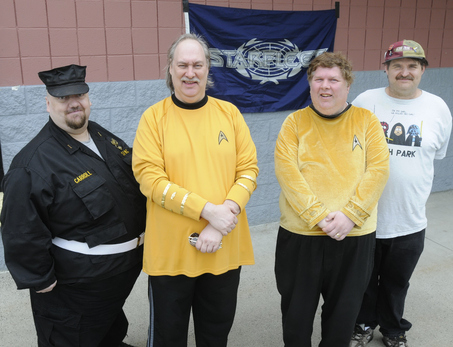
Some of us remain trapped in a fantastical mindset, and while we led a good life, and had a good wife, we haven’t matured to the point that we can meld a serious life with a fantastical mindset. We all know people who cling a little too much to fantasy, and while we try not to think less of them, it can prove difficult to take them serious. These people are apt to have an unhealthy addiction to gaming, science fiction, vampires, and now zombies. These people, depending on the progression of their fantastical mind, often have little to nothing to offer corporate America.

sct star trek.jpgOthers have all the foolishness of unconventional thinking, and fantasy, behind them early on. They are often children of ultra-serious parents who want their children devoid of foolish thinking. These people eventually get so locked in on serious, or conventional, ways of thinking that they end up neglecting that part of their brain that indulges in fantasy, art, and creativity for so long that they ignore a huge ingredient of what it means to be human. They eventually veer so far into the serious side of life that they become disgusted by creative thinkers. They “don’t have time” for such silliness. They have developed the tunnel vision necessary to compete in the corporate world, and they can’t understand people that don’t have a master plan. These people usually have a mathematical equation for life.

They prefer the absolutes inherent in the Superman story over the cloudy interpretations offered by the Batman character. They prefer the concrete absolutes of standard music over any creative music that messes with the formula, and they prefer the more standard comedy of Everybody Loves Raymond over the comedic study of intangibles on Seinfeld. These are bottom line people who will tell you all you need to know in life to succeed are two words: “Yes and sir!”

At some point, this type usually crashes and burn under the weight of all that seriousness. The purchases they’ve made to substantiate their status begins to lose their luster, the family no longer interests them in a substantial manner, and the career they’ve worked their whole lives for has suddenly become meaningless to them. When they reach that point, they either seek the fantasy of an adulterous affair, a job change, a move to another state, or all of the above. At some point, the master plan loses value, and they become perpetually unsatisfied with their direction. These people can be just as unhappy as the fantastically minded, and neurologists say that the only thing keeping them from utter insanity is the fantasy they experience in the dream world while sleeping. Everyone tells artists to have something to fall back on, in case their creative pursuits never come to fruition, but you rarely hear anything like this directed at conventional thinkers that succeed in conventional ways with nothing fulfilling the side of their brain that contains healthy ingredients of play and fantasy.

KidThe healthiest mindset, and the one probably most difficult to achieve is the matured, creative mind. The matured, creative mind is one that has progressed beyond the fantastical thoughts of youth to a more practical hybrid of conventionally unconventional thinking. The problem they generally have is how to make their unconventional thoughts productive, practical and profitable, for as anyone who has worked in a corporation knows it’s not exactly a conducive climate for unconventional thinkers. In this equation, of course, the onus is on the creative mind to make their talents know to their bosses.

Some, like CEO Steve Jobs suggests that anyone unable to reach their creative peak, should try hallucinogenics. This statement made some creative types think that Steve Jobs wasn’t as creative as we had all been led to believe. It made some of us think that he views creative types from the same, jealous distance conventional thinkers view creative types. How many times have we heard non-creative types assign drug usage to creative types? “They had to be on something to make that,” they say. “No normal human could create something like that, sober.” Those of us who have flirted with creative thought encounter epiphanies on a much lower scale, know that the mind can be mined with constant work, and it can produce incredibly creative thoughts without artificial aid. Jobs’ comment was such a shock from such a creative mind that we wondered how creative he was. If he were that creative, why would he feed into that cliché?

Those who know the story of Apple, know that Steve Wozniak was the creative genius behind the Apple I and II, and he had a major influence on the Apple Macintosh. We didn’t know the instrumental role Jonathon Ive played as the chief architect of the iPod, and that he was a part of a team that included: Jon Rubenstein, Scott Forstall, Michael Dhuey, and Tony Fadell. We learned that while Jobs may have overseen the project, but we had no idea these names were the creative types behind the final product we know today.

Jobs’ role in the insurgence, and resurgence, of Apple is unquestioned, but the undue credit he received (see took) for the iPod outraged those on the creative team who sweat blood over it. Jobs was the leader of the company at the time, and he changed the company’s culture to “think different”, and he eliminated distractions to provide more focus. He may have been overly demanding with the aesthetics, the processes and the machinations, and he may have remained stubbornly unsatisfied with what he termed “unfinished” products. He may have gotten more out of his creatives than anyone in his market, and in the end he was the “guy in charge” of the company that created products that were unmatched in its field, but Steve Jobs did not deserve the amount of creative credit he took for the products it produced. And some creative types were partial to the complaints his creative teams made, after Steve Jobs said all creative types should take drugs to increase their creativity.

The primary reason it bothered us is that it’s the typical charge that all conventional thinkers make about creative types that create something conventional thinkers consider inhumanly creative. I don’t know if this “They had to have been on some wild drugs” cliché began with The Beatles, but it does appear to be one of the origins of the charge. The other reason that it bothered creative types is that it allowed non-creative types to feel more comfortable in their serious, mathematical world: “Well, I could’ve created something like that too, if I decided to take all those drugs.”

When it first came out that Led Zeppelin sold their souls to the devil, that made sense to a number of my friends, because, “No one could come up with that many great songs on their own.” When these friends grew out of such fantastical notions, they changed their minds on the subject saying that “corporate guys, or unaccredited songwriters, must have stepped in there and changed, mixed, altered, or finessed the final product, because there’s no way Page and Plant wrote all those songs alone.” Or, they say, “They must’ve been stoned out of their minds to think up things like these.” It bothers creative minds, because we know it’s possible to reach unbelievably creative planes without artificial substances, and those who have tried some artificial substances don’t see how an altered state of consciousness can lend itself to productive creativity.

It’s possible that mind-altering drugs can introduce thoughts to a brain, but how many of those thoughts are absolute nonsense? It’s possible that they can lead the brain to “Think different”, but my guess is that it takes a sober brain to sort through those different thoughts to help them make sense. I wonder if we were the tamper with the timeline and The Beatles never touched a drug, how much different would their discography be? As with using ‘save your hair’ products, it’s almost impossible to know if the mind-altering drugs did it, or if the drugs gave the mind the perception that they were free to do something wildly different than they ever tried before. It could be that continued use of hallucinogenic drugs teaches one to finesse creativity in an altered state, but most truly creative minds only experiment with altered states, and most of them found that it didn’t enhance their creativity. Unfortunately, in the case of The Beatles, and Led Zeppelin, it appears as if they either created, or fed into, this misconception.

That cliché was born, in my opinion, based on the frustration that non-creative types have for those that are excessively creative. These people can accept that a bunch of fellas could sit around and write Back in Black, or Eliminator, but “You’re trying to tell me that three guys (John Paul Jones) came up with Led Zeppelin IIZosoand Physical Graffiti? Sober? With their souls still intact? Come on!? There’s just no way.”

Some non-creative types make the same charge with Albert Einstein. They state that the autopsy performed on Einstein’s body showed traces of LSD, as well as Dimethyl-triptimene in his system. They also state that his heart exploding could’ve easily have been caused by years of cocaine use. This led all non-creative types to almost leap with joy, as it confirmed for them the fact that no one man could think all that stuff up, not sober, with his soul intact. As we all know, these opiates were common, at the turn of the century in medicines and painkillers, so the fact that they were in his body, at the time of his death, doesn’t necessarily indicate that Einstein used them recreationally, or to enhance his creativity. “It was still in his system,” non-creative types would argue, “and whether he took these opiates for medicine or recreationally, it’s possible that it affected him.” It’s also possible that it didn’t.

EinsteinHow many people looked up to the stars and tried to figure out the ways of the universe prior to Einstein? How many of them ingested the same opiates, whether or not it was deemed medicinal? How many of those same people had all of the same information on the abstract concepts, and couldn’t make meaning of them in the categorical manner Einstein did by picturing himself riding a light ray bareback? “By picturing himself riding a light ray bareback, you say? Yeah, he had to be on some serious stuff to think like that. That ain’t normal.”

Einstein also said that playing the violin helped him make sense of the universe by helping him make a connection with sense-experiences. Is that something a drug-user would say? Perhaps, but here’s something that could blow your mind, so if you’re not prepared for it read no further, but it’s possible, possible that a person could indulge in different thoughts so often, that they produce creative ideas that are unimaginable to those who have never indulged in creative thinking.

“Insanity is doing the same thing over and over again and expecting different results,” Einstein once said to define insanity. 

Einstein thought differently, and he thought so differently, so often, that he was able to approach the problems from so many different angles that he ended up approaching these problems in ways conventional thinkers couldn’t fathom. They still can’t fathom it, so they suggest that it had to be drugs.

Those of us who routinely think different know where the mine is. In our experience, it’s not chock full of illustrative colors. It’s just a mine. If you’re anything like me, you’ve been surface mapping and sampling that mine your whole life, so you know exploring and exploiting the mine will be worthwhile, because you know the ore and minerals in there, all you have to do now is drill deep to start the discovery phase, the development stage, until we reach the production stage. It’s not simple or immediate, but the hard work we put into excavation will produce results.

The results for the reader will be the highlight reels of all of our effort, as we learn to edit and delete until the effort is removed. The excised material is the nonsense we developed in childhood, and the whimsical inanities we created on mind-altering substances, be they drugs, beer, or other stimulants. Most of the time, we just write poor sentences, be they littered with errors, or those not as engaging as we originally thought. We’ve all unearthed bizarre ideas, sober and otherwise. An overwhelming majority of them, about 99%, are cast aside, but there are some valuable nuggets in that mine that needed to be cultivated and cleaned up. We won’t have fans in the stands who “were there” when the star was born, because most artistic endeavors occur in quiet corners when no one else is around. Most of it is finessed, staring at a poor sentence, trying to approach it in multiple ways to make it make sense, and most of the finished product, an article, essay, or novel is an assemblage of highlight reels that appears inhumanly creative. 

It would be foolish to say that some brilliant creative types don’t find refuge in mind-altering substances from The Beatles to Edgar Allen Poe, but did their alteration of choice enhance the thoughts or form them? It’s the 100 monkeys on typewriters joke that suggests one of them could accidentally write Hamlet. Anyone could write Sergeant Peppers or The Raven on the right drug. Everyone could be creative, brilliantly creative, if they had the time and resources necessary to devote time to it. I don’t know if it’s jealousy, or if most people have no idea how hard it is to create something beautiful, but I think we should all drop our ideas about shortcuts regarding the creative process and just recognize brilliance for what it is.     

Most creative people came about their matured creativity naturally, for creativity cannot be taught. It can be workshopped, and it can be finessed day by day and interaction by interaction, but no one can teach another person how to be brilliantly creative. For that reason, and for all the reasons listed above, creativity remains a largely unexplained phenomenon, but those of us who have spent most of our lives honing the science and math parts of our minds would much rather think mind-altering substances spawn that which separates them from creative brilliance.

Let Your Freak Flag Fly!


“Some of the times you just gotta let your Freak Flag fly,” my aunt said to her brother. I had no idea what they were talking about, and I didn’t really care, but I didn’t think any definition of this otherwise illusory idiom could remedy my dad’s issues. If Freak Flag is actually a thing and not something my aunt just made up, I thought, my dad may have been as far from having a Freak Flag as anyone on Earth. His primary goal in life was to fit in, and he did anything and everything he could to make that happen. My aunt was the opposite. She did everything she could to stand out as a hip, cutting edge, and appear young, or her definitions of all of the above. She knew more about the hip artists and songs in Billboard Top 40 than I ever have, she wore hip, cutting edge clothing better suited to women ten years younger than her, and she dropped whatever hip terms she heard young people say. When she dropped the term Freak Flag I thought it was yet another one of her embarrassing attempts to appear hip, but that particular phrase stuck with me for whatever reason. I never used it, but when I later heard someone on a hip, top-rated television show say it, I knew something was afoot. Then, one of my friends said it in school, and a week later I began hearing it everywhere.

“Where did you hear that phrase?” I asked my friend.

“Dude, I don’t know. I’ve been saying it for decades,” he said. Unbeknownst to me, this was the key to keeping it cool in the phraseology universe, for no one ever seems to know where they hear hip, cutting edge terminology first. To be fair, it can be difficult to remember where we first heard a phrase we’ve been saying for a time, but purveyors of this particular phrase appeared to conveniently forget where they heard it to leave the impression that they started it.

There’s apparently a lot of prestige wrapped up in starting a phrase, and if someone gets a taste of it, they don’t give it up willingly. Whatever the case is, when obsessively curious types pursue such matters, we often receive everything from blank faces to evasive and defensive responses. Even if the user just started using the phrase last February, those who are evasive and defensive want us to think they’ve been saying it for so long that they dismiss all questions about its origins as uncool.

If we found a truly reflective individual who didn’t mind talking about the first time they heard the phrase, it might result in a humdrum response, “My Cousin Ralphie is da shiznit, and when I heard bra say it I wanted his awesome sauce all over me.” If this individual were that honest, they might run the risk of being so over as to be drummed out of the in-crowd, for the clique might deem that confession a violation of the binary, unspoken agreement those in the in-crowd have designed for the world of phraseology. In their world, users want their audience to consider them the originator of the phrase, and anyone who insists on pursuing this line of interrogation runs the risk of being drummed out on an “If you have to ask …” basis.

Another unspoken rule in the hip, phraseology universe is that we better hurry up and use the terms we enjoy saying as often as we can before a kool kat steps in to declare that the days of using the phrase are now over. “Stop saying that. I’m trying to get the word out that that is so over. Tell your friends.” We might be disappointed to learn that we are no longer able to use words, phrases, or idioms that we enjoy using, but we know that when kool kats step in to warn us that it’s over, it’s a serious blow in this artificial architecture, and we know that by continuing to use such a phrase, we run the risk of being so over. This begs a question to the arbiters of language who declare they’ve been saying this for decades, how is it that you never encountered some kool kat who declared your favorite phrase so over in that time span? Did you ignore them, and if you did, why should I listen to you?

A work associate of mine attempted to play the kool kat by correcting me in front of a group of people. “Dude, stop saying that,” he said inadvertently using the tired phrase to end phrases. “I’m trying to get the word out that that phrase is over. Tell your friends.” Anytime we hear someone issue such a condemnation, it’s human nature to assume that it’s rooted in something the speaker learned from a person with some authority on the matter. In my experience, however, most of these self-professed arbiters of language consider starting a hip phrase fine but ending one divine. Those with no standing in the hierarchy of cool often take it upon themselves to issue such a condemnation without knowing anything more on the matter than anyone else, but they hope that by pushing us down a notch they might improve their standing in the hierarchy.

Like most of those in the lowest stratum of this hierarchy, I knew nothing about this confusing world of using hip, insider, kool kat language, so I was in no position to question my work associate, but by my calculations this feller was a doofus. He was such a complete doofus that I would no sooner consider seeking advice from him on language than I would his words of advice on dating. I still don’t know if this fella assumed a level of authority on this matter based on the idea that he considered me inferior, of if he heard this news from a more authoritative figure, but I decided he did nothing to earn a seat on my personal arbitration board. That situation led me to wonder how we determine our arbiters of words and phrases. My guess is that most people will not heed such advice from just anyone, as that might unveil their status in this hierarchy. My guess is that we make discerning choices based on superficial, bullet point requirements we have for those issuing them? Put another way, if the doofus was more attractive and a little less chubby, I may have been more amenable to his guidance on the matter.

✽✽✽

For fact checkers, a decent search on “Let your Freak Flag fly” suggests that it first appeared in a Jimi Hendrix song If 6 was 9 in 1967. It was later popularized in a David Crosby song Almost Cut my Hair that he wrote for the Crosby, Stills, Nash, and Young album Déjà vu. Due to the fact that these first appearances occurred in an artistic venue, however, we can guess that the phrase made its way through the “in-crowd” circuit long before Hendrix or Crosby used it in their songs.  

The Urban Dictionary defines “Letting Your Freak Flag Fly” as: “A characteristic, mannerism, or appearance of a person, either subtle or overt, which implies unique, eccentric, creative, adventurous or unconventional thinking.” 2) “Letting loose, being down with one’s cool self, preferred usage to occur in front of a group of strangers. Your inner freak that wants to come out, but often is suppressed by social anxiety.” 3) Unrestrained, unorthodox or unconventional in thinking, behavior, manners, etc. One who espouses radical, nonconformist or dissenting views and opinions that are outside the mainstream. When traveling through the bible belt of the U.S., it’s best not to let your freak flag fly high. Otherwise, you’ll be harassed and attacked by these backwater, backward thinking theocrats.

Typical Freak Flag Flyers make very specific decisions to avoid titles. They tend to be abstract thinkers who believe they fly high over those of us who believe in nouns (i.e. people, places, and things). Freak Flag Flyers tend to know more about those nouns than the average person, “Because those people haven’t done their homework.” Some Freak Flag Flyers base their outlier status on anecdotal information of these nouns to whom others swear allegiance, on the idea that if we knew what they, the Freak Flag Flyers know, we would be just as sophisticated in our skepticism about allegiances.

Most people fly under a flag: Americans fly under the Stars and Stripes; the Irish fly under the Irish tricolor; and the British fly under the Union Jack. There are some people, however, who fly under no flag, and they eagerly provide this information to anyone who asks. Don’t expect them to admit to flying under a Freak Flag either, for the very essence of flying under a Freak Flag is designed to give its flyer an open-ended, free lifestyle persona that doesn’t conform to societal definitions such as allegiance or definition … Even if such a definition extends itself to a Freak Flag. They aren’t proud members of a country, political party, or a coalition of freaks. They’re just Tony, and any attempt we make to define them as anything but Tony –based on what they do and say– will say more about us and our need for definition, than it does them. Freak Flag Flyers tend to be moral relativists who ascribe to some libertarian principles when those political principles adhere to matters they find pleasing –those who suggest, as Dave Mason did, “There ain’t no good guys, there ain’t no bad guys. There’s only you and me and we just disagree”- but they tend to distance themselves from economic libertarian ideals, for that might result in too much libertarianism.

Some Freak Flag Flyers raise their flags in political milieus, but most Freak Flags involve simple eccentricities and peculiarities. An individual who prefers to listen to complicated and obscure music could be said to fly a Freak Flag in that regard, but they usually keep that information close to the vest when their more normal family members and friends are around. An individual who enjoys various concoctions of food, philosophies, and other assorted, entertainment mediums could be said to have a Freak Flag, but most of these people live otherwise normal lives. We can have a Freak Flag without being a freak, in other words, but the general term Freak Flag is reserved for those activities we engage in and those preferences we have that could be embarrassing if they found their way back to our normal friends and family members.

Even if we don’t have what others might call a Freak Flag, we can identify with the mindset of those who once dared to let theirs fly. Now that we’re all normal and stable, we might not remember the days when we strove for some sort of definition, or we may be embarrassed by it, but most of us can recall a day when we dared to be different.

A Freak Flag Flying friend of mine, a Dan, worked in a Fortune 500 corporation, and he was a corporate joe from head to upper calf. To maintain some semblance of his Freak Flag status, however, Dan wore a wide variety of loud socks and skater shoes that appeared out of place with the rest of his business casual attire that it was impossible not to notice. I’m not sure if it enhanced Dan’s Freak Flag flyer status or took away from it, but he did have flames of fire on those Converse Chuck Taylors, and he wore these notoriously short-lived Chuck Taylors for about a decade, so he must’ve purchased them on an annual basis to keep his preferred characterization alive.

When I asked Dan why he wore that ensemble, he said, “I just like it” in the typical “I’m just Tony” Freak Flag Flyer vein. I dug deeper, of course, and I saw a man who wanted to succeed in the corporate climate by being everything his boss wanting him to be while not being a complete corporate sellout. He wanted the best of both worlds, and he thought some flames on his feet allowed him to let Freak Flag fly.

I’ve met the “I’m just Tony” Freak Flag Flyers who can’t articulate their need to fly one, and they attempt to nullify any questions about their nature by asking you why you think they’re different. Some think we’re putting them on trial, and we are, sometimes. Sometimes, we’re just interested in their essence. I’ve met others who were just different people, and they were quite comfortable draping themselves in a Freak Flag. They taught me that the ultimate definition of a Freak Flag flyer is a relative concept defined by the individual. It’s almost the complete opposite of my aunt’s attempts to be younger and hipper than her peers, as the true Freak Flag flyer does not engage in Freak Flag flying, they just are who they are in a manner that is more organic than any character my aunt might dream up.