Influences: John Irving, Stephen King, Chuck Palahniuk, Raymond Carver, Larry David, David Bowie, Mike Patton, and Ayn Rand.
Style: Short sentences, easily readable, and little in the way of description.
Genre: Information, humor, and psychological interpretation.
Everyone has had an experience with a Vincent McKenna (played by Bill Murray), a St. Vincent, and very few of them involve any form of redemption. St. Vincents are St. Vincents as a result of the demons that chase them into being the people they are, and those demons are, often, so powerful that they cannot be thwarted.
Anyone that has read my personal experiences with Ellis Reddick, knows that I’ve had my own experience with a St. Vincent, and that I’ve been affected by his sociopathic tendencies in a subtle manner that I may never entirely shake. Ellis Reddicks, and St. Vincents, are considered ideal characters for horror movies and coming-of-age style redemptive movies. They are often nice people (in the coming-of-age movies) that require a viewing from a non-traditional lens, and it’s in that scope that they often find the redemption that no one ever afforded them before. Having said all that, St. Vincent is a really good movie for its honesty, and it’s all too realistic (for some of us) portrayal of a demon-ridden, lout that tries to take advantage of everyone around him, but as anyone that has watched a movie made in this century (the 21st century) knows, he’s not going to be such a bad guy at the end of this production, and in the version of reality depicted in this particular movie no one really is.
The demons that chased Ellis Reddick are the same that presumably drove Vincent throughout his life, except for the alcohol and the stripper. The demeanor, the overall outlook, and the need for vices are all the same. Vincent McKenna is an alcoholic that frequents the track, and spends some of his day and most of his nights with a stripper in a seemingly asexual relationship. He tries to take advantage of everyone around him, including a banker, and a recently divorced single mother to fund his loutish behavior. With the banker, Vincent finds out that the money he’s received thus far from the bank, as a result of a reverse mortgage, has been completely tapped. The banker tries to explain the process of a reverse mortgage, and the idea that as far as the process is concerned, the bank can no longer afford to finance Vincent McKenna’s lifestyle. Anyone that understands this process, understands what the banker is saying, but Vincent (and thus the audience) believes that the banker could find a way to continue to fund Vincent’s lifestyle, and the fact that he doesn’t makes the banker a tool. The banker then becomes, in a limited manner that only characterizes Vincent’s current plight further, a bad guy. There is some struggle at this point, however, in totally believing that the banker is a bad guy. He looks at Vincent with confusion in a manner that suggests that his hands are tied, but the sympathy for the main character cannot be shaken. There is no struggle with the story of Vincent taking advantage of the single mother’s situation however. That is more blatant and –in an odd way that makes the audience uncomfortable– kind of funny.
The John Nolte, November 14, 1014 review for Breitbart.com, suggests that the movie, St. Vincent, is basically trope-less, or as he describes it, “It isn’t a tropey-trope.” I’m guessing that Nolte is stating that this movie isn’t so loaded with tropes that it’s totally derivative, and thus unwatchable. If this is what he’s saying, he’s right, but it’s still loaded with so many tropes that any serious review would probably have to mention the word to be taken seriously, even when they are attempting to dismiss the adjective. The primary reason to watch this movie, as with any movie Bill Murray is involved in is Bill Murray.
Bill Murray pulls his role off with the inexplicable, characteristic ease he pulls off every role. As Steve Martin once said of Bill Murray: “It can’t be that easy for him. It just can’t!” Inherent in Martin’s consternation is the consternation that Hollywood, the critics’, and most Americans display with their inability to understand why he is popular, and why they love him too. The consternation also suggests that there has to be some underlying philosophy, or effort to it all, that no one can see. If it were any other actor, most people would accuse Bill Murray of sleepwalking through most of the movies he’s done. He doesn’t appear to care about all that, and we love him for it. I love him for it. It may have something to do with what Bill Murray said, “I knew from the moment I finished reading the script for Ghostbusters that we would all be able to be late for the rest of our lives.” It may have something to do with, as Truman Capote once said, “All an author needs is one truly great book.” It may have been his years on Saturday Night Live, the movies What about Bob? or GroundhogDay, or the stories of “citizen” Bill Murray that have made their way into the zeitgeist, but one gets the feeling that if St. Vincent were his first movie, we would all love his performance without knowing why.
If it’s true, as political philosopher Hannah Arendt says that “To think critically is always to be hostile,” then the reader could regard this review as hostile. Most critical thinkers prefer to think of a critical review as an honest review. Some critical thinkers rip apart commercials and cartoons. They may enjoy these vehicles, but they can’t shut that critical portion of their brain off, no matter how much they enjoy the presentation before them. Some may view critical thinking as negative thinking, or cynical thinking, and some may take critical thinking a step too far. The latter tend to think that the audience of that criticism can’t help but think that they are striving for the cachet that critical thinking can gain a person.
Having said all that, Theodore Melfi’s directorial debut of his screenplay is very good. The primary reason for this, as I’ve stated, is that Melfi and Murray combined to characterize this Vincent McKenna character in a manner that recalled the Vincent McKennas I’ve known throughout my life. That alone, in my opinion, makes the movie worthwhile. As the movie moves through this methodical characterization, we only love to hate Vincent McKenna more. Prior to the redemptive phase of the movie, the trope that we all have to suspect in a modern well-rounded movie, I was reminded of all of the St. Vincents I’ve known, as I worked my way through the confusing aspects of youth –looking for a hero to imitate or emulate– I found them all falling so far short that the St. Vincent redemption eventuality seemed both inevitable and incorrect to my experience with this type of person.
Other than the fact that this curmudgeon, this Vincent McKenna, doesn’t have a tropey-trope-like, Scrooge-style redemption at the end, but all the surrounding characters do, I would point out that just about everything else in this movie has been done, ad nauseum, before. The most pervasive trope in this movie, and that which seems so pervasive in modern cinema, is that “there are no good guys, there are no bad guys. There’s only you and me babe, and we just can’t agree”. And if there are bad guys, they may be bad guys to traditional thinkers, but once viewed through a non-traditional lens, they can be something more, something better. The lens of this movie is, of course, provided by a child, the neighbor’s son, named Oliver. Another “bad guy” Oliver’s bully becomes a good guy after a more traditionally-minded style of beating. The audience’s focus then shifts to the villainous divorced Dad of Oliver. As the movie plays out, the audience realize he’s not such a bad guy after all either.
The St. Vincent’s I’ve known were not Vietnam Veterans, and they weren’t retirees that had already lived a life when I knew them. When I knew them, they were fully immersed in the depths of their failure, so it may be unfair to equate St. Vincent with the curmudgeons and louts I’ve known throughout my life, but (again to the credit of the movie) they reminded me so much of some of the awful characters that have littered my life that I couldn’t help but feel cheated by the happy, redemptive ending. When it involves Bull Murray though, it’s impossible to leave angry.
Getting out the vote is a term that most of us know, but few of us define. When we hear that politician A beat politician B, because politician A was better able to get out the vote, we all accept that as a standard measure of a successful campaign, but few of understand what that term actually means. We assume this means that politician A’s platform encouraged groups who normally don’t vote to vote, we also assume that politician A has built a ground game that has state and local supporters encouraging their friends and family to vote. We may even think of local people who drive to elderly people’s homes to assist them to their local voting booth. Those who were fortunate enough to receive a letter similar to the one in the accompanying photo, with an accompanying post card, before the November 4, 2014 election, now have an alternative definition of getting out the vote.
Chances are if a voter is a resident of North Carolina, New York, Kansas, Alaska, Illinois, or Florida, and they are a registered voter with a spotty record of voting, in one of these “projected-to-be” close elections, they received something along the lines of this letter. Chances are they were shocked and outraged at the ominous, threatening, Orwellian, and some would say invasive language used in this mailing. Chances are, at one point or another, they’ve heard others complain, and grow outraged, at the invasion of privacy that is occurring in America, but it’s never affected them, so they’ve always found it difficult to get worked up over it. Chances are, if you were one that received one of these mailings that has now changed for you.
Various election commissioners, and spokesmen, gained some distance from this activity by saying that voters have nothing to worry about with these letters, because they did not write these letters. A public relations firm, they said, wrote the mailings. The election officials may have approved the mailings, but they did not read them, and they had no input into the language used. We can guess that the public relations firm who wrote the mailing devised an answer for the campaign to use in this defense. We can also guess that this is a ‘go away’ answer that PR firms develop to answer the question without really saying anything. The answer follows the Clintonian blueprint of delay, delay, until the situation goes away.
For those who don’t find this answer acceptable, one election official floated a trial balloon that suggested this ‘get out the vote’ campaign was “Used by Democrats to counter the suppression efforts that Republicans employ” –the most prominent of which is the requirement that a voter provide identification when they register to vote. This tactic attempted to take focus away from the activity in question by focusing it on the enemy.
This election official, a New York State Democrat Committee spokesman named Peter Kauffmann, then added, “The difference between Democrats and Republicans is they don’t want people to vote and we want everyone to vote.” If that doesn’t do it for you, how about something along the lines of ‘We all need to do whatever it is we have to do rid our country of the politics of hate!’ This might seem like a silly tactic, but it works for those who hope it’s true.
If the reader is still not satisfied after all that, well, they’re just going to have to accept the fact that they received this ‘get out the vote’ mailer, because they are perceived to be a lazy, apathetic person who needs to be threatened with language that a New York Post piece characterizes as “better suited to a mob movie” that culminates in a “Democrats: vote or we’ll kick your ass!” type of message that may intimidate you into turning off the Minecraft to vote!
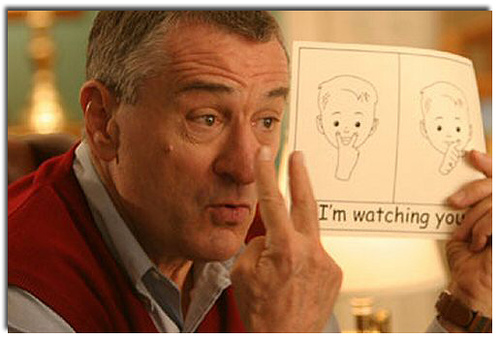
If the voter is still upset after Democrats remind you that “Our democracy works better when more people vote, not less”, and they consider these tactics to be along the lines of public shaming and a “we’re watching you” form of personal intimidation, they’re probably just going to have to well … shut up. It’s the new way of getting out the vote, as a result of the findings from various behavioral studies, including a 2008 Yale University study, that suggest that these tactics are very effective, so we had all better get used to it.
One would have to assume that if market testers put these mailings before the American public, and they asked these Americans how effective they thought these tactics would be in turning out the vote, these mailings would never go out. We can guess that 99 to 100% of the test subjects would suggest that not only would these tactics not work, and that they might cause a reflexive rebellion. What would be that form of rebellion? One would have to guess that a majority of these test subjects would say that they might include the recipient voting for the opposite party, if they had access to the party responsible for sending them the intimidating letter. “Americans won’t respond well to such intimidation techniques,” is something that most of us would say in our exit interview.
I’m sorry, but you’re wrong, these behavioral studies suggest, and the New York Post piece furthers, reporting that “Such attempts to shame people to vote –what politicos call “social pressure” or peer pressure– has become more common place, and it was used in the ‘get out the vote’ 2012 Obama campaign.”
The Democrat National Committee (DNC), feared a backlash from voters when the idea of attempting to shame them into voting was first presented to them (circa 2006). As evidenced by the mailings received by registered Democrats, in 2014, and an October, 29 2010 New York Times pieceon this matter by Sasha Issenberg, the DNC is reported to have received enough evidence between 2006 and 2014 to suggest otherwise.
“Before the 2006 Michigan gubernatorial primary,” writes Issenberg, “Three political scientists isolated a group of voters and mailed them copies of their voting histories, listing the elections in which they participated and those they missed. Included were their neighbors’ voting histories, too, along with a warning: after the polls closed, everyone would get an updated set.
“After that primary, the academics examined the voter rolls and were startled by the potency of peer pressure as a motivational tool. The mailer was 10 times better at turning nonvoters into voters than the typical piece of pre-election mail whose effectiveness has never been measured.
“Political consultant, and manager of Al Gore’s first Senate campaign Hal Malchow, was intrigued by the results of that initial mailer. Machow started a direct-mail firm and attempted to coerce its clients, The DNC and the A.F.L.-C.I.O., to use these tactics to increase their voter turnout. As stated earlier, these clients blanched at first, fearing that the language sounded intimidating, and that they could result in a backlash.
“In reaction to those fears, Malchow softened the language of a future mailer sent to over 11,000 New Jersey residents, as that state prepared for a gubernatorial election. The language in this letter was less ominous “while still making it clear that recipients’ voting habits would continue to be monitored.” The softened language of that mailer went as follows: “We hope to be able to thank you in the future for being the kind of citizen who makes our democracy work.” The result was less effective than the original mailer Malchow had proposed, but it increased voter turnout by 2.5%. Future letters also thanked voters for their past participation while hoping to encourage current participation at the same time. ”
The Issenberg article goes on to describe the various behavioral science techniques employed by others, and the history of behavioral science influencing elections. It does not describe, however, how the language in this mailing went from the softened, thankful language Malchow employed in the New Jersey campaign and the ominous “We’re watching you!” letters received by the residents of the states listed above in 2014.
Another website, called Outside the Beltway, doesn’t provide an explanation either, but it does provide a reason stated by a spokesman of the New York State Democrat Committee, a Peter Kauffmann, behind the need to intimidate people. The exact question put to Mr. Kauffmann regarded why the state of New York would tacitly approve such a mailer:
“This flyer is part of the nationwide Democrat response to traditional Republican voter suppression efforts – because Democrats believe our democracy works better when more people vote, not less.”
The site also lists the intimidation some Floridians experienced from a letter sent by a group funded by the state and national realtors association that included the message:
“Your neighbors will know. It’s public record.”
The final “vote shaming” letter the site presented on this site is one received by residents of North Carolina. The North Carolina Democrat Party sent this particular letter, and as the author of the Outside the Beltway piece, Doug Mataconis suggests, it “contains some of the exact same wording as the New York letter.”
“Public records will tell the community at-large whether you vote or not. As a service, our organization monitors turnout in your community,” the letter says, according to WRAL in Raleigh. “It would be an understatement to say that we are disappointed by the inconsistent voting of many of your neighbors.”
Some versions of these letters include an ominous warning at the bottom that anyone that has had a stern grandmother, or a strict nun for a teacher, will know well:
“If you do not vote this year, we will be interested to hear why not.”
If you had that stern grandmother, or strict nun for a teacher, you know that piercing glare that often follows such disappointment. That piercing glare rises over the horn-rimmed glasses, into the subject’s soul, until we all experience a reflexive shudder. Another, similar version of this letter states:
“We will be reviewing (Your) County official voting records after the upcoming election to determine whether you joined your neighbors who voted in 2014.”
Remember, while reading the full-fledged letters, and the excerpts contained herein, that registered, Democrat voters are the most common recipients. Those that read such letters may reflexively conclude that the party of Big Brother, the Republican Party, is sending them out. Other than a 2014 letter that Mitch McConnell sent to Kentucky voters that some call intimidating, that after reading numerous times I find difficult to call intimidating, and a 2012 letter in Virginia, I was not able to find another Republican engaging in any similar tactics.
“Who you vote for is your secret,” one of these campaign mailers state, “But whether or not you vote is public record.”
Anyone that has watched the TV series, The X-Files, can imagine these words coming from the smoking man, bad guy –with pictures of Republicans in his background. To show you how shocking this would be if it were on TV, as opposed to real life, this chunk of The X-Files’ dialogue would be coming come from the good guy —with Democrats pictures in the background— the Fox Moulder character.
The sites that show these letters, report the activity, and comment on the text therein, are careful to add that none of these tactics are illegal. The letter, with the accompanying post card, even instructs you that there is nothing-illegal going on here, with its qualifier, “Who you vote for is secret, but …” One has to wonder why they felt the need to include this qualifier? We can guess that they knew the outrage they would receive, but they were willing to endure that if they saw a 2.5-to-10% increase in turnout? Did they fear lawsuits, voluminous calls to the election commissioner, or the secretary of state? Did they add the bit about “Whether you vote or not is public record” to assure you of the letter’s legality? If it did, did it also assure you that the letter wasn’t, in any way, treading along the line of ethics? Did it assure you that this letter wasn’t the least bit creepy? Did it lead you to believe that it wasn’t, in anyway, infringing upon your right to be apathetic? The latter may seem a goofy right to champion, but among the many rights we have in this Republic, is our right to sit on our couch and play Minecraft straight through an election if we want to.
A site called Gothamist listed some reactions from recipients of this mailing in the state of New York:
“I’m a regular voter and loyal Democrat, so I was taken aback by this creepy and almost threatening letter from the New York State Democratic Committee that I got in the mail today,” one disturbed reader in Downtown Brooklyn told us.
“Another who received the mailer on the Upper West Side added, “I can’t believe they think this will actually make anyone more likely to vote, and it certainly doesn’t make me want to vote for any of the Democratic establishment candidates.”
The unofficial target of these letters appears to have been registered voters that do not vote 100% of the time. Another unofficial target, in most of these states, appears to have been registered Democrat voters that do not vote 100% of the time, and the final unofficial target of these letters –that we assume through inference– was uninformed registered Democrat voters that do not vote 100% of the time. (The latter inference is made based on the reasonable assumption that a number of young, Democrat voters registered in the past for the sole purpose of voting for Barack Obama as president, but that they did not have the same passion for the candidates of a midterm election in their state and locale. We also base this inference on the assumption that most informed-to-well-informed voters need less prompting to vote.) For all of these apparent targets, there are other stories of twelve-year-olds being the subjects of these mailings, and others that do not meet the age requirement, and still others that happened to live in another state during an election that they were reported to have missed.
One could say, based on the public shaming and “we’re watching you” form of personal intimidation contained in these letters, that their primary message is that citizens need to fulfill their patriotic and civic duty and vote. Some might suggest that this campaign tactic dates back to the campaign to elect George Washington, but the “we’re watching you” text, the “If you do not vote this year, we will be interested to hear why not,” that the New York Post characterized as a: “Democrats: Vote or we’ll kick your ass!” tactic is new to some of us.
It’s not new that politicians, and political parties, and election commissions, call upon you to vote. What has not been a point of concentration of theirs, or that of our society in general, is the call for people to educate themselves before they vote. Friends and family may call upon you to vote, to fulfill your civic and patriotic pride. They inform the uninformed of the thousands that have died to maintain this right/privilege/honor for them, but if the undecided voters decides not to educate themselves –for whatever reason— on the issues, or the politicians, how is going through the motions of voting doing a service to those in the past, present, or future? They will be filling in ovals, touching computer squares, or punching out chads.
No one is saying that this duty to cast an informed vote requires that the voter buy a subscription to The New York Times, The Wall Street Journal, or the local newspaper. No one is saying that the uninformed voters become political junkies, but every civic-minded patriot that plans to vote should know the basics of the politicians, the initiatives, and the judges they vote on. These people will affect the voter’s community, state, and country. If the undecided voters grows sleepy at the mere mention of the word politics, or you get so irritated by the subject that you run out of the room screaming, once your Uncle Joe starts in, and you’re going through the motions in the voting booth so everyone will shut up about you dishonoring those that have sacrificed their lives. Don’t vote.
Don’t vote if you have a proclivity for voting for the cutest candidate. If you are one that has a propensity for voting for the candidate that is taller than their opponent is, or one that you’d most like to have a beer with, don’t vote. Don’t vote for a person that makes you feel more comfortable, but you can’t put your finger on why. People, and now parties, will try to make you feel guilty for failing to vote, but you should do everything you can to resist heir intimidation tactics. Don’t listen because you know enough to know that your vote could lead to you voting for the worst possible candidate for your community, state, and country. Don’t vote, no matter how guilty others try to make you feel for not doing so, because you know that the best thing you can do to fulfill your patriotic/civic duty to your community, state, and country is to avoid inflicting upon them your willful ignorance.
If, however, you are an apathetic citizen that is wearing down under the weight of all this pressure to vote –even if you don’t educate yourself– just vote! You may not understand it, but you just can’t fight it anymore. If this is you, and you were further intimidated into voting by this letter, with an accompanying post card –even though you find it hard to believe that all of these behavioral studies suggest this works, and that they will continue to use it in upcoming election based upon their findings– go ahead and vote. Take note of the political party that approved this mailing, be it Democrat or Republican, and vote the opposite. If an exit pollster pesters you about the candidate to whom you cast your vote, tell them, and tell them why. Tell them that you don’t care about its legality, or the information they’ve gleaned from their precious behavioral studies. Tell them that you regard the letter as an attempt at personal intimidation, and that you want to punish such behavior.
If it’s true, as the Chinese proverb states, “A child’s life is like a piece of paper on which every person leaves a mark” could the same principle be applied to TV shows and our sense of humor?
Has anyone ever informed you that they have something of a twisted, dark, and “some would say” sadistic sense of humor? Have the two of you entered into an unspoken agreement that no one has a sense of humor as unusual as theirs? Have they tried to leave the impression that they sat in some dark room and gestated into the character that stands before you? If you press this person, they will walk you through all the dark caverns of their sense of humor and point out all the bearded ladies, wolf boys, and evil dwarfs that have informed their sense of humor. No matter how common you may find the material that has informed their “twisted, bizarre, and some would say sadistic sense of humor”, these people will insist their sense of humor is more advanced, more sadistic, and more quirky than yours.
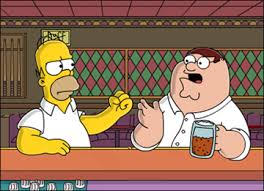
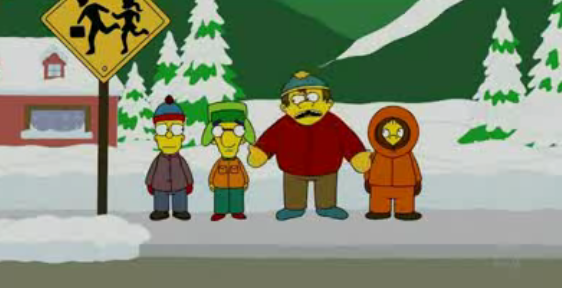
How many of us loved The Simpsons for over a decade? How many of us still watch the show? The Simpsons seemed groundbreaking at one point in our definition of comedy, until we we were provided other, “more groundbreaking” humor from the likes of Family Guy and South Park. After seeing those shows break new ground, The Simpsons no longer seemed as cutting edge as it once had. Our sense of humor evolved somehow, and those at the water cooler that continue to mimic the humor from The Simpsons no longer seem as funny as they once were.
The question that some of us have regarding TV comedies, in particular, is are these comedies popular because they broke new ground, or does it have more to do with the manner in which they tap into the spirit of the age, or the zeitgeist? Family Guy and South Park have both paid homage to The Simpsons, and it could be stated that they both operated from the template that The Simpsons created, but at some point they may began to expound upon it. If that’s true, could it be said that these two shows created something that moved us past The Simpsons, or did The Simpsons become such an obvious staple in the culture that it lost its provocative edge in the zeitgeist? Put another way, if The Simpsons somehow managed to outdo both of these shows in the next couple of years in a provocative manner, could it recapture the audience, or is it impossible to recapture that perceived edge once it’s gone?
Those looking to be cutting edge, among their friends, are constantly updating their sense of humor. Whereas The Simpsons used to be perceived as “on the cutting edge” of all forms of groundbreaking humor, it reached a point that TV people call a “Jump the Shark” moment where it was no longer. The same thing has happened to cutting edge TV comedies going to back to Sanford and Son, All in the Family, The Lucy Show, and The Honeymooners.
A number of books have been written on the psychological study of humor, and how it progresses, and they have attempted to capture this phenomenon. The question is, is this progression the greater curiosity, or should the greater story of the study of humor, as it pertains to television, focus on the the fact that even though we’ve moved past The Simpsons, it has left a mark on our sense of humor we may never be able to escape.
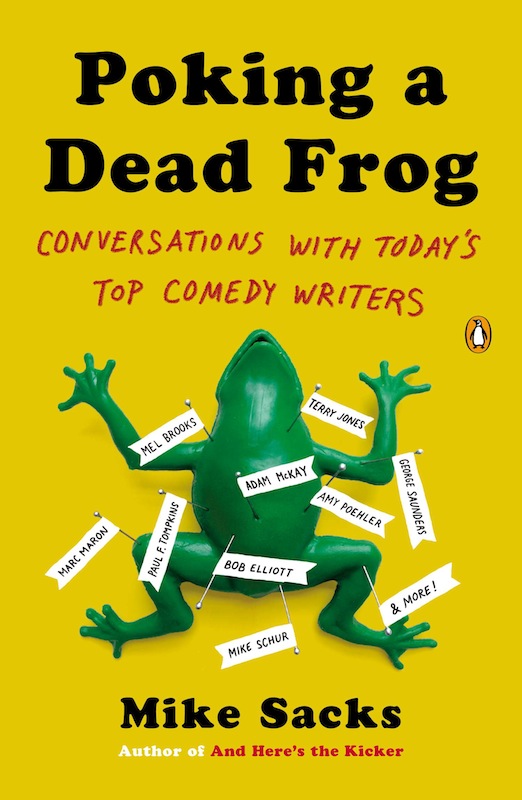
Poking a Dead Frog
Humor can be dissected, as a frog can, but the thing dies in the process and the innards are discouraging to any but the purely scientific mind … [Humor] won’t stand much poking. It has a certain fragility, an evasiveness, which one had best respect,” –E.B. White writing in The New Yorker.
As a play on this E.B. White quote, author Mike Sacks titled his book Poking a Dead Frog to provide a thesis for a book that attempts to investigate the art of comedy by interviewing a group of TV and movie writers that may have influenced the core of what modern-day Americans define as funny more than any others.
In Sacks’ first interview, we meet a writer from the television shows Saturday Night Live (SNL) and Late Night with David Letterman named James Downey.
Working for SNL for as many years as he has, Downey has written numerous sketches with other writers, and SNL’s performers. He offers an assessment of the difference between the two approaches to comedic presentations that he qualifies may be a broad generalization, but one he believes to be true:
Writers tend to write ordinary people in weird situations. Performers tend to write weird people in ordinary situations.
“The primary critique that most writers have with performer-written sketches is that writers are obsessed with writing original and cutting edge material. Performers don’t mind writing material that may resemble material that the audience may have seen a million times before, and it bothers the writer that the audience doesn’t seem to mind.
“Writers treat comedy as a science where advances are made, and we must always move forward, never backward. Once something is done, no matter how groundbreaking it is, it perhaps should be built upon, but never repeated. For performers, the fact that something has been done before is neither here nor there. Writers get themselves all tied up in knots worrying if their current material is too similar to other things.
“As for me, I wish originality were prized by audiences, but it doesn’t seem to be that important to them. Figuring out the right balance is everything.”
In the Downey scenario, the performer can be excused for writing a less-than-groundbreaking sketch, because they’re the ones on stage. They’re the ones that get the laugh for being funny, or the arrows for the material that isn’t. Few audience members would excuse a performer for attempting a complicated sketch that didn’t play well on stage, on the basis that it was written by a writer that tried too hard to be groundbreaking. Likewise, they don’t give the writer plaudits for a groundbreaking sketch that hits the mark. Most audience members, and critics, give all of the credit and blame for a performance to the performer. Thus, the performer can be excused for preferring the laugh over the groundbreaking provocation that may not go over as well as it appears to on paper, or in theory. It’s their career that’s on the line here, their reputation on the national stage. While the insiders may know the responsible party for the sketch, it’s the performer left with his performance hanging out for all to see that will define him from that point forward.
Once something is done, no matter how groundbreaking it is, it perhaps should be built upon, but never repeated.”
A performer could also be excused for wanting to repeat, or build upon, a sketch that works on the basis that it’s so hard to find one. A writer, on the other hand, doesn’t think that their groundbreaking sketch can be built upon. They look at what they’ve done as a concise, “one off” work of brilliance, and any attempts to repeat it would be perceived as forced by the audience. The performer says nonsense, and applies a far too subtle tweak for the repeat performance. Assigning their creative brains to the audience, the writer thinks that the audience will see through this far too subtle tweak and recognize the repeat performance for what it is. They don’t, complains Downey, they enjoy it in a manner they did the first time through, and this confounds writers.
Writers tend to make certain demands of themselves, and the material they release. The audience, however, is far less demanding. They just want to laugh, or in all other ways, be entertained. The easiest way to entertain is to seek the patterns of entertainment that we’ve all seen a million times. This answer does not count on the people (be they writers or performers) that do it better than us, but on the idea that most humans are more comfortable with the comfort of “getting it” than they are being challenged on some epistemological level. This was thoroughly covered in the Exit Strategy of Sitcoms blog, and in the What’s So Funny?blog.
Many writers fume over the mundane forms of entertainment that others enjoy. In my own struggles to find provocative material, I’ve surfed though other blogs to read their “Ruminations on a day in my life”. Most of these blogs are ten times as popular as the one you’re reading right now, and it’s obvious that most people find the 101 reasons a cat moves across a room at the sound of a can opener more entertaining than a blog on why we fear, or a researched, and original, dissertation on the electromagnetic path between our brain and God.
As a writer of a number of the political sketches done on SNL, James Downey made some assessments of comedian Bill Maher’s brand of political humor:
Bill is a funny guy, but he seems to prefer what (Downey’s former SNL alum Seth Meyers calls) clapter (that is some laughter combined with clapping) instead of actual laughs. A lot of his (Maher’s) material runs to the “White people are lame and stupid and racist” trope. It congratulates itself on its edginess, but it’s just the ass-kissiest kind of comedy going, reassuring his status-anxious audience that there are some people they’re smarter than.”
Whether it’s the “ass-kissiest kind of comedy going” from performers giving their audience what they want, or the thought-provoking, groundbreaking comedy that writers try to produce, we all make determinations on comedy. We all judge what is funny, and what is not, without making conscious decisions about it, and we’re all affected by it in one form or another.
The “Once something is done, no matter how groundbreaking it is, it perhaps should be built upon, but never repeated,” line Downey uses to explain the difference between writers, performers, and what the audience demands defines the difference between writers and their audience on another level. All writers have received the compliment from an audience member that suggests that you should do a sequel of the story they’ve written, or that they should expound on the theme in one way or another. This compliment is a double-edged sword in many ways, for while the writer has to love the compliment, the idea of repeating it feels like the idea of repeating it. The first question a writer has is “How? How would you have me repeat it?” which of course is not the audience member’s responsibility, but the writer’s. The point the writer would then make is that they poured their heart out in the story, and while they love you for saying that you thought it was so good that I should just do it again, they also hate you for suggesting that it looked so easy that you should be able to just enter that world again, and do it again, but … different. Just flip that “on” switch is what they’re saying. It’s a very writer-esk, artistic thing to say that they can’t just do it again, but as most writers know there is no such “on” switch, unless you’re writing a “ruminations on life” blog that involves cats running to can openers. Those sequels seem to write themselves, because no one cares, yet everyone cares, and they love them, so writers just pound them out.
 Anyone that has read my personal experiences with Ellis Reddick, knows that I’ve had my own experience with a St. Vincent, and that I’ve been affected by his sociopathic tendencies in a subtle manner that I may never entirely shake. Ellis Reddicks, and St. Vincents, are considered ideal characters for horror movies and coming-of-age style redemptive movies. They are often nice people (in the coming-of-age movies) that require a viewing from a non-traditional lens, and it’s in that scope that they often find the redemption that no one ever afforded them before. Having said all that, St. Vincent is a really good movie for its honesty, and it’s all too realistic (for some of us) portrayal of a demon-ridden, lout that tries to take advantage of everyone around him, but as anyone that has watched a movie made in this century (the 21st century) knows, he’s not going to be such a bad guy at the end of this production, and in the version of reality depicted in this particular movie no one really is.
 Rilaly