What is it about a relatively simple man named Grigori Yefimovich Rasputin that still captivates us? Historians who look deep into history are as fascinated with him as novices who read history for entertainment value. Why would a book about a Russian peasant who died over 100 years ago attract our eye in the halls of thousands of books in American bookstores or libraries? Why would my pre-teen nephew know an eye-popping amount of information on a relatively unimportant historical figure born 100 years before he was, and why would he want to know more?
The idea that we would still be talking about a dirty, ill-mannered, and poorly educated peasant from the Siberian village of Pokrovsho in the Tyunsky Uyezd of Tobolsk Governate (or for the rest of you the Yarkovsky District of Tyumen Oblast) would’ve shocked the millions of people who lived through early 20th century Russia with Rasputin. The Russian citizenry probably assumed we’d be talking about one of their leaders, one of their military heroes, their writers, philosophers, or even their murderers, but this lowly peasant wasn’t any of those. Yet, his story, his legacy, continues to intrigue movie makers, those who write bios, news magazine pieces, web articles, and blogs over 100 years after some Russian nobleman, and the richest man in Russia, murdered Rasputin on Dec. 30, 1916.
Is it all about those eyes? We can talk about intrigue he created in the Russian Empire, the power of influence that he allegedly wielded on the Tsar’s wife, after allegedly healing her son of hemophilia, or the legend of the “man who wouldn’t die”, but we learn the breadth of that information after the initial intrigue. Why have I read so much about him, why do I watch bios on him, why do I write about him, and why did you click on this article about him? Why do we want to learn about him, and why do we continue to want to learn more?
The initial intrigue, we can only guess, is those eyes. Rasputin had long, famously unwashed hair, a long beard, and a couple of penetrating, spooky, and some might say creepy eyes. Many of us have what others might call “nice” eyes, many of us have eyes some consider striking, but how many of us have eyes that lead songwriters to write songs? Who cares what he looked like, we might say, good looking people with striking features litter history. I wasn’t drawn to learn more about Rasputin, because he was good looking, or he had unusual features. Then why were you?
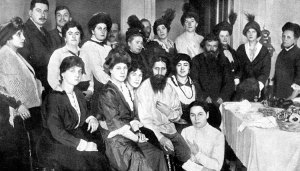 Rasputin Brought Down an Empire
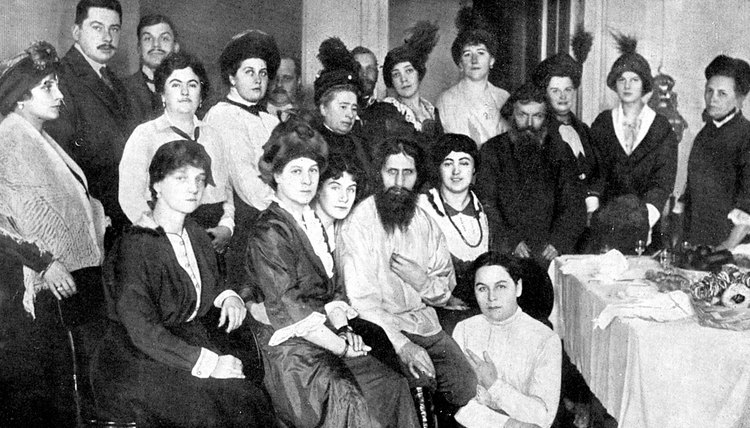
A story about a relatively unknown citizen participated in the fall of an empire would be noteworthy regardless the circumstances. The idea that the man who did it was a lowly, ill-mannered, poorly educated peasant in the highly structured class structure of early 1900’s Russia is one of the primary reasons we’re still fascinated with Grigori Yefimovich Rasputin.
For a variety of reasons, there will always be gaps between the classes. There are gaps in every country and every era, but the gaps we have now don’t even compare to the cultures and societies of the early 1900’s and before. Russia’s class structure was so entrenched, in the early 1900’s, that if a peasant received an education, it was considered pointless. The pre-WWI Russian political structures, their religious and social values, and various legal codes and rules made upward mobility in the classes all but impossible. If a Russian teacher were caught teaching peasants that they could be anything they wanted to be, the parents of those students probably would’ve complained that the teacher was engaging in a sick, cruel joke. The idea that a commoner, much less a peasant, might climb so far up the ladder to one-day advise the ruling family of the empire was likely so far-fetched that no Russians considered it even a remote possibility.
While many historians argue about the actual level of influence the peasant we now know as Rasputin exerted on the Romanovs, some of them argue that Rasputin’s murder might have precipitated the fall of the Romanov Empire. Whether it was a direct result of Rasputin’s influence, his murder, or some sort of tangential influence, I believe the correlation derived from what I call The Rasputin Paradox.
The Rasputin Paradox occurs when a team uses a scapegoat to explain their lack of success. When the leaders of an enterprise build, or take it over, they believe they are the ones who can lead it to success. When they fail, they might not view one individual responsible for that failure a scapegoat in the purest sense of the word, but they might be susceptible to the belief that if they were able to remove that person it might their last impediment to success. What often happens, shortly after they remove this person, is that they find themselves exposed to blame for anything that goes awry in the aftermath. The leaders might attempt to convince some team members, and themselves, that the scapegoats’ coattails can still be found in the accounting figures, the blame eventually falls on them when there are no more scapegoats.
In the relationship between the Romanovs, Rasputin, and the citizens of Russia, it’s vital to note that the Romanovs may not have ever considered Rasputin a scapegoat in the purest sense. They probably assumed they were doing just fine. The citizens didn’t, and they reportedly placed an inordinate amount of blame for the ineptitude of the empire on Rasputin. After his murder, however, their perception of glaring failure on the part of the Russian Empire focused squarely on the Romanovs, and it eventually led to their bloody overthrow in a February revolution that started less than two months after Rasputin’s murder.
Rasputin was a Piece of Junk who Influenced an Empire
Even by the hierarchical standards of early 1900’s Russia, in which they viewed peasants as below vermin, Grigori Yefimovich Rasputin was a slob. He was an ill-mannered poorly educated drunk who stunk. We’ve all met men who have no regard for standards of politeness, but most of them find a way to conceal their ignorant, belligerent ways around women. The impolite might not revere women the way most of us do, but they’re usually respectful in their company, especially if that woman exhibits impressive levels of refinement. No matter how one chooses to characterize refinement, chivalry, or manners, historians suggest Rasputin was likely the exact opposite. Russians reviled him as a sexual deviant. They suggest that he was a little more than a con man who used women to make political connections and gain influence.
When these women recommended Rasputin to the empire, they informed the court that he had the otherworldly powers necessary to help the Romanovs cure their son of hemophilia. When the Romanovs agreed to see him, his appearance before the court must have shocked them. Did they find some way to overlook his characteristics for the presumed benefit of their son, or did his appearance, and the rumors of his demeanor, lead them to presume he was some sort of conduit to otherworldly powers? When the well-mannered, more attractive men, schooled in refined ways stood before the court, detailing the ways they could help Alexei Romanov, the Romanovs were likely more skeptical. They probably heard it all before. What was Rasputin’s appeal? He had a history of “curing” people long before he stood before the Romanovs, and that word-of-mouth surely made it to Alexandra and Nicholas before the interview, but that likely didn’t prepare them for the appearance of this man. When he appeared before them, they likely fell prey to the very human belief that a person who eschews common pleasantries and niceties is more mysterious and thus, more in tune with spiritual and less conventional means of healing. (Most historians suggest that Nicholas never fell under Rasputin’s spell, but Alexandra did.)
Another element that aided Rasputin’s rise was that the Romanovs were desperate to end the suffering of their child’s pain, and they exhausted the conventional means of the more conventional men of medicine with far more education. Were they so desperate that they were willing to try anything, or were they more susceptible to what they considered the more spiritual means that Rasputin appeared to fulfill? Whatever the case was, Rasputin managed to use this speculation, based on his appearance, to gain more influence in the Russian Empire, and he used it to achieve a place in history for which Russian peasants didn’t even bother dreaming.
 His Appearance
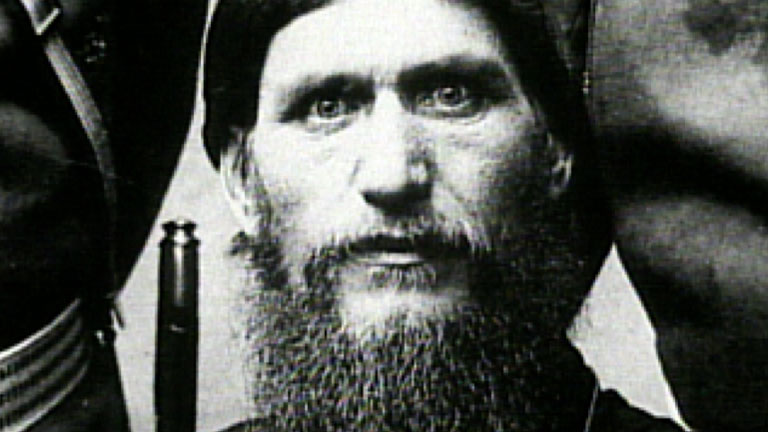
“Those eyes,” is the first and last thing we say when we see a photo of Grigori Yefimovich Rasputin. In the portraits we have of Rasputin, we see the long, famously unwashed and unkempt hair, and in some pictures we see that he didn’t tend to his beard too well either. These are pictures, portraying (we assume) Rasputin looking his best, or at least after he’s had a chance to spruce up a bit. This begs the question, what did he look like when he wasn’t saying “cheese!”? We might also ask if his refusal to adhere to hygienic norms added to an almost bestial lore. If that’s the case how many unkempt historical figures were never mentioned again in history? How many of Rasputin’s fellow peasants didn’t or couldn’t uphold the beauty standard of modern times? How many different outfits did peasants of the era have? How many cleaning products did they own? How many of them lived most of their lives in conditions we might consider unsanitary, filthy, and unlivable conditions? If part of Rasputin’s allure is looks, how did he manage to rise above the peasants he grew up around? Was he a naturally attractive man, or is it all about the eyes? Some have eyes that observers call nice. “He has nice eyes.” Others have “striking eyes”, but there is something noteworthy, striking, and unusual going on in Rasputin’s eyes. We don’t know exactly what we’re seeing when we look into those eyes, but we can’t look away. No matter how we look at those eyes, we cannot walk away without thinking that the man had a powerful gaze.
We can feel the power of those eyes, just looking at them. A cheap, con man, hypnotist might pay good money to attain those eyes. We can only imagine how Russian citizens must have reacted under their spell, but the photos we now have of Rasputin are black and white. If those eyes were as coal black as they appear in black and white photos, we might almost feel soothed by the certain consistent definition they appear to have. The idea that they were blue, which some describe as an “intensely, cold blue”, as depicted in the colorized version below, must have proved so unsettling that a part of Rasputin’s purported charm and charisma probably came from reassuring those who saw “those eyes” that he meant them no harm.
 We all act to enhance and counteract our physical characteristics, and Rasputin might have developed a soothing tone to counteract the imaginations of the spiritual and easily spooked villagers he knew. Coupled with the eyes, we have the long hair, the infamous beard, and overall unkempt appearance, and we assume we have an appearance trapped somewhere between our caricatures of Jesus of Nazareth and Satan. If the eyes were as hypnotic as some suggest, we can imagine that he would be the most memorable person those of the era ever met in any crowd or gathering. Couple his unsettling appearance, with his much talked and charm and charisma, and the rumored size of his member, and we have a figure who left such a profound mark on history that we’re still talking about him 100 years after his death.
 He Cured a Child of Hemophilia

As stated in the Rasputin II: A Miracle at Spala article, Rasputin never “cured” the tsar’s son Alexei. Alexei Romanov had hemophilia the day he was born, and he died with it. What is not in dispute is the fact that Rasputin temporarily ended the suffering Alexei experienced as a result of the temporary, painful symptoms of hemophilia. How Rasputin accomplished this is the subject of much speculation. (Some suggest Rasputin used horse-whispering techniques to soothe the boy, some say he understood the healing powers of magnetism, and others suggest he knew more about medicine than most of his peers, including the medical professionals of his era).
No matter what he did, the consensus at the time suggests he did soothe the boy into temporary health. Some historians suggest that Rasputin simply called for Alexei’s doctors to stop giving him aspirin, an agent of blood thinning, as we now know. Did Rasputin know more about aspirin than Alexei’s team of doctors, or did he happen upon someone who just happened to theorize that aspirin thins the blood, and Rasputin happened to witness the results that no other medical professional in his era knew?
As a lowly peasant, Rasputin also had less to lose than the medical professionals who were lining up to be a close medical advisor to the Romanovs. If he failed, he would go back to living the life he always knew, as a peasant. Did he step in and say something as simple as, “Why don’t we try something different?” That might seem so simple, but we can guess that the medical professionals didn’t want to make all of their other colleagues look bad, or they simply followed the “proper diagnosis” of hemophilia by giving Alexei aspirin. Our modern minds suggest this is less a compliment to Rasputin’s ability and/or know how and more a critique of the medical knowledge of the era. If this speculation is true, we might regard Rasputin as nothing more than a right-time, right place charlatan who took advantage of the lack of knowledge in his era to become a close advisor of the tsarina Alexandra Romanov. In light of this theory, we might even consider the “healing” of Alexei a footnote in history.
Historians debate what Rasputin actually did to cure Alexei, but what is not in debate is that everyone from Alexandra on down regarded what Rasputin did was amazing, at the very least, and miraculous at most. This poorly educated peasant essentially saved the empire, in their minds, by saving the heir to the crown, and mother Russia was so grateful that they (Alexandra specifically) awarded him the role of close advisor.
He would use this seat to not only advise Alexandra on how to treat Alexei’s ailments, but some believe he fostered such a quality relationship with her that he began advising her on matters of state. Some believe she would then whisper such advice to Tsar Nicholas II. When the tsar then went to join his fellow countrymen in battle, the tsarina was left in charge, and some believe Rasputin’s influence grew in the tsar’s absence.
Some, including the British Secret Intelligence Service, believed that Rasputin’s influence on Alexandra, and thus Nicholas, was so profound that it might have precipitated Russia withdrawing forces in WWI. They believed that Rasputin, for all of his folklore, was actually something of a pacifist, and that he was advising the empire to withdraw its forces from World War I. This conspiracy theory suggests that Britain needed Germany concentrating at least some of their forces on Russia, until the United States would enter the war. This theory suggest that the British Secret Intelligence Service was so worried about Rasputin’s influence on the empire that they might have encouraged, devised, participated in, or financially funded the murder of Rasputin. The author of this theory, Joseph T. Fuhrman, further states that “Britain’s Military Intelligence, Section Six, (MI6), [recently] promised to publish its files on Rasputin’s murder, but it decided to delay it, we can assume, to avoid cooled relations between Moscow and London.”
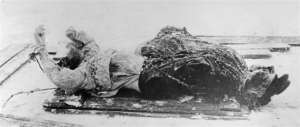 Rasputin’s Assassination

“They tried poisoning him, shooting him and drowning him,” my History teacher said, “but Grigori Yefimovich Rasputin was a man who would not die.” The various stories of the assaults on Rasputin suggest that a prostitute without a nose stabbed him, and that he survived, even though his blood loss was considerable, and his internal organs allegedly fell out.
Two years after the prostitute stabbed him, a team of nobles led by Felix Yusupov, the richest man in Russia, attempted to lace his tea and cakes with cyanide to assassinate him. When Rasputin showed no signs of succumbing to the cyanide, they upped the dose they put it in his wine. When that didn’t produce immediate results, they tried stabbing him, and then they tried shooting him. They shot at him five times, and three of those shots hit. He was not dead at this point, allegedly, so they tried clubbing him to death. Convinced that he was finally deceased, the team of assassins rolled him up in a carpet and threw him in the Malaya Nekva river. Some speculate that he was not dead when he hit the water, and that he drowned or died of hypothermia. My History teacher added to this myth stating that “The assassins secured Rasputin in this carpet with chains connected to concrete blocks that they hoped would bound him to the bottom of the river.” The History teacher added that when Russian officials were finally able to crack through the frozen Malaya Nekva river to retrieve the body, they found the carpet, the cinder blocks, and the chains, but they found no body.
“Is he alive today?” one of my fellow students asked.
“They never found a body,” our teacher answered.
We didn’t even question the details, because who would? Our teacher was a learned man in a seat of authority, and it was a fantastic tale. Who cares if it’s 100% true or not. Historians suggest that it might be quite a stretch to say that that tale is true. They all agree that a prostitute with no nose stabbed him, but they suggest that it’s debatable that his internal organs fell out. They agree that a team of assassins gathered to poison, stab, and shoot him. They agree that the nobles shot at him, five times, and three hit. The historical accounts we’ve read suggest that the final shot, the one delivered execution style to the forehead, killed Rasputin. The autopsy report, these reports say, confirm that. The historians suggest that it’s plausible, due to the dose of cyanide and the locations of most of the bullets on Rasputin’s body, that any mere mortal could’ve survived in the short-term, but that Rasputin would’ve eventually succumbed to them. They suggest that when Rasputin didn’t die immediately, the team of assassins panicked. They may have assumed that Rasputin’s much-speculated supernatural powers kept him alive through all that. Historians speculate that much of what followed Rasputin’s demise, including the clubbing and chaining him to the bottom of the river was based on irrational fears that led the assassins to some literal measures of overkill. Who cares, though, the myth of the man who wouldn’t die, and couldn’t be killed, fascinates us so much that it comprises much of the reason we’re still reading and writing about him over 100 years after his murder.
The myth of the man who wouldn’t die probably influenced the writers of Friday the 13th, Halloween, and Nightmare on Elm Street. For many of us the details of how Rasputin lived pale in comparison to the manner in which he was killed. He was the original Man Who Wouldn’t Die. As discussed throughout this article and Rasputin III: The Murder of Grigori Yefimovich Rasputin, there is speculation, interpretation of eyewitness accounts, and myths surrounding Rasputin’s. There are some facts, such as those detailed in the autopsy report, and official reports, but are those facts? We might never know for sure, but the one thing we do know is most great story tellers, like my History teacher, don’t let facts get in the way of a great story.
The Myth
Some might say the folklore surrounding the tale of “the man who wouldn’t die” is the number one reason the fascination surrounding Rasputin might never end, but I believe it is a combination of all of the above. If, for example, Rasputin managed to leap through the strict class structure of his culture to the roles of advisor to the empire and Holy Fool, he saved the life of the tsar’s son, and he escaped death a couple of times, but he looked like Jimmy Carter, it might have affected his historical value. The fact that not only are the facts of Grigori Rasputin’s story a little spooky, but he looked creepy and spooky ups his historical value exponentially.
The lore of Grigori Yefimovich Rasputin is also rife with speculation, as the Russian Empire, at the time of Romanov rule, was so mired in secrecy that we will never know the truth of what happened during these years. As opposed to most empires of similar size and scope, the Romanov was extremely successful in keeping a tight lid on leaks, and the speculation based on eye-witness accounts is as dubious as eye-witness accounts are. This only invites speculation, folklore, myths and conspiracy theories fill the gaps. Yet, we do have to sympathize with the Romanovs for how damaging would it be for them to release information that when the Romanovs finally produced a male heir that he was constantly on the verge of death, until a “lower than vermin” peasant came along and “cured” him. It would do nothing but damage their cause to publicly admit, or historically record that the crown, or the court, received advice from a peasant on state matters. When we gather all of the secondhand information together, and we couple it with the notion that some of the information we have about Rasputin, the Romanovs, and their relationships was likely spread by the regime that took over after the revolution to further advance their cause, and their agenda further complicates any attempts at separating fact from fiction. Even if one tenth of these tales are true, they’re so wild and fascinating that we’ve been passing it down for over 100 years, and those who hear these stories will probably be passing them on for 100 more.
This article is a culmination of the first three articles. For a more detailed account of the life of Rasputin, you might enjoy these articles: Part I: Rasputin Rises, Part II: A Miracle at Spala, and Part III: The Murder of Rasputin.


 Rilaly