Leonardo da Vinci’s Woodpecker


“Describe the tongue of the woodpecker and the jaw of the crocodile,” Leonardo da Vinci wrote as a reminder to himself in his Codex Atlanticus.

How many of you are curious about inconsequential matters? Let’s see a show of hands. How many of those curiosities will end up serving something greater? Some will and some might, you never know. We could end up studying something largely consider inconsequential that ends up helping us understand ourselves better, our relationship to nature, and all of interconnected facets of our ecosystem. What seems inconsequential in the beginning can prove anything but in other words, but what would purpose could the study of a bird’s tongue serve a 16 th century artist? 

“Everything connects to everything else,” a modern da Vinci might have answered. There is no evidence that the 15th and 16th century Leonardo da Vinci ever said, or wrote, those words, and it’s likely apocryphal or a 20thcentury distillation of Leonardo’s notebook passages on the unity of nature, such as the earth-man analogy he made in the Codex Leicester or water’s role in the Codex Atlanticus. So, the answer is da Vinci studied the woodpecker’s tongue to try to find a greater connection, right? Maybe, sort of, and I guess in a roundabout way. When we study da Vinci’s modus operandi, we discover that his research did involve trying to find answers, but his primary focus was to try to find questions. He was, as art historian said, Kenneth Clark said, “The most relentlessly curious.” That characterization might answer our questions with a broad brush, but it doesn’t answer the specific question why even the most relentlessly curious mind would drill so far down to the tongue of the woodpecker for answers. For that, we turn back to the theme we’ve attributed to da Vinci’s works “Everything connects to everything else.” He wasn’t searching with a purpose, in other words, he was searching for a purpose of the purpose of the tongue.

We’ve all witnessed woodpeckers knocking away at a tree. Depending on where we live, it’s probably not something we hear so often that it fades into the background. When we hear it, we stop, we try to locate it, and we move on. Why do they knock? Why does any animal do what they do? To get food. Yet, how many of us have considered the potential damage all that knocking could have on the woodpecker’s brain? If another animal did that, it could result in headaches, concussions, and possible long term brain damage. How does a woodpecker avoid all of that? Prior to writing this article, I never asked how the woodpecker avoided injury, because I never delved that deep into that question, because why would I? As with 99.9% of the world, I just assumed that nature always takes care of itself somehow. As curious as some of us are, da Vinci’s question introduces to the idea that we’re not nearly as curious as we thought.
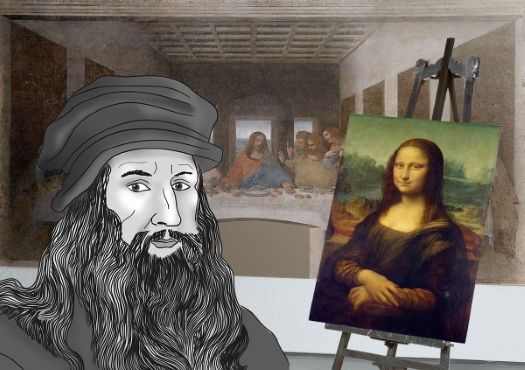
Was da Vinci one of the most relentlessly curious minds that ever existed, or was he scatterbrained? We have to give him points for the former, for even wondering about the woodpecker’s tongue and the crocodile’s jaw, but the idea that he we have no evidence that he pursued these questions gives credence to the latter.

Did he find the fresh carcass of a woodpecker to discover how long the tongue was relative to the small bird, and its comparatively small head? Did he initially believe that the extent of its functionality involved helping the bird hammer into wood, clear wood chips, and/or create a nest. If his note was devoted to what he saw the bird do, he probably saw it perform all of these chores, coupled with using it to retrieve ants and grubs from the hole its knocking created. If da Vinci watched the bird, he probably saw what every other observer could see. It doesn’t seem characteristic to da Vinci to leave his conclusions to superficial observations, but I have not found a conclusion in da Vinci’s journal to suggest that he dissected the bird and found the full functionality of the tongue. There were no notes to suggest da Vinci found, asIFOD.comlists: 
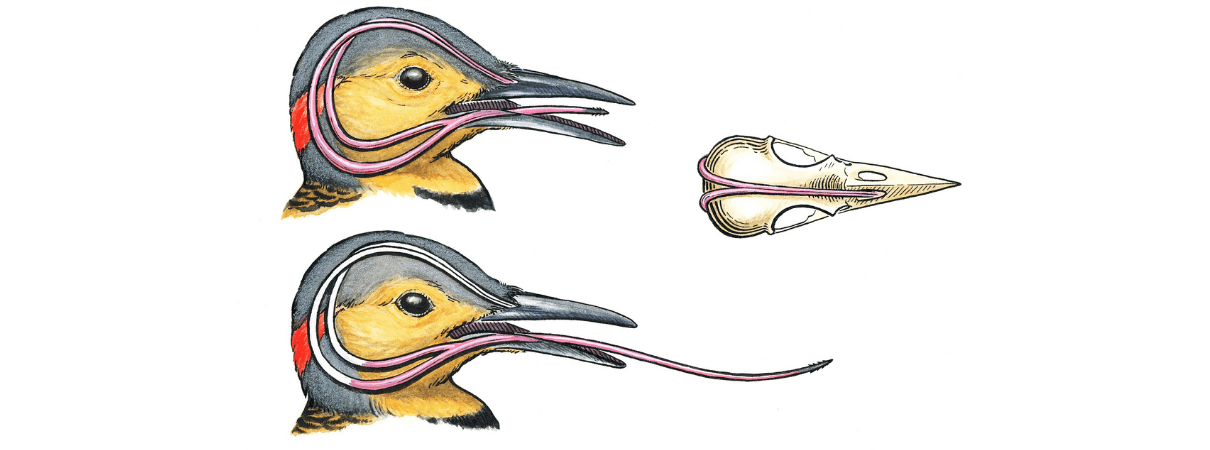
“When not in use, the woodpecker’s unusually long tongue retracts into the skull and its cartilage-like structure continues past the jaw to wrap around the bird’s head and then curve[s] down to its nostril. In addition to digging out grubs from a tree,the long tongue protects the woodpecker’s brain. When the bird smashes its beak repeatedly into tree bark, the force exerted on its head is ten times what would kill a human.But its bizarre tongue and supporting structure act as a cushion, shielding the brain from shock.”    

Brilliant musicians dive deep into sound, acoustics, and how they might manipulate them in a unique manner to serve the song. Writers pay attention to the power of words, as we attempt to hone in on their subtle yet powerful forms of coercion, and the power of the great sentence. Artists, in general, seek to achieve a greater understanding of little relatively inconsequential matters for the expressed purpose of gaining a greater understanding of larger concepts, but a study of the woodpecker’s doesn’t appear to serve any purpose, large or small.  

The idea that he was curious about the tongue is fascinating, as it details the full breadth of his sense of curiosity, but it still didn’t appear to serve a purpose. The only answer Walter Isaacson wrote for da Vinci’s relentless curiosity was:

“Leonardo with his acute ability to observe objects in motion knew there was something to be learned from it.”   

There is no evidence to suggest that Leonardo da Vinci regretted the idea that he didn’t create more unique paintings, but I would’ve. If I worked as hard as da Vinci obviously did to hone the talent he did, I would regret that I left so few paintings for the historical record. (Though he may have created far more than we know, art experts are only able to definitively declare that da Vinci created 15-20 paintings.) Thus the price we art aficionados pay for da Vinci for stretching himself so thin ( as discussed in Walter Isaacson’s Leonardo da Vinci), is relatively few paintings.

“You could say that,” we might say arguing with ourselves, “but if he wasn’t so relentlessly curious about such a wide range of what we deem insignificant matters, the relatively few works we now know likely wouldn’t have the detailed precision we now know.” If he wasn’t so relentless curious about the particulars of the manner in which water flows, and the effects of light and shadow, the techniques he employed (sfumato andChiaroscuro) might’ve taken future artists hundreds of years to nuance into its final form. Da Vinci did not discover these techniques, but according to the history of art, no one employed them better prior to da Vinci, and the popularity of his works elevated these techniques to influence the world of art.   

Arguments lead to arguments. One argument suggests that thirty quality artistic creations define the artist, and the other argument suggests that one or two masterpieces define an artist no matter how many subsequent pieces he puts together. An artist who creates a Mona Lisa or a The Last Supperdoesn’t need to do anything else.I understand and appreciate both arguments, but we can’t fight our hunger for MORE. When we hear the progressions that led to The Beatles “The White Album”, and then we hear “The White Album” we instantly think if those four could’ve kept it together, or Come Together one more time, we could’ve had more. If Roger Avary and Quentin Tarantino didn’t have a falling out after Pulp Fiction, they could’ve created more great movies together? If Franz Kafka could’ve kept it together, and devoted more of his time to writing, it’s possible that Metamorphosis and The Trial wouldn’t be the two of the far too few masterpieces he created.

The rational side of me knows that more is not always more, and that the “Everything connects to everything else” theme we connect to da Vinci’s modus operandi informed the art we now treasure, and I understand that his obsessive pursuit of perfection led to his works being considered the greatest of all time, but I can’t get past the idea that if he wasn’t so distracted by everything that took him away from painting, we all could’ve had so much more. Yet, I reconcile that with the idea that that which made him is that which made him, and he couldn’t just flip that which made him into the “off” position to create more art.

Why did da Vinci pursue such mundane matters? Author Walter Isaacson posits that da Vinci’s talent “May have been connected to growing up with a love of nature while not being overly schooled in received wisdom.” On the subject of received wisdom, or a formal education, da Vinci was “a man without letters”, and he lacked a classical education in Latin or Greek. As with most who rail against those with letters after their name, da Vinci declared himself “a disciple of experience”. He illustrated his self-education by saying, “He who has access to the fountain does not need to go to the water-jar.” He who has access to primary sources, in other words, doesn’t need to learn about it throughthe second-hand knowledge attained in text books. Da Vinci obviously suffered from an inferiority complex in this regard that led him down roads he may not have traveled if his level of intelligence was never challenged. His creative brilliance was recognized and celebrated, as da Vinci knew few peers in the arena of artistic accomplishment. We can guess that his brilliance was recognized so early that it didn’t move his needle much when even the most prestigious voices expressed their appreciation for his works. Yet, the one thing we all know about ourselves is that we focus on our shortcomings, and while we celebrate his intelligent theories and deductions, we can only guess that those with letters behind their name dismissed him initially. “What do you know?” they might have asked the young da Vinci, when he posed an intellectual theory. “You’re just a painter.” Was he dismissed from intellectual discussions in this manner early on in life? Was he relegated-slash-subjugated to the artistic community in his formative years, in a way that grated on him for the rest of his life? Did he spend so much of his time in intellectual pursuits, creating and defeating intellectual boogie men in a manner that fueled a competitive curiosity for the rest of his life? 

Even today, we see brilliantly creative artists attempt to prove their intellectual prowess. It’s the ever present, ongoing battle of the left vs. right side of the brain. The brilliant artist’s primary goal in life, once accepted as a brilliant artist is to compensate for his lack of intelligence by either displaying it in their brilliant works of art or diminishing the level of intellect their peers have achieved. Is this what da Vinci was doing when he laid out a motto for all, one he calledSaper vedere(to know how to see). He claimed that there are three different kinds of people, “Those who see by themselves, those who see when someone has shown them and those who do not see.” In this motto, da Vinci claims his method superior, which it is if one counts consulting primary sources for information, but why he felt the need to pound it into our head goes to something of an inferiority complex.

One element that cannot be tossed aside when discussing da Vinci’s relentless curiosity is that he was born into a comfortable lifestyle. The young da Vinci never had to worry about money, food, or housing. As such, he was afforded the luxury of an uncluttered mind. When a young mind doesn’t have to worry about money, food, or achieving an education to provide for himself and his family, he is free to roam the countryside and be curious about that which those with more primary concerns do not have time to pursue. Isaacson’s writing makes clear that although Leonardo da Vinci was an unusual mind on an epic, historical scale, the privilege of thinking about, and obsessing over such matters can only come from one who has an inordinate amount of free time on his hands. Perhaps this was due to his privilege, his comfortable lifestyle, or the idea that he didn’t have much in the way of structured schooling to eat up so much of his thoughts and free time in youth. 

Having said that, most modern men and women currently have as much, if not more, free time on their hands, and we could probably compile a list of things we wonder about a thousand bullet points long and never reach the woodpecker’s tongue, the peculiarities of the geese feet, or the jaws of a crocodile to the point that we conduct independent studies or dissections. We also don’t have to do primary research on such matters now, because we have so many “jars of water” that we no longer have the need to go to the fountains to arrive at ouranswers.  

Consider me one who has never arrived at an independent discovery when it comes to nature and animals, as I don’t seek primary source answers on them. I, too, am a student of the jaws of water that various mediums, be they documentaries on TV or books, but I am a student of the mind, and I do seek primary source information on the subject of human nature. On this subject, I do not back away from the charge that I’m so curious about it that I exhibit an almost childlike naïveté at times, but reading through Leonardo’s deep dives makes me feel like I’ve been skimming the surface all these years. I mean, who drills that deep? It turns out one of the greatest artists of all time did, and now that we know the multifaceted functions of the woodpecker’s tongue, we can see why he was so fascinated, but what sparked that curiosity? It obviously wasn’t to inform his art, and there is nothing in da Vinci’s bio to suggest that that knowledge was in service of anything. He was just a curious man. He was just a man who seemingly asked questions to just to ask questions, until those questions led him to entries in journals and paintings that we ascribe to the theme everything connects to everything else.
Rasputin IV: Why is Rasputin Still Famous?


What is it about a relatively simple man named Grigori Yefimovich Rasputin that still captivates us? Historians who look deep into history are as fascinated with him as novices who read history for entertainment value. Why would a book about a Russian peasant who died over 100 years ago attract our eye in the halls of thousands of books in American bookstores or libraries? Why would my pre-teen nephew know an eye-popping amount of information on a relatively unimportant historical figure born 100 years before he was, and why would he want to know more? 

The idea that we would still be talking about a dirty, ill-mannered, and poorly educated peasant from the Siberian village of Pokrovsho in the Tyunsky Uyezd of Tobolsk Governate (or for the rest of you the Yarkovsky District of Tyumen Oblast) would’ve shocked the millions of people who lived through early 20th century Russia with Rasputin. The Russian citizenry probably assumed we’d be talking about one of their leaders, one of their military heroes, their writers, philosophers, or even their murderers, but this lowly peasant wasn’t any of those. Yet, his story, his legacy, continues to intrigue movie makers, those who write bios, news magazine pieces, web articles, and blogs over 100 years after some Russian nobleman, and the richest man in Russia, murdered Rasputin on Dec. 30, 1916.

Is it all about those eyes? We can talk about intrigue he created in the Russian Empire, the power of influence that he allegedly wielded on the Tsar’s wife, after allegedly healing her son of hemophilia, or the legend of the “man who wouldn’t die”, but we learn the breadth of that information after the initial intrigue. Why have I read so much about him, why do I watch bios on him, why do I write about him, and why did you click on this article about him? Why do we want to learn about him, and why do we continue to want to learn more? 

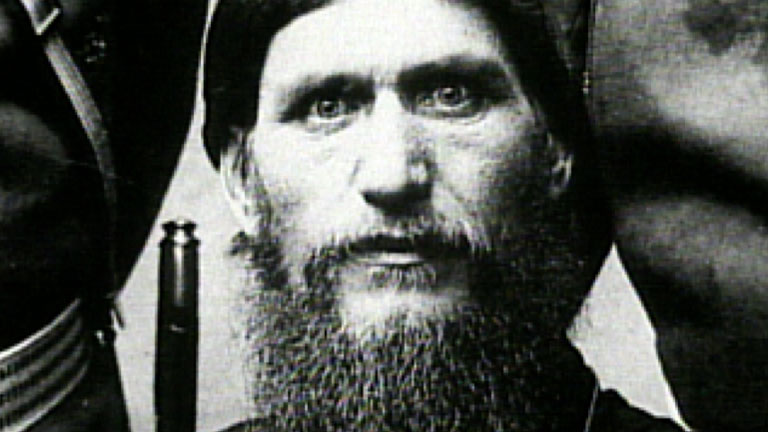
The initial intrigue, we can only guess, is those eyes. Rasputin had long, famously unwashed hair, a long beard, and a couple of penetrating, spooky, and some might say creepy eyes. Many of us have what others might call “nice” eyes, many of us have eyes some consider striking, but how many of us have eyes that lead songwriters to write songs? Who cares what he looked like, we might say, good looking people with striking features litter history. I wasn’t drawn to learn more about Rasputin, because he was good looking, or he had unusual features. Then why were you? 

Rasputin Brought Down an Empire

A story about a relatively unknown citizen participated in the fall of an empire would be noteworthy regardless the circumstances. The idea that the man who did it was a lowly, ill-mannered, poorly educated peasant in the highly structured class structure of early 1900’s Russia is one of the primary reasons we’re still fascinated with Grigori Yefimovich Rasputin.

For a variety of reasons, there will always be gaps between the classes. There are gaps in every country and every era, but the gaps we have now don’t even compare to the cultures and societies of the early 1900’s and before. Russia’s class structure was so entrenched, in the early 1900’s, that if a peasant received an education, it was considered pointless. The pre-WWI Russian political structures, their religious and social values, and various legal codes and rules made upward mobility in the classes all but impossible. If a Russian teacher were caught teaching peasants that they could be anything they wanted to be, the parents of those students probably would’ve complained that the teacher was engaging in a sick, cruel joke. The idea that a commoner, much less a peasant, might climb so far up the ladder to one-day advise the ruling family of the empire was likely so far-fetched that no Russians considered it even a remote possibility.

While many historians argue about the actual level of influence the peasant we now know as Rasputin exerted on the Romanovs, some of them argue that Rasputin’s murder might have precipitated the fall of the Romanov Empire. Whether it was a direct result of Rasputin’s influence, his murder, or some sort of tangential influence, I believe the correlation derived from what I call The Rasputin Paradox.

The Rasputin Paradox occurs when a team uses a scapegoat to explain their lack of success. When the leaders of an enterprise build, or take it over, they believe they are the ones who can lead it to success. When they fail, they might not view one individual responsible for that failure a scapegoat in the purest sense of the word, but they might be susceptible to the belief that if they were able to remove that person it might their last impediment to success. What often happens, shortly after they remove this person, is that they find themselves exposed to blame for anything that goes awry in the aftermath. The leaders might attempt to convince some team members, and themselves, that the scapegoats’ coattails can still be found in the accounting figures, the blame eventually falls on them when there are no more scapegoats.

In the relationship between the Romanovs, Rasputin, and the citizens of Russia, it’s vital to note that the Romanovs may not have ever considered Rasputin a scapegoat in the purest sense. They probably assumed they were doing just fine. The citizens didn’t, and they reportedly placed an inordinate amount of blame for the ineptitude of the empire on Rasputin. After his murder, however, their perception of glaring failure on the part of the Russian Empire focused squarely on the Romanovs, and it eventually led to their bloody overthrow in a February revolution that started less than two months after Rasputin’s murder.

Rasputin was a Piece of Junk who Influenced an Empire

Even by the hierarchical standards of early 1900’s Russia, in which they viewed peasants as below vermin, Grigori Yefimovich Rasputin was a slob. He was an ill-mannered poorly educated drunk who stunk. We’ve all met men who have no regard for standards of politeness, but most of them find a way to conceal their ignorant, belligerent ways around women. The impolite might not revere women the way most of us do, but they’re usually respectful in their company, especially if that woman exhibits impressive levels of refinement. No matter how one chooses to characterize refinement, chivalry, or manners, historians suggest Rasputin was likely the exact opposite. Russians reviled him as a sexual deviant. They suggest that he was a little more than a con man who used women to make political connections and gain influence.

When these women recommended Rasputin to the empire, they informed the court that he had the otherworldly powers necessary to help the Romanovs cure their son of hemophilia. When the Romanovs agreed to see him, his appearance before the court must have shocked them. Did they find some way to overlook his characteristics for the presumed benefit of their son, or did his appearance, and the rumors of his demeanor, lead them to presume he was some sort of conduit to otherworldly powers? When the well-mannered, more attractive men, schooled in refined ways stood before the court, detailing the ways they could help Alexei Romanov, the Romanovs were likely more skeptical. They probably heard it all before. What was Rasputin’s appeal? He had a history of “curing” people long before he stood before the Romanovs, and that word-of-mouth surely made it to Alexandra and Nicholas before the interview, but that likely didn’t prepare them for the appearance of this man. When he appeared before them, they likely fell prey to the very human belief that a person who eschews common pleasantries and niceties is more mysterious and thus, more in tune with spiritual and less conventional means of healing. (Most historians suggest that Nicholas never fell under Rasputin’s spell, but Alexandra did.)  

Another element that aided Rasputin’s rise was that the Romanovs were desperate to end the suffering of their child’s pain, and they exhausted the conventional means of the more conventional men of medicine with far more education. Were they so desperate that they were willing to try anything, or were they more susceptible to what they considered the more spiritual means that Rasputin appeared to fulfill? Whatever the case was, Rasputin managed to use this speculation, based on his appearance, to gain more influence in the Russian Empire, and he used it to achieve a place in history for which Russian peasants didn’t even bother dreaming.

His Appearance

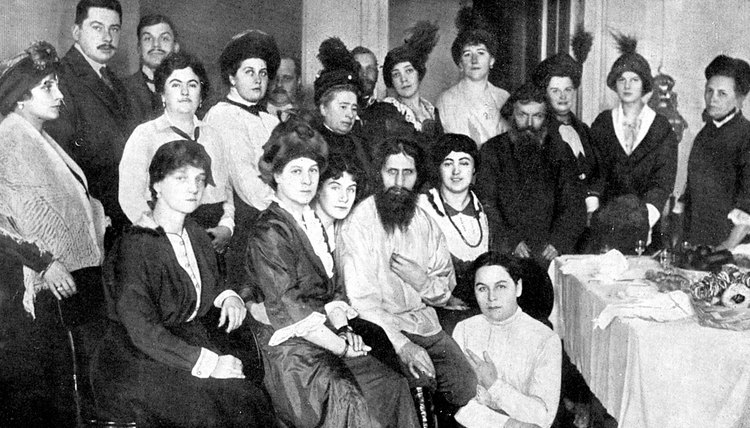
“Those eyes,” is the first and last thing we say when we see a photo of Grigori Yefimovich Rasputin. In the portraits we have of Rasputin, we see the long, famously unwashed and unkempt hair, and in some pictures we see that he didn’t tend to his beard too well either. These are pictures, portraying (we assume) Rasputin looking his best, or at least after he’s had a chance to spruce up a bit. This begs the question, what did he look like when he wasn’t saying “cheese!”? We might also ask if his refusal to adhere to hygienic norms added to an almost bestial lore. If that’s the case how many unkempt historical figures were never mentioned again in history? How many of Rasputin’s fellow peasants didn’t or couldn’t uphold the beauty standard of modern times? How many different outfits did peasants of the era have? How many cleaning products did they own? How many of them lived most of their lives in conditions we might consider unsanitary, filthy, and unlivable conditions? If part of Rasputin’s allure is looks, how did he manage to rise above the peasants he grew up around? Was he a naturally attractive man, or is it all about the eyes? Some have eyes that observers call nice. “He has nice eyes.” Others have “striking eyes”, but there is something noteworthy, striking, and unusual going on in Rasputin’s eyes. We don’t know exactly what we’re seeing when we look into those eyes, but we can’t look away. No matter how we look at those eyes, we cannot walk away without thinking that the man had a powerful gaze.

We can feel the power of those eyes, just looking at them. A cheap, con man, hypnotist might pay good money to attain those eyes. We can only imagine how Russian citizens must have reacted under their spell, but the photos we now have of Rasputin are black and white. If those eyes were as coal black as they appear in black and white photos, we might almost feel soothed by the certain consistent definition they appear to have. The idea that they were blue, which some describe as an “intensely, cold blue”, as depicted in the colorized version below, must have proved so unsettling that a part of Rasputin’s purported charm and charisma probably came from reassuring those who saw “those eyes” that he meant them no harm.

We all act to enhance and counteract our physical characteristics, and Rasputin might have developed a soothing tone to counteract the imaginations of the spiritual and easily spooked villagers he knew. Coupled with the eyes, we have the long hair, the infamous beard, and overall unkempt appearance, and we assume we have an appearance trapped somewhere between our caricatures of Jesus of Nazareth and Satan. If the eyes were as hypnotic as some suggest, we can imagine that he would be the most memorable person those of the era ever met in any crowd or gathering. Couple his unsettling appearance, with his much talked and charm and charisma, and the rumored size of his member, and we have a figure who left such a profound mark on history that we’re still talking about him 100 years after his death.          

He Cured a Child of Hemophilia

As stated in the Rasputin II: A Miracle at Spala article, Rasputin never “cured” the tsar’s son Alexei. Alexei Romanov had hemophilia the day he was born, and he died with it. What is not in dispute is the fact that Rasputin temporarily ended the suffering Alexei experienced as a result of the temporary, painful symptoms of hemophilia. How Rasputin accomplished this is the subject of much speculation. (Some suggest Rasputin used horse-whispering techniques to soothe the boy, some say he understood the healing powers of magnetism, and others suggest he knew more about medicine than most of his peers, including the medical professionals of his era).

No matter what he did, the consensus at the time suggests he did soothe the boy into temporary health. Some historians suggest that Rasputin simply called for Alexei’s doctors to stop giving him aspirin, an agent of blood thinning, as we now know. Did Rasputin know more about aspirin than Alexei’s team of doctors, or did he happen upon someone who just happened to theorize that aspirin thins the blood, and Rasputin happened to witness the results that no other medical professional in his era knew?

As a lowly peasant, Rasputin also had less to lose than the medical professionals who were lining up to be a close medical advisor to the Romanovs. If he failed, he would go back to living the life he always knew, as a peasant. Did he step in and say something as simple as, “Why don’t we try something different?” That might seem so simple, but we can guess that the medical professionals didn’t want to make all of their other colleagues look bad, or they simply followed the “proper diagnosis” of hemophilia by giving Alexei aspirin. Our modern minds suggest this is less a compliment to Rasputin’s ability and/or know how and more a critique of the medical knowledge of the era. If this speculation is true, we might regard Rasputin as nothing more than a right-time, right place charlatan who took advantage of the lack of knowledge in his era to become a close advisor of the tsarina Alexandra Romanov. In light of this theory, we might even consider the “healing” of Alexei a footnote in history.

Historians debate what Rasputin actually did to cure Alexei, but what is not in debate is that everyone from Alexandra on down regarded what Rasputin did was amazing, at the very least, and miraculous at most. This poorly educated peasant essentially saved the empire, in their minds, by saving the heir to the crown, and mother Russia was so grateful that they (Alexandra specifically) awarded him the role of close advisor.

He would use this seat to not only advise Alexandra on how to treat Alexei’s ailments, but some believe he fostered such a quality relationship with her that he began advising her on matters of state. Some believe she would then whisper such advice to Tsar Nicholas II. When the tsar then went to join his fellow countrymen in battle, the tsarina was left in charge, and some believe Rasputin’s influence grew in the tsar’s absence. 

Some, including the British Secret Intelligence Service, believed that Rasputin’s influence on Alexandra, and thus Nicholas, was so profound that it might have precipitated Russia withdrawing forces in WWI. They believed that Rasputin, for all of his folklore, was actually something of a pacifist, and that he was advising the empire to withdraw its forces from World War I. This conspiracy theory suggests that Britain needed Germany concentrating at least some of their forces on Russia, until the United States would enter the war. This theory suggest that the British Secret Intelligence Service was so worried about Rasputin’s influence on the empire that they might have encouraged, devised, participated in, or financially funded the murder of Rasputin. The author of this theory, Joseph T. Fuhrman, further states that “Britain’s Military Intelligence, Section Six, (MI6), [recently] promised to publish its files on Rasputin’s murder, but it decided to delay it, we can assume, to avoid cooled relations between Moscow and London.”

Rasputin’s Assassination

“They tried poisoning him, shooting him and drowning him,” my History teacher said, “but Grigori Yefimovich Rasputin was a man who would not die.” The various stories of the assaults on Rasputin suggest that a prostitute without a nose stabbed him, and that he survived, even though his blood loss was considerable, and his internal organs allegedly fell out.

Two years after the prostitute stabbed him, a team of nobles led by Felix Yusupov, the richest man in Russia, attempted to lace his tea and cakes with cyanide to assassinate him. When Rasputin showed no signs of succumbing to the cyanide, they upped the dose they put it in his wine. When that didn’t produce immediate results, they tried stabbing him, and then they tried shooting him. They shot at him five times, and three of those shots hit. He was not dead at this point, allegedly, so they tried clubbing him to death. Convinced that he was finally deceased, the team of assassins rolled him up in a carpet and threw him in the Malaya Nekva river. Some speculate that he was not dead when he hit the water, and that he drowned or died of hypothermia. My History teacher added to this myth stating that “The assassins secured Rasputin in this carpet with chains connected to concrete blocks that they hoped would bound him to the bottom of the river.” The History teacher added that when Russian officials were finally able to crack through the frozen Malaya Nekva river to retrieve the body, they found the carpet, the cinder blocks, and the chains, but they found no body.

“Is he alive today?” one of my fellow students asked.   

“They never found a body,” our teacher answered.

We didn’t even question the details, because who would? Our teacher was a learned man in a seat of authority, and it was a fantastic tale. Who cares if it’s 100% true or not. Historians suggest that it might be quite a stretch to say that that tale is true. They all agree that a prostitute with no nose stabbed him, but they suggest that it’s debatable that his internal organs fell out. They agree that a team of assassins gathered to poison, stab, and shoot him. They agree that the nobles shot at him, five times, and three hit. The historical accounts we’ve read suggest that the final shot, the one delivered execution style to the forehead, killed Rasputin. The autopsy report, these reports say, confirm that. The historians suggest that it’s plausible, due to the dose of cyanide and the locations of most of the bullets on Rasputin’s body, that any mere mortal could’ve survived in the short-term, but that Rasputin would’ve eventually succumbed to them. They suggest that when Rasputin didn’t die immediately, the team of assassins panicked. They may have assumed that Rasputin’s much-speculated supernatural powers kept him alive through all that. Historians speculate that much of what followed Rasputin’s demise, including the clubbing and chaining him to the bottom of the river was based on irrational fears that led the assassins to some literal measures of overkill. Who cares, though, the myth of the man who wouldn’t die, and couldn’t be killed, fascinates us so much that it comprises much of the reason we’re still reading and writing about him over 100 years after his murder.

The myth of the man who wouldn’t die probably influenced the writers of Friday the 13th, Halloween, and Nightmare on Elm Street. For many of us the details of how Rasputin lived pale in comparison to the manner in which he was killed. He was the original Man Who Wouldn’t Die. As discussed throughout this article and Rasputin III: The Murder of Grigori Yefimovich Rasputin, there is speculation, interpretation of eyewitness accounts, and myths surrounding Rasputin’s. There are some facts, such as those detailed in the autopsy report, and official reports, but are those facts? We might never know for sure, but the one thing we do know is most great story tellers, like my History teacher, don’t let facts get in the way of a great story.

The Myth

Some might say the folklore surrounding the tale of “the man who wouldn’t die” is the number one reason the fascination surrounding Rasputin might never end, but I believe it is a combination of all of the above. If, for example, Rasputin managed to leap through the strict class structure of his culture to the roles of advisor to the empire and Holy Fool, he saved the life of the tsar’s son, and he escaped death a couple of times, but he looked like Jimmy Carter, it might have affected his historical value. The fact that not only are the facts of Grigori Rasputin’s story a little spooky, but he looked creepy and spooky ups his historical value exponentially.  

The lore of Grigori Yefimovich Rasputin is also rife with speculation, as the Russian Empire, at the time of Romanov rule, was so mired in secrecy that we will never know the truth of what happened during these years. As opposed to most empires of similar size and scope, the Romanov was extremely successful in keeping a tight lid on leaks, and the speculation based on eye-witness accounts is as dubious as eye-witness accounts are. This only invites speculation, folklore, myths and conspiracy theories fill the gaps. Yet, we do have to sympathize with the Romanovs for how damaging would it be for them to release information that when the Romanovs finally produced a male heir that he was constantly on the verge of death, until a “lower than vermin” peasant came along and “cured” him. It would do nothing but damage their cause to publicly admit, or historically record that the crown, or the court, received advice from a peasant on state matters. When we gather all of the secondhand information together, and we couple it with the notion that some of the information we have about Rasputin, the Romanovs, and their relationships was likely spread by the regime that took over after the revolution to further advance their cause, and their agenda further complicates any attempts at separating fact from fiction. Even if one tenth of these tales are true, they’re so wild and fascinating that we’ve been passing it down for over 100 years, and those who hear these stories will probably be passing them on for 100 more.  

This article is a culmination of the first three articles. For a more detailed account of the life of Rasputin, you might enjoy these articles: Part I: Rasputin Rises, Part II: A Miracle at Spala, and Part III: The Murder of Rasputin.

Don’t Go Chasing Eel Testicles: A Brief, Select History of Sigmund Freud


We envy those who knew, at a relatively young age, what they wanted to do for a living. We may have experienced some inspirations along the way, but we either lost interest quickly, or we never follow through. Whatever the case was, no one I know read medical journals, law reviews, or business periodicals in our formative years. We preferred reading the latest NFL preview guide, a teenage heartthrob magazine, or one of the many other periodicals that offer soft entertainment value. Most of us opted out of reading altogether and chose to play something that involved a ball. Life was all about fun for the kids in our block, but there were other, more serious kids, who we wouldn’t meet until we were older. They may not have known they would become neurosurgeons, but they were so interested in medicine that they devoted huge chunks of their young lives to learning everything their young minds could retain. “How is that even possible?” we ask. How are they able to achieve that level of focus when they were so young? Are we even the same species?

At an age when we’re so unfocused, some claim to have had tunnel vision. “I didn’t have that level of focus,” some said to correct the record, “not the level of focus to which you are alluding.” They might have diverged from the central focus, but they had more direction than anyone we knew, and that direction put them on the path of doing what they ended up doing, even if it wasn’t as specific as we might guess.

The questions regarding what we should do for a living has plagued so many for so long that comedian Paula Poundstone captured it with a well-placed joke, and I apologize, in advance, for the creative paraphrasing: “Didn’t you hate it when your relatives asked what you wanted to do for a living? Um, Grandpa I’m 5. I haven’t fully grasped the importance of brushing my teeth yet. Now that I’m forty, I’ve finally figured out why they asked that question,” Paula Poundstone added with a comedic pause. “They were looking for ideas.”

Pour through the annals of great men and women of history, and you’ll find that some of the greatest minds of science didn’t accomplish much of anything until late in life. Your research will also show that most of the figures who achieved success in life were just as dumb and carefree as children as the rest of us, until something clicked. Some failed more than once in their initial pursuits, until they discovered something something that flipped a switch.

Even those who know nothing about psychology, know the name Sigmund Freud. Those who know a little about Freud know his unique theories about the human mind and human development. Those who know anything about his psychosexual theory know we are all repressed sexual beings plagued with unconscious desires to have relations with some mythical Greek king’s mother. What we might not know, because we consider it ancillary to his greater works, is that some of his theories might have originated from Freud’s pursuit of the Holy Grail of nineteenth-century science, the elusive eel testicles.

Although some annals state that an Italian scientist named Carlo Mondini discovered eel testicles in 1777, other periodicals state that the search continued up to and beyond the search of an obscure 19-year-old Austrian’s in 1876.[1] Other research states that the heralded Aristotle conducted his own research on the eel, and his studies resulted in postulations that stated either that the beings came from the “guts of wet soil”, or that they were born “of nothing”.[2] One could guess that these answers resulted from great frustration, since Aristotle was so patient with his deductions in other areas. On the other hand, he also purported that maggots were born organically from a slab of meat. “Others, who conducted their own research, swore that eels were bred of mud, of bodies decaying in the water. One learned bishop informed the Royal Society that eels slithered from the thatched roofs of cottages; Izaak Walton, in The Compleat Angler, reckoned they sprang from the ‘action of sunlight on dewdrops’.”

Before laughing at these findings, we should consider the limited resources those researchers had at their disposal. As is oft said with young people, the young Freud did not know enough to know how futile the task would be when a nondescript Austrian zoological research station employed him. It was his first real job, he was 19, and it was 1876. He dissected approximately 400 eels, over a period of four weeks, “Amid stench and slime for long hours” the New York Times wrote to describe Freud’s working conditions. [3] His ambitious goal was to write a breakthrough research paper on an animal’s mating habits, one that had confounded science for centuries. Conceivably, a more seasoned scientist might have considered the task futile much earlier in the process, but an ambitious, young 19-year-old, looking to make a name for himself, was willing to spend long hours slicing and dicing eels, hoping to achieve an answer no one could disprove.

Unfortunate for the young Freud, but perhaps fortunate for the field of psychology, we now know that eels don’t have testicles until they need them. The products of Freud’s studies must not have needed them at the time he studied them, for Freud ended up writing that his total supply of eels were “of the fairer sex.” Some have said Freud correctly predicted where the testicles should be and that he argued that the eels he received were not mature eels. Freud’s experiments resulted in a failure to find the testicles, and he moved into other areas as a result. What kind of effect did this failure have on Freud, professionally and otherwise? 

In our teenage and young adult years, most of us had low-paying, manual labor jobs. We did these jobs to get paid when no one else would pay us. We bussed tables, took bags to hotel rooms, parked cars, and did whatever we had to to get paid. Our only goals in life were to do the job well enough to keep the boss off our back. We had no direction, and no one I know did what they did to end up in the annals of history. When we got fired or quit, we just moved onto the job that paid us more. We didn’t think about rewarding or fulfilling. We just knew we didn’t want to do that (whatever we did in the first job) anymore. 

Was Freud’s search for eel testicles the equivalent of an entry-level job for him, or did he believe in the vocation so much that his failure devastated him? Did he slice the first 100 or so eels open and throw them aside with the belief that they were immature? Was there nothing but female eels around him, as he wrote, or was he beginning to see what plagued the other scientists for centuries, including the brilliant Aristotle? There had to be a moment, in other words, when Sigmund Freud realized that they couldn’t all be female. He had to know, at some point, that he was missing the same something that everyone else missed. He must have spent some sleepless nights struggling to come up with a different tactic. He might have lost his appetite at various points, and he may have shut out the world in his obsession to achieve infamy in marine biology. He sliced and diced over 400 after all. If even some of this is true, even if it only occupied his mind for four weeks of his life, we can imagine that the futile search for eel testicles affected Sigmund Freud in some manner.

If Freud Never Existed, Would There Be a Need to Create Him

Every person approaches a topic of study from a subjective angle. It’s human nature. The topic we are least objective about, say some, is ourselves. Some say that we are the central focus of speculation when we theorize about humanity. All theories are autobiographical, in other words, and we pursue such questions in an attempt to understand ourselves better. Bearing that in mind, what was the subjective angle from which Sigmund Freud approached his most famous theory on psychosexual development in humans? Did he bring objectivity to his patients? Could he have been more objective, or did Freud have a blind spot that led him to chase eel testicles throughout his career in the manner Don Quixote chased windmills?

After his failure, Sigmund Freud would switch his focus to a field of science that would later become psychology. Soon thereafter, patients sought his consultation. We know now that Freud viewed most people’s problems through a sexual lens, but was that lens tinted by the set of testicles he couldn’t find a lifetime ago? Did his inability to locate the eel’s reproductive organs prove so prominent in his studies that he saw them everywhere he went, in the manner that a rare car owner begins to see his car everywhere, soon after driving that new car off the lot? Some say that if this is how Freud conducted his sessions, he did so in an unconscious manner, and others might say that this could have been the basis for his theory on unconscious actions. How different would Freud’s theories on sexual development have been if he found the Holy Grail of science at the time? How different would his life have been? If Freud found fame as a marine biologist with his findings, he may have remained a marine biologist.

How different would the field of psychology be today if Sigmund Freud remained a marine biologist? Alternatively, if he still made the switch to psychology after achieving fame in marine biology, for being the eel testicle spotter, would he have approached the study of the human development, and the human mind from a less subjective angle? Would his theory on psychosexual development have occurred to him at all? If it didn’t, is it such a fundamental truth that it would’ve occurred to someone else over time, even without Freud’s influence?

We can state, without fear of refutation, that Sigmund Freud’s psychosexual theory has sexualized our beliefs about human development, a theory others now consider disproved. How transcendental was that theory, and how much subjective interpretation was involved in it? How much of the subjective interpretation derived from his inability to find the eel testicle? Put another way, did Freud ever reach a point where he began overcompensating for that initial failure?

Whether it’s an interpretive extension, or a direct reading of Freud’s theory, modern scientific research theorizes that most men want some form of sexual experience with another man’s testicles. This theory, influenced by Freud’s theories, suggests that those who claim they don’t are lying in a latent manner, and the more a man says he doesn’t, the more repressed his homosexual desires are.

The Williams Institute at UCLA School of Law, a sexual orientation law think tank, released a study in April 2011 that stated that 3.6 percent of males in the U.S. population are either openly gay or bisexual.[4] If these findings are anywhere close to correct, this leaves 96.4 percent who are, according to Freud’s theory, closeted homosexuals in some manner. Neither Freud nor anyone else has been able to put even a rough estimate on the percentage of heterosexuals who harbor unconscious, erotic inclinations toward members of the same sex, but the very idea that the theory has achieved worldwide fame leads some to believe there is some truth to it. Analysis of some psychological studies on this subject provides the quotes, “It is possible … Certain figures show that it would indicate … All findings can and should be evaluated by further research.” We don’t know in other words, there’s no conclusive data and all findings and figures are vague. Some would suggest that the facts and figures are so ambiguous that Freud’s theories were nothing more than a provocative and relatively educated and subjective guess.[5]

Some label Sigmund Freud as history’s most debunked doctor, but his influence on the field of psychology and on the ways society at large views human development and sexuality is indisputable. The greater question, as it pertains specific to Freud’s psychosexual theory, is was Freud a closet homosexual, or was his angle on psychological research affected by his initial failure to find eel testicles? To put it more succinct, which being’s testicles was Freud more obsessed with finding during his lifetime?


[1]https://en.wikipedia.org/wiki/Eel_life_history

[2]http://www.theguardian.com/environment/2010/oct/27/the-decline-of-the-eel

[3]http://www.nytimes.com/2006/04/25/health/psychology/analyze-these.html

[4]https://en.wikipedia.org/wiki/Demographics_of_sexual_orientation

[5]http://www.pbs.org/wgbh/pages/frontline/shows/assault/roots/freud.html