How to Succeed in Writing X: Blog Writing


Rule#1: If you have any respect for comedy, you should avoid trying to be funny. Comedy should almost be an accidental afterthought. It should be what happens in the course of numerous rewrites. A good one-liner is hard to find, and it usually falls in the lap of the unsuspecting. It’s rarely among those first thoughts that occur in a first draft. Those one-liners are often born and bred into you. It’s often what those who know your sense of humor find hilarious. It’s usually based on what you do for a living, and all of experiences you’ve had in life. Some of us may see where you’re headed, but most of us do not … not to the point of finding humor in it. Those jokes that you write that are more universally hilarious are probably either directly, or indirectly, ripped off from some other, more universally accepted vehicle. The path to the more honest, organic place of comedy is often found within a serious piece that takes twists and turns before that piece can be declared complete. It can also be found in bits that you add after rereading your completed, serious piece so often that the words bore you. It is also usually found the day after, the week after, the month after you’ve achieved the degree of objectivity necessary to land an honest and pure line that is funny in a more universal manner.

We all think we’re funny, but even the best of the best stand-up comedians will tell you that they rarely get it right in their first draft. They test their material before live audiences, and they shape, craft, and hone it based on the audience’s reactions. A writer usually does not have the luxury of a live audience, so they must trust their instincts, and as any experienced stand-up comedian will tell your instincts are almost always wrong. As a result, you need an audience, and if you’re unable to find one, the only substitute you have is an objective perspective that can only be gained through the amount of rewrites it takes to achieve it.

femisphere_mommy-bloggers1

Rule#2: If there any writers reading this blog in search of one useful nugget, let it be this: We don’t care about you, and we’re not interested in what you think. Your modus operandi (M.O.) from this point forward should be to manipulate your reader into believing that they’ve arrived at your opinions independently.

Uninteresting way: “I like fruit better than candy. Who doesn’t? You put a strawberry Twizzler in front of me, and a beautiful piece of nature’s own, and I’ll take the piece of fruit every time. It’s healthier, it’s succulent, and I would much rather support the strawberry growers association than some huge monolithic, candy corporation that doesn’t give a fig about my health.”

Interesting way: “Thanks to the innovations made in chemical enhancement, and the machinery on the production line adding a precise quantity of these chemicals to every licorice strip, every single Twizzler you eat is going to be perfect. Twizzlers, therefore, have the advantage of consistency, but what does this type of consistency achieve for the consumer? Is a twenty-seventh Twizzler licorice strip going to taste any better than the first one you eat? A strawberry, on the other hand, has a certain inconsistency inherent in Mother Nature, and that inconsistency may lead to a greater belief in the quality of its gems, through scarcity, but I find it hard to believe that anyone can eat a perfect strawberry without thinking it’s better than anything man has attempted to reproduce in a lab.”

Both of these versions contain variations of an opinion, of course, but one is so over-the-top that it does it little more than tell us what the writer thinks. The attempts to persuade are so loaded with an agenda that some readers may rebel, and those that agree will only have their biases confirmed. No reader will leave the piece believing that they have learned something new, or that the writer has used some ingenuity to express a point. By limiting the piece to what the writer thinks, they are telling us that don’t care what we think. The import some readers will have is that the writer is a wonderful person, and they’ve finally found a vehicle for spreading the word.

Rule#3: We are not interested in your process. “You may be wondering how I came about this brilliant blog … ”  We’re not. “A friend of mine asked what I thought about some take a famous person had on an extremely controversial topic, and I said this, and she said that, and this ingenious blog is my response to that.” Some people are curious about the creative process, I’ve seen them ask about it in various replies. Most aren’t. If you become famous, or you create a piece that generates a lot of interest, there may be some call for the minutiae regarding your process, until then try incorporating the delete button into your process a little more. It may help you get to the point a little quicker.

Rule#4: Try to be succinct. Though I’m sure that some may find it hilarious for me to tell anyone to be succinct, my M.O. is to express my thoughts as succinctly as possible. I do have trouble limiting the number of words in my pieces, and that may be my failing, but I do make that attempt. Venture out into the blogosphere and you’ll find numerous bloggers that do the opposite. They stretch a point out to the 1,500 word, universally agreed upon length of substantial pieces.

These blogs, make me think of that scene where a TV director signals the news anchor to stretch a segment out, with banter, to fill time until the next commercial break. Sports radio appears to have been founded on this concept. These venues attract people that can blather in such a seamless manner that the audience doesn’t even know they’re being blathered. One of the keys to being considered talented enough to fulfill such duties appears to involve being able to say the same thing over and over with varying inflections to keep the key demo watching through the twenty minutes of commercial breaks that occur in any given hour. Me thinks that some bloggers get caught up in this definition of talent, and they attempt to duplicate it with banter and blathering.

Rule#5: Be provocative. Some may read that word and believe that it is specifically devoted to shocking the reader into questioning their moral fiber, but I prefer to focus of the base of the word provoke. Provoke your reader into thought by leading them down a road that they may have never been down before. There’s two schools of thought on this. One is to come up with breathtakingly original material that no one has ever considered before, but this one is difficult if not impossible to do on a continual basis. The more opportune avenue is to take a relatively common idea and put a spin on it that few have considered before.

The most common avenue for achieving this is to take an event from one’s own life and attempt to provide a unique spin on it. If you are going to include your personal opinions of these events, you should do so within the context of the narrative. The best role I’ve found for the ‘I’ character in these pieces is that of the straight man looking out on the madness that surrounds. Your thoughts, if you feel the need to include them, should occur soon after the reader has arrived at that opinion. At that point, you can decorate with jokes of obviousness, or extreme analogies that exaggerate the already arrived at opinion. The latter should not be done from the new age, clever “I’m so dumb it’s entertaining” perspective that so many bloggers now obsess over.

We’ve all read those “A Day in the Life” blogs that are specifically not provocative, go nowhere, and contain nothing funny or substantial. Judging by the hundreds of replies that say nothing entertaining in return, they’re quite popular. I’ve often wondered why people read these blogs, but they have apparently tapped into some sort of universal appeal that I cannot. The basis for these otherwise mundane blogs is to set a base from which the author can make leaps into humor or ingenuity, but the reader has to click on the blog first, and they do, and the whole cycle proves that I may be so dumb that it’s entertaining, because I don’t understand why anyone would purposely click on the 101 things my cat did when they heard the can opener blogs.

Free Your Mind and Creativity Will Follow


“You just sit there young man, and think about what you’ve done!” is something that most of us have heard at one point or another.  We’ve heard this from a mother, a grandmother, or some authority figure in our lives.  Sitting in silence is an excellent punishment for a young mind that wants to move, explore, and participate, and the negative connotations we apply to such forced inactivity, may be the reason that some of us still avoid it as often as we can.  For some minds, however, it may be the key to tapping into untapped resources of creativity.

Ardent advocates of noise would disagree.  They would suggest that the best way to find that creative place occurs in the exchange of ideas.  The distracted mind, they would say, requires forced participation.  They also say that suggesting these minds need more space, and more silence, may allow the cracks of distraction to grow wider.

moronThe very idea that silence should play a role in the creative process seems antithetical to everything we’ve been taught. We, as a people, have spent so much time trying to create technological advances that put an end to silence that we’re now conditioned to believe that cluttering our minds with voices and images may lead us to finding individual, creative thought in that stew.  Some do, of course, as every brain works different.  Those that require more processing of information –conditioned to the same beliefs about the creative process– may buy a self-help guide to find out what’s wrong with them.  For them, the source of creative thinking can, more often than not, be found in the brain itself … If it is allowed to breathe a little.

As Dorothy Gauvin stated:

“Your mind makes connections between facts and experiences that may seem unrelated to a logical entity like a robot.  Imagination connects the dots and comes up with an ‘Aha moment’ we call inspiration.”

These technological distractions that we have, and all of the noise of the day, prevents our imagination from taking what we’ve learned to that place where all the dots can be connected to produce a creative thought, or what Ms. Gauvin calls ‘an Aha moment’.

“Remember the famous quote from A.A.Milne,” she writes, ‘Sometimes I sit and think and sometimes I just sits.’”

Some of us spent most of our time outside of the Socratic Method of teaching looking in.  We’ve witnessed other brains firing right along with the teacher’s.  The teacher hits them with a question, they fire right back; the teacher probes deeper, the students respond in kind, and a summary discussion ensues in which all participants are rewarded with like-minded smiles when they’ve reached the same conclusion.  Some of us have always wanted to be those people, and we have been … the next day.  The next day, we arrived in that class with an answer that would’ve knock our teacher right on her keister … If we had thought of it yesterday.  We wanted a do over.  We wanted to show the class that we had the perfect answer.  It was too late for us, of course, the class moved on.

Every mind works different.  Some minds are excellent for business, and school, and they can come up with the perfect solution on the spot.  With that perfect guide, they can delve deeper into the depths of the mathematical mind than either party imagined possible, or they do it so quick that some of us stare on dumbfounded.

The spoils for thinking often go to the quick, and that fact has led some of us to believe that we were the dumb.  Our “Aha moments” do arrive, but they arrived when we were walking down the stairs, after the meat of the discussion has long since passed, and we thought of all the things we could’ve and should’ve said. Our minds work different, and even if we realized this in school, we may not have been rewarded in the manner the quicker minds were, but it may have been less frustrating or embarrassing to realize that our brains work different.

If you have a “down the stairs, could’ve, should’ve said” brain, Ms. Gauvin writes, you may want to consider the idea of developing a routine that involves a moment, or a series of moments, where all you do is sit in silence to digest what you’ve experienced.  She writes that some meditate, some contemplate, and some “just sits” there in a manner that “suits their circumstances and personality”.  She says that once you figure out how your brain works, you should consider creating a regular period in which you experience silence in the manner high profile “professionals in Medicine, Sports, and the Arts” all do.

Feathers

“Free your mind, the rest will follow.” —En Vogue

Years after reading the brilliant, Raymond Carver short story Feathers,  I reread it.  I was confused.  I went back to the title of that story to make sure it was the same short story I read all those years ago and recommended to everyone I knew that expressed even a slight interest in fiction.  It was the same short story, of course, and it was just as good as I remembered, but I had so jumbled the details of that story that I misremembered it into an original short story.

Carver’s short story was so great that I experienced a creative high after reading it.  As an aspiring, young writer, I have to imagine that reading that story was equivalent to a young basketball player watching Michael Jordan drive the baseline against the Knicks in the 1993 playoffs.  Carver, like Jordan, made it look so easy that I thought I could do it.

The focus of Carver’s story was, of course, the main characters, but my focus churned on the side characters.  I identified with them in some manner I couldn’t grasp at first.  I decided to explore.  I decided that this exploration was worthy of a short story, my short story.

Upon rereading Feathers years later, I realized that the side characters were so far removed from the ones that I had created that no lawyer in the land could prove an infringement on, or plagiarism of, Carver’s material.  After getting over that initial spate of confusion, and some feelings of being so stupid as to misremeber those characters, I realized that I had come up with my first original “quality” short story.  And all of those leaps occurred in quiet moments where all I did was ‘sit and think’ about them and the short story, and my relation to them.

The Sounds of Silence

Silence can be difficult to find at times.  We spend so much of our time trying to keep our minds active, focused, and participatory that we’ve cluttered it with noise, under the proviso that “No TV and no beer make Homer crazy”, until we’ve reached a point where our lives are drained of silence.

If you’re one that needs a creative space of silence, and you’re able to find time for it, it’s important to note that there is no specific quantity of silence from which creativity is born.  Laying out such a provocative idea may lead some to say that it doesn’t work for them.  “I tried it,” they will say. “It ain’t for me.”  Our natural retort will be, “Well, how long did you try it?  How much effort did you put into it?”  It’s a pointless –square peg in a round role– discussion for some, of course, because all minds are different.  For those creative minds that don’t know how their brains work yet, and the others that have to deal with them, this may be an eye-opener.  For those that experience writer’s block, or creative fatigue, silence may be the one method they haven’t tried yet.

interactionYour silence should be drained of distractions.  We all have minor distractions that pervade our silence, such as what sassy Susie said to us the other day; the delicious burger that we’re planning to eat tonight; reliving the Blackhawks championship run; and how the stand-up comedian described going to the bathroom in the toilet tank as going top shelf, and we all have an almost unnatural propensity to dwell on those ideas.  To void your mind of such distractions, I like to think of the process the Tom Cruise character went through in the movie Minority Report, when interacting with the futuristic gestural interface to find the information he wanted in its database.

Not all silence should be active, or focused, but it does require a certain degree of participation to find the undiluted creative area.  Focusing yourself into specifics is difficult, of course, but if you can swipe these distractions away, you can achieve various specific, creative thoughts on the subjects of your own choosing.  The key to creative thought, in my opinion, is to create an eighth day in which you, the god of your creation, can rest with everything that hit you in the previous seven days.  The key is to avoid putting headphones on when you jog, mow, or workout at the gym.  Some may go so far as to “just sits” in a quiet room, others may take long drives alone to nowhere with the radio in the off position.

I found the perfect vehicle for freeing my mind, a while back, when I got myself the most brainless job imaginable.  I didn’t do that for this purpose, of course.  When I was forced, by management, to do away with all distractions for the ostensible purpose of placing all of my focus on a job that I could’ve accomplished in early R.E.M. stages, I achieved a state of blankness.  Not everyone is as fortunate as I was to have found such a tedious job, I understand, and for those of you forced to focus on a demanding job will need to find another avenue, but many have found silent moments to stew.

This blaring horn of creative silence can also be found in the most innocuous places like a doctor’s waiting room.  My advice: once you reach that point where you’ve waited so long that you’re so bored that the urge to pick up that magazine –you’d never read otherwise–overwhelms you, fight that urge.  Fight that urge and stare out at the dregs of humanity that wait with you.  Look at that guy with tousled hair and frayed jeans, in a short-sleeved shirt, and wonder why no one ever taught him how to dress.  When you’re engaged in the monotony of lawn work, fight the urge to wear headphones, and pick those dandelions naked … without aural accompaniment, or stimuli of any kind.  Free the mind from everything that you’ve been jamming into it for the previous seven days, and “just sits there” on an eighth day of rest, and the rest will follow.

The Debilitating Fear of Failure


“The reason we struggle with insecurity,” notes Pastor Steven Furtick, “is because we compare our behind-the-scenes with everyone else’s highlight reel.”

Some quotes educate us on matters we know nothing about, but the ones that stick take a matter we know everything about and puts a clever twist on it that changes our perspective. We all know failure, or some level of it, at various points of our life. Some of those failures have shaped us in profound ways that we assume everyone remembers them the moment we enter a room, and some people will, but will they remember their own, or will they compare our failings to their highlight reels.

Pastor Steven Furtick

“Acknowledging failure,” Megan McArdles writes in the book The Up Side of Down: Why Failing Well is the Key to Success, “Is a necessary first step in learning from it.”

Some of us are old enough to remember the severe penalty for missing a rung on the monkey bars. An erroneous grab, at the very least, could land a victim center-of-attention status, as we attempted to find our feet. At worst, it would cause the pack of onlookers to send an emissary to the office with a call for assistance. These everyone-is-looking-at-you moments are so immersed in embarrassment, and pain, that few can see any benefit to them.

Most of those liable for such situations, have lowered the monkey bars, and made the ground so forgivable that one would have to fall from a skyscraper to receive any pain. Thanks to these and other technological advances, fewer children get hurt on playgrounds, fewer playground manufacturers get sued, and everyone is much happier. There is one casualty, however, the pain of failure.

No one wants to see a child cry, and we should do everything we can to prevent it, but pain teaches us.

After a near fall in a supermarket, the checker complimented me on the agility and nimbleness I displayed to avoid hitting the ground. “It could be that,” I returned, “or it could be said that only someone so well-practiced in the art of falling knows how to avoid it.”

I eventually did touch ground a short time later, at a family reunion. I also touched a parked car, and then I touched the ground again. Among the lessons I learned is that pain hurts. Had it been a simple fall, it would be hardly worth noting. This was one of those by-the-time-this-ends type of falls everyone will be looking, some will be concerned, and most will be laughing. I thought I corrected my trajectory a number of times, but I was moving too fast. By the time it was finally over, I silenced just about everyone in the vicinity. The kids around me laughed, as kids will do when anyone falls, and my age-denying (Not Defying!) brother laughed, but if the Greg Giraldo line, “You know you’re getting old when you fall down, no one laughs and random strangers come running over acting all concerned,” is true, then I am getting old.

Most lessons in life are learned the hard way, and they are often learned in isolation, in that even our closest friends and family members distance themselves from us in these moments, so that they have no association with them. These dissociations range from laughter to sympathy, but the latter can be just as dissociative as the former if it’s done a right. The point is, no matter how we deal with these moments of failure, we usually end up having to deal with them alone. 

The point is that the lessons learned through pain and embarrassment, are lessened by lowering the monkey bars, providing a forgiving ground, and instituting zero tolerance bully campaigns. The point is that those of us that see little-to-no benefit derived from bullying, or that any benefits are inconsequential when compared to the damage done by the bully may eventually see the fact that few lessons in life are learned by the individual, until those kids enter adult arenas.

A quote like Pastor Steven Furtick’s, also tells us the obvious fact that we’re not alone in having moments of failure, but that those that can deal with them in the proper perspective might actually be able to use them to succeed on some levels.

Artistic Creations

Any individual that attempts to create some form of art knows more about comparing another’s “highlight reels” to their “behind-the-scenes” efforts better than most.

How many times did Ernest Hemingway grow insecure when comparing his behind-the-scenes efforts to the shining lights that preceded him? How many times did he fail, how many times did he quit, and give up, under that personally assigned barometer, before finally finding a unique path to success?

Even in the prime of his writing career, Hemingway admitted that about 1 percent of what he wrote was usable. Think about that, 1 percent of what he wrote for The Old Man and the Sea, was publishable, worth seeing, and that which Hemingway considered worthy of the highlight reel that we know as the thin book called The Old Man and the Sea. The other 99 percent of what he wrote, proved to be unpublishable by Hemingway’s standards. Yet, this highlight reel of the Old Man and the Sea writing sessions are what has inspired generations of writers to write, and frustrated those that don’t consider all of the behind-the-scenes writing that never made it in the book’s final form.

mark-twain-6fa45e42400eea8cac3953cb267d66a33825a370-s6-c30Mark Twain

“Most of what Mark Twain wrote was dreck,” writes Kyle Smith.{1}

Most of us know Tom Sawyer and Huckleberry Finn, the highlight reels of Mark Twain’s writing. We know the infamous Twain quotes that occurred in the numerous speeches he gave, and the essays that he wrote, but it is believed that he wrote as many as 50,000 letters, 3,000 to 4,000 newspaper and magazine articles, and hundreds of thousands of words that were never published. Twain also wrote hundreds of literary manuscripts—books, stories, and essays—that he published, and then abandoned, or gave away. Almost all of it has been discovered over the last century, and placed in a home called The Mark Twain Papers.{2}

Very few of us are so interested in Mark Twain, or any of his writing, that we want to read his “dreck”. Very few of us are so fanatical about Twain that we want to know the material he, and his publishers, deemed unpublishable. Yet that “dreck” ended up fertilizing the foundation of his thought process so well that he churned out two highlight reels that many agree to be historic in nature. Similarly, very few would want to want to watch a Michael Jordan, or a Deion Sanders, practice through the years to tweak, and foster their athletic talent to a point that we now have numerous three to four second highlight reels of their athletic prowess. Their behind-the-scenes struggles may provide some interesting insight into their process, but they’ve become a footnote at the bottom of the page of their story that no one wants to endure in total.

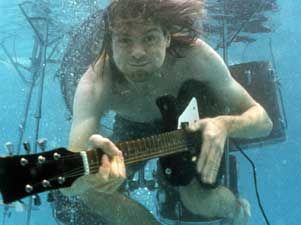
nirvanain-365xXx80Kurt Cobain

When we hear the music contained on Nirvana’s Nevermind, we hear a different kind of genius at work. We hear their highlight reels. We don’t know, or care, about all of the “dreck” Kurt Cobain wrote in quiet corners. Most of us, don’t know, or care, about the songs that didn’t make it on Nevermind. Most of us don’t know, or care, about all the errors he committed, the refining, and the crafting that went into perfecting each song on the album, until the final form was achieved. We only want the final form, the highlight reels, and some of us only want one highlight reel: Smells Like Teen Spirit.

On an album prior to Nirvana’s Nevermind, called Bleach, Kurt Cobain penned a song called Floyd the Barber. “Where does the kernel of a song like that start?” Soundgarden’s Chris Cornell asked. Cornell may not have come from the exact same background as Cobain, and he may not have been influenced by the exact same artists as Cobain, but he presumably felt like his creative process was so close to Cobain’s that he couldn’t fathom how the man achieved such divergence from the norms of musical creation. Those familiar with Cobain’s story also know that he was heavily influenced by the music of Soundgarden, and that fact probably confused Cornell all the more.

Other than Soundgarden, Cobain also loved Queen, The Beatles, The Pixies, The Melvins, and a number of other lesser known bands. How much of his early works were so similar to those artists that no one took him seriously? As I wrote earlier, it’s a major part of the artistic process that every artist goes through to attempt to duplicate influential artists in some manner. It’s a step in the process of crafting original works. When that artist duplicates those that came before them often enough, the artist (almost accidentally) begins to branch off into building something different … if they have any talent for creation in the first place.

Divergence in the artistic process

Few artists can pinpoint that exact moment when they were finally been able to break the shackles of their influences, for it happens so progressively that it’s almost impossible to pinpoint. Most artists do remember that moment when that one, somewhat inconsequential person said that some aspect of their piece wasn’t half bad however. At that point, the artist becomes obsessed to duplicate, or replicate, that nugget of an idea. Once that nugget is added to another nugget, those nuggets become a bold idea that wasn’t half bad. Once that is achieved, another bold idea is added, until it all equals a “halfway decent” compendium of ideas that may form something good. At that point, the artist believes he has something that others may consider unique enough to be called an artistic creation in its own right. When enough unique, artistic creations are complete, the artist may eventually achieve their own highlight reels.

When did Cobain finally begin to branch off? How did he become divergent, and creative, and different on a level that made him an organic writer to be reckoned with? How many casual statements, spray paintings on walls, and other assorted personal experiences had to occur before Kurt Cobain had the lyrics for Nevermind? How many different guitar structures did Cobain and company work through, until he arrived at something usable? How many Nevermind lifted music or lyrics from other failed songs, casual strummings in a closet, and offshoots of other guitarists? What did Floyd the Barber, Come as You Are, and Pennyroyal Tea sound like in those moments when they first found their way from notepad to basement practice sessions? How many transformations did these songs go through in those practice sessions, until they were entirely original, and transformative, and legendary additions to the albums they were included on? If Cobain were alive to answer the question, would he acknowledge that Nevermind is a 1% highlight reel of about a decade of work? Most of us don’t care, we only want to hear the highlight reels, so we have something to tap our finger to on the ride home from work.

Cobain’s highlight reel, Nevermind, proved to be so popular that record execs, and fans, called for a B-list, in the form of the album Incesticide. That album proved Cobain’s B-list was better than most people’s A-list, but what about the D-list, and E-list songs that proved to be so embarrassing that no one outside his inner circle ever knew they existed?

The point is that some of us are so influenced by an artist’s highlight reels that we want to replicate it, and duplicate it, until we become equally as famous as a result, and when we don’t, we think that there is something wrong with us. The point is that the difference between a Mark Twain, a Hemingway, a Cobain, and those that compare their behind-the-scenes work to an influential artist’s highlight reels is that while these artists recognized that most of what they did was “dreck”, they also knew that their behind-the-scenes struggles could be used as fertilizer to feed some flowers.

So, the next time you sit behind behind-the-scenes of your computer keyboard, tattered spiral notebook, or whatever your blank canvas is, remember that all of those geniuses —who so inspired you to be doing what you are doing right now— probably spent as many hours as you do staring at a blank page, or a blinking cursor, trying to weed through all the “dreck”, that every artist creates, to create something different, something divergent from all those creations that inspired them to create. You now know that they succeeded in that plight, but you only know that because the only thing you want to see, hear, and read are their highlight reels.

{1}http://www.forbes.com/sites/kylesmith/2014/02/20/what-mark-twain-van-halen-and-dan-rather-teach-us-about-failure/

{2}http://www.marktwainproject.org/about_projecthistory.shtml