Hoomans, Ha!men, and Humans 


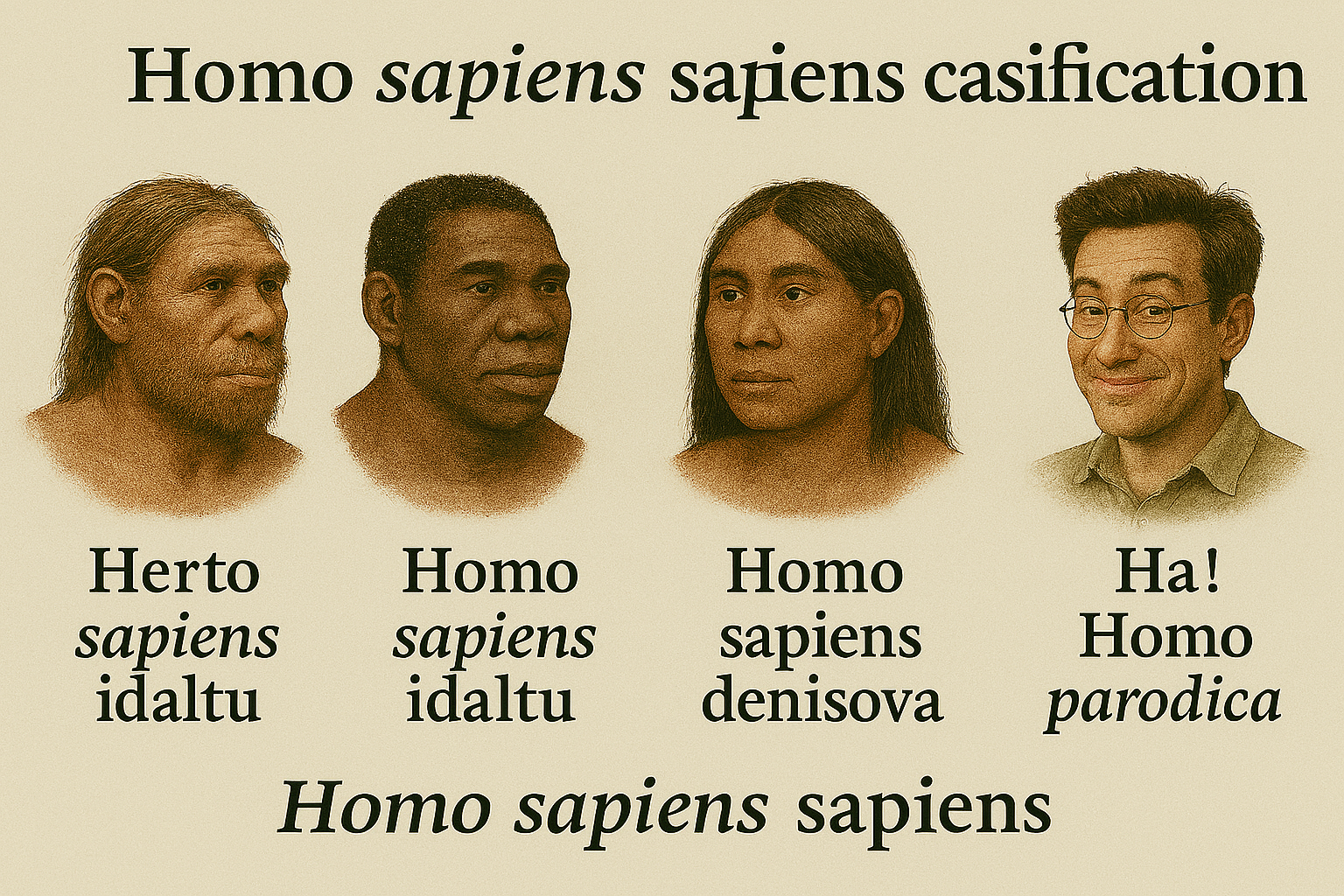
Taxonomists and biological anthropologists classify modern humans as the Homo sapiens sapiens species. No, that is not a typo. The reason for the double-word is that we are a subspecies of the Homo sapiens species. Taxonomists and biological anthropologists created this distinction to separate Homo sapiens sapiens species from the Homo sapiens neanderthalensis, or Neanderthals, the Homo sapiens idaltu, or Herto man, and the debatable inclusion of the Homo sapiens denisova, or Dragon man. We’re all homos, in other words, under the genus Homo, and the biological anthropologists break us down after that.

Our Homo sapiens sapiens subspecies is characterized by advanced cognitive abilities, language, and complex social structures. We’re the most complex subspecies in this regard, but if aliens from another planet were to meet us, greet us, and play in all our reindeer games, they probably wouldn’t agree that we all belong in the same categorization.

When we talk about Alien Life Forms (ALFs) here, we’re talking about Spock, S’Chn T’Gai Spock from the original Star Trek. Spock was half-human, half Vulcan, but we’re going to characterize our ALF as a full-on Vulcan, a full-on reason and rational thinking Vulcan with no empathetic or sympathetic emotions. In this ALF’s After Earth report home, it would write, “Even Earth’s scientists refrain from proper delineations in their Homo sapiens subspecies, because the scientific community thinks that a proper breakdown of various individuals in their subspecies might hurt feelings, but there are clear delineations. Some Homo sapiens sapiens have not fully evolved to the point that they belong to that species. Others have.”

If we never meet Spock-like ALF, or fail to prove they exist, we’ll never be able to verify this characterization. Thus, we will have to turn to the closest thing we have to an Alien Life Form in our universe, one with intimate knowledge of the Homo sapiens sapiens that is dispassionate enough to provide objective analysis. I would nominate the cat. Anyone who has owned a cat knows that we share an off again relationship with them. The cats definition of our relationship might even be punctuated with a “I really don’t care that much what happens to you” exclamation point that is furthered by a “As long as I get some milk and food every once in a while, and someone or something keeps me stimulated every once in a while I’ll continue to exist near you.”

Some might say the dog has as much, if not more, knowledge of our species as the cat, but the dog is biased. Dogs love us. They are so loyal that if they were commissioned to analyze our species, they would tell us what we want to hear. There’s a reason we call them man’s best friend, and it is largely based on the idea that they accept us for who we are. They don’t analyze us in the manner a cat will, and they know nothing about our inadequacies or failures, because their sole goal in life is to make us happy. They know when we’re happy, they’re happy. Cats are almost 180-degrees different.

Instagram posters have characterized this on again, off again, “I really don’t care that much what happens to you” relationship we have with cats with a somewhat humorous, somewhat condescending term that their cats use to describe us, hoomans. Hoomans is a cutesy eye-dialect, similar to that of the “No Girlz Allowed” sign that moviemakers put outside the door of a boy’s clubhouse. The cutesy error is employed to enhance the cutesy idea that cats and young boys can’t spell. The moviemakers might even add a backwards ‘R’ to further emphasize the cuteziness of the boy’s sign.

Another intent behind the cutesy hoomans contrivance is to inform us that we’re not viewing this interaction from the customary human perspective. We’re viewing this particular interactions from a perspective we may not have considered before, the cat’s.

In that vein, the unsympathetic delineations of the cat would suggest there are Homo sapiens sapiens who fail the “advanced cognitive abilities, language, and complex social structures” standards put forth by biological anthropologists. They might suggest we introduce a Homo sapien confusocortex, or Confused Man, subspecies for those who haven’t evolved completely. 

These hoomans were born at full capacity, and their schooling years proved that they were able to achieve full functionality, but as with any muscle, the brain can deteriorate with lack of use. We’re not attempting to make fun of them, but there is a delineation between those who know how to operate at an optimum, and those who fail to make necessary connections.

In the cat-world, I’m not sure if they would characterize me as a human or a hooman. I think they might develop a separate category for those of us who measure up, but we enjoy disrupting the meticulously crafted model they’ve created for human actions and reactions. The cats view such joyful interference with their carefully designed understanding of human nature and its patterns with something beyond skepticism. They’re alarmed. If we watch cats in the wild, they study their prey carefully to gauge whether or not they’ll get hurt. If after examining us completely, they developed a full categorization, it might be ha!men. My brief experience with cats informs me that they don’t have a sense of humor, so it would be impossible for them to properly categorize ha!men without some form of condescending insults. My guess is they would spit out something like, the symbolic, or ironic inversion of their cultural input often critiques the very idea of cultural output, then twist it into recursive satire. Their social systems resemble Escher prints—technically sound, emotionally disorienting. “They are players, jokesters, and fools,” the cats would conclude, “and we say that in the most condescending way possible.”   

Ha!men know that pets and children create profiles of humans based on patterns, and I think cats are quite comfortable with the thought that hoomans were put on this planet to serve them. Hoomans are to provide the cat food, milk, a place to relieve themselves, and various forms of stimuli. It’s a tenuous relationship that suggests if hoomans fail to fulfill the expectations of their relationship the cat will simply go to another hooman who can. Those hoomans who fulfill expectations can, could, and probably should receive the reward of affection. They know adult hoomans need this every once in a while, and they don’t mind occasionally playing that role for them, as long as the bullet point, requirements are met.

They also know we arrive home at around 5:30, feed them and themselves, and sit before the glowing box for a couple hours before it’s time to go to bed. They grow accustomed to these patterns, the way we conduct ourselves, the way we make sounds at one another, and our gait pattern. When we meet their criteria, they might sleep or find some other stimuli to occupy them, as they probably find most hoomans as boring as any other superior would find the actions of their underlings.

I don’t know cats would characterize me, but I highly doubt they would consider me boring. I’ve been their sole focus more times than I can count, and there have been occasions where these rooms housed a half-dozen people. I noticed how cats study us with more intensity than any other pet at a very young age, and I found it creepy in the beginning. “What are you looking at?” I wanted to ask, as if that would help matters. I noticed, early on, that when I acted somewhat out of sorts it only intensified their study of me. After numerous interactions over the years, I found their study of me fascinating, and I began tweaking my actions to destroy their research.

Just to be clear, I never touched one of these cats. I just enjoyed playing the role of their anecdotal information, their aberration. I exaggerated my differences just to be different than any other human they’d ever met, just to see how they’d react. The minute the cat owner I was dating left the room, I would walk across the room in a decidedly different gait pattern. I might slow turn my head to them in the manner an alien would in a movie, and I’d repeatedly stick my tongue out at them. I might even take a drink coaster and throw it across the room in an erratic manner. The list of things I did just to mess with their heads is long, but those are a few examples I remember. I’ve found that all we have to do is act a few deviations away from the normal hooman actions to make their pupils expand with increased scrutiny or fear.

Do the same things to a dog, and they might raise their head for a second, their ears might even perk, or they might even bring us a toy, thinking we want to play. Whatever they do, their reactions suggest they’re either less alarmed by abnormalities among the hoomen population, more forgiving of those who suffer from them, or they’re less intelligent than the cat and thus less prepared for an eventual aberration that cats foresee. Cats immediately switch to alert status. They don’t care for these games. If they don’t run from the room to avoid what they think could happen, they watch ha!men with unblinking, rapt attention. Even when they realize it’s just an act, as evidenced by our return to normalcy when the woman-owner returns to the room, they continue to study us. “I’ve decided that I don’t like you,” is the look they give us ha!men throughout.

***

Suzy Aldermann wasn’t a ha!men, but we thought she was. When we heard what happened at a corporate boardroom, we thought Suzy’s portrayal of a ha!man might’ve been one of the most brilliant portrayals we ever heard. Prior to that meeting, she appeared to abide by so many of the tenets of human patterns that when she deviated, we thought Suzy was employing a recursive inversion technique known to all ha!men as the perfect conceptual strategy for dismantling normative frameworks from within.

Prior to her “full-fledged panic attack!” Suzy successfully presented herself as an individual of advanced cognitive abilities, language, and complex social structures. So, when she experienced this panic attack, this “full-fledged panic attack!” after she opened the door to a meeting room and saw Diana Pelzey conversating with her chum, we thought she brilliantly portrayed a ha!man to the uninformed. As the report goes, Suzy whispered to a friend that she would not be attending the meeting because Diana was present. “BRILLIANT!” we said. “Absolutely brilliant that Suzy would pick the least threatening person in the room to initiate her alleged panic attack!” We all agreed to keep Suzy’s ruse secret to see how it would play out, and we expected a lot of hilarious high-brow hi-jinx as a result. The joke, it turned out, was on us. We either overestimated Suzy or underestimated her, I’m still not sure which, but it became clear that Suzy decided to run away rather than up her game to match, and/or surpass Diana’s presentation. It was, according to Suzy, a full-fledged panic attack.

In the aftermath of our misreading, anytime we met a melodramatic hooman who was having a “full-fledged panic attack!” over a relatively insignificant issue, our instinctive response, based on our understanding of human patters is to think either she’s a ha!man who is joking, or she probably needs to experience some real problems in life to gain proper perspective.

Yet, when we’d talk to Suzy, she’d detail a relatively rough upbringing that included some eyebrow-raising experiences. Those incidents were real issues that Suzy had to manage, and she had to claw through the tumult to reach a resolution. The normal human progression, for those of us who study humans with relative intensity, is that when a human experiences a number of real problems, they become better at resolving them through experience. Suzy worked her way through all of those problems, but she never developed better problem, resolution skills.

We’ve all heard from other souls who purport to travel some tumultuous avenues. Wendi Hansen, for example, detailed for us her “rough life,” but when she was done, we couldn’t help but think that much of her self-imposed trauma was the socio-political equivalent of first-world problems. Suzy was no Wendi Hansen. Suzy’s issues were real and severe, and they were backed up by eye-witness testimony. Our natural assumption is that if she’s experienced problems far worse than a colleague purportedly interested in stealing her job, it would be nothing compared to what she’s experienced in real life.  

If we were to view the humans, the ha!men, and the hoomans from the perspective of the Alien Life Form (ALF), or the cat, without empathy or sympathy, we would conclude that some humans get stronger, better, or gain a level of perspective that allows them to see minor problems for what they are in the moment. Some hoomen, on the other hand, deploy the tactical maneuver of retreat, and they do so, so often that they never fully develop their confrontational muscles.

After experiencing so many different souls who maneuver around their tumultuous terrains differently, I now wonder if hoomans, who’ve experienced real problems in life, blow otherwise insignificant issues up into real problems, because they’re more accustomed to handling their problems at that level. Either that or they know if they retreat during the relatively insignificant phase, it might never progress into more severe phases. Whatever the case is, their experiences have taught them that they can’t handle problems, and as a result of retreating so often, they never do.

***

“It’s a lie,” Angie Foote told me, regarding something Randy Dee told the group.

“It’s not a lie,” I said. “It might be an exaggeration, a mischaracterization, or something he believes is true but is in fact false. It’s not what I would call a lie.”

“Barney, he told everyone that this is what he does, and I’ve seen how he does it. He doesn’t do it that way. He’s a durn liar is what I’m saying.”

Angie is what we in the biz call a simple truther. She sees everything in black and white. A truth is a truth, and a lie is a lie. There is no grey matter involved in her universe. I respect simple truthers in this vein, because I used to be one. I’m still one in many ways, but experiencing precedents in life can wreck the comfortable ideas we develop in our world of simple math and science. Facts are facts and truth is truth is their mantra.

Some of us hear a lie, and we know it’s a lie. When we’re telling lies, we know we’re lying, and we can’t help but view the rest of humanity from our perspective. When they’re lying, they know that one plus one equals two. I know it, you know it, and most importantly, they know it. We witnessed them doing one thing, and we heard them say they do something else, and they said it as if it was something they truly believed happened! How can they do that with a straight face?

My asterisk in the ointment, my new definition of a lie, is that a lie is something someone says that they know to be false. There are good liars who are so good at it that they can convince themselves that it’s true before they try to convince us. The other liars, the fascinating ones, fall into a greyer area. They don’t know they’re lying.

One of the most honest men I ever met, a Randy Dee, taught me the grey. Randy Dee told some whoppers. He told some untruths to me, regarding events that happened the previous night, and I was there for those events. 

He misinterpreted the truth so often that it affected how I viewed him. When I viewed him, and the way he’d lie, I’d watch him with the rapt attention a cat would when encountering a ha!man who proved an aberration to my study of human patterns. While involved in this study, I became convinced that we could put a lie detector on him, and he’d pass with flying colors. “He’s just a durn liar!” I said to myself. Yet, if you knew this guy, and I did, you’d know he’s not lying, not in the strictest sense of the word. By the standard of taking everything we know about lying and inserting that into the equation, Randy Dee never told a lie.

I knew Randy well for a long time. I knew him so well that I learned he was incapable of lying. He was a law-and-order guy who despised deception and all of the other characteristics inherent in criminality. Yet, by our loose standards of truth v. lying, the man was a big, fat liar.

He was incapable of detecting the lies others told him, because he just didn’t think that way. He was somewhat naive in that regard, and after getting to know him well, I considered it almost laughable that anyone would consider him a liar.

Randy Dee was an unprecedented experience for me, and I would have a lot to sort through before I fully understood what I was experiencing with him. If we took this to a social court with a simple truther sitting in the role of a judge, we would experience an exchange of “He’s lying.” ‘I’m telling you he’s not. You have to get to know him.’ “You’re over-thinking this.” ‘If you know the guy as well as I do, you’d know he’s incapable of lying.’ “All right, he’s an idiot then.” ‘If idiot suggests a lack of intelligence,’ I would reply, ‘You have to meet him to know he’s anything but.’

If this argument reached the point of no-return, one of us might suggest using a lie detector. If Randy Dee passed the lie-detector test, the simple truther would then suggest that there was something wrong with that mechanism, and there might be.

When lie detectors first entered the scene, their findings were considered germane to cases. Judges, lawyers, and juries not only thought their findings should be admissible in proceedings, they considered them germane to findings. 

“Did he take a lie detector test?” a judge might ask. “Yes, your honor,” the defense attorney said, “and he passed with flying colors.” Lie detectors eventually became less prominent, because they were deemed wildly inconsistent. How can a machine with no powers of empathy, sympathy, or any emotions differentiate between hoomens, ha!men, and humans to produce inconsistent findings? What progressions occurred? Were so many Ha!men and Hooman able to beat lie detectors so often that the machines lost their relevance in criminal cases?

Randy Dee, a man who was so honest that it seemed almost ridiculous to suggest otherwise taught me that the reason lie detectors are wildly inconsistent has more to do with the idea that we’re wildly inconsistent. We can convince ourselves of a lie, so thoroughly, that it’s not a lie anymore, and we can do it without ever trying to deceive anyone or anything in the case of lie detectors. Ha!men might do it just to see if they can defeat the machine, and its ability to detect different biological reactions, but hoomens might do it because they lose the ability to make those necessary connections that produce truth. The latter provides a wild ride to those of us who once viewed human nature in the ritualistic patterns cats will, and if we continue to view hoomens with the rapt attention a cat gives a Ha!man, until we find the truth, it will wreck every simplistic truth we thought we knew about lying liars and the lies they tell.  

I am a Cookie, It’s Good Enough for Me


“Do you have any cookies other than chocolate chip?” I asked the cashier of a popular sandwich chain.

“We don’t,” he said with a smile. The smile appeared to accept the complaint for what it was, but it also asked me why I was just being difficult. ‘Why would you want anything other than chocolate?’ that smile asked me. ‘It’s delicious for criminy’s sake!’

Age has taken away a few of my favorite things (more on that never) and chocolate is one of them. I get minor headaches whenever I eat it, but those minor headaches carry the implicit warning that the more I eat the worse the headache. I farted around found out that my body was serious, serious as a head attack.

I usually simply say no thanks when people offer me some, but some people won’t take no for an answer. ‘Why don’t you want any chocolate?” they ask. ‘It’s delicious for criminy’s sake!’”

When I tell people why, they feel bad for me. Their sympathy is not directed toward the headaches, but the idea that I will no longer be able enjoy chocolate as much as they do. “I don’t think I could do it,” some say with a self-deprecating smile.

“Of all the things age has taken away from me,” I tell them, “I probably miss chocolate the least.”

“How could you not miss it the most?” they say with the same look that that cashier gave me.

“I used to go to the candy aisles at gas stations to pick from their chocolate selections,” I tell them. “Now, I move down the aisle to their non-chocolate ones. It’s easier than you think.”

Prior to that forced transition, I had no idea candy aisles at gas stations were 90% chocolate, not counting gum. The selections at various get-togethers are about 95% chocolate, and the desert items on a restaurant menu are nearly 100% chocolate. Now that I was on the outside looking in, I wondered if we all loved chocolate this much, or if it reminded us of our grandmother, and all of the confections she used to bake, and all of those glorious smells. Did it become such a staple in our diet, because it reminds us those days at the pool with all of our friends, or do we just love it that much? Some questions are complicated that require scientific research, and some are simple. The simple truth about chocolate is we like eating it, because it’s delicious for criminy’s sake!

“It’s all about the chocolate,” a friend of mine, who used to be an event planner, said. She learned the hard way when she offered her client “cookies” for their event. She neglected to inform her client that her cookie offerings would not include chocolate chip cookies or any chocolate. She just listed cookies on the menu items, and her client signed off on it

“Nobody wants sugar cookies, peanut butter, or oatmeal raisin!” her client screamed. “My attendees were like, where’s the chocolate chip cookies? They blamed me for this, not you. We were expecting chocolate chip cookies, chocolate strawberries, chocolate pastries, and even a chocolate fountain. You didn’t give us any chocolate? What kind of outfit are you running here?” 

A poll suggested 35% of respondents said chocolate chips cookies were their favorite cookie, and almost half (46%) said they ate chocolate chip cookies frequently in their childhood. My guess is the latter number was skewed by the vagueness of the question. If the pollsters asked the specific question, “For those of you who had the capability, or permission to eat cookies on a regular basis, how many of you ate chocolate chip?” By better defining that question, me thinks that 46% number might double.

After a couple incidents, my mom learned to preempt our disappointment when she brought cookies home. Before opening the package, she’d tell us that the cookies weren’t chocolate. She had nothing against chocolate. She just thought we might want some different every once in a while. We didn’t, we wanted chocolate. We were disappointed, but she knew if she told us beforehand that we wouldn’t be so angry to find out there wasn’t any chocolate on the way.

That forced transition away from chocolate informed me that we don’t want chocolate. WE WANT CHOCOLATE! If someone doesn’t learn how to soften the blow that there won’t be any chocolate, we’re disappointed, confused, and outraged. “Who do you think you are? What kind of outfit are you running here?” I don’t know if this has always been the case, or if I only see it now because of my new perspective, but it is all about chocolate.

***

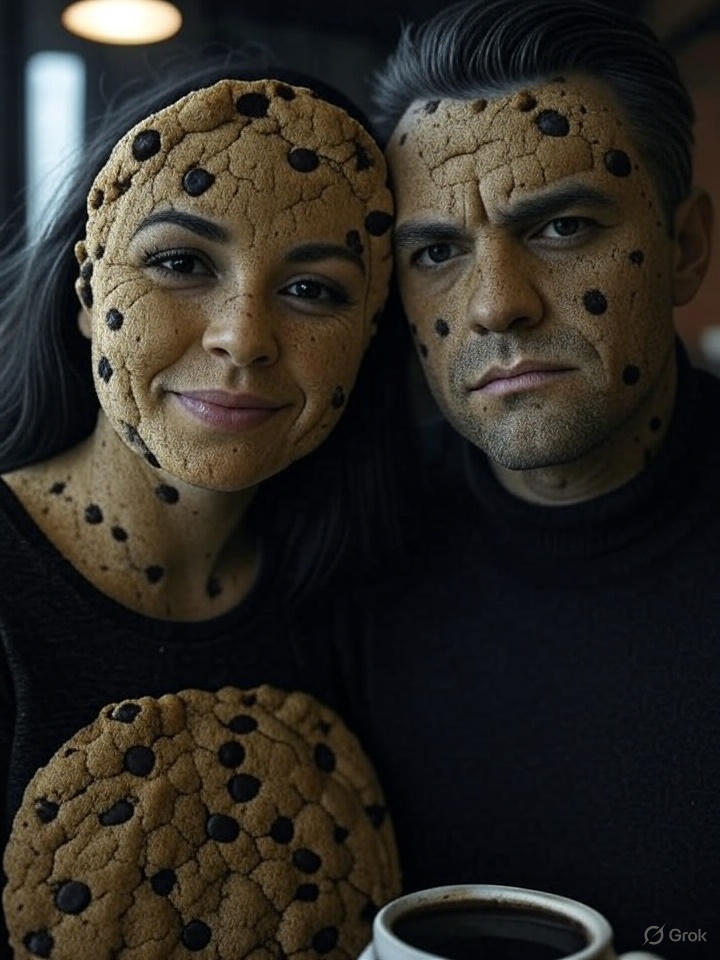
We don’t need a different perspective to know that the chocolate chip “cookies” of our world dominate rooms. They are the beautiful men and women who walk among us. We see what happens when they walk down the hall, or into our corporate meeting rooms. If we’re able to view reactions from the outside looking in, it can be quite humorous to watch reactions to them.

Some of us cringe, as we try to deny them entry in our space by telling everyone how awful we think they are, but when they talk to us, we feel an unusual and embarrassing blush come on. They can make us feel, “I can’t believe I’m admitting this,” special for just a moment. Some of us smile and laugh at everything they say, even though we just talked about how we hate them seventy-five minutes ago.

I don’t know if this is endemic to the human being, or if cicadas, squirrels and amoebas share our reactions to the beautiful beings of their species, but I’m more inclined to believe it has something to do with cultural conditioning. The chocolate chip cookies of our society appear to have it all, and as hard as we try to make dents in their impact, no societal cynicism can tear down that wall. We’re not talking those store bought, dry, and crumbly cookies that look so appealing on the shelf, because they’re manufactured and marketed so well. We’re talking the individually wrapped, freshly-baked variety that most sandwich shops offer as a side-item. We’re talking about the type of chocolate that appears so moist that we swear we can see our reflection in it. They’re the most popular, the prettiest on the shelf, and the definition of quality by which all of the others are compared.

Most of us grew up other thans who saw the power of beauty, natural athleticism, and money in our cookie-cutter in our world. We watched those chocolate chips cookies fly off the shelf, and we wanted to be them for just a moment, just to know what it felt like to be a chocolate chip cookie. After learning the harsh realities of the never-will-be’s, we learn to live the life of an other than, until we convince ourselves that we’re a don’t-wanna-be. Our people, along with the cynical comedians, don’t encourage this. They prefer the ‘if you can’t beat them, hate them’ route. Hating them is supposed to make us feel better about ourselves, but it never does. Instead of correcting the course, we double down. We tell one another these lies to help us help others appreciate our gifts and our other indefinable traits to elevate our status from other thans to better thans.

Chocolate chip cookies don’t have doors slammed in their face, or that’s what we tell ourselves. We externalize our hatred to try to minimize our struggle. Yet, we had opportunities, fewer by comparison, but we had some. How many paths were available to us? Did we choose the one we’re currently on, or was it thrust upon us?

Adaptation to the limits of being an other than often requires creativity, and creativity comes and goes. We can also feel it fade with age. Our bountiful brains were once filled with fantastical ideas about how the world could work, and how different it could be if it was different. When that didn’t work, we doubled down, almost in rebellious reaction, until we stepped beyond the border and lost our anchor. Stephen King developed odd theatrics, but he maintained a common man premise from which the spectacular rose. We learned from that, and we adapted, but we were so creative that we could grow a little too creative at times. When we finally found our niche, we enjoyed it, but a niche is a niche, an “other than” as it were that rarely produce a chocolate chip in our nacre formation.

That frustration leads us to wonder how many chocolate chip cookies are 100% pure, and how many are tainted? We take what we want to take from everything, and we want to believe that our favorite chocolate chip cookies were wholesome? The cynics would say that the only 100% pure chocolate chip cookies are those that came from our grandmother’s oven, and the rest are all tainted in the manufacturing process.

“Nothing is pure, and nothing is absolute! You still admire that chocolate chip cookie? Did you know he cheats on his taxes, steps out on his wife, and his children never felt close to him?” This is the cynical side of the “other thans”, and I’m not even sure if those nattering nabobs of negativity truly enjoy twisting their handle bar mustaches in this manner. They enjoyed doing this in high school, we all did, because it made us feel better to know more than the simpletons who believe in nouns, but when does continuing to do what we did in high school becomes so high school?

“There are matters where this matters, but we’re talking about a television star from a television show. Why don’t we just let that guy enjoy his chocolate chip cookie in peace,” we say.

“BOO!” they say. “I’m not going to let that television star off the hook, because that he wasn’t the wholesome cookie he portrayed, not in his personal life.”

“Our friend needs to bake an other than?” they say. “Everyone bakes chocolate chip cookies. He needs to try something different?”

“But everyone loves chocolate chip cookies,” we say. “They’re delicious for criminy’s sake!”

***

As an other than, we learn to use our personality to create something that serves a purpose. We then do what we do, until we reach that “Why am I still doing this?” question. Then we reach a point where we’ve answered every possible question we can think up. At another point, beyond that question, we realize that as confusing and disjointed as all this can be, it’s us. It’s who we are, what we are, and how we conduct ourselves. It’s our element, and how we conduct ourselves when we’re in our element, and until we reach a point where we can all learn how to bake bakery fresh, chewy chocolate chip cookies, through some sort of genetic modification, driven by AI, we’ll be forced to admit that we cannot all be chocolate chip cookies.

Some people actually prefer peanut butter cookies, sugar, oatmeal raisin, and all the other thans. I’ve met them. They don’t develop biological reactions to chocolate later in life. They just prefer an other than, because they find them delicious. They’re anecdotal evidence that not every person in the world prefers chocolate, but if you’re a restaurant, a gas station, or an event planner, you know it’s all about the chocolate.

We all have moments when something other than chocolate chip cookies appeal to us, but do we ever look back with regret that we didn’t try harder to be a chocolate chip cookie in a chocolate chip cookie world? Do we regret not pursuing their ingredients for success, success, SUCCESS? Some of us not only moved past all the resentment and regret, we moved into a middle ground of our own choosing. We’re the ones they call one strange cookie. We not only accepted this idea that we’d never be chocolate chip cookie, we embraced it. Some characterize this midlevel existence as a stuck-in-the-middle one, with its own unique level of suffering, but we chose to view it as us being baked differently. We used our ingredients to come up with something different. I’m not claiming that I built a better cookie, and I can’t say if it’s worse, but it took me a long time to reach a point where I can say it’s mine, “I am a cookie, and it’s good enough for me.”

Figurative Schemes of Thought


“Teachers teach to the dumbest kids in class,” a former student said to try to explain why we all found school so boring. It felt like truth when I read that, unvarnished, “the stuff they don’t want you to know” truth, because it explained so much. Some of my teachers were so slow and boring. I used to be a quick thinker, which shouldn’t be confused with a quality thinker. My brain operated in hyper-drive, both literally and figuratively, and I often had trouble slowing it down long enough to soak in details. Details drove me nuts, they still do, and when you ask me to slow it down to make sure I get all the details, I shut down. When storytellers focus too much of their presentation on detail, I want to yell, “Just go to it! Get to the point!” When I read what this former student wrote, I wanted to believe it because I thought it explained why my teachers talked so slow, repeated themselves so often, and why they focused so much on inane and insipid details. That truth, it turns out, has no basis in fact. It’s much closer to a myth that we all want to believe.

When I read that truth, I should’ve reminded myself of the line I gave my conspiracy theory friend, “Just because it’s the most negative and cynical idea you can find, and it sounds like something the status quo doesn’t want you to know, doesn’t mean it’s true.”

My guess is that if we polled 1,000 teachers, 950 of them would say that that snarky assessment is false at best or an excuse poor students develop to explain why they did so poorly. They would probably add that while a quality teacher would never abandon a struggling student, it doesn’t mean they would slow the lesson plan down so much that they fail to cover the material they are required to cover in a semester. Schools provide teachers so many different avenues to explore with struggling students that there would be no need to slow the lesson plan down. That makes sense and all that, but the idea that the teachers I had were so boring, because they were trying to slow it down for Wally just explains so much to me. After sorting through various teachers I’ve had, I dismissed this idea as not only unprovable but inconsequential.

The more I tossed the idea of this assessment around, the more I thought every subject, every lesson plan, and every presentation is one quality teacher away from being interesting. I experienced that when a teacher made Economics so interesting to me that I entered college an Economics major, until I took some classes with poor teachers, and I realized how boring the subject was. I even had a teacher who could make Shakespeare fascinating, another who made World History exciting, and I have to imagine there’s an individual out there who could make Anthropology interesting, hard to believe, but I have to imagine that it’s possible. 

Most of my teachers weren’t the type of people we would follow into a fire to save people. They slogged through the material as much as we did. We shared the idea that they probably chose the wrong profession with them. We knew this because we had those charismatic types who could make a lecture about the Sumerians interesting.

For most of the teachers I had there was obviously no prerequisite placed on the ability to craft a quality presentation to attract an audience. There is, however, for  politicians, podcasters, and other entertainers. They have to craft a presentation that appeals to a wide-ranging audience. The same holds true for an advertising agency that hope to sell their presentation to a corporation.

“If you want to know anything about a culture,” someone once said. “Watch its commercials.” There might not be an institution that pays more attention to the cultural mores of society than the average advertising agency. They spend millions studying the culture through sociological and psychological research, and they market test all of their commercials before airing them to understand us better. They pay for this, because they know if they’re going to be able to convince a corporation to give them money, they need to prove that they know us better than we know ourselves. The one obvious fact they know is funny sells, but funny has all sorts of constraints around it, so they pack their commercials with the most common, least offensive jokes they can find to appeal to the lowest common denominator. I appreciate all the time and money they devote to crafting the perfect pitch for a product, but when one of these insults to my intelligence runs through my home I realize there is hatred in my heart, and if the Catholic Church is right about the progressions involved in Judgment Day, I could face obstacles. 

“It says here that you do had hatred in your heart,” St. Peter might say with the pearly gates in his backdrop.

“That is absolutely not true,” I would protest.

“It says you hate beets, the Dallas Cowboys, and commercials.”

“Commercials?” I would say. “How can a hatred of commercials affect my standing in the afterlife?”

“Hatred in the heart is hatred in the heart,” he might say while thumbing through my life.

“I’m sorry, but that just doesn’t seem fair,” I would protest. “Commercials are a non-entity. I didn’t hate the players involved in making commercials. I know they have a job to do and all that, but I just found them such an insult to my intelligence and my sense of creativity, and the repetitive nature of them drove me mad, but you’re telling me that I face eternal damnation because I hated commercials?”

“What? No, you’re probably looking at three-to-five in purgatory for the general sense of hatred in your heart, but you’ll probably get out in eighteen months with good behavior.”

MacPhail’s MacGuffin

If entertainers and statesmen fashion their presentation to try to appeal to the lowest common denominator, and commercials employ dumb guy jokes, how do movie makers and TV show producers craft their projects for greater appeal? 

Have you ever watched a movie with an excessively complex plot? We’re not dumb, and we’ve probably watched a million movies, but some screenwriters and directors fall in love with complexities that involve weaving tangled webs of intricacies with various twists and turns. I might be a lot dumber than I think, but I prefer to think that I never cared about a character, or a plot, so much that I’m going to follow them through the laborious labyrinths that “brilliant” screenwriter create.

A screenwriter named Angus MacPhail (apparently a real person and not a pseudonym) developed a device for dumb people like me who don’t care as much about complex plots as much as “brilliant” writers think. He called it: The MacGuffin. MacPhail and Alfred Hitchcock teamed up on several MacGuffin projects. The very basic definition of the MacGuffin concept is that it doesn’t really matter to an audience what the characters of a story are after as long as the chase is compelling.

The most interesting element of this MacGuffin concept is how true it is, even to a movie buff like me. After watching several MacGuffin movies, I realized that I could watch such a movie, thoroughly enjoy that movie, and love it so much that I memorize certain chunks of dialog from that movie without ever thinking about what the movie was really all about. I’ve read some Reddit discussions about what the characters in the movie Pulp Fiction were after. I loved that movie, and I consider it one of the most memorable movies ever made, but when they broke the movie down, I realized that I didn’t devote a thought to what the characters were actually after in that movie. Pulp Fiction is a movie that many movie freaks consider one of the best examples of a MacGuffin, because it never explains what the characters are actually after. When the Redditors explained their theories, I found them fascinating, and I realized that not only were their theories better than mine, I never even developed a theory, and I LOVED that movie so much that I saw it numerous times, something I rarely do.

The next question I ask those who employ the MacGuffin device is, is it an attempt to dumb the movie down for the dumbest kids in the class? The answer to that question might involve the overly complex and condescending, “Yes and no.” Yes, in the sense that we dumb guys can’t or won’t follow all of the complexities, and no, in the sense that the MacGuffin device helped moviemakers in their negotiations with producers. 

The primary reason moviemakers “dumb-down” their beloved productions is to appease investors. The primary investors are called executive producers, because they often either fund the movie themselves, or they play a major role in securing funds for that movie. Some producers are so involved in the process of making movies that they offer notes: “This particular concept requires too much explanation, and that other idea needs more explanation.” Moviemakers mostly hate these notes, but they know that if they are going to make a multimillion-dollar production, they need to follow their producers’ notes. Hitchcock and MacPhail believed that using the MacGuffin device satisfied both parties by offering no explanations at all. They believed that if the chase was good enough, the audience wouldn’t care what the characters were actually chasing. We have to imagine that they experienced pushback, as the producers surely dropped a note that read, “We need some explanation, or the audience will feel lost.” Hitchcock and MacPhail were right.

“I’m From the Future. How is ya’?”

One note producers drop probably drop on moviemakers during productions that involve speculative themes is how to introduce foreign concepts in a more seamless fashion that appeals to all moviegoers without confusing them or belaboring the point with too much exposition. “How do I follow your notes without ruining my production?” is probably the reply most moviemakers send back.

The 1927, German film called Metropolis provided an example that movie makers now use to resolve the tricky dilemma of introducing characters from the future. The moviemakers could’ve simply had one of the actors say, “Maria is a robot from the future.” They could’ve also had the year of Maria’s introduction on screen, or on set somewhere (and they may have at some point.) The producers and moviemakers ended up creating a figurative scheme of thought by suggesting that everything in the future will be silver-metallic. Robots, like Maria, will be silver-metallic in the future, and the rest of us will follow suit by wearing silver-metallic clothing. Metropolis was so influential, in this regard, that for the next fifty-some odd years, movie makers forced actors, playing characters from the future, to wear silver-metallic costumes to symbolically represent their tense. Did any of them think we’d all be wearing silver-metallic clothing in the future, no, but they did this to conform to the figurative scheme of thought Metropolis developed. 

Why did they choose silver-metallic? I think we can all agree that silver-metallic just looks futuristic. Either that, or this image might be so ingrained that that’s just the way we see it now, but my guess even if Metropolis was never made, some futuristic, speculative movie would’ve come up with the idea. The colors silver-metallic and the color white, are those we most closely associate with space and time travel, and most people in the present and past rarely wear/wore silver-metallic clothing. 

My guess is, more than anything else, the silver metallic clothing solved the movie maker’s tricky dilemma of how to introduce a man from the future? Again, they could’ve simply had the character say, “Hi, I’m Arnie, and I’m from the future. How is ya’?” And that line might work in a quirky Wes Anderson movie, but it would prove awkward and stilted in others. How many of us introduce ourselves by saying, “I’m Arnie, and I’m from the present.” Even if we traveled back to the past, we would still regard our tense as the present tense, as in we’re presently in the past. Thus, the movie making world decided the best way to inform the audience that their character was a man from the future was to present him in an outfit no one from the present would wear. Once this symbolic representation was established by Maria, we either began thinking everyone in the future will wear silver metallic clothing, or the movie makers engrained the image in our head through repetition. 

This symbolic image is so ingrained now that if we went into a supermarket with a silver-metallic outfit on, people might begin hounding us for Lotto numbers, sports predictions, prognostications on world affairs, or stock tips. If silver-metallic suits are becoming more common, we probably wouldn’t immediately assume that their silver-metallic clothing means they’re from the future, but what if they spoke in an emotionless monotone? 

Speculative movies have long speculated that human emotions will no longer drive us in the future, on our next evolutionary plane, a concept most notably explored by Star Trek. They imply that we will no longer be as sad, angry, or happy in the future, and their implicit suggestion is that that will be a result of taking us all off the money standard. 

Taking humans off the money standard is, at the very least, an interesting thought experiment. Some suggest that if we did away with the cultural, social, and worldwide reliance on money, it could diminish sadness, feelings of hopelessness, anger, jealousy, and it could eliminate most of the crimes those emotions inspire. That’s possible, but it’s also possible that we might not aspire to be better today than we were yesterday without some kind of reward. The pursuit of money is widely regarded as a soul-less venture, and we’ve all heard the line money is the root of all evil. Yet, depending on how we earn it, money is also the best reward we’ve developed for hard work. If money is the root of all evil, it’s also at the root of some feelings of purpose, a sense of fulfillment, and it can promote feelings of definition and identity. Money has tangible qualities, of course, but so many of its complex intangibles make us who we are today, and the unforeseen consequences of doing away with money could be an article unto its own.

The Aliens are Turning

Movie characters from the future no longer wear silver, metallic outfits, as we’re all past that silliness now, but we still have numerous figurative schemes of thought in our movies that we fail to see them, because they’re so ingrained.  

‘Who is the alien?’ we ask while in the audience of one of those aliens from another planet movies. “I don’t know. We’ll have to wait until one of them turns their head,” they say. ‘What?’ “Just watch.” Most movie aliens either have a different musculature structure, or they haven’t learned the mechanics behind a full shoulder/torso turn well enough to mimic a full human turn properly. In the 1978 version of The Body Snatchers, a movie I believe set the symbolic representation, the aliens only turn their head, and they fail to incorporate the shoulders and torso in that turn. The turn is also so slow that it appears eerily mechanical and menacing. Their stiff, unnatural motions, dictate their inhuman nature to us. “He’s the alien!” we all scream. The sudden switch in music helps, but only to accompany the visual. 

If we’re trying to locate movie aliens in other social situation, we should note that if these movies are correct, the evolution of most aliens from another planet also failed to provide them casual conversation sounds, as they tend to communicate in a lexicon of roars, high-pitched squeals, or creepy, slither sounds that humans find unnerving. If movies are correct, aliens from another planet do not have mundane interactions. If we were to witness one of them in a transaction at a Walmart franchise, from their home planet, it would probably involve a series of various roars and slithering sounds that we would find so unpleasant we wouldn’t shop at that location. 

Monsters Only Eat Non-Believers

If we find ourselves a character in a monster movie, we should also know that believing the raving lunatic in our production could save our lives, as movie monsters, humanoid and otherwise, have a particular, dietary preference for non-believers. If we survive that first round, we should then avoid thinking that they’re mindless, bloodthirsty beasts, yet we cannot doubt their ferocity either. Failure to do any of the above will lead the monster to zero in on us to prove us wrong. “Why does a monster of blind bloodlust care if we doubt its existence?” we might ask. ‘They just do,’ the raving lunatic will inform us with dramatic repetition. ‘They do just do.’

When we first witness the monster, we see it in its more natural setting. In the second scene, we hear the roar, and just about every roar suspiciously mimics the ferocious roar of the lion. They roar in a projectile manner with their spines bent in an S-shape formation, and they do it in a manner that shows us nearly all of their teeth. We might even notice that their saliva is thick and gelatinous. Even some individual species of sharks have evolved a lion’s roar, and we don’t question that, because we know that that means they’re just that ferocious. 

Another sync-up we have with modern moviemakers is our fascination with motive. Why does a killer kill? Why does a monster kill? Nonbelievers suggest that it/he just has a blind bloodlust. Believers know better. They know that it’s too simplistic to believe that anyone, or anything, has a primal lust for killing. They know it’s complicated, and figuring out its primary motive is the best method to finding a way to eventually pacify it. 

In early movies, monsters had no motive, they were built on blind, bloodlust and destruction, but modern moviemakers know that their monsters/aliens don’t necessarily need a motive, but we do, and it’s usually political. Modern audiences require complex motives that call for scientific research. It’s just too simplistic for us to believe that a beast would harm or kill another being, because the idea that any beast acting in an instinctive manner when encountering something foreign is reductive. It’s also reductive and simplistic to explore the idea that a foreign entity might act in a reflexively defensive manner, or that they might view humans as a source of food. These speculations suggest that foreign entities are relatively primal, and as we all know, suspect, or fear, foreign entities have an intelligence that we cannot comprehend.

Even some slasher flicks, with human monsters, now feed into our need to know what motivates someone, or something, to kill us. “If they were just nicer to it, perhaps it wouldn’t feel the need to kill them all,” we now whisper in theaters. “They just need to understand it better.” Thus, scientists and reporters are often the sole survivors of the monsters, because the monsters appreciate their desire to understand them better. 

Indicators of an Infernal Influence

Most of us don’t pay attention to these figurative indicators, but thanks to the image provided by The Exorcist, we now know that one of the ramifications of undergoing a possession is that it will damage our daughter’s complexion. In its place will be the ruddy complexion of the meth head, that is accompanied by a creepy green hue. It also won’t matter if we instructed her to use conditioner that day, because her hair will go instantly scraggly and oily when the demon infiltrates. Possession movies teach us that demons know how to manipulate our vocal cords in such a way that it doesn’t matter if we’re a young woman during a possession, all victims of a possession will assume a deep, rich demonic voice. What is a demonic voice, we don’t know, but if our child is possessed and her new, demonic voice reminds everyone of Bob, the electronics department employee at Best Buy, we’re probably going to have a tough time convincing anyone to help us exorcise that demon from her system. That’s because everyone knows that demons come out growling and speaking some antiquated language in a hissing whisper that is punctuated by a lion’s roar.

“I know she sounds like Bob from Best Buy, but I’m telling you that my daughter is possessed by a demon named Gerty, which I know makes no sense either, because Satan usually gives his minions more creative, multi-syllabic names, but this is an actual possession Larry. We either need to run or find a Bible written in a language other than English, like Latin or Aramaic.” 

There comes a point in everyone’s existence when they’ve read too many books, listened to too much music, and watched too many movies. When we reach that point, it becomes difficult to avoid spotting the indicators that moviemakers use to abide by our figurative schemes of thought. They can insert a wide variety of creative inserts to their production, but there are certain touchstones that the audience needs to follow along without confusion. When we witness the agreed upon touchstones, we know exactly what they mean, and we know that the producer forced the moviemakers to incorporate agreed upon symbolic representations to get the audience from point A to point D. 

Most of these touchstones are so ingrained and expected now that we don’t even see them for what they are. If you’ve ever watched a movie with a child who hasn’t watched the hundreds of thousands of movies you have, you’ve probably heard, “How did you know that guy was from the future?” If you recognized that it was all about the silver-metallic suit, you probably opened up a can of worms that you couldn’t answer until you began thinking about these figurative schemes of thought that you didn’t even know you absorbed until they asked you about them. Once these touchstones enter our mind’s eye, it’s difficult to separate them from the mostly fallacious theme that teachers teach to the dumbest kids in the class. 

“We need to rewrite this scene, so the dumbest kids in the class can get it,” the producer’s note says, and the creative types probably argue with their proposals, saying we want to introduce a new way to introduce a man from the future, an alien, a monster’s mindset, or a product of a demonic possession. “Too much exposition,” the producer might reply, or “the characterization is too complicated, just give them meth face, have them make a head-only turn, or put them in a silver-metallic suit. Even the dumbest kids in the class will get that.” The moviemaker might fight back with righteous indignation regarding their creative interpretation, but they know most ideas won’t get off the ground without the producer’s check.

“Fortune favors the brave and the bold,” is a phrase we’ve learned through the years, and we all want to be the renegade, the maverick who bucks the trends set by others. We don’t want to follow the rules, we want to be the exception to the rule, but if we’re going to attract a wide audience, we learn that no one appreciates the exception until they become successful. We also learn that the irreplaceable become the replaceable when they refuse to follow the rules.