A Personal St. Vincent


Everyone has had an experience with a Vincent McKenna (played by Bill Murray), a St. Vincent, and very few of them involve any form of redemption. St. Vincents are St. Vincents as a result of the demons that chase them into being the people they are, and those demons are, often, so powerful that they cannot be thwarted.

st-vincent-movie-reviewsAnyone that has read my personal experiences with Ellis Reddick, knows that I’ve had my own experience with a St. Vincent, and that I’ve been affected by his sociopathic tendencies in a subtle manner that I may never entirely shake. Ellis Reddicks, and St. Vincents, are considered ideal characters for horror movies and coming-of-age style redemptive movies. They are often nice people (in the coming-of-age movies) that require a viewing from a non-traditional lens, and it’s in that scope that they often find the redemption that no one ever afforded them before. Having said all that, St. Vincent is a really good movie for its honesty, and it’s all too realistic (for some of us) portrayal of a demon-ridden, lout that tries to take advantage of everyone around him, but as anyone that has watched a movie made in this century (the 21st century) knows, he’s not going to be such a bad guy at the end of this production, and in the version of reality depicted in this particular movie no one really is.

The demons that chased Ellis Reddick are the same that presumably drove Vincent throughout his life, except for the alcohol and the stripper. The demeanor, the overall outlook, and the need for vices are all the same. Vincent McKenna is an alcoholic that frequents the track, and spends some of his day and most of his nights with a stripper in a seemingly asexual relationship. He tries to take advantage of everyone around him, including a banker, and a recently divorced single mother to fund his loutish behavior. With the banker, Vincent finds out that the money he’s received thus far from the bank, as a result of a reverse mortgage, has been completely tapped. The banker tries to explain the process of a reverse mortgage, and the idea that as far as the process is concerned, the bank can no longer afford to finance Vincent McKenna’s lifestyle. Anyone that understands this process, understands what the banker is saying, but Vincent (and thus the audience) believes that the banker could find a way to continue to fund Vincent’s lifestyle, and the fact that he doesn’t makes the banker a tool. The banker then becomes, in a limited manner that only characterizes Vincent’s current plight further, a bad guy. There is some struggle at this point, however, in totally believing that the banker is a bad guy. He looks at Vincent with confusion in a manner that suggests that his hands are tied, but the sympathy for the main character cannot be shaken. There is no struggle with the story of Vincent taking advantage of the single mother’s situation however. That is more blatant and –in an odd way that makes the audience uncomfortable– kind of funny.

The John Nolte, November 14, 1014 review for Breitbart.com, suggests that the movie, St. Vincent, is basically trope-less, or as he describes it, “It isn’t a tropey-trope.” I’m guessing that Nolte is stating that this movie isn’t so loaded with tropes that it’s totally derivative, and thus unwatchable. If this is what he’s saying, he’s right, but it’s still loaded with so many tropes that any serious review would probably have to mention the word to be taken seriously, even when they are attempting to dismiss the adjective. The primary reason to watch this movie, as with any movie Bill Murray is involved in is Bill Murray.

Bill Murray pulls his role off with the inexplicable, characteristic ease he pulls off every role. As Steve Martin once said of Bill Murray: “It can’t be that easy for him. It just can’t!” Inherent in Martin’s consternation is the consternation that Hollywood, the critics’, and most Americans display with their inability to understand why he is popular, and why they love him too. The consternation also suggests that there has to be some underlying philosophy, or effort to it all, that no one can see. If it were any other actor, most people would accuse Bill Murray of sleepwalking through most of the movies he’s done. He doesn’t appear to care about all that, and we love him for it. I love him for it. It may have something to do with what Bill Murray said, “I knew from the moment I finished reading the script for Ghostbusters that we would all be able to be late for the rest of our lives.” It may have something to do with, as Truman Capote once said, “All an author needs is one truly great book.” It may have been his years on Saturday Night Live, the movies What about Bob? or Groundhog Day, or the stories of “citizen” Bill Murray that have made their way into the zeitgeist, but one gets the feeling that if St. Vincent were his first movie, we would all love his performance without knowing why.

If it’s true, as political philosopher Hannah Arendt says that “To think critically is always to be hostile,” then the reader could regard this review as hostile. Most critical thinkers prefer to think of a critical review as an honest review. Some critical thinkers rip apart commercials and cartoons. They may enjoy these vehicles, but they can’t shut that critical portion of their brain off, no matter how much they enjoy the presentation before them. Some may view critical thinking as negative thinking, or cynical thinking, and some may take critical thinking a step too far. The latter tend to think that the audience of that criticism can’t help but think that they are striving for the cachet that critical thinking can gain a person.

Having said all that, Theodore Melfi’s directorial debut of his screenplay is very good. The primary reason for this, as I’ve stated, is that Melfi and Murray combined to characterize this Vincent McKenna character in a manner that recalled the Vincent McKennas I’ve known throughout my life. That alone, in my opinion, makes the movie worthwhile. As the movie moves through this methodical characterization, we only love to hate Vincent McKenna more. Prior to the redemptive phase of the movie, the trope that we all have to suspect in a modern well-rounded movie, I was reminded of all of the St. Vincents I’ve known, as I worked my way through the confusing aspects of youth –looking for a hero to imitate or emulate– I found them all falling so far short that the St. Vincent redemption eventuality seemed both inevitable and incorrect to my experience with this type of person.

Other than the fact that this curmudgeon, this Vincent McKenna, doesn’t have a tropey-trope-like, Scrooge-style redemption at the end, but all the surrounding characters do, I would point out that just about everything else in this movie has been done, ad nauseum, before. The most pervasive trope in this movie, and that which seems so pervasive in modern cinema, is that “there are no good guys, there are no bad guys. There’s only you and me babe, and we just can’t agree”. And if there are bad guys, they may be bad guys to traditional thinkers, but once viewed through a non-traditional lens, they can be something more, something better. The lens of this movie is, of course, provided by a child, the neighbor’s son, named Oliver. Another “bad guy” Oliver’s bully becomes a good guy after a more traditionally-minded style of beating. The audience’s focus then shifts to the villainous divorced Dad of Oliver. As the movie plays out, the audience realize he’s not such a bad guy after all either.

The St. Vincent’s I’ve known were not Vietnam Veterans, and they weren’t retirees that had already lived a life when I knew them. When I knew them, they were fully immersed in the depths of their failure, so it may be unfair to equate St. Vincent with the curmudgeons and louts I’ve known throughout my life, but (again to the credit of the movie) they reminded me so much of some of the awful characters that have littered my life that I couldn’t help but feel cheated by the happy, redemptive ending. When it involves Bull Murray though, it’s impossible to leave angry.
 

Poking the Televised Frog


If it’s true, as the Chinese proverb states, “A child’s life is like a piece of paper on which every person leaves a mark” could the same principle be applied to TV shows and our sense of humor?

imagesHas anyone ever informed you that they have something of a twisted, dark, and “some would say” sadistic sense of humor?  Have the two of you entered into an unspoken agreement that no one has a sense of humor as unusual as theirs?  Have they tried to leave the impression that they sat in some dark room and gestated into the character that stands before you?  If you press this person, they will walk you through all the dark caverns of their sense of humor and point out all the bearded ladies, wolf boys, and evil dwarfs that have informed their sense of humor.  No matter how common you may find the material that has informed their “twisted, bizarre, and some would say sadistic sense of humor”, these people will insist their sense of humor is more advanced, more sadistic, and more quirky than yours.

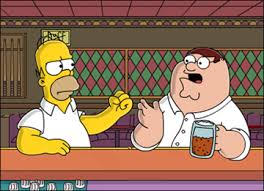
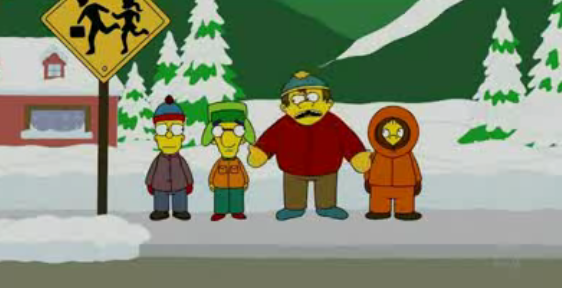
How many of us loved The Simpsons for over a decade?  How many of us still watch the show?  The Simpsons seemed groundbreaking at one point in our definition of comedy, until we we were provided other, “more groundbreaking” humor from the likes of Family Guy and South Park.  After seeing those shows break new ground, The Simpsons no longer seemed as cutting edge as it once had.  Our sense of humor evolved somehow, and those at the water cooler that continue to mimic the humor from The Simpsons no longer seem as funny as they once were.

The question that some of us have regarding TV comedies, in particular, is are these comedies popular because they broke new ground, or does it have more to do with the manner in which they tap into the spirit of the age, or the zeitgeist? Family Guy and South Park have both paid homage to The Simpsons, and it could  be stated that they both operated from the template that The Simpsons created, but at some point they may began to expound upon it.  If that’s true, could it be said that these two shows created something that moved us past The Simpsons, or did The Simpsons become such an obvious staple in the culture that it lost its provocative edge in the zeitgeist? Put another way, if The Simpsons somehow managed to outdo both of these shows in the next couple of years in a provocative manner, could it recapture the audience, or is it impossible to recapture that perceived edge once it’s gone?

Ssi_2Those looking to be cutting edge, among their friends, are constantly updating their sense of humor.  Whereas The Simpsons used to be perceived as “on the cutting edge” of all forms of groundbreaking humor, it reached a point that TV people call a “Jump the Shark” moment where it was no longer.  The same thing has happened to cutting edge TV comedies going to back to Sanford and Son, All in the Family, The Lucy Show, and The Honeymooners.

A number of books have been written on the psychological study of humor, and how it progresses, and they have attempted to capture this phenomenon.  The question is, is this progression the greater curiosity, or should the greater story of the study of humor, as it pertains to television, focus on the the fact that even though we’ve moved past The Simpsons, it has left a mark on our sense of humor we may never be able to escape.

Poking a Dead Frog

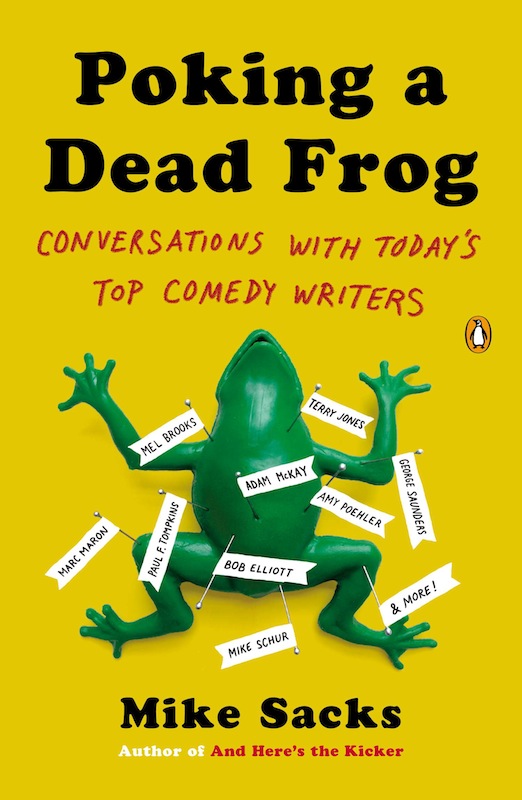
188611979_9780143123781_Poking_a_Dead_Frog-copy

Humor can be dissected, as a frog can, but the thing dies in the process and the innards are discouraging to any but the purely scientific mind … [Humor] won’t stand much poking.  It has a certain fragility, an evasiveness, which one had best respect,” –E.B. White writing in The New Yorker.

As a play on this E.B. White quote, author Mike Sacks titled his book Poking a Dead Frog to provide a thesis for a book that attempts to investigate the art of comedy by interviewing a group of TV and movie writers that may have influenced the core of what modern-day Americans define as funny more than any others.

In Sacks’ first interview, we meet a writer from the television shows Saturday Night Live (SNL) and Late Night with David Letterman named James Downey.

Working for SNL for as many years as he has, Downey has written numerous sketches with other writers, and SNL’s performers.  He offers an assessment of the difference between the two approaches to comedic presentations that he qualifies may be a broad generalization, but one he believes to be true:

Writers tend to write ordinary people in weird situations.  Performers tend to write weird people in ordinary situations.

“The primary critique that most writers have with performer-written sketches is that writers are obsessed with writing original and cutting edge material.  Performers don’t mind writing material that may resemble material that the audience may have seen a million times before, and it bothers the writer that the audience doesn’t seem to mind. 

“Writers treat comedy as a science where advances are made, and we must always move forward, never backward.  Once something is done, no matter how groundbreaking it is, it perhaps should be built upon, but never repeated.  For performers, the fact that something has been done before is neither here nor there.  Writers get themselves all tied up in knots worrying if their current material is too similar to other things.

“As for me, I wish originality were prized by audiences, but it doesn’t seem to be that important to them.  Figuring out the right balance is everything.”

In the Downey scenario, the performer can be excused for writing a less-than-groundbreaking sketch, because they’re the ones on stage.  They’re the ones that get the laugh for being funny, or the arrows for the material that isn’t.  Few audience members would excuse a performer for attempting a complicated sketch that didn’t play well on stage, on the basis that it was written by a writer that tried too hard to be groundbreaking.  Likewise, they don’t give the writer plaudits for a groundbreaking sketch that hits the mark.  Most audience members, and critics, give all of the credit and blame for a performance to the performer.  Thus, the performer can be excused for preferring the laugh over the groundbreaking provocation that may not go over as well as it appears to on paper, or in theory.  It’s their career that’s on the line here, their reputation on the national stage.  While the insiders may know the responsible party for the sketch, it’s the performer left with his performance hanging out for all to see that will define him from that point forward.

Once something is done, no matter how groundbreaking it is, it perhaps should be built upon, but never repeated.”  

A performer could also be excused for wanting to repeat, or build upon, a sketch that works on the basis that it’s so hard to find one.  A writer, on the other hand, doesn’t think that their groundbreaking sketch can be built upon.  They look at what they’ve done as a concise, “one off” work of brilliance, and any attempts to repeat it would be perceived as forced by the audience.  The performer says nonsense, and applies a far too subtle tweak for the repeat performance.  Assigning their creative brains to the audience, the writer thinks that the audience will see through this far too subtle tweak and recognize the repeat performance for what it is.  They don’t, complains Downey, they enjoy it in a manner they did the first time through, and this confounds writers.

Writers tend to make certain demands of themselves, and the material they release.  The audience, however, is far less demanding.  They just want to laugh, or in all other ways, be entertained.  The easiest way to entertain is to seek the patterns of entertainment that we’ve all seen a million times.  This answer does not count on the people (be they writers or performers) that do it better than us, but on the idea that most humans are more comfortable with the comfort of “getting it” than they are being challenged on some epistemological level.  This was thoroughly covered in the Exit Strategy of Sitcoms blog, and in the What’s So Funny? blog.

Many writers fume over the mundane forms of entertainment that others enjoy.  In my own struggles to find provocative material, I’ve surfed though other blogs to read their “Ruminations on a day in my life”.  Most of these blogs are ten times as popular as the one you’re reading right now, and it’s obvious that most people find the 101 reasons a cat moves across a room at the sound of a can opener more entertaining than a blog on why we fear, or a researched, and original, dissertation on the electromagnetic path between our brain and God.

As a writer of a number of the political sketches done on SNL, James Downey made some assessments of comedian Bill Maher’s brand of political humor: 

Bill is a funny guy, but he seems to prefer what (Downey’s former SNL alum Seth Meyers calls) clapter (that is some laughter combined with clapping) instead of actual laughs.  A lot of his (Maher’s) material runs to the “White people are lame and stupid and racist” trope.  It congratulates itself on its edginess, but it’s just the ass-kissiest kind of comedy going, reassuring his status-anxious audience that there are some people they’re smarter than.”

Whether it’s the “ass-kissiest kind of comedy going” from performers giving their audience what they want, or the thought-provoking, groundbreaking comedy that writers try to produce, we all make determinations on comedy.  We all judge what is funny, and what is not, without making conscious decisions about it, and we’re all affected by it in one form or another.

The “Once something is done, no matter how groundbreaking it is, it perhaps should be built upon, but never repeated,” line Downey uses to explain the difference between writers, performers, and what the audience demands defines the difference between writers and their audience on another level.  All writers have received the compliment from an audience member that suggests that you should do a sequel of the story they’ve written, or that they should expound on the theme in one way or another.  This compliment is a double-edged sword in many ways, for while the writer has to love the compliment, the idea of repeating it feels like the idea of repeating it.  The first question a writer has is “How?  How would you have me repeat it?” which of course is not the audience member’s responsibility, but the writer’s.  The point the writer would then make is that they poured their heart out in the story, and while they love you for saying that you thought it was so good that I should just do it again, they also hate you for suggesting that it looked so easy that you should be able to just enter that world again, and do it again, but … different.  Just flip that “on” switch is what they’re saying.  It’s a very writer-esk, artistic thing to say that they can’t just do it again, but as most writers know there is no such “on” switch, unless you’re writing a “ruminations on life” blog that involves cats running to can openers.  Those sequels seem to write themselves, because no one cares, yet everyone cares, and they love them, so writers just pound them out.

Killing Patton: A Review


Sometimes you have to pick the gun up to put the Gun down.” ― Malcolm X

The true soldier fights not because he hates what is in front of him, but because he loves what is behind him.” ― G.K. Chesterson

092414_bill“Nobody likes war,” is the old adage.  Some do.  Some have it coursing in their veins.  These types do not seek war, but once it happens, something kicks in that separates them from the rest of us.  Something intangible that no one can teach defines them among their peers. Give these types what they deem to be a justifiable and worthy cause and they won’t hesitate to lay down their lives for people they’ve never met.  General George Smith Patton Jr. was one of these men. The intro of Patton’s most famous speech expressed as much:

“Men, all this stuff you hear about America not wanting to fight, wanting to stay out of the war, is a lot of (BS). Americans love to fight. All real Americans love the sting and clash of battle. When you were kids, you all admired the champion marble shooter, the fastest runner, the big-league ball players and the toughest boxers. Americans love a winner and will not tolerate a loser. Americans play to win all the time. That’s why Americans have never lost and will never lose a war. The very thought of losing is hateful to Americans. Battle is the most significant competition in which a man can indulge. It brings out all that is best and it removes all that is base.”

Patton first saw combat in what has been called the Pancho Villa Expedition, or the Mexican Expedition of 1916, he then saw action in World War I (WWI), and then, of course, in WWII.  Like many men of his era, Patton saw war for most of his adult life.  Whereas some came to be affected by it in deleterious ways, Patton was emboldened by it.

Pacifists, like the television show M*A*S*H’s character Hawkeye Pierce, have never understood this mentality.  The character stated –and I’m paraphrasing— “I never understood how someone that wrote as beautifully as Ernest Hemingway, would choose war as his subject.”  The implicit statement in the character’s complaint is that only way Hemingway could write about such things is by never experiencing the true horror of it firsthand.  Yet, a cursory glance through Hemingway’s history shows that he was an ambulance driver in WWI, a position that led him to see more carnage than all of the M*A*S*H writers combined, yet unlike the M*A*S*H writers, he continued to write of some of the glory that could be found in war, in many of his most famous books.  The complaint that pacifists like Hawkeye Pierce, have of Hemingway is, if he saw the casualties of war how could he focus on the glory, when there is no glory in war, and the only winners are the ones that lose the least. Hemingway agreed, at least in part, saying:

“Never think that war, no matter how necessary, nor how justified, is not a crime.”
― Ernest Hemingway

For better or worse, most of the men of Hemingway and Patton’s generation were either tacitly, or personally, affected, influenced, and characterized by war.  Hemingway’s life was so influenced by the various wars that occurred in his life that for him to write on another subject was difficult.  He did it, but many claim that most of his best works chronicled war.  As a side note, Hemingway did attempt to enter WWI, but he received a deferment based on poor vision.  Patton’s life was as influenced by war, and to write a piece on him without including descriptions of their war time activities he engaged in would be nearly impossible.  War defined him, and he defined wars.

Killing Patton

For those not familiar with the process that Bill O’Reilly and Martin Dugard bring to the discussion of history in their Killing series, Martin Dugard does the research and Bill O’Reilly takes that research and puts it in a readable style that O’Reilly equates to a John Grisham style of writing.  The research that Mr. Dugard performed in the eight books written before the Killing series so impressed Bill O’Reilly, that Bill labeled him one of the best researchers in the country.

The benefits of the partnership they formed comes through in the readability that O’Reilly brings to Martin Dugard’s research.  I must confess here, that I have never read one of Mr. Dugard’s books, but as a researcher, and writer, I can tell you that it’s very difficult to edit, or delete, large chunks of the work you’ve done in research.  A decent writer, knowing the virtues of pace and readability, will remove those large chunks of work that the researcher has unearthed and provide an easy read of the material.

Those of us that love history, love many of the mainstream, history books, but we also know that they have a tendency to get bogged down in detail.  Even the best of these books require breaks.  There’s just too much information in them for one brain to handle in one setting.  Thus, the formula that these two men have laid out is that the writer, Bill O’Reilly, will surf through all of Dugard’s research and use only that which fits what he terms a readable pace.

In the book Killing Patton: The Strange Death of World War II’s Most Audacious General, the two authors uncover a wealth of information.  At its best, the book provides details of some of WWII’s most heroic efforts.  It provides details of the lives, and the actions of some of WWII’s great leaders Patton, General Dwight D. Eisenhower, Josef Stalin, Adolf Hitler, Franklin D. Roosevelt, and some details of Winston Churchill’s actions during the War.  It also informs the readers of WWII’s lesser-known heroes, the warriors that carried out the orders of all those listed above.  There are moments in the book, a reader will find thrilling, and other moments involving the chilling details of how close this war came to going the other way if not for some crucial German mistakes, some of which were procured through Allied deceptions.  Those of us that believed that WWII came to an end soon after the Omaha Beach landing have been corrected by many authors, including the two here.

The most controversial portion of Killing Patton involves the death of General Patton.  It provides details of a conspiracy theory that the Premier of the Soviet Union, Josef Stalin, may have ordered Patton killed.  Anyone that knows anything about Bill O’Reilly has to suspect that this was his idea.  One has to suspect that while sifting through Dugard’s research, Mr. O’Reilly unearthed a sales tactic to separate Killing Patton from the numerous books written on WWII.  The latter involves as much speculation on my part, as the conspiracy theory does.

As the theme of a 2003 ABC special, conducted on the assassination of John F. Kennedy suggested, some of the times, it’s difficult to believe that consequential men can die by inconsequential means, or that inconsequential men can take down consequential men … Even by accident, as appears to be the case of Patton.  Some of the times, it’s much more interesting to look at all of the circumstantial evidence and wrap it up in a bow for greater sales and easier promotion.  While on his promotional tour, Bill has admitted that he doesn’t know exactly what happened, and that he’s speculating with this particular theory, and that the evidence he cites is circumstantial, but he says, “There’s enough there to warrant more investigation.”  Some have questioned the latter, and others have outright refuted it.  Those that have refuted it have dismissed the entire book on the basis of this theory.  Personally, I think this is a mistake, but I would be a hypocrite if I didn’t admit that factual errors, or speculative theories, in other books have rendered those books unreadable by me.  With that qualifier out of the way, I must say that this is a great read, and there are numerous, substantiated facts in this book that are fascinating.

Some may also dismiss Killing Patton on the basis that it is but another book that glorifies war, warriors, and the archetypal males that have a lust for violence and war.  Some may argue that the very premise of such a book only contributes to the patriarchal, male dominated society that we’ve all been trying to defeat for the last few decades.  They would also argue that in our more civilized societies, the warrior mentality is a lot less necessary, as any and all threats we face are greatly exaggerated by political types of the same mind.  These men, these warriors, used to be enshrined in their cultures, but some may argue that was based on the fact that those societies were less stable, that needed warriors to help them continue as a culture.  They argue from the mentality that our civilization is so much more stable, and permanent, that intellectual diplomats, and social leaders, are far more necessary to continued peace.  Yet, those types usually fail when confronted with irrational evil, and it is at that point that warriors, like General George S. Patton, are brought in to clean up the mess and provide the continued illusion of permanence.