Norm Macdonald Could’ve Saved the World


There was something different about Norman Gene Macdonald (Norm). He was funny, but there are a bunch of different flavors of funny. Norm was the type of funny we might only see once to thirty-four times before we die. Stick with me here for just a second, and four-thousand words. There have been a bunch of guys who tried to save the world, and we all gathered together to listen to them. We followed their prescriptions for a better world, and where did that get us? Some of them cured stuff, technologized stuff, and said some profound things to change things temporarily, but after they died we all went back to the world they lived in. So, what if we tried something so unusual that it changed us. I’m always on the lookout for something different, and why aren’t you? Nobody says they’re the same as everyone else. Everyone says they’re different, but they’re all different in the same ways. “I’m different! I don’t know listen to the man or nothing.” Who’s the man, I don’t know, but the band Anthrax says he puts you in detention. Norm had no authority, and he didn’t want it, so why should we give him the keys to the castle? Well, we’ve tried everything else, and nothing has worked so far. Why wouldn’t we try something different? Just to see if it works. I watched, read, and listened to Norm a lot, and I thought he was so different that he might just be the type who could’ve saved the world.

Norm wasn’t that guy of course. He was a type who’d much rather go boozing and gambling when he wasn’t on a stage. He had that self-destructive gene that seems imprinted in his type, but what if he wasn’t? What if he was the type who could analyze us, undress us, and leave us feeling so naked with a few words that left us laughing our socks off, and we felt so foolish in our certitude and convictions that we changed just a little bit?

In our modern geopolitical world, with all of our political ideas and ideals, we’re just certain that we’re right and they’re wrong. We’re the most advanced people in the world, because we’ve learned. What have we learned? Who are the they that were better than? Other countries, other parties, other people, or the past? We might not be better than present tense people, but we’re definitely better than the past. Ok, but didn’t they think the same thing when they were in their present? They were as certain as we are that they they were better than people from the past, and they probably were, but they didn’t account for us, the people of the future. We’re the people of the future, but we think we’re the people of the present, and we are, but are we so right on, right now, that people in our future won’t think they’re superior to us, mocking us, and deriding us for our convictions? They won’t, because we have science, and we know our science. The past had gaps in their knowledge, and we filled it. We think we’ve filled those gaps so well and so thoroughly that people of the future won’t have anything to fill. “What are you going to fill?” we ask. “It’s already full.” Norm didn’t just fill the bad gaps that ignorant people believe, he filled the gaps of the good stuff that we love, want to believe, and we need to believe for our own superiority, or if he didn’t fill those gaps, he asked us to ask ourselves if it was at all possible that we might still have gaps in our understanding that future man might come along and fill and ask us why we were so stupid that we thought there weren’t any gaps. Then, there’s that truly humiliating question everyone hates and no one wants to hear, questions that make us question everything we hold dear, what if we, the people of the present turn out to be wrong about all the this and that’s that are so decided that we don’t even consider them this and that’s anymore? 

What if we missed our chance at a real game changer, because we were looking for some charismatic type who wanted things. If you have a guy who wants things, you know him, because he’s a lot like you, because you want things too. Norm didn’t appear to want anything more than to sit around and think things. Was he lazy, and did he lack ambition? Yes. He had no material desires, he didn’t do much to foster what could’ve been a better career, and he didn’t openly wish for a happy death. He basically said once we’re all dead no one is going to remember us, “So, who cares if you do things or don’t do things.” People might be sad for a while after we die, because it will be a tragic thing, and they might bring up some of the things you did and didn’t do, but after a while your name will not come up as often as it once did, until no one remembers that you were ever here. So, enjoy your life, and do and don’t do what you want.

To illustrate Norm’s point further, I saw a picture of my great-great grandfather. I didn’t even know he existed. I sort of knew that he had to exist, because for me to exist, he had to exist, but I saw a man who very loosely reminded me of former president James Garfield. I saw another great-great grandfather on the other side, who looked like Abraham Lincoln, people apparently told him he resembled Lincoln on a daily basis (sans the beard). Other than fancying the notion that I might be a descendent of two former presidents (imagine how much better my story would be if that were the case, or how comparatively depressing), I thought about how my great-great grandchildren wouldn’t exist if I didn’t exist. “I’m responsible for your existence!” You think they’ll be grateful? If they see a picture of me, they might “huh!” me and toss me aside to look at pictures of people they do know. (If they even notice a picture of me in a cloud of millions of unlabeled iPhone pictures.*Note to self: Label your photos.)

Not a Wonderful Guy 

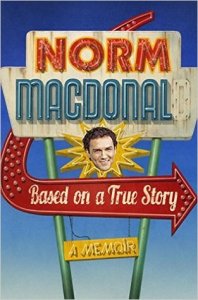
Norm didn’t write Based on a True Story: A Memoir to further his career. He wanted to write a book, and he wanted to get loads of money for it, but career advancement was about as far from a goal as it could be. What was his primary goal? What’s the primary goal of any celebrity writing a memoir? They want you to think they were one hell of a good fella or female throughout their life. 99.9% of Hollywood, political, etc, memoirs drift around various definitions of ‘wasn’t I wonderful?’ Some are direct. They’ll tell you about that time they donated to charity, interactions they had that lead you to believe they had wonderful intentions, or how comparatively awful everyone else around them was. Reading through good, old Norm’s book, we get the idea that Norm didn’t care about any of that. His closest friends, peers, and cultural commentators will tell you that the only thing Norm cared about was being funny. He didn’t care about money or fame, everyone writes that in their book, so you’ll find them wonderful, but in a strange, almost unsettling way we think Norm didn’t care about any of that. He cared about being funny. He didn’t care if you thought he was funny, as long as it was funny. Most of his friends and peers label Norm a comedian’s comedian, which in my estimation means he strove for comedic purity. How does an artist near the point of purity, at least internally? We ask those in the craft that who are pursuing the same thing. It might sound elitist, and it is, but if our goals in life revolve around making the best horseshoe known to man, we might not care what our customers, the laypeople, think, if those in our field of expertise consider those horseshoes the best they’ve ever seen.

Most artists use the memoir as a vehicle to promote their career, or their image, and the idea that while they may appear to be a little quirky to the naked eye, deep in their heart, they want you to know they are actually a very wonderful person. No matter how apathetic, somewhat cruel, and insensitive an author of such material is, the unspoken rule of such comedy is that the author breaks down the fourth wall, in some manner, to let you in on the joke and in on idea that they’re actually pretty nice and very wonderful people who care. Norm Macdonald, the character that he has created for this book, and all of the layers in between, does not seem to care that you get any of that. Most authors that approach a style similar to the book, qualify their motivations for doing what they did with follow ups that redound to the benefit of the author. Norm Macdonald does not appear to care why the reader bought his book, about their outlook on him, or if that reader feels good about themselves, and their world, when they finish the book.

Norm’s Untimely Timelessness: There are no timely elements in this book. Norm Macdonald appears to feel no need to convince us that he is actually very smart, savvy, or anything more than he is. There are no subtle approaches to timely or timeless notions that inform the audience that Norm is compassionate, empathetic, or nuanced. Norm was one of the few celebrities that did not care to tell you what he thinks about pressing or non-pressing matters of the day, and I’m not really sure he cared what he thought either.
29937870Norm was Always an Old Man

Norm was an old soul. He probably sounded old when he was very young. (How many modern books, Based on a True Story: A Memoir, invoke the word “Hoosegow”?) Norm’s dad was old when Norm entered into the world, so Norm spent most of his youth in the company of old men who knew manual labor for the majority of their lives. Norm surely went through the stages of rebellion we all go through to unshackle himself from parental influence to form an individual identity. He probably mocked his old man in various ways, and he surely rejected the old man’s ways of thinking for a time, but by the time we met him, circa aged thirty-one, he came back around to his Hoosegow talk. A more insecure comedian and cultural commentator might try to sound more hip, cutting edge, and nouveau to appeal to the audience. Norm’s voice employed an old man, old world influence that served to intrigue rather than confuse. If the reader is the type that needs some sort of qualifier, or apology, for the somewhat cruel, and insensitive scenes, takes, and reactions that occur throughout this book, it can be found somewhere in the kind, pleasing Midwestern sounding voice that Norm, and his ghost writer Charlie Manson, employed.

I knew nothing of Macdonald’s upbringing, prior to the reading of this book, and I didn’t care about it either. After reading the initial chapters of this book, however, I found myself relating to the rhythms and lexicon Norm learned from the old, hired hands he knew growing up. His dad, my dad, and their friends were old, no-nonsense men that had an old world, no-excuses, masculine structure to their being that is too often lacking in today’s culture. The locale of Macdonald’s rearing was far different than mine as it turned out, but the details of his maturation were so similar to mine that I was surprised to learn we didn’t grow up the exact same time and place. This could be as a result of Norm’s better-than-expected ability to relate to the reader, or his ghost writer’s ability to translate Norm’s thoughts into a book that I found my voice in. The ghost writer is renamed Charlie Manson for the purpose of this book (not that Charlie Manson, the other one.)

Norm on Sex

Norm enjoyed talking about sex, but he did so in a manner that is almost 180 degrees different from any cultural commentator. He talked about sex as if it were nothing more than a stage in life, as opposed to the customary way we have of referring to it as if it is life. He talked about the routine elements of sexual actions, and he talked about the routine immaturity of the act. In an online collection of his jokes, he talked about having sex in his youth, and how he grew out of it to some degree.

“I don’t care for sex. I find it an embarrassing, dull exercise. I prefer sports, where you can win.”

Even though Norm submitted his unique take on not enjoying sexual activity, he admitted to being human in this regard:

“This is the amount of time you think about sex: every once in a while. The problem becomes, when you think about it, it’s all you can think about. It encompasses your whole brain. You’re like a werewolf or something. Usually you’re a civilized human being, but then every couple of days, you’re like “Arrrgh.” Then you’ve got to close the blinds.”

As for the routine nature of it, Norm suggested that he, like all of us, tried to shake the routine of sexual activity up and try something different every once in a while:

“Sex couldn’t be simpler. I think there’s only like five things you can do in the whole thing. You ever think you invented a sixth? Then later you go, “Ah, in all humility, I guess that was pretty close to number five.”

“My wife dresses up like a nurse; then, I dress up like a nurse, also. And then, we don’t even have sex, either. We just sit behind this huge, semicircular wooden desk and get annoyed when people buzz us for juice.”

The bits above are funny, but they don’t really cut to the heart of Norm’s unique, refreshing views on sex in the manner Norm opened up about it on a transcript from a talk show:

“I find sex very repetitive and dull and kind of pointless.” Norm said he finds it a childish desire which he’s spiritually outgrown. I find sex to be a very filthy act in the sense of being shameful. Sex is an activity we don’t do in public due to its intrinsic shamefulness.” He quotes scripture saying, “When you’re a boy, you do boy things. I know most people are children for their whole life, and [sex is] a way of having fun.”

The Out-Joke

When the cavemen drained all of the comedic value out of punching each other in the face, an enterprising young caveman comedian probably tried violating his tribe’s taboo by punching women in the face. And before you say jokes like that only attract troglodytes, remember that was Mujmuj Kandar-Smith’s key demographic. Once they moved past those jokes, and the jokes about the limbs they lost in their Sabertooth Tiger hunts, they probably turned to self-effacing humor. The key to really good self-effacing humor is that it allows us to laugh at ourselves through the vulnerability of the comedian, yet most standup comedians are not of such strong constitutions that they can handle an audience laughing at them, so they cloak it in a type of humor that asks us to laugh with him, as opposed to at him. They’re letting the audience in on the joke. It’s the “aren’t I silly, aren’t we all just silly” approach that carefully approaches their foibles in a way in which we can all laugh at ourselves, so that we’re not just laughing at the comedian. Norm perfected the art of not allowing the audience in, so that the audience uncomfortably enjoys laughing at Norm. Norm didn’t invent this form of comedy, of course, as his most immediate predecessors might be David Letterman, Andy Kaufman, Chris Elliot, and perhaps Will Farrell. Yet, Norm may have even carved out his own niche in this niche in this form of comedy with his old timey lexicon that led us to believe we were laughing at our dad, our grandpa, or our predecessors. We also know that his social commentary was delivered in a tongue-in-cheek manner. In the character Norm developed, onstage and off (with this book) the reader is not so sure if it’s all good. The narrative of Based on a True Story: A Memoir leads the reader to feel sorry for the character, while laughing at his naiveté, and his inability to abide by social norms.

Norm was a Savant

Norm Macdonald didn’t do well with some basic simplicities of life. He never learned how to drive. Some, who knew him well, said that he had some difficulties with what we might consider normal human interaction, or he wasn’t gifted in this arena. When he failed to understand the consequences of his actions, some assigned motives to his actions. Others, those who knew him best, said that was just Norm. Yet, his peers suggest he might have been a comedic savant, or an individual with detailed knowledge in some specialized field. Norm was a brilliant satirist, a gifted jokester, and well-read history buff, but it appears that he was missing some ability to make links. He made a joke one time, on Adam Carolla’s podcast that he ate Count Chocula for dinner and generally had the diet of a seven-year-old child. Was it intentional, whimsical, or did he have such tunnel vision that he failed to understand some of the complexities to keep up with the rest of us. I wouldn’t say I know a truth, of course, but there is evidence of a complex understanding of the greater things in life, in the mind of Norm Macdonald, coupled with an almost child-like naïveté in matters we consider simple.

Norm was Different

Monty Python had a slogan that prefaced much of their material, “And now for something completely different.” For those of us who pine for something different, this book contains stories, reactions, and anecdotes that I have to imagine most authors, and almost all celebrities do their best to avoid. I have a sneaking suspicion that Macdonald’s public relations people asked him to include the “Based on” words to the title of his book. I have a sneaking suspicion that Norm wouldn’t mind it one bit if the reader believed this was the true story of Norm Macdonald’s life. Something tells me that his people, friends, associates, and business partners cautioned him to bolster the doubt regarding the material, because too many people might believe it’s his true story, and that this book may do some damage to his career.

Norm was a Closer

Norm’s good friend, Dennis Miller, said, “Always be closing” on a daily basis on his talk-show. As such, “Based on a True Story: A Memoir” is either building to a close throughout the various chapters, or its closing throughout. When it’s not strict to script of the respective story, hilarious anecdotes break the story up so well that one has to gather one’s self and remind themselves where the narrative was heading. The anecdotes appear to be accidental humor in other words. In the beginning of this book, I began highlighting some of the jokes believing that they would be precious jewels that I would have to remember. I do this with all provocative lines and paragraphs, but as I continued throughout the book, I gave up, knowing that when one highlights too often, the portions that are highlighted begin to lose value.

Norm Macdonald was Norm Macdonald

Norm Macdonald does whatever the hell Norm Macdonald wants. Is this a true narrative, Norm not does appear to care what the reader believes one way or another. Is this a readable narrative that involves the time-honored traditions of storytelling, Norm doesn’t appear to care. The storytelling format does have a Fear and Loathing in Las Vegas feel to it, but other than that it does not follow the rules of any celebrity memoir that I’ve ever read. He may have informed us of some true facts regarding his upbringing, and the many things that have happened to him along the way, but he doesn’t care if the readers knows the difference, or, apparently, if those distinctions could lead to some damage of his career as an entertainer. As a result, I would say that this is by far the best celebrity memoir I have ever read, but I have the feeling Norm wouldn’t care what one way or another.

Norm Macdonald Could’ve Saved the World

With all of his flaws, and according to friends, family and peers, the flaws were numerous, he probably wouldn’t have been elected a world leader, but how many world leaders are so flawed that their handlers do much of the public affairs and public relations work? He couldn’t have been elected to anything, because he wouldn’t take it serious enough. Yet, in those spare moments when the real Norm Macdonald stepped up to the plate to drop some truly profound nuggets on us, I thought this man is one of the more unusual thinkers I’ve ever heard. He was, by many accounts, the smartest guy in the room who tried to conceal his intelligence for reasons of humility, and he fell prey to the notion that smart people aren’t cool. He didn’t care about that, and he obviously did at the same time. It was so surprising to me that when I heard him talk serious, I wondered if the alternative sides of Norm Macdonald could’ve done something historic if he wasn’t so lazy and apathetic about all the things we consider so serious.

*I’ll refer to Norm Macdonald as Norm throughout this article. It’s not intended as a note of familiarity, though I do feel as if I know him as an audience member, I had no personal ties to him in anyway. I also don’t intend it as a lack of respect, as one would if they took the time to wrote his name in full, or labeled him Mr. Macdonald. I’ll refer to him as Norm throughout this article purely for readability.

It’s the Garry Shandling Blog


“90% of success is showing up.” –Woody Allen.

“Every great thing you do in life will result from failures, both large and small.” –Napoleon Hill

Failure isnt fatal, but failure to change might be. — John Wooden

No one would look at Garry Shandling and think, leading man material. If central casting were to draw up a stereotypical leading man for roles in their projects, they might use Garry Shandling’s characteristics, as a contrast for what they seek. No one who listened to Garry Shandling’s early standup routines thought, “This man needs to be on The Tonight Show, he might even make a great fill-in host, or he should have his own sitcom.” If they were to compose a list of 100 comedians most likely to succeed beyond the stage, at that time, the young Shandling would not have made any of those lists, unless he chose to pursue a career as a sitcom writer. The difference between Shandling and those “more talented” comedians he succeeded beyond, according to Shandling, was that he just continued to show up.

He began his career in comedy, as a writer on the sitcoms Sanford and Son, Welcome Back Kotter, and The Harvey Corman Show. He left that world of consistent paychecks behind to enter into the far less stable world of standup comedy. The problem with that decision, according to those who’ve documented Shandling’s career, is that he wasn’t very good at it. One of the most powerful and influential individuals in the world of comedy at the time, owner of The Comedy Store Mitzy Shore, went so far as to refuse to put Shandling on her stage. The reason she didn’t put him on stage, and one of the themes of this article, is that Mitzy Shore felt that Shandling lacked stage presence and an overall sense of command of the audience, and she had an uncanny ability to spot those characteristics. “I don’t know if Mitzy even listened to jokes,” one comedian stated. “She didn’t care if you were funny. To her, it was all about stage presence.” 

As a result, one of the funniest comedic actors of his generation wasn’t even able to make it on her stage, because of his perceived lack of talent. The lucky break, if one wants to call it that, occurred for Shandling when the “talented” comedians on The Comedy Store’s roster, decided to strike. That strike occurred as a result of Mitzy Shore’s decision not to pay her comedians. Shandling made the unpopular decision to cross that picket line, and in total desperation for a body to put on the stage, Shore eventually conceded and put him on.

Gary Shandling might even admit that the difference between Garry Shandling and the other comedians who didn’t succeed in that space was that he was willing to continue to get on the stage night after night, regardless the circumstances, the pay, or lack thereof. He was willing to face the abuse and hectoring of an audience that must have reached a point where they agreed with everything those in the know said about him.

We can only guess that while those who cared about Garry Shandling admired his courage and perseverance, they probably sat him down, at one point, and told him to go back to doing what he did best, writing for sitcoms.

The summation of all this is no one gave Garry Shandling any reason to believe in his abilities as a performer, but he continued to show up and hone his act, until a talent scout from The Tonight Show watched him for a number of nights and decided that he had the chops to make an appearance on a show that was then considered the Holy Grail for all comedians. It’s difficult to describe how powerful and influential The Tonight Show was during this era, but if you were a standup comedian who made it on the Tonight Show, and then the couch, you were known throughout the nation, if not the world. People stopped otherwise anonymous comedians on the street the next day, saying, “Hey, weren’t you on The Tonight Show last night?” Some suggest that the exposure of a five-minute set on The Tonight Show was worth more, back then, than an HBO Special and a Netflix show is today, combined. After a number of these spots, Shandling vaulted up the ladder to guest hosting for Johnny Carson for years, and The Tonight Show producers even began to seriously consider him a suitable successor for Johnny’s seat, should Johnny ever decide to retire.

Was Shandling ever as funny as Jay Leno or Jerry Seinfeld, or the many other “more talented” comedians of his era who didn’t succeed? His material was top shelf, according to those who know, but those same people considered his presentation so poor that they didn’t foresee him developing a career in the field.

He kept showing up. He kept enduring the years of bad nights, presumed harassment and humiliation, and the feelings of failure that had to have resulted from bombing so often that he achieved levels of success in TV and the movies that were unprecedented among most of his peers.

The first step, Shandling instructs, is to show up so often that you grow more accustomed to your stage fright. The import of this advice is that tips, tricks, and advice may ease the psychological trauma a little, but nothing compares to just doing it so often that the fear becomes more manageable. Writing quality material before you take to the stage helps with the confidence, of course, but nothing helps more than just doing it so often that you almost incidentally become better at it.

The next step is to work your material before an audience and tweak it based on their reactions. Some have said that this might be the hardest part of the job, and it is never ending, but at some point a routine does develop. At some point you create a greatest hits of jokes package that you can take to a talk show. It’s implied throughout this part of the process that a comedian has to have thick skin for those in the audience that will help you shape material in good and bad ways.

Thick skin, to my mind, is an understatement. How about rhinoceros skin, or the type of skin necessary to evolve from a sane, somewhat humorous individual to someone who is asking around 450 paying customers a night (the seating capacity of The Comedy Store) three-to-four times a week what they think. The first question that comes to mind is how many paying customers in an audience understand that you’re just working on material? How many of them will be patiently understanding? How many people would pay to see someone perform raw, untested material, and how many people will let an unknown comedian know that they’re no better than them, and that the comedian should be sitting next to them in the audience? Unless it’s some sort of amateur night, most people will sit with folded arms, wondering why the owner decided to put this newbie on stage on their only night out of the week. These people enjoy the schadenfreude of watching another person squirm. This thick skin requires that the aspiring comedian move past such people, and the consistent feelings of failure, the heckling, and the excruciating nights where you’re left alone to adjust your material for the next night of more of the same.

The night after we bomb onstage, the natural inclination of most sane individuals might be to adjust the material in such a way that it sounds like the exact opposite of the night before. The inclination may be to list those jokes under the “rejected” heading. The inclination may be to consider a scorched earth policy on all that material. It’s often somewhere in between, say successful comedians. The successful comedian has to believe in the material, they say, and it may require nothing more than some tweaking of the language. They might want to consider adding something here, deleting something there, changing the point of emphasis, or the point of perspective. Then, just when a comedian reaches a point where they’re comfortable with their material, they’ll want to do a complete overhaul that puts them in an uncomfortable place where they’re nervous and agitated and learning from the audience again, because once a comedian becomes feels comfortable with the material they reach a point that no successful comedian wants to reach: comfort.

A comedian is no longer striving when they’re comfortable, and they’re no longer developing fresh, new material that makes the audience so uncomfortable that they’re laughing with you, as opposed to at you. The space all comedians search for exists somewhere between artistic purity and honesty, a sweet spot that can take some over a decade to find, if they ever do.

This struggle, according to Garry Shandling, didn’t involve the material. He may have needed years to shape the material, but the basic task of writing jokes always came easy to him. His presentation, on the other hand, had always been lacking to some degree, and the fact that he kept showing up to put himself in the uncomfortable position of exposing this weakness before others bore fruit in the form of an insecure, neurotic character who was insecure about his presentation skills.

What Shandling did, to create a long prosperous career, was combine his greatest strength, and his greatest weakness to form a pure, honest character that he would hone over the course of a decade in the form of two television shows: It’s Garry Shandling’s Show and The Larry Sanders Show. These shows featured a character who knew how to write material but was forever worried, and neurotic, about his presentation. He took everything his greatest supporters said about him, combined with everything his greatest critics said about him to develop one of longest and most fruitful careers in comedy. The shows he starred in won nineteen Emmy nominations, numerous American Comedy Awards, and a spot in the hearts of many standups who regard him as one of the most influential comedic actors of all time.

Garry Shandling’s story is, in essence, the exact opposite of all those sad, depressing “could’ve been, should’ve” stories of individuals that were on the cusp of stardom but didn’t make it … for a variety of reasons. His is a tale of a “couldn’t have been, shouldn’t have been” character that showed up so often, and worked so hard that he was … for a variety of reasons. His unlikely story should remain an inspiration for those marginal talents, who are informed that they are marginal talents, that there may be a sweet spot for you too, if you are willing to work your tail off and show up so often to succeed. It’s your job to find it, use it, and hone it.

The one cliché in the Garry Shandling bio is the “no one believed in me or my talent as much as I did” angle that has been put forth by so many, but in Garry Shandling’s case, it appears to be the unvarnished truth. The non-believers may have been witness to some killer material, but they may have believed that a more skilled, more charismatic presenter would better serve that material. His is the story of an individual of marginal talents that believed in himself beyond reason.

To those that have never heard of Garry Shandling, or believe that I am overselling the insecure, neurotic characteristics of a man who has succeeded in life to the degree he has, I challenge you to watch the interview Ricky Gervais did with him in 2010. The purpose of this interview, for Ricky Gervais, was to deify Shandling as a comedic luminary, and to pay homage to Shandling as a personal influence. Shandling, however, appears as insecure and unsure of himself in this interview as he may have been as an upstart comedian in 1978. Even after all Garry Shandling accomplished in his career, this interview is uncomfortable to watch in parts, and in other parts, it appears almost confrontational. Even the most informed viewer –who knows Shandling’s schtick, and knows that some of it is schtick– can’t help but think that at least some of what they’re watching is an exposé of a man who is unsatisfied with his career, relatively unhappy, and uncomfortable in his own skin.

The idea that Shandling has lost whatever it was he once had crosses the viewer’s mind, as does the idea that he might be too old, or that he’s been out of the game so long that he can’t handle this type of interview anymore. There are parts of the interview when the viewer begins to feel sorry for Shandling, and we want someone to step in and put an end to his pain. Those informed viewers who know the Shandling story know that was Garry Shandling. He never had it, in the manner some define the elusory “it”, but that doesn’t stop the intrigued from watching something that becomes almost unwatchable in parts. A description that Garry Shandling, himself, might admit is a beautiful encapsulation of just about everything he did throughout his illustrious and unusual career.

Poking the Televised Frog


If it’s true, as the Chinese proverb states, “A child’s life is like a piece of paper on which every person leaves a mark” could the same principle be applied to TV shows and our sense of humor?

imagesHas anyone ever informed you that they have something of a twisted, dark, and “some would say” sadistic sense of humor?  Have the two of you entered into an unspoken agreement that no one has a sense of humor as unusual as theirs?  Have they tried to leave the impression that they sat in some dark room and gestated into the character that stands before you?  If you press this person, they will walk you through all the dark caverns of their sense of humor and point out all the bearded ladies, wolf boys, and evil dwarfs that have informed their sense of humor.  No matter how common you may find the material that has informed their “twisted, bizarre, and some would say sadistic sense of humor”, these people will insist their sense of humor is more advanced, more sadistic, and more quirky than yours.

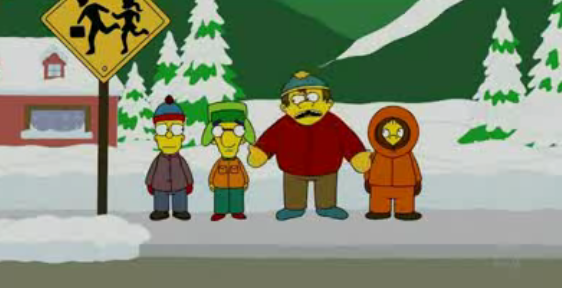
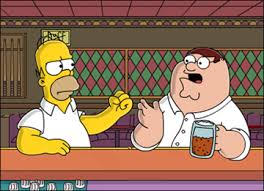
How many of us loved The Simpsons for over a decade?  How many of us still watch the show?  The Simpsons seemed groundbreaking at one point in our definition of comedy, until we we were provided other, “more groundbreaking” humor from the likes of Family Guy and South Park.  After seeing those shows break new ground, The Simpsons no longer seemed as cutting edge as it once had.  Our sense of humor evolved somehow, and those at the water cooler that continue to mimic the humor from The Simpsons no longer seem as funny as they once were.

The question that some of us have regarding TV comedies, in particular, is are these comedies popular because they broke new ground, or does it have more to do with the manner in which they tap into the spirit of the age, or the zeitgeist? Family Guy and South Park have both paid homage to The Simpsons, and it could  be stated that they both operated from the template that The Simpsons created, but at some point they may began to expound upon it.  If that’s true, could it be said that these two shows created something that moved us past The Simpsons, or did The Simpsons become such an obvious staple in the culture that it lost its provocative edge in the zeitgeist? Put another way, if The Simpsons somehow managed to outdo both of these shows in the next couple of years in a provocative manner, could it recapture the audience, or is it impossible to recapture that perceived edge once it’s gone?

Ssi_2Those looking to be cutting edge, among their friends, are constantly updating their sense of humor.  Whereas The Simpsons used to be perceived as “on the cutting edge” of all forms of groundbreaking humor, it reached a point that TV people call a “Jump the Shark” moment where it was no longer.  The same thing has happened to cutting edge TV comedies going to back to Sanford and Son, All in the Family, The Lucy Show, and The Honeymooners.

A number of books have been written on the psychological study of humor, and how it progresses, and they have attempted to capture this phenomenon.  The question is, is this progression the greater curiosity, or should the greater story of the study of humor, as it pertains to television, focus on the the fact that even though we’ve moved past The Simpsons, it has left a mark on our sense of humor we may never be able to escape.

Poking a Dead Frog

188611979_9780143123781_Poking_a_Dead_Frog-copy

Humor can be dissected, as a frog can, but the thing dies in the process and the innards are discouraging to any but the purely scientific mind … [Humor] won’t stand much poking.  It has a certain fragility, an evasiveness, which one had best respect,” –E.B. White writing in The New Yorker.

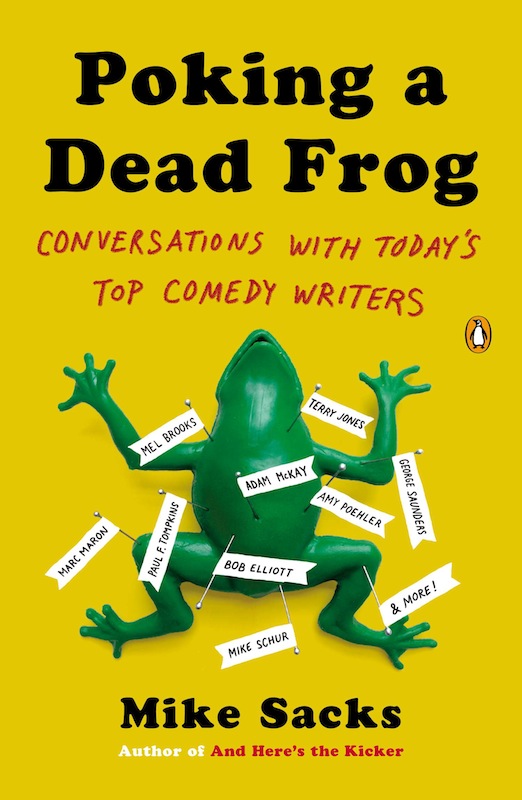
As a play on this E.B. White quote, author Mike Sacks titled his book Poking a Dead Frog to provide a thesis for a book that attempts to investigate the art of comedy by interviewing a group of TV and movie writers that may have influenced the core of what modern-day Americans define as funny more than any others.

In Sacks’ first interview, we meet a writer from the television shows Saturday Night Live (SNL) and Late Night with David Letterman named James Downey.

Working for SNL for as many years as he has, Downey has written numerous sketches with other writers, and SNL’s performers.  He offers an assessment of the difference between the two approaches to comedic presentations that he qualifies may be a broad generalization, but one he believes to be true:

Writers tend to write ordinary people in weird situations.  Performers tend to write weird people in ordinary situations.

“The primary critique that most writers have with performer-written sketches is that writers are obsessed with writing original and cutting edge material.  Performers don’t mind writing material that may resemble material that the audience may have seen a million times before, and it bothers the writer that the audience doesn’t seem to mind. 

“Writers treat comedy as a science where advances are made, and we must always move forward, never backward.  Once something is done, no matter how groundbreaking it is, it perhaps should be built upon, but never repeated.  For performers, the fact that something has been done before is neither here nor there.  Writers get themselves all tied up in knots worrying if their current material is too similar to other things.

“As for me, I wish originality were prized by audiences, but it doesn’t seem to be that important to them.  Figuring out the right balance is everything.”

In the Downey scenario, the performer can be excused for writing a less-than-groundbreaking sketch, because they’re the ones on stage.  They’re the ones that get the laugh for being funny, or the arrows for the material that isn’t.  Few audience members would excuse a performer for attempting a complicated sketch that didn’t play well on stage, on the basis that it was written by a writer that tried too hard to be groundbreaking.  Likewise, they don’t give the writer plaudits for a groundbreaking sketch that hits the mark.  Most audience members, and critics, give all of the credit and blame for a performance to the performer.  Thus, the performer can be excused for preferring the laugh over the groundbreaking provocation that may not go over as well as it appears to on paper, or in theory.  It’s their career that’s on the line here, their reputation on the national stage.  While the insiders may know the responsible party for the sketch, it’s the performer left with his performance hanging out for all to see that will define him from that point forward.

Once something is done, no matter how groundbreaking it is, it perhaps should be built upon, but never repeated.”  

A performer could also be excused for wanting to repeat, or build upon, a sketch that works on the basis that it’s so hard to find one.  A writer, on the other hand, doesn’t think that their groundbreaking sketch can be built upon.  They look at what they’ve done as a concise, “one off” work of brilliance, and any attempts to repeat it would be perceived as forced by the audience.  The performer says nonsense, and applies a far too subtle tweak for the repeat performance.  Assigning their creative brains to the audience, the writer thinks that the audience will see through this far too subtle tweak and recognize the repeat performance for what it is.  They don’t, complains Downey, they enjoy it in a manner they did the first time through, and this confounds writers.

Writers tend to make certain demands of themselves, and the material they release.  The audience, however, is far less demanding.  They just want to laugh, or in all other ways, be entertained.  The easiest way to entertain is to seek the patterns of entertainment that we’ve all seen a million times.  This answer does not count on the people (be they writers or performers) that do it better than us, but on the idea that most humans are more comfortable with the comfort of “getting it” than they are being challenged on some epistemological level.  This was thoroughly covered in the Exit Strategy of Sitcoms blog, and in the What’s So Funny? blog.

Many writers fume over the mundane forms of entertainment that others enjoy.  In my own struggles to find provocative material, I’ve surfed though other blogs to read their “Ruminations on a day in my life”.  Most of these blogs are ten times as popular as the one you’re reading right now, and it’s obvious that most people find the 101 reasons a cat moves across a room at the sound of a can opener more entertaining than a blog on why we fear, or a researched, and original, dissertation on the electromagnetic path between our brain and God.

As a writer of a number of the political sketches done on SNL, James Downey made some assessments of comedian Bill Maher’s brand of political humor: 

Bill is a funny guy, but he seems to prefer what (Downey’s former SNL alum Seth Meyers calls) clapter (that is some laughter combined with clapping) instead of actual laughs.  A lot of his (Maher’s) material runs to the “White people are lame and stupid and racist” trope.  It congratulates itself on its edginess, but it’s just the ass-kissiest kind of comedy going, reassuring his status-anxious audience that there are some people they’re smarter than.”

Whether it’s the “ass-kissiest kind of comedy going” from performers giving their audience what they want, or the thought-provoking, groundbreaking comedy that writers try to produce, we all make determinations on comedy.  We all judge what is funny, and what is not, without making conscious decisions about it, and we’re all affected by it in one form or another.

The “Once something is done, no matter how groundbreaking it is, it perhaps should be built upon, but never repeated,” line Downey uses to explain the difference between writers, performers, and what the audience demands defines the difference between writers and their audience on another level.  All writers have received the compliment from an audience member that suggests that you should do a sequel of the story they’ve written, or that they should expound on the theme in one way or another.  This compliment is a double-edged sword in many ways, for while the writer has to love the compliment, the idea of repeating it feels like the idea of repeating it.  The first question a writer has is “How?  How would you have me repeat it?” which of course is not the audience member’s responsibility, but the writer’s.  The point the writer would then make is that they poured their heart out in the story, and while they love you for saying that you thought it was so good that I should just do it again, they also hate you for suggesting that it looked so easy that you should be able to just enter that world again, and do it again, but … different.  Just flip that “on” switch is what they’re saying.  It’s a very writer-esk, artistic thing to say that they can’t just do it again, but as most writers know there is no such “on” switch, unless you’re writing a “ruminations on life” blog that involves cats running to can openers.  Those sequels seem to write themselves, because no one cares, yet everyone cares, and they love them, so writers just pound them out.