Rilalities VI


Lucky is the man who does not secretly believe that every possibility is open to him.” — Walker Percy

1) A Man on the Rise534382_543655018980917_1211806109_nWe all have a formula for success, but how flawed are they? How many inconsequential matters make it into our formula? I met a man who achieved a relative level of success in life. The only problem was he didn’t know how to set an alarm clock, so I showed him … numerous times. Frustrated and embarrassed by this revelation, he stopped me and said, “Just give me a damned wake up call!” He looked at me with a bemused smile that contained shades of embarrassment. The shades of embarrassment suggested that he knew he should know how to do this by this point in his life, if he wasn’t a senior citizen he was close. Beneath that subtle shade of embarrassment was a bold confidence that suggested this moment  didn’t bother him as much as I thought it should. I was so shocked that I could barely return a polite smile. I figured that someone, a mom, a wife, or a secretary obviously made sure his clocks ran on time. The man’s confidence, combined with this lack of knowledge, led me to share this moment with a number of people, until I finally ran into someone who knew who that feller was. “That man is the vice-president (VP) of one of the most prestigious companies in the world,” he said mentioning the name of the company in question.

It seemed unfair to me that a man who knows so much should achieve so little, while this near infant-of-a-man should rise to the upper reaches of our society. The difference between the two, life has taught me, is tunnel vision.

Long after meeting that VP, I met a man named Kelsey Anderson. As opposed to the specific knowledge that the VP gained, attained, and sustained, Kelsey was more of a generalist. “Okay, that man is just smart,” someone once said after spending some time in his company. “He is,” I said. “No doubt about that, but he has no direction. He’s never learned how to apply that knowledge in any productive way.” Kelsey and I spent about six months working next to each other in a big company, and my impression of him only strengthened over time.  

The question is who is smarter, who’s more successful, and who has the better game plan? The VP obviously focused his more limited resources in one particular area, until he eventually succeeded beyond 99 percent of most men. Kelsey was an impressive intellect who could’ve taken that alarm clock apart and rebuilt it. He was one of those guys who appears to know a surprising amount of something about everything, but he had no particular area of focus, no direction, and thus no arena in which to display his prowess. His potential to succeed was unbound, and we all knew it. He knew it. The vice-president had comparatively limited resources, but he obviously learned his limitations early on, and he learned how to hone those few strengths he had to become what we all deem successful.

We’ve all witnessed impressive people before, but how many people do we know that are so impressive that their listeners cannot contain themselves? Most people try to find the one thing that is not impressive about the impressive, so that they can feel more comfortable in their less than impressive lives. Most people do not say things like: “What’s he doing here?” … among us?

“If someone were to just give me half-a-(durned) chance … ” Kelsey would complain when I complimented him on his intelligence. The compliment I gave didn’t please him. It made him more angry about his station in life. “I just-I have so many ideas … ” he complained. He knew so much, about so much, that he was an intimidating force of a man, but he had learned so little in life that he never found out how to capitalize on it. Watching him, one was left to wonder how many learned men in history had so much trouble harnessing their ability that they were deemed a failure by those that knew them? And how many lesser men learned how to harness their limited ability, until they achieved a place in history we all know well?

Catchers and framing

2) Framing an Argument: Have you ever found out that an overwhelming number of people disagree with something you’ve believed in for so long that it’s now an ingrained truth to you? Is this issue something that you hold so close to your heart, that it pains you to learn that so many disagree with you? The disagreements you’ve heard aren’t simple disagreements either, they’re profound, substantive disagreements that cause you to question everything you once held dear.

The first question that your like-minded cohorts will ask you is what is wrong? Even moral issues are relative when looked at in a certain light. There are no absolutes, they will say. You may love that answer for it falls in line with your philosophy, but it doesn’t satisfy the internal dilemma you’re experiencing, because the contradictory information pouring in is penetrating.

You simply need a course in framing, your like-minded cohorts will say. The art of framing employs the soul of wit: brevity. If you can frame your issue in the form of a sound bite, a lyric, one frame of one cartoon, or a couple of pictures, the world will be your oyster. The particulars of the argument may damn you to the point of being wrong on this particular issue, but you need not worry about the particulars when you’re framing. Your goal, in this the age of 140 words, is to succinctly portray your position in a manner that can be repeated, and shared, until you’re as close to right as you can possibly be without saying the wrong thing, and your brokenhearted brethren will like you for it.

3) LANGUAGE: I’ve always had a passing interest in the French language. When it’s fluently spoken, it can sound so rhythmic and beautiful. I was so taken by the language that I decided to take a college course in French. It became clear to me (about a month in) how passing that fascination was. I still enjoyed hearing the language though, and I’ve even tried my hand at using some of the language’s more exotic words with all of the umlauts, graves, and aigues in place. It was my goal to speak the language in a manner absent the mundane, specific-to-America renderings. The French word for accessories, accouterments, got a hold of me once, and I began using it as often as I could. It made me feel exotic and a little worldly when my English speaking friends would say, “What?”

“It means accessories,” I would say with a subtle amount of smugness that bathed in the exotic juices of knowing a little French. I finally ran into a native French speaker some time later, and I couldn’t wait to give the word a test drive. I used it in proper context, and I thought I had my elocution down. I had also used the word for years at that point, so I felt confident in the idea that I could now say it without the effort those that had never heard the word used.

When my native French speaking friend said: “What?” I was a little taken aback.

“Isn’t that French for accessories?” I asked.

He asked me to repeat it, and when he was able to pick himself up off the floor, he informed me that most non-native French speakers should just stick with the American renderings.

elliwtch4) SELF-PROMOTION: Rarely will you read an author write, “I’d like to talk about myself now … ” They’re usually more creative than that, but some of them aren’t. Some of them should spend a little more time trying to creatively frame their indulgence a little better.

I recently put a book down that contained the words: “They don’t want Harlan Ellison messing around with that.” Speaking in the third person can be funny, and some of the times it can be an affectation of funny that leaves the reader thinking that they’re about to go down an unusually funny, self-defecating (sic) path, but this particular fork in the road was not a veiled attempt at humor, nor was it eventually self-deprecating. This was pure self-promotion. This was Harlan Ellison telling the reader that the establishment regards him as a dangerous rascal that keeps on mucking up the status quo to a point that they believe he must be constrained to maintain their precious military, industrial complex. They’re afraid of what Harlan Ellison might tell you, Harlan basically writes. They do not want Harlan speaking out, because they know that his powerful words can cause unrest. Harlan also wants you to know that the establishment, the man, doesn’t appreciate him speaking out, because they’re afraid of his thoughts, and he’s much more powerful than you know (or perhaps than he even knows), but the man knows, and they have tried to find some way of shutting him up. Either that, or the cynic in me believes, that Harlan wants you to feel like an outsider that doesn’t know how truly rascally Harlan can be, so you may want to buy more of his books to find out. When we buy a book, we do want to find out what an author thinks, and we’ve been tantalized by his thoughts through some other medium that led us to being so interested in his thoughts that we wanted to purchase a compendium of them, but when that author qualifies his thoughts in a manner that suggests that he believes that his thoughts are extravagantly provocative, some of us simply tune him out.

5) Quote: Recalling the fifty year anniversary of the legislation, George Will writes of President Lyndon B. Johnson’s Great Society: “In 1964, 76 percent of Americans trusted government to do the right thing just about always or most of the time. Today, 19 percent do. The former number is one reason Johnson did so much; the latter is one consequence of his doing so.”

The Debilitating Fear of Failure


“The reason we struggle with insecurity,” notes Pastor Steven Furtick, “is because we compare our behind-the-scenes with everyone else’s highlight reel.”

Some quotes educate us on matters we know nothing about, but the ones that stick take a matter we know everything about and puts a clever twist on it that changes our perspective. We all know failure, or some level of it, at various points of our life. Some of those failures have shaped us in profound ways that we assume everyone remembers them the moment we enter a room, and some people will, but will they remember their own, or will they compare our failings to their highlight reels.

Pastor Steven Furtick

“Acknowledging failure,” Megan McArdles writes in the book The Up Side of Down: Why Failing Well is the Key to Success, “Is a necessary first step in learning from it.”

Some of us are old enough to remember the severe penalty for missing a rung on the monkey bars. An erroneous grab, at the very least, could land a victim center-of-attention status, as we attempted to find our feet. At worst, it would cause the pack of onlookers to send an emissary to the office with a call for assistance. These everyone-is-looking-at-you moments are so immersed in embarrassment, and pain, that few can see any benefit to them.

Most of those liable for such situations, have lowered the monkey bars, and made the ground so forgivable that one would have to fall from a skyscraper to receive any pain. Thanks to these and other technological advances, fewer children get hurt on playgrounds, fewer playground manufacturers get sued, and everyone is much happier. There is one casualty, however, the pain of failure.

No one wants to see a child cry, and we should do everything we can to prevent it, but pain teaches us.

After a near fall in a supermarket, the checker complimented me on the agility and nimbleness I displayed to avoid hitting the ground. “It could be that,” I returned, “or it could be said that only someone so well-practiced in the art of falling knows how to avoid it.”

I eventually did touch ground a short time later, at a family reunion. I also touched a parked car, and then I touched the ground again. Among the lessons I learned is that pain hurts. Had it been a simple fall, it would be hardly worth noting. This was one of those by-the-time-this-ends type of falls everyone will be looking, some will be concerned, and most will be laughing. I thought I corrected my trajectory a number of times, but I was moving too fast. By the time it was finally over, I silenced just about everyone in the vicinity. The kids around me laughed, as kids will do when anyone falls, and my age-denying (Not Defying!) brother laughed, but if the Greg Giraldo line, “You know you’re getting old when you fall down, no one laughs and random strangers come running over acting all concerned,” is true, then I am getting old.

Most lessons in life are learned the hard way, and they are often learned in isolation, in that even our closest friends and family members distance themselves from us in these moments, so that they have no association with them. These dissociations range from laughter to sympathy, but the latter can be just as dissociative as the former if it’s done a right. The point is, no matter how we deal with these moments of failure, we usually end up having to deal with them alone. 

The point is that the lessons learned through pain and embarrassment, are lessened by lowering the monkey bars, providing a forgiving ground, and instituting zero tolerance bully campaigns. The point is that those of us that see little-to-no benefit derived from bullying, or that any benefits are inconsequential when compared to the damage done by the bully may eventually see the fact that few lessons in life are learned by the individual, until those kids enter adult arenas.

A quote like Pastor Steven Furtick’s, also tells us the obvious fact that we’re not alone in having moments of failure, but that those that can deal with them in the proper perspective might actually be able to use them to succeed on some levels.

Artistic Creations

Any individual that attempts to create some form of art knows more about comparing another’s “highlight reels” to their “behind-the-scenes” efforts better than most.

How many times did Ernest Hemingway grow insecure when comparing his behind-the-scenes efforts to the shining lights that preceded him? How many times did he fail, how many times did he quit, and give up, under that personally assigned barometer, before finally finding a unique path to success?

Even in the prime of his writing career, Hemingway admitted that about 1 percent of what he wrote was usable. Think about that, 1 percent of what he wrote for The Old Man and the Sea, was publishable, worth seeing, and that which Hemingway considered worthy of the highlight reel that we know as the thin book called The Old Man and the Sea. The other 99 percent of what he wrote, proved to be unpublishable by Hemingway’s standards. Yet, this highlight reel of the Old Man and the Sea writing sessions are what has inspired generations of writers to write, and frustrated those that don’t consider all of the behind-the-scenes writing that never made it in the book’s final form.

mark-twain-6fa45e42400eea8cac3953cb267d66a33825a370-s6-c30Mark Twain

“Most of what Mark Twain wrote was dreck,” writes Kyle Smith.{1}

Most of us know Tom Sawyer and Huckleberry Finn, the highlight reels of Mark Twain’s writing. We know the infamous Twain quotes that occurred in the numerous speeches he gave, and the essays that he wrote, but it is believed that he wrote as many as 50,000 letters, 3,000 to 4,000 newspaper and magazine articles, and hundreds of thousands of words that were never published. Twain also wrote hundreds of literary manuscripts—books, stories, and essays—that he published, and then abandoned, or gave away. Almost all of it has been discovered over the last century, and placed in a home called The Mark Twain Papers.{2}

Very few of us are so interested in Mark Twain, or any of his writing, that we want to read his “dreck”. Very few of us are so fanatical about Twain that we want to know the material he, and his publishers, deemed unpublishable. Yet that “dreck” ended up fertilizing the foundation of his thought process so well that he churned out two highlight reels that many agree to be historic in nature. Similarly, very few would want to want to watch a Michael Jordan, or a Deion Sanders, practice through the years to tweak, and foster their athletic talent to a point that we now have numerous three to four second highlight reels of their athletic prowess. Their behind-the-scenes struggles may provide some interesting insight into their process, but they’ve become a footnote at the bottom of the page of their story that no one wants to endure in total.

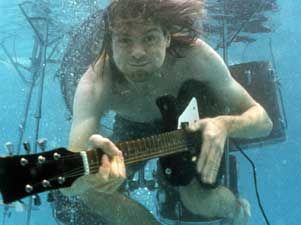
nirvanain-365xXx80Kurt Cobain

When we hear the music contained on Nirvana’s Nevermind, we hear a different kind of genius at work. We hear their highlight reels. We don’t know, or care, about all of the “dreck” Kurt Cobain wrote in quiet corners. Most of us, don’t know, or care, about the songs that didn’t make it on Nevermind. Most of us don’t know, or care, about all the errors he committed, the refining, and the crafting that went into perfecting each song on the album, until the final form was achieved. We only want the final form, the highlight reels, and some of us only want one highlight reel: Smells Like Teen Spirit.

On an album prior to Nirvana’s Nevermind, called Bleach, Kurt Cobain penned a song called Floyd the Barber. “Where does the kernel of a song like that start?” Soundgarden’s Chris Cornell asked. Cornell may not have come from the exact same background as Cobain, and he may not have been influenced by the exact same artists as Cobain, but he presumably felt like his creative process was so close to Cobain’s that he couldn’t fathom how the man achieved such divergence from the norms of musical creation. Those familiar with Cobain’s story also know that he was heavily influenced by the music of Soundgarden, and that fact probably confused Cornell all the more.

Other than Soundgarden, Cobain also loved Queen, The Beatles, The Pixies, The Melvins, and a number of other lesser known bands. How much of his early works were so similar to those artists that no one took him seriously? As I wrote earlier, it’s a major part of the artistic process that every artist goes through to attempt to duplicate influential artists in some manner. It’s a step in the process of crafting original works. When that artist duplicates those that came before them often enough, the artist (almost accidentally) begins to branch off into building something different … if they have any talent for creation in the first place.

Divergence in the artistic process

Few artists can pinpoint that exact moment when they were finally been able to break the shackles of their influences, for it happens so progressively that it’s almost impossible to pinpoint. Most artists do remember that moment when that one, somewhat inconsequential person said that some aspect of their piece wasn’t half bad however. At that point, the artist becomes obsessed to duplicate, or replicate, that nugget of an idea. Once that nugget is added to another nugget, those nuggets become a bold idea that wasn’t half bad. Once that is achieved, another bold idea is added, until it all equals a “halfway decent” compendium of ideas that may form something good. At that point, the artist believes he has something that others may consider unique enough to be called an artistic creation in its own right. When enough unique, artistic creations are complete, the artist may eventually achieve their own highlight reels.

When did Cobain finally begin to branch off? How did he become divergent, and creative, and different on a level that made him an organic writer to be reckoned with? How many casual statements, spray paintings on walls, and other assorted personal experiences had to occur before Kurt Cobain had the lyrics for Nevermind? How many different guitar structures did Cobain and company work through, until he arrived at something usable? How many Nevermind lifted music or lyrics from other failed songs, casual strummings in a closet, and offshoots of other guitarists? What did Floyd the Barber, Come as You Are, and Pennyroyal Tea sound like in those moments when they first found their way from notepad to basement practice sessions? How many transformations did these songs go through in those practice sessions, until they were entirely original, and transformative, and legendary additions to the albums they were included on? If Cobain were alive to answer the question, would he acknowledge that Nevermind is a 1% highlight reel of about a decade of work? Most of us don’t care, we only want to hear the highlight reels, so we have something to tap our finger to on the ride home from work.

Cobain’s highlight reel, Nevermind, proved to be so popular that record execs, and fans, called for a B-list, in the form of the album Incesticide. That album proved Cobain’s B-list was better than most people’s A-list, but what about the D-list, and E-list songs that proved to be so embarrassing that no one outside his inner circle ever knew they existed?

The point is that some of us are so influenced by an artist’s highlight reels that we want to replicate it, and duplicate it, until we become equally as famous as a result, and when we don’t, we think that there is something wrong with us. The point is that the difference between a Mark Twain, a Hemingway, a Cobain, and those that compare their behind-the-scenes work to an influential artist’s highlight reels is that while these artists recognized that most of what they did was “dreck”, they also knew that their behind-the-scenes struggles could be used as fertilizer to feed some flowers.

So, the next time you sit behind behind-the-scenes of your computer keyboard, tattered spiral notebook, or whatever your blank canvas is, remember that all of those geniuses —who so inspired you to be doing what you are doing right now— probably spent as many hours as you do staring at a blank page, or a blinking cursor, trying to weed through all the “dreck”, that every artist creates, to create something different, something divergent from all those creations that inspired them to create. You now know that they succeeded in that plight, but you only know that because the only thing you want to see, hear, and read are their highlight reels.

{1}http://www.forbes.com/sites/kylesmith/2014/02/20/what-mark-twain-van-halen-and-dan-rather-teach-us-about-failure/

{2}http://www.marktwainproject.org/about_projecthistory.shtml