A Review of The Last Headbangers: NFL Football in the Rowdy, Reckless 70’s


Ken Stabler, Terry Bradshaw, “Mean” Joe Green, Steve Bartkowski, Jack Tatum, Jack Ham, Jack Lambert, Bob Griese, Larry Csonka, Franco Harris, Jim Otto, Roy Blount, George Atkinson, John Matuszak and Phil Villapiano gave birth to something in the 70’s that we call the NFL.  They didn’t start the league, of course, but by most definitions it is the premier league it is today based on the sacrifices they, and the many others who played the game, made.
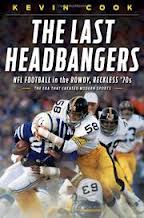
last headbangeIt was an age of sloppy, weather drenched, and poorly maintained fields.  It was an age that involved “legalized” use of steroids, which involved some using horse testosterone that was equivalent in dosage to that which is given to a 1,200 lb. horse before a race.  The result of this is the now well-known ‘roid rage’ that most certainly affected the hits involved in the game.  Steroid usage was so prolific in the game, during these years, that some players admitted that they could tell who was on steroids and who wasn’t by the look in their eyes.

It was an era that not only allowed, but encouraged late hits, hitting receivers in a vulnerable position, and exacting head-to-head hits that caused massive migraines and concussions.  It was an age of stick ‘um, touchdown dances, and toothless, sweaty linebackers that would cause a normal citizen to walk to the other side of the street to avoid them.  It was a game that involved none of the genteel, poetic resonance attributed to the strategic nature of baseball.  Yet, prior to the 70’s, professional football was baseball’s broad.

In the 70’s, Baseball had Reggie Jackson and the Yankees, The Red Machine, the A’s, The World Series, and a tradition so rich it achieved the moniker “The National Pastime”.  The NFL players mentioned above, the Monday Night Football guys, Pete Rozell, Al Davis, Don Shula, and a number of others took professional football from a proverbial backyard sport to the heights of the national stage.  They were so successful that the number two sport is now football’s dejected broad.

GEORGE CARLIN: “Football has hitting, clipping, spearing, blocking, piling on, late hitting, unnecessary roughness and personal fouls. Baseball has the sacrifice.  Football is played in any kind of weather – rain, sleet, snow, hail, mud, can’t read the numbers on the field, can’t read the yard markers, can’t read the players’ numbers; the struggle will continue.  In baseball, if it rains, we don’t come out to play.”

Baseball played well to the prolific sports writer that could artfully and poetically lift its magnificence with an analysis that called upon its rich history and place in American tradition.  It has a subtle strategy that can be brought to life through careful and leaned analysis from a great play-by-play and color commentator team on radio. Newspapers also favor baseball in that they can provide a daily recap of each day’s games in a manner deemed almost inconsequential in other sports.  Football, however, has a special, visual quality that no other sport can match throughout an entire game.  Basketball may provide more visually tantalizing highlights, but the game of football has a more irresistible appeal from start to finish.  “It is for this reason,” writes author Kevin Cook, “that the rise of football occurred in conjunction with the proliferation of television sets across the country.”

This was proven out by a risky move that the NFL and the ABC network agreed upon called Monday Night Football.  What was once a rising sport, became “the” sport, the new national pastime, with dynamic personalities, such as Howard Cosell, selling it to millions.  Monday Night Football also produced the first moment of “must see” TV for one enthusiastic, young football fanatic in a city of Nebraska: “Halftime Highlights”.  Cook details, in his book, that Cosell’s initial “Halftime Highlights” were totally unscripted, and they were “by today’s standards” poorly produced.  Yet, anyone who was privileged enough to watch those 70’s, Cosell highlights, knows the profound effect they had on the game and the national psyche.  Some of us still run imaginary plays, calling them out in Cosell’s staccato.

Football also had one thing that baseball did not: scarcity.  This aspect is not covered in Cook’s book, but I believe it was one of the determining factors in the battle between baseball and football.  Baseball had 162 games, sprint training, the playoffs, and The World Series.  If a team was successful, they could’ve played 176 games a year at that point in history, and that’s a lot of games for one to maintain acute focus.  Baseball did have events; they had opening day; the All-Star game; a few weeks of pennant chase games for those involved; and The World Series, but for the most part baseball was/is basically a six-month marathon.  Baseball is equivalent to NASCAR in one aspect, as my friend said: “In NASCAR, everyone pays attention to the first five laps, and the last five laps, but you talk and eat dinner in between.”  One can forget about baseball for months at a time, in other words, but just about every football game means something.  The NFL only played fourteen times a year for most of the 70’s, seventeen times if one counted the playoffs and The Superbowl.  One game was played on television, on Sunday, between noon and three, fourteen times a year, and then there was Monday Night Football.  We now have Monday Night, Thursday night, Sunday night football, and Saturday night football once the college season is over.  But in the 70’s, the NFL only appeared on Sunday afternoons and Monday nights, and this provided a regular season NFL game an “event” status that baseball, basketball, and Hockey could only dream of attaining..

Author Kevin Cook expands: “It seems to me that things were accelerating so much, we were looking for something faster. The NFL was more the counterculture, more a rock ‘n’ roll kind of sport compared to sedate, old baseball. And I think that’s why it appealed to a generation that was looking for something newer and more exciting. And they found it in football, especially on TV.”{1}

Kevin Cook’s The Last Headbangers provides all of the details of the teams, and their games, that precipitated the rise: The Immaculate Reception; The Dolphins undefeated season, and the games involved in that season; and the instrumental battles between the Raiders, the Steelers, the Dolphins, and the Cowboys.  He also talks about the end of that era with “The Catch” by Dwight Clark in the corner of the end zone against the Cowboys.  The era began with a catch, the Immaculate Reception, and it ended with a catch “The Catch” in Kevin Cook’s narrative.  He talks about how that 49ers offense called the “west coast” offense took advantage of the many rules changes that favored the passing game and changed the game from the sloppy, smash mouth, and run oriented offenses to the clean, crisp, and almost machine like precision that modern day NFL teams have copied, revamped, updated, and instituted in their offensive strategies.

In a broader sense, The Last Headbangers brought a “nothing new” approach to those avid NFL fans who have been inundated with the rich tradition that the 70’s and the early 80’s produced.  ESPN, MNF, the NFL network, and others have all captured these elements hundreds of times before, but Kevin Cook does unearth some nuggets that we longtime fans didn’t know.  Shula’s competition committee, for instance, narrowed the hash marks from the traditional, college width to one they hoped would open up the passing game, but it only allowed running backs more room lateral room, and the running game flourished for a time.  Most football fanatics heard sketchy details about Larry Csonka leaving the NFL in his prime for the WFL, but when he was asked to summarize his tenure in the WFL, Csonka replied: “It was nice to make money playing football.”

On that note, Cook reports that most of the top NFL players of the early 70’s still had to have part-time jobs for their existence, as they only made between $18,000 and $22,000 a year on average.  Number one draft pick Terry Bradshaw had to sell cars in the offseason, and Franco Harris had to hitchhike to games.

It was also fascinating to learn that what drove Bill Walsh to accomplish much of what he did in the early 80’s, as a result of being passed over for the Cincinnati Bengals job by Paul Brown when Brown retired from that position.  Apparently, Brown had been damaging Walsh’s prospects throughout the league by calling every owner in the NFL to tell them that his assistant coach was inept and a trouble maker.  Another thing that Brown informed NFL owners about, a fact we learned from the NFL Channel’s exposé on Bill Walsh, was that Brown believed Walsh was too mercurial to handle the rigors of coaching at an NFL level.  His highs were too high, and his lows were too low.  After seeing what Walsh would accomplish with the San Francisco 49ers, most of these owners probably wish they had never listened to Brown, but Brown’s characterization of Walsh would eventually bear out.

When Walsh was passed over for the Bengals’ head coaching job, and he found out that Brown had muddying the waters for Walsh and his career prospects in the NFL, he was crushed.  Walsh would eventually exact his revenge, of course, by taking two Super Bowl trophies from his former mentor’s Bengals.  The book, The Last Headbangers, also details that Walsh had something of a Noll/Bradshaw relationship with his quarterback Joe Montana that culminated in Montana saying: “(F-bomb) you, you white-haired (person who sucks on … roosters).”

In the promotional interview with NPR for the book, author Kevin Cook talks about the suffering that a lot of the players are now enduring for playing the game, “A friend of mine calls them sport’s greatest generation, because they had an inkling that they were risking their futures.”  When we hear players, like former Rams DE Fred Dryer, say, “I would have to roll off the bed onto the ground in order to lessen the pain enough to be able to walk around for a day.” When we hear former Vikings running back Robert Smith say that he retired prematurely, after seeing the former Houston Oilers’ great Earl Campbell in a wheelchair, and when we read Cook document that some former NFL stars can’t drag a pocket comb through their hair, at the age of 45 or 50, we are forced to realize what these players foresaw and played through.  It’s a point Cook elucidates when he points out the few players, like Franco Harris and Phil Villapiano, that were able to escape prolonged and debilitating injuries in their post-football careers.

The thing is, as Cook’s friend said, these players did “have an inkling” that they were doing long-term damage to their bodies every time they took the field, every time they woke up the morning after and heard a doorbell that didn’t ring, and every time they covered up an injury, because they “weren’t injured they were hurt,” as Don Shula was known to ask the players who groaned on the sidelines that they couldn’t go in for the next play.  Very few twenty something males consider the long-term health consequences of their actions, so it’s debatable whether they considered this or not, but most of we naysayers haven’t put our bodies through a quarter of what they did.

Reliving the moments that made the NFL the premier game that it is today with Cook are thrilling.  The man describes the players, and the plays, with a flair that one cannot help but notice comes from the perspective of a fan.  This is the book’s great selling point for much of the book, but it is its downfall in others.  As Cook warns: “This book isn’t meant to glorify the uglier aspects of NFL football in the 1970s and early ’80s.  The drugs, the booze, the cheating and headhunting, the occasionally seamy sex, and the risks the game posed to players’ health.”  As that statement entails, there is some discussion that will satisfy prurient interests, but there’s not enough.  Don’t get me wrong, I’m not saying a book of this nature must delve into the seedier side of the game to satisfy me, but this book almost seems to respect the game too much.  It doesn’t feel rounded out enough.

The book Sweetness by Jeff Pearlman explored the entirety of Walter Payton’s career.  Some may say it was too negative and disrespectful, but that author complained that those who said such things simply haven’t read the entire book.  The point is that a writer has a duty to report both sides of the story to his readers if he is going to produce a worthwhile book.  We all hate to have our heroes diminished in any way, but a writer can do it in a responsible and journalistic manner to produce material that we didn’t already know, isn’t that why we purchase such books in the first place.  One gets the feeling that Cook saw how the NFL brotherhood ganged up on Pearlman, and he didn’t want any part of that.

Kevin Cook does conclude The Last Headbangers with some reporting, but he does it in an ESPN-style “Where are they now” human interest type stories on Franco Harris and Phil Villapiano.  As with all of those tedious, ESPN-style stories created to fill time, most readers don’t personally care that Franco’s son unsuccessfully ran for office and Phil’s son unsuccessfully trained to make a Division I football team, and we don’t care that Villapiano eventually gave Harris a noogie over the Immaculate Reception.

It is a well done book, and Cook has created a real page-turner for any avid fan of 70’s football, but you do finish the book with the feeling that there is something more to the story than we’re being told.
Consider the Lobster: A Review


Consider the Lobster starts out as most brilliant, pop psychology books do from an angle we may have never considered before. Since this book is a collection of divergent essays, it should be reviewed chapter by chapter and essay by essay. The first essay Big Red Son involves comedic talk of the porn industry. To be fair to the author, David Foster Wallace, this essay was first written in 1998, and some may conclude it unfair to declare it dated, but I didn’t read this until 2012, so I am forced to say that this material has been mined for all its worth at the time of my reading. (See Chuck Palahniuk’s Snuff.) The second chapter Some Remarks on Kafka’s funniness… whets the appetite. The general theme of this chapter “that humor is not very sophisticated today” has been mined by those of us obsessed with pop culture, but Wallace does get some points for listing the specific problems with the current sense of humor that doesn’t understand the sophisticated and subtle humor of author Franz Kafka. He says: “Kafka’s humor has almost none of the particular forms and codes of contemporary US amusement.” This launches the Wallace into a detailed list of complaints about contemporary humor brought to the homes of TV watchers.

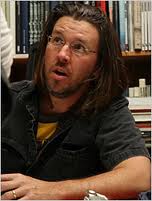
David Foster Wallace

“Kafka’s humor has almost none of the particular forms and codes of contemporary U.S. amusement. There’s no recursive wordplay or verbal stunt-pilotry, little in the way of wisecracks or mordant lampoon. There is no body-function humor, nor sexual entendre, nor stylized attempts to rebel by offending convention. No slapstick with banana peels or rogue adenoids. There are none of the ba-bing ba-bang reversals of modern sitcoms; nor are there precocious children or profane grandparents or cynically insurgent coworkers. Perhaps most alien of all, Kafka’s authority figures are never just hollow buffoons to be ridiculed, but they are always absurd and scary and sad all at once.”

The point that Wallace attempts to make is that his students don’t understand Kafka’s absurdist wit, because they are more accustomed to being spoon-fed their entertainment. They’re not accustomed to having to think through something as complex as Kafka’s central joke:

“That the horrific struggle to establish a human self-results in a self whose humanity is inseparable from that horrific struggle. That our endless and impossible journey toward home is in fact our home.”

The chapter is worth reading not for its “When I was a kid, we had to walk ten miles to school” style of complaining about the youth of the day, but the illustrative manner in which Wallace complains about humor in general. A complaint this author laments may not be generational.

The fourth chapter may be the selling point for this book. In it, Wallace describes a war that has been occurring in the English language for a couple generations now. Wallace calls it a Usage War. The Usage War describes how one side, the more traditional side, AKA the prescriptive side, pleads for a return to traditional English. He talks of the other side, the more modern side that describes itself as a more scientific study of the language, updating our usage on a more inclusive plane. The latter, called the descriptive side, calls for more political correctness in its language. It calls for a more comprehensive list of words and usage that incorporates styles of language such as Ebonics and words that are more commonly used, such as “irregardless”. Previous to this reading, I heard that tired phrase “everything is political”, but I had no idea that that phrase could be extended to dictionaries. The author’s reporting on this subject is excellent. It is informative without being biased, and it is subjective with enough objectivity to present both viewpoints in a manner that allows you to decide which side is more conducive to progress in our language.

Wallace is not as unbiased in his John McCain chapter however. He makes sure, in the opening portions of an article –that was paid for by the unabashedly liberal periodical Rolling Stone— that his colleagues know that he is not a political animal (i.e. he is stridently liberal). He lets them know he voted for Bill Bradley. Other than the requisite need a writer of a Rolling Stone article feels to display their liberal bona fides, it’s not clear why Wallace included his opinion in a piece that purports to cover an election campaign. If I were granted the honor of being paid to cover a Nancy Pelosi campaign, for example, I would not begin this piece with a couple of paragraphs describing how I feel about her politics, but such is the state of journalism in America today…particularly in the halls of the unabashedly liberal Rolling Stone.

To have such an article begin with a political screed that is different than mine, would normally turn me off, but I’ve grown used to it. (I know, I know, there is no bias.) The real turn off occurs after the reader wades through the partisan name-calling, to the languid dissertation on the minutiae involved on a campaign bus. If you’re ever aching to know what goes on in a political campaign, I mean really aching to know, this is the chapter for you. I would say that most are curious about the machinations that occur behind the scenes, but I would say that most of those same people would have their curiosity tested by Wallace’s treatment here. He wrote that the editors at Rolling Stone edited the piece. He wrote that he always wanted to provide his loyal readers a director’s cut. After reading through the first twenty pages of this chapter, I was mentally screaming for that editor to step in and assist me through the piece. It’s not that his writing is poor, of course, nor that it’s entirely without merit, but you REALLY have to be one who aching to know the inner workings of a campaign. You have to want to know bathroom difficulties —such as keeping a bathroom door closed on a tour bus— you have to want to know what reporters eat, why they eat it, and when. You have to want your minutiae wrapped up in minutiae, until your eyes bleed with detail. I have a cardinal rule about never skipping passages. I live with the notion that I can learn something from just about everything an author I deem worthy writes, and I deem Wallace to be a quality writer with an adept and varying intellect, but I had to break my cardinal rule with this chapter. It was a painful slog.

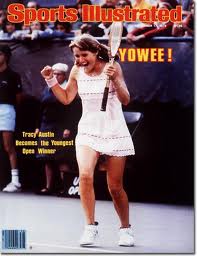
As for the chapter on Tracy Austin, Wallace laments the fact that championship level athletes aren’t capable of achieving a degree of articulation that he wants when he purchases one of their autobiographies. Tracy Austin, for those who don’t know, was a championship level tennis player. Wallace purchased her autobiography hoping that, as an adult long since removed from the game of tennis, Austin would be able to elucidate the heart of a champion. He hoped that Austin would be able to describe for us what went through her mind at the moment when she achieved the pinnacle of her career, and he wanted to know what she thought about the accident that led to her premature retirement. He wasn’t just disappointed, he writes, in the manner that he is disappointed with sideline interviews that are loaded with “we give it 110%, one game at a time, and we rise and fall as a team” style clichés. He sums up his disappointment with the following:

“It may well be that we spectators, who are not divinely gifted as athletes, are the only ones able truly to see, articulate, and animate the experience of the gift we are denied. And that those who receive and act out the gift of athletic genius must (out of necessity) be blind and dumb about it—and not because blindness and dumbness are the price of the gift, but because they are its essence.”

imagesCAY91IXCWe talk about athletic accomplishment. They do it. We analyze and speculate about their prowess. They exhibit prowess. We concentrate on the arena of the mind, and their concentration lies in physical prowess. We, non-athlete types, think about the things they do, we fantasize about them, and they do them. We think about how glorious it would be to sink a championship winning basket over Bryon Russell, Michael Jordan just does it. We wonder what Michael might do if he missed that shot. Michael didn’t think about that. We think about, and write about, that incredibly perfect and physically impossible baseline shot of Tracy Austin just made. She just does it. We see the replays of their exploits endlessly repeated on Sportscenter, and we hear almost as many different analyses of them. We then think about these plays from all these varied angles that are provided, and we project ourselves onto that platform. We don’t think about all the rigorous hours a Jordan and Austin spent preparing for that moment, we simply think about that moment, and what it would mean to us to have conquered such a moment. So, when one of these athletes steps away from that stage to offer us a few words about that moment and those few words center around the “I just did it” meme, we are profoundly disappointed. To paraphrase Yoda, “They don’t think, they do, or they do not.” They use the force granted to them though spending a greater percentage of their lives in gyms, on tennis courts, and in weight rooms. They concentrate on muscle memory to prevent the mind from interfering with their eventual completion of the act. If we, non-athlete types, were in a similar situation, we might think about the significance of the history of the game, the profundity of the moment, and how this moment might affect the rest of our lives. We might also think about how many people are watching us, if Bryon is a better athlete than we are, and if he will block our shot. We think about what our peers are going to say about this play after the game, and we become so immersed in the enormity of the moment that we probably think too much to make the shot. The point is that they’ve made that shot so many times, in so many different ways, in practice and in games, that they simply rely on muscle memory to make the championship shot. They may think about that shot, as long as it takes them to project it, but once they step on the court, they go on auto-pilot and complete the mission. They would probably love to give Hemingway-esque descriptions of their game, that satisfy us all, because they know it might land them an announcer job of some sort, but there is a reason Joe Montana, Michael Jordan, and so many other top-shelf athletes that broadcasters would’ve paid millions for never ended up with a job in a booth. There’s a reason Larry Bird and Magic Johnson were two of the greatest of all time, but they weren’t great coaches. There’s also a reason, and a number of reasons why they could accomplish what we never could.

I used to wonder what announcers were talking about when they said, “He’s too young to understand what this means.” This kid, as you call him, has been playing this game his whole life for this game, and he’s lived the life of the championship level athlete, which means sacrificing the norms of daily life that his peers knew, and he’s done all that for “this” moment. What do you mean he doesn’t know what it means? It dawned on me, after a couple struggles with it, that this kid doesn’t know what this moment would mean to the announcer … and, subsequently, those of us at home watching. In that post-game interview, then, we’re looking for something, some little nugget with which we can identify. When we get phrases from the cliché vault, we’re so disappointed that they didn’t put more effort into helping us identify with their glory, or our sense of their glory. We’re frustrated that they couldn’t reach us on our level. Yet, as Wallace states, it is the essence of a championship level athlete to be “blind and dumb” during the moments that define them, and we all know this to one degree or another. We’ve all seen these championship level athletes being interviewed about their individual moments thousands of times, so why do we continue to be so frustrated with them, and does this continued sense of frustration begin to say more about them or us?

Today’s Music Ain’t Got the Same Soul


As a former AOP (album oriented person), I have finally come to realize that most songs, on most albums, by most artists, are crap.  It’s a tough admission for me to make, especially after decades of fighting against my “single-loving” friends on this very issue.

downloadThe Beatles may be one of the few exceptions to this rule. The Beatles made about five albums that were almost top to bottom perfect, but then again they had three bona fide songwriters in their group. Those three songwriters could usually write one to two great songs a piece for the albums The Beatles would release on an annual and biannual basis. When The Beatles broke up, these three artists continued that trend.  They would write one to two great songs on solo albums that they would usually release on a semi-annual basis. One of those songs would get extensive airplay on the radio, and we would all run out and buy the album. To our disappointment, there would probably be only one other song on their solo albums that could be enjoyed long-term. A couple of the other songs on those albums were self-indulgent, political rants, and the rest were just filler. Led Zeppelin may be one of the other another exceptions, but they sold their souls to the devil(!), and there’s Queen, but Queen had four solid songwriters in their band.

There are other exceptions to the rule of course, and I’m sure you have them in mind, but were those exceptions the first album your “my guys” made for a major label? If that’s the case, you have to ask yourself how many years of writing went into the making of that first album? If that’s the case, I submit that that first album was a compendium of all the years this artist(s) spent as a struggling, starving artist. Kurt Cobain once said that if he knew what he was doing, he would’ve spaced out all the songs on the album Nevermind, to presumably allow some of those single songs to appear as lead singles for forthcoming albums.

From what I understand of the business, and I understand very little, the first album usually generates little to no money for the artist. The reason for this is that the record company assumes all the financial risk for this unknown artist on first albums, and this unknown artist is usually so eager to sign with a major label that they forego most of their rights. Most new artists have little-to-no pull in the signing process, and most labels take advantage of them on that basis. Most labels are also hesitant to give a lot of money to a new artist, because they know that they will go out and ruin their minds and bodies on drugs and alcohol with all of their new found money. Other than the objective to make the most money they can off the artist, they might also want to keep the artists hungry enough to produce at least one more great album.

After the artist is raped by the label on the first contract for the first album, they’re usually bled dry by the lawyers who seek to rectify that first deal. This gives them the hunger necessary to complete a second album. This second album is usually rushed by the artist, the label, the lawyers, and all of those with their hands in the pot trying to cash in on the success of the first album. It usually sells well, based on the success of the first one, and the critics often label this effort “the sophomore jinx”. The second album usually contains the “could’ve beens” and “should’ve beens” that didn’t make the cut on the first album, and that album usually sounds rushed, sporadic, and often times sub par, but we can’t blame the artist too much for wanting some of the money they missed out on with the first album. If the artist was allowed some time to write a new single, and some time is usually reserved solely for studio time in the world of music –because most artists are not artistic on their time– we may get one marginal-to-good song on this record that would’ve been a better-than-average filler song on the first album.

“Wait one cotton-picking moment here,” you say. “The artist I listen to says that they don’t do it for the money.” That’s just good business. Very few artists, outside the for reals world of rap artists, would tell us that they’re in it for the money. If they believe it is about the money, and for some it is, then they’re probably not very good artists. For those who are quality artists, that love the art form, money is a happy byproduct that pays the rent and the grocery bills. Money allows the artist the free time necessary to concentrate on their craft, and that is important even if they won’t admit it. If an artist is in it solely for the money (or the fame), if they’re being for reals, they’re probably producing the schlock that comprises most of the Top 40. It is about the money though, for those artists who truly know something about business side. They know that that when a customer hands over dollars for product, they’re complimenting such products in a manner that allows the artist to keep producing said products.

Sting once said: “Anyone can write a hit, but it takes a true artist to write an album of excellent material.” 

If that’s the case, there just aren’t as many artists out there nowadays. Either that or my patience for half-hearted material has diminished, because there appears to have been a dearth of great albums in the last ten years. My guess is either there are fewer spectacular artists out there nowadays, or we have over-estimated these artists in the music field for decades. Perhaps these artists were never were as intelligent, or as brilliant, as rock journalists led us to believe. I’m not just taking about the members of ‘80’s hairbands in this critique, or the starlet that tries to show off her body parts to remain relevant.  I’m talking about our favorite artists. I’m talking about the seminal artists who have graced the covers of corporate magazines for decades. I’m talking about the artists that the marketing arms of these corporate magazines, and the corporate labels, have led us to believe were complicated geniuses. Maybe they were just better than most at crafting an image, maybe they are not as deep as we perceived them to be, and maybe we need re-evaluate our definition of the term “musical genius” based on the fact that they can’t come out with three decent songs every two years.

If we are to judge an artist based upon their albums, and not their singles, then we have to assume that they’re not very deep. The Beatles came out with nearly three albums a year in the 60’s, and they came out with some complete albums, top to bottom. With today’s artist, we’re lucky if they come out with an album every two years, and as I said those albums usually only produce two decent songs on average. Whatever the case is, I usually make my own albums out of all of the singles and some of the secondary songs released today. The rest of the songs released by these complicated artists are just drivel. Thanks iTunes and Spotify!