The Nonconformity Market


Cool dudes are out there, and nonconformity is their thing. They seek out that which others consider odd. They know that they are trendsetting fashionistas, and that everyone they know, knows it too. They know it better than we do, and they know that they’re not rebelling. They don’t care for labels. This is just who they are. They preach their nonconformist tastes to every fake nonconformist in their inner circle, and they get off on the fact that we don’t understand them. They are the only true nonconformist they know. They don’t fall prey to the whims of the Man, that fat cat, or the Scooby Doo bad guy, CEO that smokes cigars he lit with $100 dollar bills. They are an individual with selective, refined tastes that supersede everyone else’s tastes, and this is your status in their world. They are the true nonconformist.
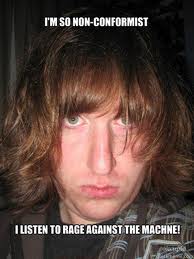
noncomWhat they don’t understand is that the world is immersed in nonconformist rebels, and that they are so numerous that there are nonconformist rebel markets created for nonconformist rebellious consumers that rebel against conformity. What they don’t understand is that the capitalist pig system abhors conformity for the most part, for if nonconformity didn’t exist there would be very few stores in a mall, there would be little stratification of prices in each store, and there wouldn’t be the large number of products in the large numbers of stores in every mall.

In our youth, it was possible for supermarket chains to have multiple items in the breakfast row. They had the cereal section, in that row, and that was bracketed by other breakfast-related items. The variety of cereals have grown so varied that there is but little room in that side of the aisle for Pop Tarts and other breakfast related items. A shopper is more apt to find maple syrup, and other smaller items on the opposing side of the aisle, or in another aisle altogether.  

Walk into any cell phone store, and we’ll see a number of phones that conform to the function of nonconformity, but we’ll probably see that store for what it is after a while. We’ll start to realize that these stores appeal to our sense of non-conformity, or our elevated knowledge of the technology of one phone versus another that we’ll end up skipping that store to go to the one three stores down that appeals our knowledge and our sense of non-conformity. If we are so well informed that we know that neither of these stores provide the degree of technology necessary to suit our needs, boy, have we got a store for you online.

If you’re willing to pay a little bit more for a socially conscious store, we have a whole line of products for you, and they are friendlier to the environment, they have “We support Green Peace” stickers on all of their products, and anything and everything we abhor about what is being done in the South American rain forests. Let those poor suckers continue to buy their inferior products from store A, but they should do so with the knowledge that they are not down for the cause.

The capitalist pigs of the cell phone industry, the clothing industry, the electronics industry, and the leather wallet industry know more about your selection process than you do. They know that our discerning, refined tastes are such that we would never buy a candle wax that is distilled from “Big” oil. Our preferred candle is composed of a wax carefully removed from honeycombs created by bees, so as to not disturb their honey making process or their larvae storage. They also know that to cater to their clientele, they will be required to provide an example of this process to all concerned consumers in a video on their website. These stores know, probably more than any other outlets, that the success of their niche market depends on making their customers feel more socially conscious, more knowledgeable, and more empathetic, and as such it will be required of them to provide their customer base an outlet through which they can further detail their pleasure, or complaints, with the products they sell in their store. As such, they will have some sort of comments section on their website that they will have to monitor on a daily basis, for even the most simple reply to the comments on the website will substantiate the long-held beliefs of their customer base. All they will have to say is something along the lines of “You’re right Doogie Howser232, we will address your valuable information at our next meeting.”

We are all victims of our own knowledge of markets and political consciousness. We make decisions in life, based on what we read and know. Our discerning tastes based on knowledge are studied and commented on in board meetings, and there is nothing special about us. We are members of a demographic, and if we do manage to somehow become an outlier in anyway, there will be a new market created to suit our new stratified needs and desires.

This new market will want to know how much we now “know” about phones and clothes, and they will soon find a way to appeal to us on a new, knowledge level. They want to understand what shaped our new knowledge, and why we think that way, and they want to have that perfect product ready for us when we’re ready to open up our pocketbook.

But I am a true nonconformist, rebels that doesn’t give a durn about any of that nonsense. The capitalist pig machine can shrivel up and die for all I care, but you’re adding to it poopy bear. We’re all creating, and adding to, a diversified and stratified market that has existed longer than we’ve been alive. We can say we’re rebels, but the month after we claim a new discerning taste, a rebel store will open up with all kinds of new, rebel paraphernalia to appeal to us. You’re a punker you say? Well, where did you get all your punker gear? Did you make it by hand? No, well, what else do you have in that Punkers R’ Us bag?

It’s called consumer rebellion, and it’s become such a primary staple in the capitalist pig, American system that capitalist pigs have opened up a store in just about every mall in America just for us? We wear a constant, nonconformist snarl, how can a capitalist pig sell a snarl? We can’t, but we can give you everything you need to bracket that snarl. We can sell a suitable get up that frames that snarl in such a way that it can make it more powerful during rebellious consumption. We can buy a tongue stud at this store, but for those who want spikes in the shoulder pads of their leather jacket we may have to go to the store three doors down and across the hall, and to buy the latest rebellious, nonconformist punk rock album, we’ll have to go down to the first floor. The current, capitalist pig system in America today needs you! and your rebellious consumerism to survive and thrive.

Tattoos were once the epitome of rebellion. An individual could define himself as an outlier with one simple, strategically placed tattoo that was somewhat visible, but not so visible that it was obvious. An individual with a tattoo attained instantaneous conversation status. Everyone has one now, so the true rebel got two, then three, and finally four, until four wasn’t enough, and the whole body art market rose from the back alley to strip mall status. How embarrassing is it to thee true rebel, tattoo aficionados that this market rose to the level where a consumer in Omaha, Nebraska found that tattoo parlors began to compete with Burger Kings in the total number of locations?

People, from the lowest marketer go to the fat cat CEOs, want to know what we’re buying and what we’re consuming, so they go to our favorite Euro bar to find out what the latest nonconformists are wearing, drinking, eating, and in all ways consuming. There’s a whole lot of consuming going on out there, and it takes a whole team of studious marketers to understand it all. These studious marketers then present their information to that fat cat CEO, with that mighty bank account, to create a fashion line that brackets your snarl and appeals to that nonconformist ethos that we have to tell the world that we just don’t give a durn about nothing.

The 50’s and 60’s were a relatively homogenous era that built a fairly homogenous market. It was the Leave it to Beaver, Dragnet, Davy Crockett era. It was an era where fat cat CEOs dictated to the populous what was hip and fashionable. If they wanted everyone and their brother or sister to buy what they were selling, they had Marilyn Monroe and Marlon Brando wear it. They had The Beatles sponsor it, they had Milton Bearle smoke it, and it all gave birth to the ‘keeping up joneses’ meme. Marketing and commercialization have always dictated style of dress, home décor, and artistic tastes, but the power they had back then was considerably stronger before the late 60’s. The late 60’s were a time of nonconformist sophistication that brought forth some degree of individualism, at least when it came to clothing and music, but the markets didn’t sit around and lick their wounds over the power they lost. They adapted. The nonconformity market was born. It was a submarket that up and coming, risk-takers, otherwise known as entrepreneurs, adapted to, and they left the conformists in the dust, until the nonconformist consumers adapted and bucked the current nonconformist trends, and the market adapted again and again, until they started appealing to the nonconformist goth with a snarl. These sub markets were all created to appeal to those that marketing and commercialization didn’t. Up and coming, risk taking entrepreneurs saw dollar signs in tie dye shirts and bell bottom pants, and Ocean Pacific shirts, and Vans shoes, and on and on, until there was a market for every form of nonconformity a hip, nonconformist dude could think up. Our level of nonconformity is actually conformity in America today, and we are no more special than the nonconformists that we are laughing about here.

As David McRaney states in his book, You are Not so Smart: “Poor people compete with resources. The middle class competes with selection. The wealthy compete with possessions. You sold out long ago in one way or another. The specifics of who you sell to and how much you make – those are only details.”

How to Succeed in Writing III: Are you Intelligent Enough to Write a Novel?


I write one page of masterpiece to ninety-one pages of (poor fiction),” –Hemingway confided to F. Scott Fitzgerald in 1934. “I try to put the (poor fiction) in the wastebasket.”

The key to writing great fiction is streamlining your story. Cut the fat! Some of the greatest authors of all time have admitted that the best additions they made to their novel were the parts they deleted. Somewhere along the line, in their writing career, they achieved objectivity. Somewhere along the line, they arrived at the idea that not all of their words were golden. Somewhere along the line, they realized that some of their words, sentences, paragraphs, and even some of their chapters were quite simply self-indulgent, wastebasket material. These self-indulgent portions, or the “ninety-one pages of (poor fiction),” of any novel are usually found in the asides.

There are asides, and then there are asides. Some asides are what we enjoy in a novel. Some provide setting, pace, and drama. Some also build suspense by taking us away from the train barreling down on the main character to form a cliff hanger. Some fortify the characteristics of a character, and kill a novel. Most asides are unnecessary in the grand scheme of things. As anyone who has read a novel can attest, most novels could be written in forty pages, but that’s a short story, and short stories don’t sell as well as novels. They don’t sell as well, because readers want involvement. Readers don’t fall in love with snapshot stories. They want a world. They not only want to know the humans that they are reading about, they want to be involved with them. They want to see them breathe, they want to hear them talk to an employee at a Kwik Shop, and they want to feel the steps these characters take from place to place. They want to know these people, so when something happens to them, they can care about them. They want to know the minutiae of the human they’re reading about, but they don’t want to get so caught up in the minutiae that they’re taken off pace, and they don’t want to read a self-absorbed writer who thinks it’s all about them. Cut the fat! Get to the point already!

“I’ve met a number of intelligent people throughout my life, and I’ve met a number of people I consider brilliant. I’ve met very few that were able to combine the two.” –Unknown.

One such aside involved the author trying to prove how intelligent they are. The desire to be perceived as intelligent is a strong, driving force in all of us. How many stupid and overly analytical things do we say in one day to try to get one person to think that we’re not a total idiot? This desire to prove intelligence is right up there with the drive to be perceived as beautiful and likeable. It’s right up there with the desire to be seen as strong, athletic, independent, and mechanically inclined. We spend our whole lives trying to impress people. Even those who say that they don’t care what others think are trying to impress us with the fact that they don’t care.

In my first era of writing, I wrote a lot of these self-indulgent asides that contributed little to the story. I was a new student to the world of politics, and I was anxious to prove to the world that I was one smart cookie. I also wanted to show that half of the world that disagreed with my politics how wrong they were. So, I put my main character through an incident, and he came out of it enlightened by a political philosophy that agreed with mine. In various other pieces, I wanted to inform the world of all of this great underground music I was experiencing. My thought process at the time was: “Hey, if Stephen King can get away with telling us about tired rockers that we’ve all heard a thousand times. Why can’t I tell a few readers about a group they’ve never heard before?” Copy the masters right? I wanted the world to know both sides of my brain in the same artistic piece. After taking a step back, I reread the novel, and I achieved enough objectivity to realize that it was all a big ball of mess.

If I was going to clean this mess up and start writing decent stories, I was going to have to divide my desires up. I was going to have to cut the fat. I was going to have to discipline myself to the creed that should be recited nightly by all aspiring storytellers: Story is sacred. I was going to have to learn to channel my desire to be perceived as smart into political and philosophical blogs. I was going to have to channel my desires to have people listen to my “discovered” music into Amazon.com reviews, and my stories, my novels, and my short stories would be left pure, untarnished stories with no agendas. By dividing these desires up, I would be able to proselytize on the role of the Puggle in our society today, and the absolute beauty of Mr. Bungle’s music, without damaging my stories or boring the readers of my stories. I learned the principle the esteemed rock band Offspring tried to teach the world when they sang: “You gotta keep ‘em separated.”

There’s one writer, he-who-must-not-be-named, who never learned this principle. This author presumably got tired of being viewed as nothing more than a storyteller. This author knew he was intelligent, and all of his friends and family knew he was intelligent, but the world didn’t know. The world only knew that he was a gifted storyteller, and they proved this by purchasing his books by the millions, but they didn’t know that he was so much more. This author achieved as much in the industry, if not more, as any other writer alive or dead (It’s Not King!), but he remained unsatisfied with that status. He needed the world to know that he wasn’t just a master of fiction. He needed the world to know he was as intelligent as he was brilliant, and he wrote the book that he hoped would prove it. It resulted in him ticking off 50% of his audience. 50% of his audience disagreed with him, and his politics, and they (we!) vowed to never read another one of his novels again. This is the risk you run when you seek to be perceived as intelligent and brilliant in the same work.

thomas-mannBut politics makes for such great filler, and to quote the great Thomas Mann: “Everything is political.” Well, there’s politics, and then there’s politics. If you’re one of those who doesn’t know the difference, and you don’t think your politics is politics, you should probably be writing something political. If you’re one of those who wants to write politics into your novel simply because it makes for such great filler, however, then you should try to avoid the self-indulgent conceit that ticks off that half of the population that disagrees with your politics. You’ll anger some with this, you’ll bore others, and the rest of us won’t care that you think it’s vital that your main character expresses something in some way that validates your way of thinking. We will just think it’s boring proselytizing from an insecure writer who needs validation from their peers. Stick to the story, we will scream, as we skip those passages or put your book down to never read anything you’ve ever written again.

You will need to be somewhat intelligent though. You’ll need enough to know your punctuation and grammar rules, you will need to know when and where to make paragraph breaks, and you will need to know how to edit your story for pace, but these aspects of storytelling can be learned.

“I am not adept at using punctuation and/or grammar in general…” A caller to a radio show once informed author Clive Barker. She said that she enjoyed writing, but it was the mechanics of writing that prevented her from delving into it whole hog. “Are you a clever story teller?” Clive asked her. “Do you enjoy telling stories, and do you entertain your friends with your tales?” The woman said yes to all of the above. “Well, you can learn the mechanics, and I strongly encourage you to do so, but you cannot learn the art of storytelling. This ability to tell a story is, largely, a gift. Either you have it or you don’t.”

Be brilliant first, in other words, and if you can achieve brilliance, you can learn the rest. You can gain the intelligence necessary to get a thumbs up from a publisher, an agent, and eventually a reader, but you cannot learn brilliance. You cannot gain artistic creativity, and it’s hard enough to prove artistic brilliance. Why would you want to further burden yourself by going overboard in trying to also prove intelligence, and thus be everything to all people?

Let the people see how brilliant you are first! Gain a following. Once you have achieved that pied piper Wildeplateau, you can then attend to the self-indulgent effort of proving your intelligence. I don’t understand why that is so important to those who achieve artistic brilliance, but if I could understand their mindset better, I would probably be one of them. The preferred method of achieving all of your goals is to ‘keep ‘em separated’, but there are always going to be some who need to prove their intelligence and brilliance in the same Great American Novel. Those people are going to say Stephen King is a much better example to follow to the best-seller list than I am, and he achieved his plateau with a little bit of this and a little bit of that sprinkled in his prose. The question you have to ask yourself is, is he the rule or the exception to the rule? If Stephen King’s model is your preferred model, and these political and music parts are so germane, so golden, and so uniquely special to your story, keep them in. As Oscar Wilde once said, “You might as well be yourself, everyone else is taken.”

Today’s Music Ain’t Got the Same Soul


As a former AOP (album oriented person), I have finally come to realize that most songs, on most albums, by most artists, are crap.  It’s a tough admission for me to make, especially after decades of fighting against my “single-loving” friends on this very issue.

downloadThe Beatles may be one of the few exceptions to this rule. The Beatles made about five albums that were almost top to bottom perfect, but then again they had three bona fide songwriters in their group. Those three songwriters could usually write one to two great songs a piece for the albums The Beatles would release on an annual and biannual basis. When The Beatles broke up, these three artists continued that trend.  They would write one to two great songs on solo albums that they would usually release on a semi-annual basis. One of those songs would get extensive airplay on the radio, and we would all run out and buy the album. To our disappointment, there would probably be only one other song on their solo albums that could be enjoyed long-term. A couple of the other songs on those albums were self-indulgent, political rants, and the rest were just filler. Led Zeppelin may be one of the other another exceptions, but they sold their souls to the devil(!), and there’s Queen, but Queen had four solid songwriters in their band.

There are other exceptions to the rule of course, and I’m sure you have them in mind, but were those exceptions the first album your “my guys” made for a major label? If that’s the case, you have to ask yourself how many years of writing went into the making of that first album? If that’s the case, I submit that that first album was a compendium of all the years this artist(s) spent as a struggling, starving artist. Kurt Cobain once said that if he knew what he was doing, he would’ve spaced out all the songs on the album Nevermind, to presumably allow some of those single songs to appear as lead singles for forthcoming albums.

From what I understand of the business, and I understand very little, the first album usually generates little to no money for the artist. The reason for this is that the record company assumes all the financial risk for this unknown artist on first albums, and this unknown artist is usually so eager to sign with a major label that they forego most of their rights. Most new artists have little-to-no pull in the signing process, and most labels take advantage of them on that basis. Most labels are also hesitant to give a lot of money to a new artist, because they know that they will go out and ruin their minds and bodies on drugs and alcohol with all of their new found money. Other than the objective to make the most money they can off the artist, they might also want to keep the artists hungry enough to produce at least one more great album.

After the artist is raped by the label on the first contract for the first album, they’re usually bled dry by the lawyers who seek to rectify that first deal. This gives them the hunger necessary to complete a second album. This second album is usually rushed by the artist, the label, the lawyers, and all of those with their hands in the pot trying to cash in on the success of the first album. It usually sells well, based on the success of the first one, and the critics often label this effort “the sophomore jinx”. The second album usually contains the “could’ve beens” and “should’ve beens” that didn’t make the cut on the first album, and that album usually sounds rushed, sporadic, and often times sub par, but we can’t blame the artist too much for wanting some of the money they missed out on with the first album. If the artist was allowed some time to write a new single, and some time is usually reserved solely for studio time in the world of music –because most artists are not artistic on their time– we may get one marginal-to-good song on this record that would’ve been a better-than-average filler song on the first album.

“Wait one cotton-picking moment here,” you say. “The artist I listen to says that they don’t do it for the money.” That’s just good business. Very few artists, outside the for reals world of rap artists, would tell us that they’re in it for the money. If they believe it is about the money, and for some it is, then they’re probably not very good artists. For those who are quality artists, that love the art form, money is a happy byproduct that pays the rent and the grocery bills. Money allows the artist the free time necessary to concentrate on their craft, and that is important even if they won’t admit it. If an artist is in it solely for the money (or the fame), if they’re being for reals, they’re probably producing the schlock that comprises most of the Top 40. It is about the money though, for those artists who truly know something about business side. They know that that when a customer hands over dollars for product, they’re complimenting such products in a manner that allows the artist to keep producing said products.

Sting once said: “Anyone can write a hit, but it takes a true artist to write an album of excellent material.” 

If that’s the case, there just aren’t as many artists out there nowadays. Either that or my patience for half-hearted material has diminished, because there appears to have been a dearth of great albums in the last ten years. My guess is either there are fewer spectacular artists out there nowadays, or we have over-estimated these artists in the music field for decades. Perhaps these artists were never were as intelligent, or as brilliant, as rock journalists led us to believe. I’m not just taking about the members of ‘80’s hairbands in this critique, or the starlet that tries to show off her body parts to remain relevant.  I’m talking about our favorite artists. I’m talking about the seminal artists who have graced the covers of corporate magazines for decades. I’m talking about the artists that the marketing arms of these corporate magazines, and the corporate labels, have led us to believe were complicated geniuses. Maybe they were just better than most at crafting an image, maybe they are not as deep as we perceived them to be, and maybe we need re-evaluate our definition of the term “musical genius” based on the fact that they can’t come out with three decent songs every two years.

If we are to judge an artist based upon their albums, and not their singles, then we have to assume that they’re not very deep. The Beatles came out with nearly three albums a year in the 60’s, and they came out with some complete albums, top to bottom. With today’s artist, we’re lucky if they come out with an album every two years, and as I said those albums usually only produce two decent songs on average. Whatever the case is, I usually make my own albums out of all of the singles and some of the secondary songs released today. The rest of the songs released by these complicated artists are just drivel. Thanks iTunes and Spotify!